Case study: Gumlet turned ChatGPT mentions into 20% of inbound revenue. Read it →

LLM SEO Checklist: 25 Things to Audit Before Running Any AI Search Campaign


TL;DR
- Only 15% of the pages ChatGPT retrieves during a search session are ever cited in the final response, according to AirOps research published in March 2026. The other 85% get read and discarded. If your pages are in that pool and still not getting cited, the problem starts before your content strategy does.
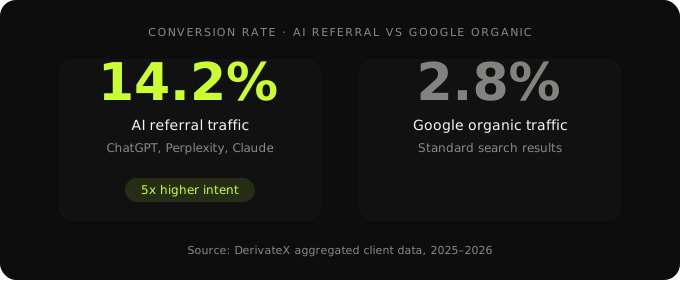
- Across DerivateX client accounts, visitors referred by AI tools convert at 14.2%, compared to 2.8% for Google organic traffic. That is a 5x gap that compounds as AI search volume grows.
- 44.2% of all LLM citations come from the first 30% of a page’s text, per Growth Memo’s February 2026 analysis. Where you place your best information matters as much as what that information says.
- Domains with active Reddit and Quora presence are roughly 4x more likely to be cited by ChatGPT than those with minimal community activity, per SE Ranking’s November 2025 research.
- Pages with a First Contentful Paint under 0.4 seconds average 6.7 AI citations. Pages loading over 1.13 seconds average 2.1, per the same SE Ranking study. Page speed is an AI visibility variable, not just a UX one.
You rank on Google. Your content is solid. Your team has been doing SEO for years. But when your ideal buyer asks ChatGPT or Perplexity for a recommendation in your category, your brand is not in the response.
That gap between Google rankings and AI citations is where most B2B SaaS companies get stuck. And the most common reaction is to start publishing more content, reformatting existing pages, or chasing the latest LLM SEO tactic. The problem with that approach is it skips the audit entirely.
LLM SEO (Large Language Model SEO) is the practice of making your content visible and citable in AI-generated answers from tools like ChatGPT, Perplexity, Gemini, and Claude. You may also see it called GEO (Generative Engine Optimization) or AEO (Answer Engine Optimization). The terms overlap; the goal is the same. When a buyer asks an AI tool a question your product answers, your brand should appear in the response.
This checklist gives you 25 items to audit before you change a single page, organized into four categories: Technical, Content, Authority, and Measurement. Want a baseline before you start? Score your site with our AI Visibility Score framework.
The sequence is intentional. Technical gaps block everything downstream. Content structure determines whether retrieved pages get cited or skipped. Authority signals determine whether pages get retrieved at all. Measurement gives you a baseline so you can actually prove what works.
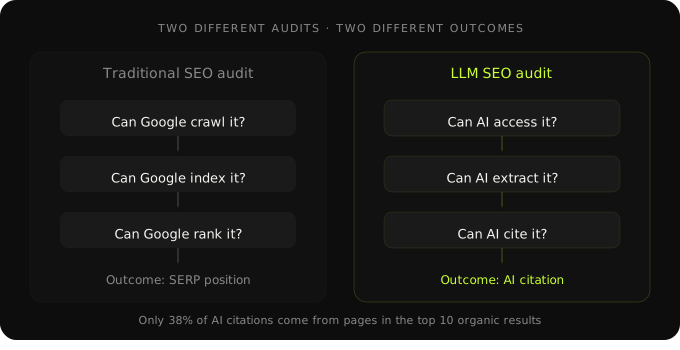
What Makes an LLM SEO Audit Different from a Traditional SEO Audit?
A traditional SEO audit checks whether Google can crawl, index, and rank your pages. An LLM SEO audit checks whether AI models can access, extract, and cite your content when generating answers. Different inputs, different outputs.
Ahrefs research from September 2025 found that ChatGPT primarily cites pages ranking at position 21 or lower about 90% of the time. That means a strong Google ranking does not translate to AI citation. A site can rank number one for a keyword on Google and still be completely absent from the ChatGPT response for the same query.
The reverse is also true: pages with modest Google rankings can earn consistent AI citations if they clear the structural and authority thresholds AI models use to select sources.
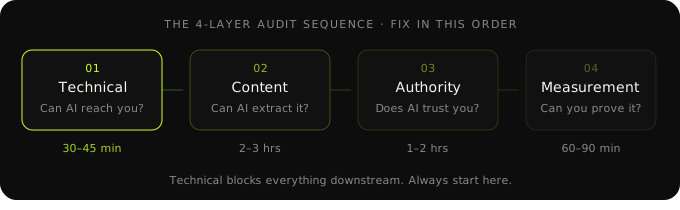
The four diagnostic layers in this checklist map to the four reasons brands fail in AI search: they are technically inaccessible, structurally uncitable, authority-absent, or measurement-blind. All four are present on the majority of B2B SaaS sites that have never run an LLM SEO audit, and all four are fixable once you know where to look.
If you want a broader view of how LLM SEO fits into a full AI SEO roadmap, start there after running this checklist.
Technical Access: Can AI Crawlers Reach Your Site? (Items 1 to 7)
Every other fix on this checklist depends on technical access working first. If the AI crawlers responsible for retrieving your content cannot reach, render, and read your pages, no amount of content restructuring will produce a citation. This section takes 30 to 45 minutes to audit fully, and it is where the highest-impact quick wins tend to live.
1. Check robots.txt for AI crawler blocks
Open your robots.txt file and search for rules that apply to GPTBot (OpenAI), ClaudeBot (Anthropic), OAI-SearchBot, PerplexityBot, and Google-Extended by user-agent name. A blanket Disallow: / rule applied to all bots blocks every one of them simultaneously.
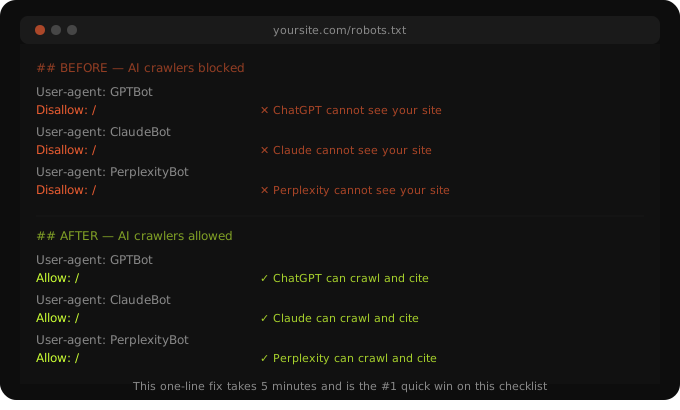
Many B2B SaaS sites inherited this configuration from a developer who set it during a staging freeze or site migration and never reversed it. If any of these crawlers are disallowed, re-allowing them is a one-line fix with an immediate downstream effect on AI visibility. For a deeper look at how robots.txt misconfigurations hurt SEO, see our guide to common robots.txt mistakes.
2. Verify that your key pages are not dependent on client-side JavaScript rendering
Right-click any high-priority page and select “View Source” in your browser. Your H1, opening paragraph, and section headings need to be visible in the raw HTML, not injected after a JavaScript framework executes. AI crawlers have limited resources for JavaScript rendering compared to Googlebot.
If your core product pages, comparison pages, or high-intent blog posts only load content after a client-side render, those pages may be functionally invisible to AI systems. Server-side rendering or static pre-rendering should be a priority fix before any content work begins.
3. Review Cloudflare settings for default AI bot management rules
Cloudflare’s bot management features, including Bot Fight Mode and Super Bot Fight Mode, can block AI crawlers without any explicit configuration from your team. The default settings in some Cloudflare plans treat AI user-agents as unwanted automated traffic.
Ahrefs documented this as a common source of accidental AI invisibility in their October 2025 checklist. Go to Security, then Bots in your Cloudflare dashboard and confirm that GPTBot and other AI crawlers are not being challenged or blocked at the edge.
4. Create or audit your llms.txt file
An llms.txt file, placed in the root directory of your domain, gives AI systems a machine-readable index of your most important content. Think of it as a sitemap built specifically for large language models rather than search engine crawlers. It does not guarantee citations, but it reduces the crawl burden for models trying to understand the structure and priority of your site.
If you do not have one, create it and include your key product pages, core comparison pages, and highest-value long-form content. If you already have one, confirm it reflects your current site architecture and is not pointing to outdated or redirected URLs. For a detailed guide on implementation, see our guide to llms.txt for SEO and AI search.
5. Confirm your pages are indexed in Bing
ChatGPT’s web search runs through Bing’s index. If your pages are not indexed in Bing, ChatGPT will never see them during browsing-mode queries. Most SEO teams only check Google Search Console and ignore Bing Webmaster Tools entirely.
Log in to Bing Webmaster Tools (or create an account if you have never set one up) and verify that your highest-priority pages are indexed. This is a five-minute check that closes one of the most common blind spots in LLM SEO.
6. Audit schema markup on priority pages
AI systems use structured data to understand content type, authorship, publication date, and topical relevance. Confirm that your most important pages carry the right schema in JSON-LD format: Article for blog posts, FAQPage for any page with a FAQ section, HowTo for step-by-step guides, and Organization on your homepage.
Use Google’s Rich Results Test to validate the markup rather than relying on what was set during initial implementation. Schema configurations drift over time as templates get updated and pages get rebuilt.
7. Check page speed on pages you want cited
SE Ranking’s November 2025 citation research found that pages with a First Contentful Paint under 0.4 seconds average 6.7 AI citations, while pages loading over 1.13 seconds average 2.1. That is a 3x gap driven partly by how AI crawlers allocate crawl budget across a domain.
Run your top 10 pages through Google PageSpeed Insights and flag anything that falls below the threshold. Server-side rendering fixes from item 2 will often improve load time as a secondary benefit.
Quick win: Items 1, 3, and 4 combined take under an hour. Checking robots.txt for accidental blocks takes five minutes. Reviewing Cloudflare’s bot settings takes ten. Creating a basic llms.txt file takes twenty. Any one of these could be the sole reason a competitor appears in your category’s AI answers and you do not.
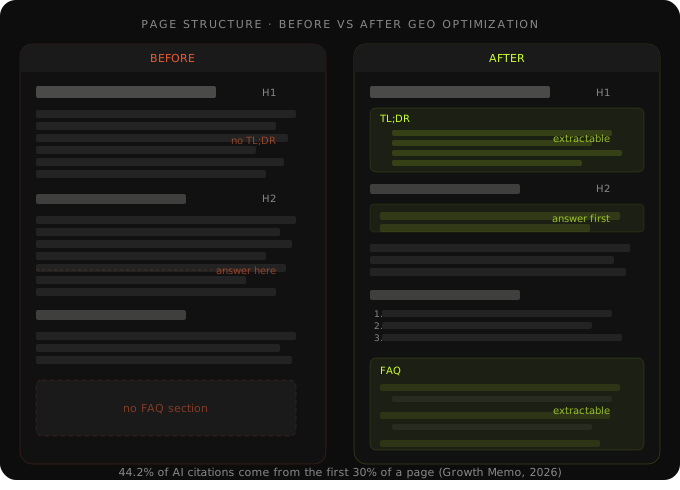
Content Structure: Is Your Content Built for AI Extraction? (Items 8 to 15)
Technical access gets your pages into the retrieval pool. Content structure determines whether they survive the citation cut. That 85% discard rate from AirOps happens at this stage, on pages that are technically accessible but structurally invisible to extraction.
The items in this section do not require a full content rewrite. Most can be retrofitted onto existing pages in a few hours. The gains from items 8, 9, and 10 alone are often visible within two to four weeks because they directly increase the density of extractable units on pages AI systems are already retrieving.
8. Answer the page’s implied question in the first 100 words
Growth Memo’s February 2026 citation analysis found that 44.2% of all LLM citations come from the first 30% of a page’s text. If the most important information on a page sits behind two paragraphs of background, the citation surface is functionally limited to whatever appears in the intro.
Audit your highest-intent pages by reading only the first 100 words of each. If that passage does not directly answer the question a buyer would type into Perplexity, rewrite the opening before making any other structural changes.
9. Add FAQ sections to every high-intent page
A FAQ section is the highest-yield GEO format available because each question-and-answer pair creates a discrete, extractable unit. AI systems do not need to infer context or reconstruct meaning: the unit is self-contained and directly attributable.
Three to five questions per page is sufficient. Write them in the natural language your buyers actually use in AI tools: “How do I…,” “What is the difference between…,” “How long does it take to…” Keyword-style questions produce topic labels. Conversational ones produce extractable units.
10. Add a TL;DR block near the top of every long-form page
A four-to-six bullet summary placed immediately after the introduction is the single most extractable chunk of an entire piece. Each bullet must be one complete, specific claim with a number, named example, or attributable outcome. Not a topic label.
A bullet that reads “AI visibility benefits” will not be cited. A bullet that reads “Brands cited in AI-generated answers convert at 5x the rate of Google organic visitors, based on DerivateX’s aggregated client data” will be. The TL;DR block is the fastest structural upgrade for pages already being retrieved but not cited.
11. Replace every vague claim with a specific, attributed one
AI models extract discrete, attributable statements. A sentence like “many SaaS brands struggle with AI visibility” will not be cited. A sentence like “content that includes statistics, quotes, and links to credible sources is cited 30 to 40% more often in LLM responses than unoptimized content, according to Hashmeta’s 2025 LLM SEO research” can be.
Audit your highest-value pages for vague generalizations and replace each one with a specific number, a named company, or an attributed study. Every unsourced assertion is a citation the model will skip.
12. Convert step-by-step processes from prose into numbered lists
Numbered processes are extracted and attributed by AI models far more reliably than the same information written across paragraphs. When Gumlet, a video infrastructure platform, restructured 45 pages in their content cluster around Q&A and numbered-step formats, their AI traffic share grew from 14.6% to 22.4% over the following quarter. That is a 53% increase tracked through GA4 and DerivateX’s citation monitoring setup.
If any key page explains a process, a workflow, or a sequence of actions in paragraph form, convert it to a numbered list and flag it for HowTo schema markup.
13. Define every technical term on its first use
AI systems favor content with clear definitional statements because definitions create extractable, citable units at the concept level. A sentence like “An AI Visibility Score (AVS) is a composite metric that tracks how often and how prominently a brand appears in AI-generated answers across ChatGPT, Perplexity, Gemini, and Claude for a defined set of target queries” is citation-ready the moment it appears on the page.
Assuming familiarity with your category’s terminology is a GEO liability, particularly on pages targeting awareness-stage or category-level queries.
14. Audit content freshness and add date signals
Perplexity and other real-time AI search platforms weight content recency heavily when selecting citations. Pages without a visible publication date are treated as potentially outdated and deprioritized accordingly.
Every high-intent page should display when it was first published and when it was last substantively reviewed. Updating a date without updating the content does not help: the model evaluates content freshness, not just the timestamp.
15. Use question-style H2s and H3s on product and landing pages
Most product pages organize content around features, not questions. “Video security features” as an H2 creates no extractable question-answer pair. “How does Gumlet protect video content from unauthorized access?” as an H2, followed immediately by a two-sentence direct answer, does. For a refresher on how heading structure affects SEO performance, see our heading tags SEO guide.
Restructuring three to five subheadings per page to follow the question-answer format is one of the most reliable ways to increase citation surface on pages that already have topical authority behind them.
Quick win: Items 8, 9, and 10 can be added to existing pages without restructuring the body. Rewriting the opening 100 words, adding a TL;DR block, and appending a three-question FAQ to your three highest-traffic pages is a half-day of work. For most sites, at least one of those pages is already being retrieved by AI systems and failing the citation cut because none of these structural elements exist.
Authority Signals: Does AI Trust Your Brand Enough to Cite It? (Items 16 to 21)
Content structure earns citations from pages AI systems retrieve. Authority signals determine whether those pages get retrieved in the first place. A brand can have structurally perfect content across its entire site and still be invisible in AI search because no external signal confirms it is credible in its category.
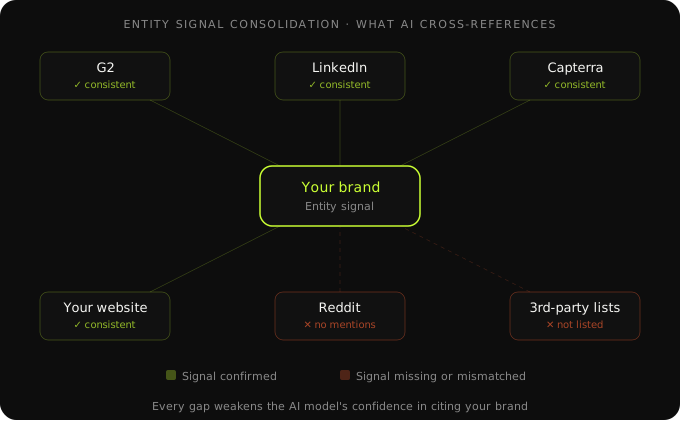
This is the layer most LLM SEO checklists either skip or reduce to “get more backlinks.” The actual mechanism is different. AI systems cross-reference third-party platforms, review sites, directory listings, and community forums when deciding whether a brand is a legitimate source on a topic. These signals function like E-E-A-T (Experience, Expertise, Authoritativeness, Trustworthiness) for AI models: they are the external corroboration that makes a brand’s own claims credible enough to cite. For a deeper look at how AI models classify brands, see our guide to entity optimization for LLM SEO.
16. Audit your presence on G2, Capterra, Trustpilot, and industry directories
SE Ranking’s November 2025 research found that domains with profiles on G2, Capterra, Trustpilot, and Sitejabber are 3x more likely to be cited by ChatGPT. The audit question is not whether a profile exists but whether it is accurate.
Check that your brand name, category, one-line description, and primary use case match exactly what appears on your own site. A profile that describes you as “project management software” when your site positions you as “resource planning for professional services firms” creates an entity mismatch that splits the signal AI systems use to classify and surface you.
17. Confirm your brand appears in at least one credible third-party comparison article
AI tools pull heavily from aggregator and comparison content when assembling answers to category-level queries. G2 is the most cited software review platform across ChatGPT, Perplexity, and Google AI Overviews, according to Radix’s 2025 research.
If your brand is not mentioned in any third-party comparison article or category list on a domain with meaningful authority, the model has no corroborating external signal to reference. In DerivateX’s audits, brands with zero third-party citation surface at baseline consistently show near-zero AI retrieval for category-level queries, regardless of the content quality on their own site.
18. Check that your founding team and key authors have current LinkedIn profiles
LinkedIn is the most cited domain for professional queries across AI Overviews, ChatGPT, Copilot, and Perplexity, according to Profound’s March 2026 research. A founder or team member with a current title, accurate company association, and at least one published article creates an entity signal the model can cross-reference.
If your team members’ LinkedIn profiles list outdated titles or a former company name, the entity signal is weakened at the source. This is a direct E-E-A-T signal for AI systems.
19. Search Reddit and Quora for your brand name and category keywords
SE Ranking’s November 2025 citation research found that domains with substantial Reddit and Quora presence have roughly 4x higher citation probability in ChatGPT. The audit here is diagnostic before it is prescriptive.
Search Reddit for your brand name, your product category, and the core problem your product solves. Document what exists. If there are no threads and no organic mentions, building genuine participation in relevant communities is a long-term authority lever worth starting now. Manufactured presence is counterproductive: AI systems value authentic engagement, not promotional posts.
20. Reconcile your brand entity description across every platform
Inconsistent entity descriptions are invisible to human readers but highly disruptive to AI systems building a knowledge graph of your brand. If your website, your G2 profile, your LinkedIn page, and third-party articles all describe you slightly differently, the model cannot confidently consolidate them into a single, trusted entity signal.
REsimpli, a CRM platform built for real estate investors, reached the number one ChatGPT citation for real estate CRM within 90 days. Entity consolidation across their online presence formed a core part of that work alongside content restructuring. Audit your brand name, category label, and one-line value proposition across your own site, all directory listings, LinkedIn, and every third-party mention you can find. Make them identical.
21. Verify backlinks from domains AI models already cite
Not all backlinks help AI visibility equally. Links from domains that AI models already cite frequently for your category carry more weight for citation probability than links from generic directories. Growth Memo’s March 2026 research found that the top 10 domains capture 46% of all ChatGPT citations in a given topic and the top 30 capture 67%.
Run 15 to 20 prompts in your category across ChatGPT and Perplexity. Document which domains appear repeatedly. If you have backlinks from those domains, you are in a strong position. If you do not, those are the link targets that will move the citation needle most.
Quick win: Items 16 and 20 are auditable in under 30 minutes. Pull up your G2, Capterra, and LinkedIn profiles alongside your homepage and read the descriptions in the same sitting. In most audits DerivateX has run, at least one major platform carries an outdated brand name, a wrong category, or a description written for a different ICP than the one the brand currently targets.
Measurement: Do You Have a Baseline Before You Start? (Items 22 to 25)
Without a measurement baseline, an LLM SEO campaign has no feedback loop. You cannot identify which fixes are producing citation movement, you cannot prioritize which pages to address next, and you cannot connect AI visibility improvements to revenue in terms that hold up in a quarterly review. If measuring AI search ROI is a priority for your team, this section is where you start.
This is the section most LLM SEO checklists skip entirely, which is precisely why most teams cannot tell whether their campaigns are working. The four items below take 60 to 90 minutes to set up. They become the foundation for every optimization decision that follows.
22. Run your top queries across ChatGPT, Perplexity, and Gemini and document the results
This is your citation baseline, and it needs to exist before any other change is made. Open each platform, run every query, and record four things for each result: whether your brand is cited by name, whether it is mentioned without a citation link, whether it is paraphrased without attribution, or whether it is absent entirely.
These four states require different interventions and point to different layers in this checklist. Run the same queries again 30 days after implementing fixes from Sections 1 through 3. The delta between those two snapshots is your evidence of progress. To start with a quick automated read, the AI Visibility Checker returns a live visibility score across four platforms in under two minutes.
23. Configure GA4 to capture AI referral traffic as a distinct channel
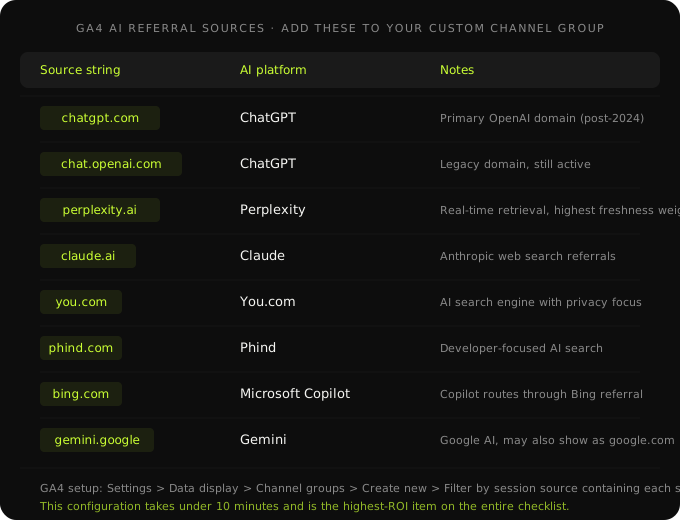
In GA4, create a custom channel group filtering for sessions where the source contains: perplexity, chatgpt, claude, you.com, phind, and bing (the last one captures traffic through Microsoft Copilot, which routes through Bing). This configuration takes under 10 minutes.
In the majority of audits DerivateX has run, meaningful AI referral volume already exists before any optimization work begins. That traffic converts at 14.2% on average across tracked accounts, compared to 2.8% for Google organic sessions. That gap makes the 10-minute GA4 setup the highest-ROI item on this entire checklist.
24. Establish an AI Visibility Score before your first campaign action
An AI Visibility Score (AVS) is a composite metric that measures how often and how prominently a brand appears in AI-generated answers across ChatGPT, Perplexity, Gemini, and Claude for a defined set of target queries. It functions as the AI search equivalent of a keyword ranking report, tracking citation frequency and share of voice across platforms rather than SERP position.
A brand can have a strong AVS on Perplexity and near-zero visibility on ChatGPT simultaneously, which points to a platform-specific structural gap rather than a general content problem. Establishing this score before you touch anything gives you a scored reference point for measuring every change that follows.
25. Define a prompt set of 20 to 30 queries and run it monthly
AI responses are probabilistic. The same query run on consecutive days can return different citations, which means a single-point check is not a reliable measurement. The approach that produces stable data is polling-based: run a consistent set of queries across platforms, record citation frequency, and track share of voice against named competitors over rolling 30-day periods.
Your prompt set should span three query types: category-level (“best CRM for real estate investors”), comparison (“your brand vs competitor”), and problem-aware (“how do I solve the core problem your product addresses”). All three types belong in your set because AI models surface different citations for each.
Quick win: Item 23 is the fastest return on this entire list. Configuring a GA4 segment for AI referral traffic takes 10 minutes and has revealed unconverted AI traffic in the majority of sites we have audited. If Perplexity or ChatGPT is already sending visitors to your site and those sessions are being lumped into “direct” or “unattributed” traffic, you are making decisions without your highest-converting channel in the data.
Frequently Asked Questions
1. I already rank on page one of Google. Why isn’t my brand showing up in ChatGPT?
Google rankings and ChatGPT citations are governed by almost entirely different signals. Ahrefs found in September 2025 that ChatGPT primarily cites pages ranking at position 21 or lower about 90% of the time, meaning top Google rankings have a weak correlation with AI citation. ChatGPT weighs technical accessibility, content structure, and third-party authority signals more heavily than SERP position.
A brand can hold the number one Google result and still be absent from the AI answer because a Cloudflare setting is blocking GPTBot, or because a better-structured competitor page gets cited instead. For a full breakdown, see our guide to ChatGPT SEO.
2. How long does a full LLM SEO audit take?
For a site with 50 to 200 pages, a thorough first-pass audit using this checklist takes two to three hours. The technical access section (items 1 to 7) is fastest at 30 to 45 minutes. Content and authority audits take the most time because they require manual page-by-page review.
Many of the quick-win fixes, like clearing a robots.txt block, reviewing Cloudflare settings, creating an llms.txt file, and configuring GA4 for AI referral traffic, can all be completed within the same session.
3. How long until I see results after running this checklist?
The timeline varies by category. Technical changes like clearing crawler blocks and updating schema markup typically show up in AI responses within one to two weeks once the site is re-crawled. Content structural improvements, including FAQ sections, TL;DR blocks, and answer-first formatting, compound over two to four weeks. Authority signals like directory updates, third-party mentions, and entity consolidation take two to three months.
REsimpli reached the number one cited CRM for real estate investors in ChatGPT within 90 days when all four audit categories were addressed from the start.
4. Do I need to optimize for ChatGPT, Perplexity, and Gemini separately?
The core work transfers across all platforms because the underlying quality signals are shared: technical accessibility, content structure, and authority. Where platform-specific tuning matters is in content freshness and measurement. Perplexity prioritizes recently updated content because it operates as a real-time retrieval system. ChatGPT draws from a mix of training data and live web retrieval.
The practical approach is to optimize for shared signals first, measure per-platform visibility, and address gaps with targeted fixes.
5. Can I do LLM SEO without changing my existing Google SEO strategy?
Yes, and this is where most of the hesitation is misplaced. Almost every fix on this checklist is additive. Adding a TL;DR block, an FAQ section, or an llms.txt file does not hurt Google rankings. In most cases, these changes improve traditional SEO performance too because they make content clearer, better structured, and more scannable. LLM SEO is a layer on top of your existing SEO work, not a replacement for it.
6. What is the difference between LLM SEO and GEO?
They refer to the same practice. LLM SEO (Large Language Model SEO) and GEO (Generative Engine Optimization) both describe the process of making content discoverable and citable by AI search tools like ChatGPT, Perplexity, Gemini, and Claude. You may also see it called AEO (Answer Engine Optimization). The terms are used interchangeably across the industry, and no meaningful technical distinction exists between them.
7. What is Citation Engineering and how is it different from regular GEO advice?
Citation Engineering is DerivateX’s methodology for making AI citations deliberate rather than accidental. Most GEO advice covers content formatting: FAQ sections, answer-first structure, schema markup. Citation Engineering treats those as one layer of a four-part system that also includes technical eligibility, authority surface expansion, and a measurement framework for tracking citation frequency over time. The distinction matters because brands that apply only the content layer often see no movement when a technical block or missing authority signal is the actual constraint.
The Audit Is the Strategy
The most important insight in this checklist is also the most frequently ignored one: LLM SEO is an audit discipline before it is a content discipline. The brands that compound AI visibility fastest are not the ones publishing the most FAQ-formatted content. They are the ones that identified and fixed their technical and authority gaps first, established a measurement baseline before their first campaign action, and let content improvements compound on top of a working foundation.
Start with items 1, 3, 4, and 23. Check your robots.txt for AI crawler blocks, review your Cloudflare bot management settings, create or audit your llms.txt file, and configure GA4 to capture AI referral traffic. Those four items take under an hour combined and will tell you more about your current AI visibility situation than any amount of content analysis.
If you want a scored baseline across all 25 items without running the audit manually, the free AI Visibility Audit returns a prioritized report. For the full methodology behind how we sequence this work, see the LLM SEO hub page.
AI search is still early enough that first-mover positioning in a category is achievable for most B2B SaaS brands that act before their space consolidates. The brands building deliberate AI presence now are the ones that will be hardest to displace 12 months from today.
Written byAyush SharmaHead of SEO & Content, DerivateX
Ayush Sharma is Head of SEO and Content at DerivateX, a full-service SEO and GEO agency for B2B SaaS. He focuses on SEO, GEO, and AI visibility for software brands, helping them get found and cited across Google, AI Overviews, ChatGPT, Perplexity, Gemini, and Claude, with results measured through to pipeline. On the DerivateX blog he covers AI visibility tracking, how LLMs choose which sources to cite, technical and JavaScript SEO for SaaS sites, and attributing AI search to revenue in HubSpot.
Cited by AI