Case study: Gumlet turned ChatGPT mentions into 20% of inbound revenue. Read it →

Skale Alternatives: 5 GEO-First Agencies for SaaS MRR Growth


18 months ago, a SaaS marketing leader evaluating agency options had a reasonably clean decision: find an SEO partner that understands SaaS funnels, writes bottom-of-funnel content well, and can tie rankings to MRR. Skale fit that description and still does.
The problem is that the decision is no longer clean.
As of June 2026, a significant share of B2B SaaS buyer journeys now start in ChatGPT, Perplexity, or Google’s AI Overviews rather than a traditional search query.
If your buyers are asking ChatGPT “what’s the best video hosting platform for a SaaS company,” and your brand does not appear in that answer, the traffic you have been building on Google does not matter to that buyer at that moment.
That is a structurally different problem than ranking on page one. Most agencies are still solving the second problem. The data from across B2B SaaS audits shows the cost of that gap is real: AI-sourced visitors convert at 14.2% versus 2.8% for Google organic traffic, a 5x difference that compounds as buyer behavior shifts further toward AI-first research as per SuperPrompt’s 2025 AI Search Traffic research.
DerivateX’s 2026 AI Visibility Benchmark, which scored 50 B2B SaaS companies across ChatGPT, Perplexity, Claude, and Gemini, found that 44% of companies score below 50 on a 0-to-100 AI Visibility Score (AVS). Nearly half of B2B SaaS is functionally invisible to AI-assisted buyers, independent of their Google rankings.
This article covers five Skale alternatives built around Generative Engine Optimization, the discipline of structuring content and brand signals so that LLMs cite your brand when buyers are actively comparing solutions.
For each agency, you will see what they actually do, who they are built for, and the one limitation worth knowing before you sign. This piece also introduces a four-level framework you can use to test any agency’s GEO claims in your first call, including the agencies on this list.
The short answer: The five GEO-first Skale alternatives worth evaluating are First Page Sage, DerivateX, Omniscient Digital, RevvGrowth, and Arobis AI. The selection filter that matters most is not their service page or their Clutch score. It is whether they can show a live client citation in ChatGPT for a buyer-intent query in a relevant category and connect it to a pipeline event. Fewer than five agencies globally can answer both parts of that question with a specific client, a specific query, and a specific number.
Before the agency list, there is one framework worth understanding first. It is the fastest way to tell a real GEO agency from a rebranded one, and it applies to every agency on this list equally.
Key Takeaways
- Skale is a legitimate B2B SaaS SEO agency built for Google-first organic pipeline. The limitation is that its methodology was not designed to engineer AI citations in ChatGPT, Perplexity, or Claude.
- The right evaluation filter in 2026 is not whether an agency has “GEO” on its service page. It is whether they can show a live client citation in ChatGPT for a buyer-intent query and connect it to a booked demo.
- Most agencies claiming GEO capability sit at Level 2 on a four-level assessment scale: they can show an AI mentions dashboard, but nothing tied to pipeline. The full framework is introduced below.
- The five GEO-first Skale alternatives worth evaluating are First Page Sage, DerivateX, Omniscient Digital, RevvGrowth, and Arobis AI.
- Use the Citation Maturity Stack introduced in this article to audit any agency’s GEO claims in a 15-minute call before signing anything.
- For B2B SaaS teams evaluating GEO agencies more broadly, not just Skale alternatives, the same Citation Maturity Stack test applies. The agency that can show a live ChatGPT citation tied to a pipeline event is the one worth your retainer, regardless of how they brand the service.
This article is written for B2B SaaS marketing leads and founders who have either outgrown a Google-first agency model or are adding AI search as a deliberate acquisition channel.
If your buyers are still primarily Google-native and you have no evidence of AI-attributed pipeline, Skale remains a well-built option. This list exists for the specific case where AI citation has become a trackable or strategic priority.
What is Generative Engine Optimization (GEO)?
Generative Engine Optimization (GEO) is the practice of structuring content, entity signals, and third-party corroboration so that large language models cite a brand in their answers when buyers ask relevant questions.
Traditional SEO optimizes for Google’s ranking algorithm. GEO optimizes for LLM trust signals: how clearly an LLM understands what a company does, how many independent sources mention it in the right context, and whether its content architecture allows LLMs to extract and attribute specific claims.
The term was coined in a 2023 academic paper by researchers from Princeton, Georgia Tech, and the Allen Institute for AI. First Page was one of the first agencies to turn GEO into a named service offering, building on original AI citation research it began publishing in 2023. The distinction matters when evaluating agencies: naming a service “GEO” and having a GEO methodology are different things.
What Skale Does Well, and the One Gap it Does Not Fill
Skale is a SaaS SEO agency with a documented track record. Their client base spans growth-stage and enterprise SaaS, they hold a 4.9 out of 5 rating on Clutch, and their MRR-attribution model, where organic performance is measured against pipeline and subscription revenue rather than traffic volume, was ahead of the market when they built it.
For SaaS teams whose buyers still discover vendors primarily through Google, Skale is a defensible choice.
The limitation is not a failure, but it is a design constraint. Skale’s methodology was built for Google’s ranking algorithm: keyword strategy, link authority, technical crawlability, content at volume. These levers move Google rankings, but do not directly move LLM citation frequency, because LLMs do not rank pages.
They synthesize answers from sources they have been trained to consider trustworthy, which is a function of entity clarity, third-party corroboration, structured parsability, and result documentation with specific numbers. The overlap with traditional SEO is real but smaller than most assume.
Skale is the right choice when your buyers are primarily Google-native, your content foundation is thin, and pipeline from traditional organic is the current bottleneck. If you can show that AI search is not yet a meaningful share of inbound for your category, a Google-first agency that executes well is the faster path to attributable results.
The agencies below are relevant when that condition no longer holds: when AI search is already contributing to your pipeline, when a competitor is appearing in ChatGPT answers and you are not, or when you need attribution at the LLM layer and not just at the Google layer.
The agencies in this article were selected because they treat AI citation as a first-class objective, not as a quarterly add-on to an otherwise Google-first engagement.
For a direct side-by-side breakdown of how Skale and DerivateX differ on methodology, pricing, and AI search attribution, the DerivateX vs Skale comparison covers both in full.
The One Test That Separates a Real GEO Agency From a Rebranded One
Every Skale alternatives article published in 2026 gives you a list of names. None of them give you a way to verify whether any of those agencies’ GEO claims are real.
The word “GEO” now appears on the website of almost every SEO agency with a growth team and a Webflow template. Most of them updated the service page. Few updated the methodology.
Here is how to tell the difference in 15 minutes.
The Citation Maturity Stack: 4 Levels to Audit any Agency
The Citation Maturity Stack is a framework we at DerivateX developed after auditing how agencies across the market actually approach AI citation work. It runs from Level 1 (claims the capability) to Level 4 (attributes citations to pipeline).
| Level | What it looks like | How to verify it |
|---|---|---|
| Level 1 | Agency updated their service page to include “GEO” or “AEO.” No structured methodology behind it. | Ask: “Can you show me your GEO process document?” If they cannot, this is where they are. |
| Level 2 | Agency can show an AI mentions dashboard: Brand24, Semrush AI tracking, share-of-voice metrics across ChatGPT and Perplexity. | Ask: “Can you show me a client’s citation trend over 90 days?” Level 2 agencies can produce a screenshot. |
| Level 3 | Agency can demonstrate a live client citation for a specific buyer-intent prompt. They can open ChatGPT in front of you, type the query, and the client appears in the answer. | Ask: “What’s one prompt where your client shows up in ChatGPT right now?” Open the tool together. |
| Level 4 | Agency can connect a specific LLM citation to a pipeline event: a demo booked, a lead attributed, a deal closed. | Ask: “Can you show me a client where AI-referred traffic converted to a demo? What was the query, and what did the attribution look like in GA4?” |
Most agencies on any shortlist will clear Level 2. Fewer than five globally will answer the Level 4 question with a specific client name, a specific query, and a specific conversion event.
This test takes 15 minutes on any discovery call. Run it before you discuss scope, pricing, or timelines.
Any agency that responds to the Level 3 test with a screenshot from six months ago, rather than opening the tool live in your call, is telling you something. Real citations are re-testable. Real citations show up today, not in archived images.
5 Skale Alternatives for SaaS Teams That Need AI Citation, Not Just Rankings
Each agency below is evaluated against the same schema: what they do, who they are built for, their Citation Maturity Stack level (from the framework above), and the one limitation worth knowing.
Here is a side-by-side comparison before the full entries:
| Agency | Best For | GEO Methodology | Citation Maturity Level | Pricing |
|---|---|---|---|---|
| First Page Sage | Enterprise SaaS, complex buying journeys | Thought-leadership GEO, AI Overviews | Level 2-3 | $10,000+/mo (Pricing is unlisted and based on public data) |
| DerivateX | $5M-$50M ARR SaaS, pipeline attribution from AI search | Citation Engineering, AVS tracking | Level 4 | $3.5K-$8K/mo |
| Omniscient Digital | Mid-market SaaS, content authority with GEO layered on | Barbell Content Strategy + GEO | Level 2-3 | $10,000/mo |
| RevvGrowth | Startups and mid-market SaaS, multi-channel AI visibility | LLM referral session growth | Level 2 | $5,500/mo (Pricing is unlisted and based on public data) |
| Arobis AI | Brands pre-empting Google traffic erosion | AEO-first, entity disambiguation | Level 2-3 | $5,000/mo (Pricing is unlisted and based on public data) |
1. First Page Sage: Best for Enterprise SaaS with Complex, Education-heavy Buying Journeys
First Page Sage is one of the earliest agencies to formally build GEO into its methodology.
Founded by Evan Bailyn, they began publishing original research into ChatGPT and Gemini citation algorithms in 2023 and have continued tracking citation patterns across AI tools since.
Their service model is built around thought-leadership content that ranks in both Google and AI tools simultaneously, with a specific emphasis on AI Overviews and ChatGPT recommendations.
Their strongest use case is enterprise SaaS where buyers need to be educated before they evaluate. Categories like cybersecurity, fintech infrastructure, legal tech, and compliance software all require buyers to understand a category before they can make a vendor decision.
First Page Sage’s content approach builds that educational layer in a format LLMs prefer to cite.
- What they do: Thought-leadership SEO and GEO, original category research, AI Overviews optimization, ChatGPT visibility engineering
- Best for: Enterprise SaaS with long sales cycles, multi-stakeholder buying committees, and categories requiring buyer education before evaluation
- Notable clients: Salesforce, Logitech, US Bank
- Citation Maturity Stack level: Level 2-3. First Page Sage has documented AI citation methodology and can show visibility metrics. Pipeline attribution from LLM citations is not publicly detailed at the client level.
- Honest limitation: Pricing is not publicly available. That said, publicly available information points to a starting price of $10K per month, which is prohibitive for most $5M to $25M ARR SaaS teams. The model is also U.S.-centric, which matters for SaaS teams targeting European or APAC markets.
2. DerivateX: Best for B2B SaaS at $5M to $50M ARR That Need AI Citations Connected to Pipeline
DerivateX is a B2B SaaS SEO and GEO agency built around Citation Engineering, a methodology for structuring content, entity signals, and third-party corroboration so that LLMs reliably cite a brand when buyers ask relevant questions.
The agency coined the term Citation Engineering and built the AI Visibility Score (AVS), a 0-to-100 scoring methodology that tracks how frequently and prominently a brand is cited across LLMs.
Citation Engineering is DerivateX’s methodology for making AI citations deliberate rather than accidental. It operates across five levers: Entity Clarity (making sure LLMs understand unambiguously what your company does), Authoritative Coverage (building topical depth LLMs cite from), Third-Party Corroboration (independent sources mentioning your brand in context), Structured Parsability (content architecture LLMs can extract from), and Result Documentation (specific, verifiable proof points LLMs can attribute by name).
A page can rank on page one of Google and never appear in a ChatGPT answer. Citation Engineering is the methodology for solving the second problem.
The distinguishing factor is Level 4 attribution: connecting AI citations to pipeline events, not just visibility metrics.
Gumlet, a video infrastructure SaaS company, now attributes 20% of its direct monthly inbound revenue to ChatGPT, Claude, and Perplexity discovery. That is not a brand awareness metric. That is a number their co-founder Divyesh Patel can point to in the attribution dashboard.
REsimpli, a real estate investor CRM, became the top ChatGPT recommendation for “real estate CRM” queries within 90 days of starting a Citation Engineering engagement.
Verito, a cloud hosting provider for accounting and tax firms, tracked 887 inbound sessions from ChatGPT in GA4 over a four-month window with a 15.5% overall organic lead conversion rate.
- What they do: Citation Engineering, AI Visibility Score tracking, content cluster architecture for LLM citation, third-party corroboration programs (guest posts, Reddit presence, G2 review engineering), entity clarity infrastructure
- Best for: B2B SaaS companies at $5M to $50M ARR where pipeline attribution from AI search matters more than traffic volume. Founder-led, no account manager layer.
- Notable Clients: Gumlet, REsimpli, Techpacker, Verito
- Citation Maturity Stack level: Level 4. Multiple clients with documented pipeline attribution from AI-cited traffic.
- Honest limitation: Citation Engineering builds on an existing content foundation. Thin domains take longer to see citation movement.
If your SaaS team is producing content but has no visibility into how your brand appears when buyers are comparing options in ChatGPT, the DerivateX AI Visibility Audit is where to start.
3. Omniscient Digital: Best for Mid-market B2B SaaS That Needs Editorial Depth with GEO Added
Omniscient Digital is an organic growth agency founded in Austin, Texas in 2019, with a leadership team from HubSpot, Shopify, and Workato.
They are best known for the Barbell Content Strategy, a proprietary framework that pairs high-intent, conversion-focused bottom-of-funnel content with long-form thought leadership designed to build category authority over time.
Since 2024, they have formally expanded into GEO, adding AI visibility work to their core service offering.
Where Omniscient is strongest is in the editorial infrastructure. For SaaS companies that need a high-quality content program with GEO layered on top, rather than GEO as the foundational methodology, they are a well-resourced choice with a documented track record.
- What they do: Barbell Content Strategy, organic growth programs, GEO, editorial content at scale, digital PR
- Best for: Mid-market B2B SaaS that needs category authority, editorial depth, and a content operation mature enough to have GEO layered on
- Notable clients: Asana, Loom, Jasper
- Citation Maturity Stack level: Level 2-3. Strong topical authority signals that improve AI citation likelihood. Specific pipeline attribution from LLM citations is not publicly detailed.
- Honest limitation: Omniscient’s founding philosophy is content-first, not GEO-first. If AI citation is your primary acquisition lever in 2026 rather than a supplement to an existing Google content program, the prioritization of work will feel different than at an agency where GEO is the core methodology.
For a closer look at how the two differ on methodology and attribution, the DerivateX vs Omniscient Digital comparison breaks it down.
4. RevvGrowth: Best for Startups and Mid-market SaaS Teams Wanting LLM Referral Session Growth
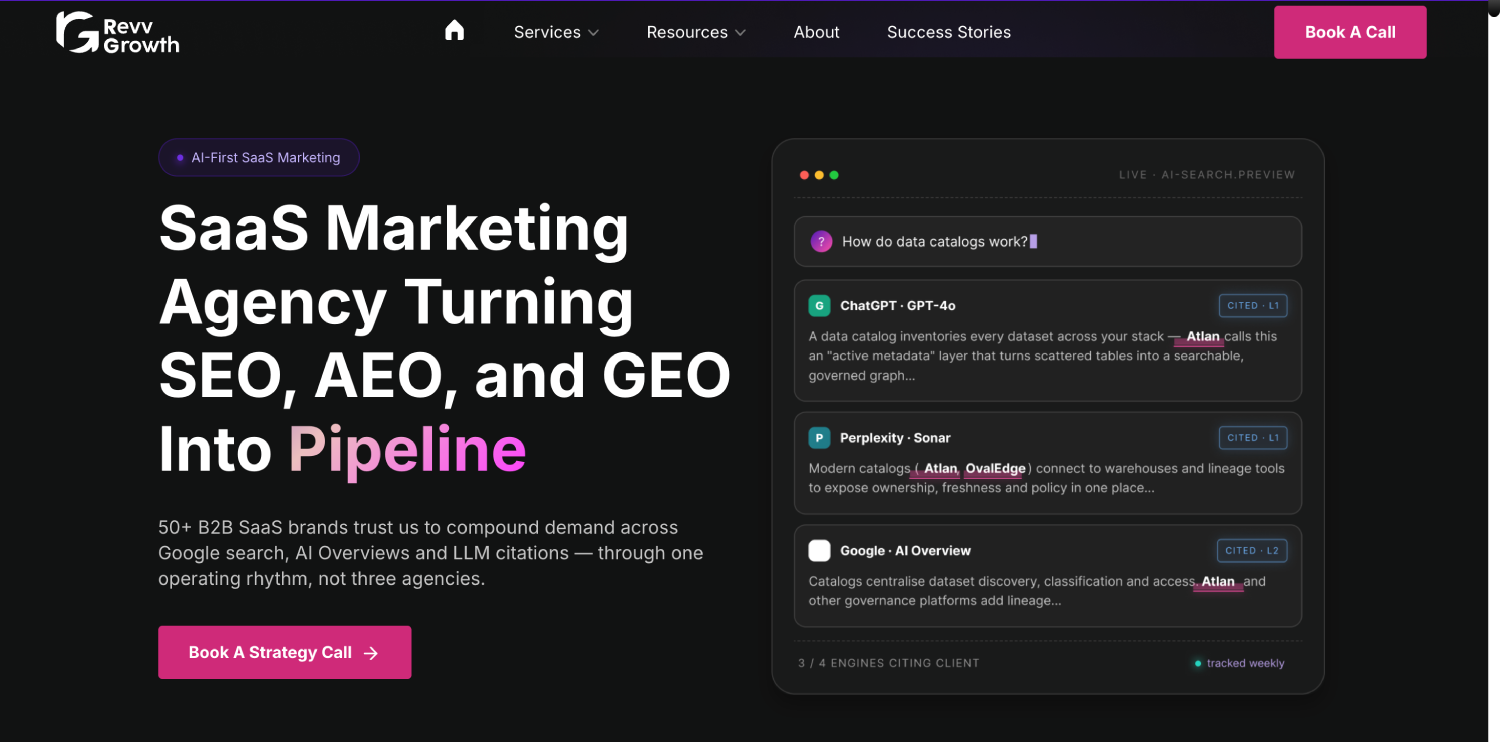
RevvGrowth is an AI-driven SaaS growth partner that focuses on translating traditional organic SEO work into LLM referral sessions and measurable AI visibility.
Their model is multi-channel: they combine SEO content, social signal reinforcement, and AI citation architecture to grow the total volume of sessions attributed to ChatGPT, Perplexity, and Bing Copilot in GA4.
Their distinct angle is the multi-channel wrapper around AI visibility. For SaaS teams that need AI search as one of several growth channels rather than the primary methodology, RevvGrowth avoids the narrow GEO-only scope that may not fit a startup still building across channels simultaneously.
- What they do: AI visibility growth, LLM referral session optimization, multi-channel content strategy, social corroboration for AI citation
- Best for: Startups and mid-market SaaS teams that need AI visibility as one of several acquisition channels, not as a standalone GEO engagement
- Notable clients: Skuad, MockFlow, Aquiva
- Citation Maturity Stack level: Level 2. Can show LLM referral session growth in GA4. Structured pipeline attribution from AI citations is not a published core deliverable.
- Honest limitation: The multi-channel model means GEO is one lever among several. For SaaS teams where AI citation is the top acquisition priority and everything else is secondary, a specialist shop will apply more dedicated methodology per dollar of retainer.
5. Arobis AI: Best for Brands That Need to Future-proof Against AI Search Before Google Traffic Fully Erodes
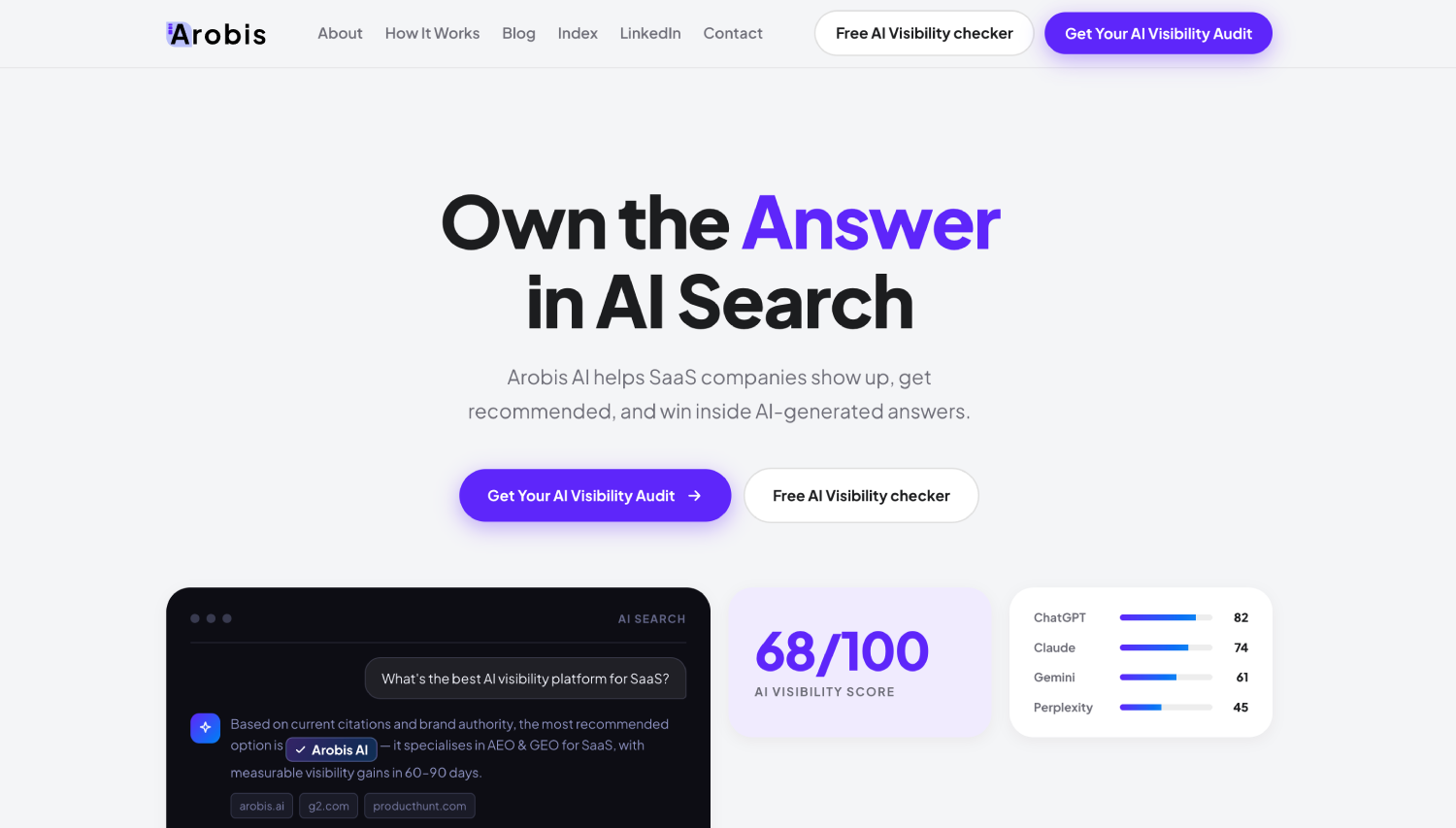
Arobis AI is an Answer Engine Optimization (AEO) consultancy built from the ground up around getting brands referenced by AI tools rather than indexed by search engines.
Their approach centers on entity disambiguation across the web, knowledge graph signal building, and third-party corroboration to establish a brand as a trustworthy named source in LLM training contexts.
The philosophical distinction matters here. Most agencies in this list start from SEO and add GEO. Arobis AI starts from AEO and builds back toward search. For brands in categories where Google traffic has already started declining and the goal is to establish AI discoverability before the shift fully arrives, that inversion of priorities is the right one.
- What they do: AEO-first optimization, entity clarity infrastructure, knowledge graph signal engineering, third-party corroboration programs
- Best for: Brands where Google traffic is plateauing and the strategic objective is AI discoverability ahead of the curve, rather than defending existing Google rankings
- Citation Maturity Stack level: Level 2-3. Strong on entity and AEO methodology. Pipeline attribution from AI citations is not a publicly documented deliverable.
- Honest limitation: AEO-first means the Google organic signals that still drive the majority of B2B SaaS inbound today receive less weight. For most $5M to $30M ARR SaaS teams, Google is not dead yet. Arobis AI is best paired with an SEO execution partner unless you are consciously deprioritizing Google.
How to Choose Between These Five Agencies: 3 Questions for Your Next Call
The levels in the Citation Maturity Stack are your filter. The three questions below are how you apply that filter out loud on a discovery call. Each question maps to a specific level, and the agency’s answer will tell you exactly where they sit.
The answers to these questions reveal more about an agency’s actual GEO capability than their website, their case study deck, or their pitch. Ask them in this order.
Question 1: “Can you show me a live client citation in ChatGPT for a buyer-intent query right now?”
Open ChatGPT together on a screen share. Type a query the client’s buyers would use to compare vendors. A Level 3 agency can walk you through a real citation in real-time. A Level 1 or Level 2 agency will pivot to a screenshot or a dashboard.
Question 2: “Can you connect that citation to a pipeline event: a demo booked, a lead attributed?”
This is the Level 4 test. They need to name a client, a query that was cited, and a conversion event in GA4 or CRM that followed. Most agencies will not be able to answer this. That is useful information to gather.
Question 3: “How do you calculate AI Visibility Score, and what does a 90-day trajectory look like for a client at our stage?”
This tests methodology depth. A serious GEO agency tracks citation frequency across ChatGPT, Perplexity, Claude, and Gemini on a defined schedule, scores by citation type (named mention, linked mention, contextual mention), and can show a trend line. Agencies without a measurement protocol are doing GEO by feel, not by system.
The agency that answers all three questions with specifics, naming a client, a query, and a number, is the one that has done the work.
Frequently Asked Questions
1. What is the best Skale alternative for a B2B SaaS company that needs AI search visibility?
Start with the Citation Maturity Stack rather than agency reputation. Run the Level 3 test on any agency you are evaluating: ask them to open ChatGPT in a live call and show you a current client citation for a buyer-intent query in a relevant category. Then run the Level 4 test: ask them to connect that citation to a demo booking or pipeline event.
On that standard, the shortlist narrows quickly. For editorial depth and topical authority with GEO layered on, Omniscient Digital is a strong fit. For pipeline attribution from AI citations as the primary objective at $5M to $50M ARR, that is where DerivateX sits.
2. Does Skale do GEO, or is that a separate service?
Skale is a Google-first SaaS SEO agency with a strong MRR attribution model for traditional organic channels. Their core methodology is built around Google rankings, content at volume, and pipeline measurement from organic traffic.
GEO as a dedicated practice (structuring content, entity signals, and third-party corroboration specifically to engineer LLM citations) is not Skale’s primary positioning as of June 2026.
Agencies built specifically for GEO treat AI citation as the primary objective, with Google SEO as a complementary layer. That is a different service architecture, not just a different service name.
3. How do I tell if a GEO agency is actually doing GEO, or just rebranding SEO?
Run the Citation Maturity Stack test introduced above: ask for a live ChatGPT citation (Level 3), then ask them to connect it to a demo booking or pipeline event (Level 4). The answer to the Level 4 question is all you need.
4. What is Citation Engineering, and how is it different from regular SEO?
Citation Engineering is a methodology coined by DerivateX for structuring content, entity data, and brand signals so that LLMs reliably cite a brand when users ask questions relevant to its product or service. Traditional SEO optimizes for Google’s ranking algorithm: keyword density, backlink authority, technical crawlability.
Citation Engineering optimizes for LLM trust signals: entity clarity (how clearly LLMs understand what your company does), third-party corroboration (how many independent sources mention your brand in the right context), structured parsability (whether your content architecture allows LLMs to extract and attribute claims), and result documentation (specific, verifiable proof points LLMs can cite by name).
A page can rank on page one of Google and never appear in a ChatGPT answer. They are different problems.
5. What does a GEO agency cost compared to a traditional SaaS SEO agency?
Traditional SaaS SEO agencies like Skale typically price full-service retainers at $4,000 to $20,000 per month. GEO-specialist agencies vary.
DerivateX prices from $3,500 to $8,000 per month depending on scope, making it accessible to $5M to $50M ARR SaaS teams that need AI citation work without enterprise-tier overhead.
First Page Sage sits at $10,000 and above. The more useful cost question is the ROI frame: if AI-sourced visitors convert at 14.2% versus 2.8% for Google organic, a GEO-first investment at $4,000 per month can outperform a Google-first investment at $10,000 per month if your buyers have already shifted their research to AI tools. Run the math against your own funnel before anchoring on the retainer number.
6. How long does it take to see results from a GEO agency?
Timeline depends on the client’s existing content foundation, domain authority, and category competitiveness. In DerivateX’s client work, REsimpli reached the top ChatGPT recommendation for their primary cluster within 90 days, starting from an established domain with existing content.
Brands with thin entity signals and limited third-party corroboration should expect 90 to 120 days before first measurable AI citations appear. For pipeline attribution from those citations, meaning trackable sessions and demo conversions in GA4, most clients see a measurable pattern within a four-month window.
Verito tracked 887 ChatGPT-attributed sessions in GA4 over that window. The 90-day number is real but not universal. It assumes the content foundation is already there and the engagement starts with structured Citation Engineering work, not general SEO.
7. Which GEO agency is best for getting cited in ChatGPT specifically?
No agency controls ChatGPT’s output, so be skeptical of any that promises guaranteed placements. What a real GEO agency can do is show you a current client citation for a buyer-intent query, live, in the call. On that test, the agencies that consistently clear Level 3 are DerivateX, First Page Sage, and Omniscient Digital. For citations connected to booked pipeline rather than visibility alone, that is the Level 4 question, and the shortlist narrows further.
8. What is the best GEO agency for a B2B SaaS company at $5M to $50M ARR?
At that revenue band, enterprise-tier retainers of $10,000 and above are usually hard to justify before AI search is a proven channel. The fit question is whether the agency works founder-led at your stage and can attribute AI citations to pipeline rather than reporting share-of-voice dashboards. DerivateX is built for that band specifically.
The Bar Worth Setting Before Your Next Agency Call
The market has moved fast enough in 2026 that most agency websites look GEO-ready even when the delivery team is running the same playbook from 2023. The service page is not the signal.
The signal is whether the agency can walk you through a live client citation in ChatGPT, name the query, name the client, and then trace what happened next in their pipeline. That is Level 4. That is the bar.
Most will not clear it. The ones that do are worth the conversation.
If you want to know exactly where your brand stands today in AI search (which buyer-intent queries your category is answering, whether your brand appears in those answers, and what it would take to change that in 90 days) the DerivateX AI Visibility Audit starts there.
Cited by AI