Case study: Gumlet turned ChatGPT mentions into 20% of inbound revenue. Read it →

The Hidden Costs of Cheap GEO: What $1,500/Month Actually Gets You

The line-by-line math behind budget GEO retainers, the three ways they quietly damage your AI search visibility, and the 4-step audit to run on your vendor before the next invoice clears.


TL;DR
- A $1,500/month GEO retainer, after a typical 50 to 60% agency gross margin, leaves roughly $600 to $750 for actual delivery. At junior offshore rates, that buys 15 to 20 hours of work per month across your entire account.
- GEO agency pricing in 2026 runs $3,000 to $20,000+ per month for retainers, based on Red Engage’s June 2026 survey of 20 agencies. The sub-$2,000 tier almost always excludes citation tracking, the one deliverable that proves the work happened.
- Cheap GEO is not neutral. Unedited AI content, near-duplicate pages, and template outreach create damage that takes one to two quarters to reverse.
- The most reliable tell of a low-quality GEO agency: they cannot show you the exact prompts they track or name a single citation they won in the past 30 days.
- A $1,500 audit is a legitimate product. A $1,500 retainer is a different animal, and confusing the two is the most expensive mistake in GEO buying right now.
Two GEO proposals are sitting in your inbox. One agency wants $1,500 a month, the other wants $5,000, and both promise the same outcome: your brand cited in ChatGPT, Perplexity, Gemini, and Google AI Overviews. Nobody on either sales call explained where the extra $3,500 goes.
Most buyers resolve this the wrong way. They assume the price gap is markup, pick the cheap GEO agency, and discover 6 months later that they bought a content mill with a GEO label on it. The gap is not markup. It is measurement, senior hours, and third-party authority work that a budget AI SEO agency structurally cannot deliver at that price.
There is also a twist that makes this decision heavier than it looks: your own buyers are running the same comparison on YOU. B2B buyers now paste vendor shortlists into ChatGPT and ask which one to pick, a shift we broke down in how B2B SaaS buyers use ChatGPT to evaluate vendors. This piece itemizes what $1,500 a month physically buys, compares it line by line against $5,000, names the three ways budget GEO actively hurts you, and hands you a four-step audit to run on any vendor, including the one you already have. Start with the market context, because the price ranges alone explain half the story.
How Much Does a GEO Agency Cost in 2026?
GEO agency retainers in 2026 typically run $3,000 to $20,000+ per month, with one-time audits priced at $1,500 to $5,000, per Red Engage’s June 2026 analysis of 20 agencies’ published and quoted pricing. WebFX’s May 2026 pricing data puts the full range even wider, from $1,500 to $50,000+ per month. The tier this post examines sits at the very bottom of that range, and the bottom behaves differently from everything above it.
The market splits into 3 broad tiers.
- Below $2,000 a month, you are buying content volume from AI drafting pipelines, usually with no prompt tracking and no senior strategist attached.
- Between $3,000 and $8,000, you enter specialist territory: tracked prompt sets, schema implementation, competitor citation analysis, and reporting that shows citations rather than rankings.
- Above $8,000, engagements add original research, digital PR at scale, and share-of-voice reporting against multiple competitors, and we listed which firms publish their rates in GEO agencies with public pricing in 2026.
Here’s the confusion that costs buyers the most money: a $1,500 audit and a $1,500 retainer are completely different products. An audit at that price is a one-time diagnostic, and a fair one. It tells you where you appear across AI engines, what is broken, and what to fix first. A $1,500 monthly retainer claims to do the ongoing work of an entire generative engine optimization program at the price of a diagnostic, and the math below shows why that claim collapses.
Why is GEO more expensive than traditional SEO?
GEO costs more than traditional SEO because it stacks 3 cost layers on top of standard content production:
- paid monitoring tooling
- multi-engine measurement labor
- heavier per-article research
For contrast, a Backlinko survey of over 300 SEO professionals from December 2025 found traditional SEO retainers averaging $1,000 to $2,500 per month.
The tooling layer alone is real money. Prompt tracking platforms like Profound, Otterly.ai, and Peec AI start at $30 to $99 per month on entry plans capped at 30-100 tracked prompts, and jump to $150 to $500 per month once you track a serious prompt set. We compared the full stack in our breakdown of the best GEO tools for B2B SaaS in 2026, and the short version is that credible measurement is never free.
The labor layer is bigger. A properly built GEO article needs entity research, competitor citation analysis, subject matter input, schema, and internal linking, which is 8 to 12 hours of combined writer and editor time in our production system at DerivateX. Someone then has to re-run the tracked prompt set across ChatGPT, Perplexity, Gemini, and AI Overviews on a recurring cadence, because AI answers shift constantly and last month’s citation is not this month’s citation.
What a $1,500/Month GEO Retainer Actually Delivers?
A $1,500 monthly GEO retainer typically delivers 2-4 AI-drafted articles, a templated monthly report, and nothing else. No tracked prompt list, no schema implementation, no competitor citation analysis, and zero senior strategist hours. That is not an accusation. It is arithmetic.
Run the unit economics yourself. Agencies need gross margins around 50-60% to survive, which leaves $600 to $750 of your $1,500 for delivery. At blended junior rates of $30 to $50 an hour, that funds 15 to 20 hours a month across your ENTIRE account: content, reporting, communication, everything.
One properly built GEO article takes 8 to 12 hours, so the only way to ship 3 to 4 articles inside that budget is to remove the research, remove the editing, remove the measurement, and let a language model write everything unsupervised.
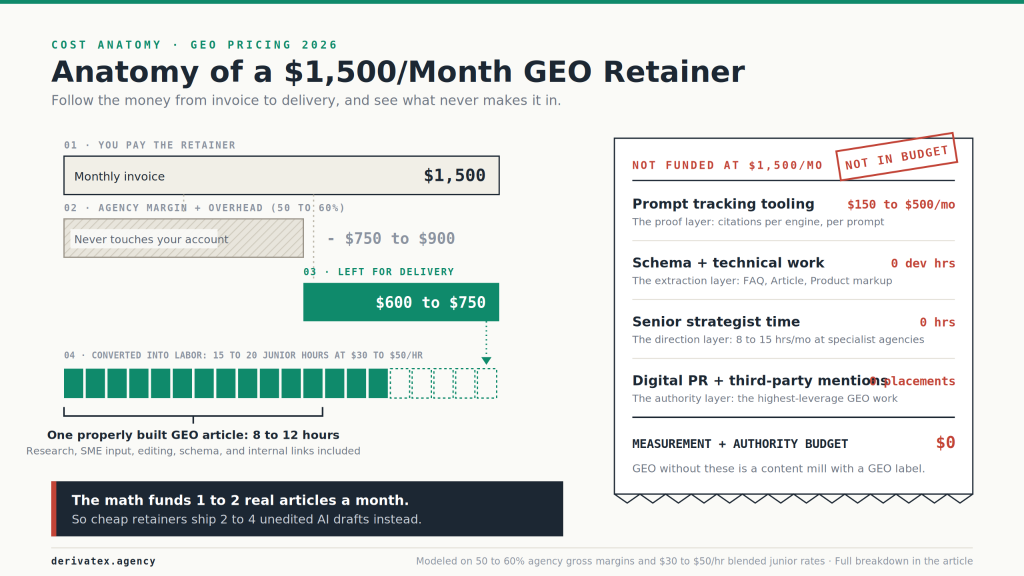
Here’s what the line items look like at that price point:
- Content: 2 to 4 posts per month, drafted by AI with light or no human editing, written by whoever is cheapest that quarter
- Prompt tracking: not included, because the tooling alone would consume a third of the delivery budget
- Technical and schema work: not included, because it requires a developer the retainer cannot fund
- Competitor citation analysis: not included
- Third-party mentions and digital PR: not included, and this is the highest-leverage component of any real GEO program
- Senior strategist hours: zero
The cruel part is that this looks fine for the first 60 days! Content is shipping, the report has charts, and the invoice is small. The absence of measurement means nobody, including the agency, knows whether a single AI engine has cited a single page.
One article, two pipelines: a worked example!!!
Follow one hypothetical article, “Best workforce attendance software for manufacturing,” through both pipelines, and the price gap explains itself.
In the $1,500 pipeline, the process takes under two hours. A junior pastes the title into a language model, gets 1,800 words back, swaps in the client’s name, and hits publish. There’s no first-party data, no named source, no schema, and no check on whether any AI engine ever retrieves it, even though retrieval mechanics are well documented in how LLMs decide what to cite.
In the $5,000 pipeline, the same title takes 10-12 hours. A strategist pulls the prompts buyers actually ask, a writer interviews someone who talks to manufacturing customers daily, the draft gets one verifiable first-party stat and a named quote, an editor rewrites it for extractability, and a developer ships FAQ schema alongside it. The tracked prompt set then confirms, week by week, whether ChatGPT or Perplexity starts citing the page. One pipeline produces a page; the other produces a measurable asset, and that difference is the entire retainer gap.
$1,500 vs $5,000 GEO Retainer: Line-by-Line Comparison
The fastest way to see where $3,500 goes is a deliverable-by-deliverable comparison. Every cell below is a quantity or a “not included,” because “limited” is how vague proposals hide empty scope.
| Deliverable | $1,500/mo agency | $5,000/mo agency |
|---|---|---|
| Content volume and authorship | 2 to 4 AI-drafted posts, junior or no editing | 4 to 6 posts, human-written with SME input, senior edited |
| Prompts tracked | Not included | 50+ buyer prompts across ChatGPT, Perplexity, Gemini, and AI Overviews |
| Tracking tooling | Not included | Dedicated platform subscription, $150 to $500/mo, absorbed by agency |
| Technical and schema implementation | Not included | FAQ, Article, and Product schema shipped monthly |
| Competitor citation analysis | Not included | Monthly report on which competitors get cited for your prompts and why |
| Third-party mentions and digital PR | Not included | 2 to 4 earned placements or corroborating mentions per month |
| Senior strategist hours | 0 | 8 to 15 hours per month |
| Reporting | Traffic and rankings template | Citation share per engine, month-over-month movement, content-to-prompt mapping |
One row on that table matters more than the other seven combined. Measurement is the dividing line, because a GEO program without tracked prompts is unfalsifiable: the agency can never be proven wrong, which also means it can never be proven right. Everything else on the $5,000 side exists to move a number that the $1,500 side never even records, and the AI Visibility Score framework shows exactly what citation-level measurement looks like when it is done properly.
Cheap agency vs in-house vs specialist agency
The $1,500 quote is usually competing against two alternatives, not one, and the three-way comparison is more honest than the two-way.
| Option | Real monthly cost | What you get and lose |
|---|---|---|
| In-house | $6,000 to $9,000 fully loaded | One content hire plus tooling; full control, but no GEO experience curve and slow ramp |
| Cheap agency | $1,500 | Content velocity; you lose measurement, strategy, and technical work entirely |
| Specialist agency | $5,000+ | Tracked citations, senior strategy, and PR; you pay for the experience curve you’d otherwise build slowly |
The in-house row surprises people. A single mid-level content marketer plus the tracking stack costs more per month than a specialist retainer, and that person still has to learn GEO from zero while competitors’ agencies run playbooks refined across dozens of accounts. The full math on that tradeoff lives in our B2B SaaS SEO agency vs in-house hire breakdown, and how much you should spend at all depends on stage, which we mapped in B2B SaaS SEO spend by ARR stage.
Can Cheap GEO Actually Hurt Your Business?
Yes. Cheap GEO is not a smaller version of good GEO; it is a different activity that produces liabilities, and the damage arrives through 3 specific mechanisms.
- Unedited AI content published at volume
- Indexing bloat
- Template outreach
Let’s dive in deeper to each one of these mechanisms:
1. Unedited AI Content Published At Volume
The first mechanism is unedited AI content published at volume, which Google now explicitly treats as spam. Google’s scaled content abuse policy targets mass-produced pages created primarily to manipulate rankings, regardless of whether a human or a machine wrote them. Research from Graphite in early 2026 estimated that AI-generated articles account for somewhere between 39% and 50% of new web text, and found the growth plateauing precisely because low-quality output keeps underperforming.
Publishing more of it does not make you visible; it makes you statistically indistinguishable from the sludge AI engines are learning to skip.
2. Indexing Bloat
Cheap pipelines produce near-duplicate articles covering the same topics with slight variations, because that is what unsupervised generation does at volume. These pages waste crawl budget, dilute the entity signals AI engines use to decide who owns a topic, and fragment internal linking across dozens of thin pages instead of concentrating authority in a few strong ones.
Google’s February 2026 Discover core update reportedly targeted exactly this pattern, demoting low-quality AI content at scale and rewarding topical authority.
3. Template Outreach
The third mechanism is template outreach that burns your brand with the publishers you will need later. Real GEO depends heavily on third-party corroboration, meaning mentions and citations on sources AI engines already trust. A cheap agency blasting templated pitches from your domain poisons those relationships before a serious program ever starts. You are not just failing to build authority; you are salting the ground.
The buyer-comparison layer makes all three mechanisms worse in 2026 specifically. AI Overviews now appear on nearly half of tracked queries, up 58% year over year, and every one of those answers is built from content the engines chose to trust.
When your prospect asks ChatGPT to compare you against two competitors, the engine judges the exact pages your cheap GEO agency published, and sludge loses comparisons you never even knew were happening.
How long does recovery take if the damage is done?
Recovery from a bad GEO engagement realistically takes one to two quarters, and it follows a three-step sequence rather than a single fix.
- Audit and prune the content: Inventory every page the cheap agency published, run the thin and near-duplicate pages through a keep-improve-delete decision, and remove or consolidate the sludge. This step alone often cuts 30 to 60% of the pages a volume-first vendor produced.
- Clean up the outreach footprint: Identify every placement and pitch sent under your brand, disavow genuinely toxic links, and personally re-approach any publisher worth keeping.
- Rebuild on one query cluster: Pick a single high-intent topic, define a tracked prompt set for it, and rebuild content, schema, and third-party mentions against that cluster for 90 days before expanding.
The honest caveat: step one hurts, because you are deleting pages you paid for. Keeping them costs more, since every month of sludge in the index extends the timeline. If the relationship itself is beyond saving, we wrote a separate playbook on how to fire an SEO company without losing your assets on the way out.
6 Signs of Low-Quality GEO Work
You can identify a low-quality GEO agency in under an hour by checking six things, and none of them requires technical skill.
- No named prompt list. Ask which exact prompts they track for you. A real program answers with a document; a fake one answers with “we monitor AI visibility broadly.”
- Reports show rankings but zero citations. GEO reporting that only contains Google positions and traffic charts is SEO reporting with the logo changed.
- No first-party data or named sources in the content. Open three recent deliverables. If every claim is generic and no human is quoted or named, a model wrote it unsupervised.
- Identical templates across their client sites. Visit two or three of their other clients’ blogs. Same structure, same headings, same cadence means a production line, not a strategy.
- No schema shipped in 90 days. Check the page source of recent posts for FAQ or Article structured data, or ask for the technical changelog. Silence is the answer.
- They cannot name one citation won in the past 30 days. This is the kill question. An agency doing real work can screenshot a ChatGPT or Perplexity answer citing their client from memory.
Seo.com’s 2026 guide to AI SEO agency red flags independently lands on the same core pattern: mass-produced generic content, secret-algorithm claims, and prices dramatically below market are the trio that predicts a bad engagement. When one vendor’s quote is a third of everyone else’s, the discount IS the red flag, and we cataloged the broader warning signs in SaaS SEO and GEO agency red flags.
How to audit your current GEO vendor in 4 steps
Run this audit in a single week, before the next invoice.
- Request the exact tracked prompt list. Not a summary, the list itself, with the engines each prompt is tracked on. Refusal or vagueness ends the audit early.
- Run 10 of those prompts yourself. Put them into ChatGPT and Perplexity, screenshot the answers, and check whether you or your competitors get cited. Use a logged-out or fresh session to reduce personalization.
- Test three recent deliverables. Run them through a plagiarism checker and an AI-detection tool. Detection tools are imperfect, so treat the result as a signal to combine with your own read, not a verdict.
- Count the technical changes shipped in 90 days. Check the site changelog, your CMS revision history, or the Wayback Machine. Zero schema, zero structural changes, and zero refreshed pages in a quarter means you have been buying only words.
What should a GEO monthly report include?
A real GEO monthly report contains five components: the tracked prompt list with citation share per engine, month-over-month citation movement, every content piece shipped mapped to the prompt it targets, technical changes deployed that month, and next month’s target prompt set. Each component exists so you can independently verify the work.
A $1,500 report typically contains exactly one of the five: content shipped. Everything else is replaced by traffic charts, which measure a different channel entirely. The mapping component matters most, because content that cannot be tied to a specific target prompt was not written for GEO in any meaningful sense. We published our full reporting standard in the 8 GEO metrics we report to clients, and the logic connecting those metrics to pipeline sits in the real ROI of GEO.
When a $1,500 GEO Agency Is the Right Choice
There are two situations where a $1,500 GEO agency is genuinely the correct buy, and pretending otherwise would make everything above less credible. The first is a pre-revenue or very early company that only needs basic content velocity while it finds product-market fit, where measurement would be premature because there is no pipeline to attribute yet. The second is a company with a strong in-house strategist who wants raw production capacity to direct, supplying the strategy, measurement, and quality control themselves.
Both cases share one property: the buyer is not expecting GEO outcomes from the retainer. They are buying labor, they know they are buying labor, and they have priced it accordingly. The failure mode is buying labor while expecting a program.
Everyone else, and specifically B2B SaaS companies between $5M and $50M ARR with real pipeline to protect, is a stage mismatch at that price. Red Engage’s 2026 pricing analysis flags stage mismatch as the single biggest risk in GEO buying, in both directions: an enterprise hiring a $3,000 agency fails the same way a seed-stage company hiring a six-figure one does.
The middle ground between $1,500 and $5,000
Two legitimate paths exist between the content mill and the full specialist retainer, and both keep the one component that must never be cut.
The first path is a reduced-scope pilot at roughly $3,000 to $4,000 a month: fewer tracked prompts, one query cluster instead of five, two articles instead of six, but the measurement layer fully intact. You learn within 90 days whether citations are moving and scale only after they do, which is exactly the structure behind our 90-day GEO sprint. The second path is consulting plus in-house execution, where a specialist builds the prompt set, the strategy, and the review process, and your own team produces the content under that direction.
Whichever path you take, the non-negotiable is measurement. A smaller tracked program beats a bigger untracked one every single time, because the smaller one can be evaluated and the bigger one can only be believed. The cheapest honest starting point costs nothing: run a free AI visibility audit before signing anything, so you know your citation position before any vendor takes credit for it.
5 Questions to Ask a GEO Agency Before Signing
Five questions, asked verbatim, separate real GEO agencies from rebadged content mills faster than any proposal review. Copy these into your next call.
- “Which specific prompts will you track for us, and on which engines?” A good answer names a discovery process and a number, like 50 buyer prompts across four engines. A bad answer says visibility will improve holistically.
- “Who writes the content, and can I see their bylines?” Good answers name humans with published work. Bad answers describe a proprietary content system, which is a language model wearing a trench coat.
- “What happened with your last client that churned?” Honest agencies have a real answer, because every agency has churn. Evasion here predicts evasion everywhere.
- “Show me one citation you won for a client in the past 30 days.” The answer should be a screenshot within a day. Anything slower means they do not track citations, which means nothing in the proposal is measurable.
- “What exactly do you hand over if we leave?” The right answer includes the prompt list, the citation logs, and all content. Data hostage tactics, like tracking run under the agency’s own accounts, should end the conversation immediately.
The methodology behind questions one and four is not secret, and any agency claiming proprietary magic is hiding either simplicity or emptiness. The full logic of how engines choose whom to cite is public in the Citation Engineering framework, and if you want a scored version of this entire vetting process, use the GEO agency evaluation checklist on every vendor in your shortlist.
How long does GEO take to show results?
Expect first citation movement in 60 to 90 days and meaningful share of voice on your target prompts by month four to six. GEO compounds because AI engines re-crawl continuously and third-party authority accumulates over months rather than weeks, which is also why the market sells retainers instead of one-off projects. We charted the full citation curve in how long it takes to get cited by ChatGPT.
The timeline is exactly why cheap engagements fail even when the content is passable. Companies churn out of budget retainers around month three, right before the window where results would appear, so the engagement dies unmeasured and unproven. For a first-party reference point: REsimpli went from absent in AI answers to the top-cited CRM for real estate investors across 10+ high-intent prompts within 90 days of working with DerivateX, and Gumlet now attributes roughly 20% of direct monthly inbound revenue to LLM citations, documented month by month in the Gumlet case study. Both timelines required the measurement and senior hours that the $1,500 tier removes.
FAQ
Can a cheap GEO agency actually hurt my rankings and AI visibility?
Yes. The three main damage mechanisms are unedited AI content at scale, which Google’s scaled content abuse policy treats as spam, near-duplicate pages that waste crawl budget and dilute your entity signals, and templated outreach that damages your reputation with publishers whose mentions real GEO depends on. The damage compounds quietly because budget retainers include no measurement, so nobody detects the problem until traffic or citations visibly drop. Recovery typically takes one to two quarters of pruning, cleanup, and rebuilding.
Can’t I just start with a $1,500 GEO agency and upgrade later once it works?
The plan fails on its own logic: without tracked prompts, you will never get the “once it works” signal, because nothing is being measured. You will get content and traffic charts, not citation data, so month six looks exactly like month one and the upgrade decision never triggers. Worse, if the cheap engagement published sludge, you upgrade into a cleanup project instead of a growth project. Starting smaller but measured, like a $3,000 to $4,000 pilot on one query cluster, gives you a real upgrade signal within 90 days.
Does switching GEO agencies reset my progress?
Your durable assets transfer fully: published content, earned third-party mentions, schema, and any citations already won stay with your domain, not the agency. What resets is tracking history and strategy context, which is why the handover file matters. Before signing with any agency, make contractual deliverables out of the tracked prompt list, the citation logs, and admin access to every tool account. If your current vendor runs tracking under their own accounts and refuses to hand it over, that is a data hostage tactic and a reason to leave.
Is a $1,500 GEO audit worth it even if the retainer isn’t?
Yes, and the distinction matters. Red Engage’s 2026 pricing data puts one-time GEO audits at $1,500 to $5,000, and at that price an audit is a fair diagnostic: where you currently appear across ChatGPT, Perplexity, Gemini, and AI Overviews, what is technically broken, and a prioritized fix list. The audit’s limit is that it identifies the work without doing any of it. The trap is a vendor selling audit-level effort as a monthly retainer, charging diagnostic prices for what they claim is an ongoing program.
Can my in-house SEO team handle GEO without an agency?
They can, with two additions: tracking tooling and a learning curve budget. Your team needs a prompt tracking platform, which runs $30 to $500 per month depending on prompt volume, plus time to learn citation-focused content structure, entity optimization, and third-party corroboration work that traditional SEO never required. The hybrid model often works best: a specialist builds the prompt set and strategy, and your in-house team executes under that direction. Fully loaded, one in-house hire plus tools costs $6,000 to $9,000 a month, so in-house is not the cheap option either.
Why do GEO agencies charge so much more than SEO agencies?
Three cost layers exist in GEO that traditional SEO does not carry. Monitoring tooling for tracked prompts costs $30 to $500 per month before any work starts. Measurement labor is recurring, because prompt sets must be re-run across four engines on a regular cadence as AI answers shift. Per-article production is heavier, since citable content needs entity research, first-party data, named sources, and schema, roughly 8 to 12 hours per piece versus 2 to 4 for standard SEO content. Backlinko’s December 2025 survey put average SEO retainers at $1,000 to $2,500 monthly; GEO’s floor sits higher because the deliverable stack is genuinely bigger.
The Price Gap Is a Measurement Gap
The single most important thing to take from this piece is that the difference between a $1,500 and a $5,000 GEO retainer is not markup, it is measurement. Every other deliverable on the comparison table, from senior strategy to digital PR, exists to move a citation number that the cheap tier never records in the first place. An unmeasured GEO program is not a budget version of a real one; it is a belief system with an invoice.
Your next step takes one hour, not one contract. Get your baseline citation position across ChatGPT, Perplexity, Gemini, and AI Overviews before you talk to any vendor, ours included, so no agency can take credit for visibility you already had. Run the free AI visibility audit, then take the five questions from this piece into every sales call and watch which agencies answer with documents and which answer with adjectives.
The comparison layer is only getting bigger from here. With AI Overviews already appearing on nearly half of tracked queries and buyers pasting shortlists into ChatGPT before they ever book a demo, the quotes you are comparing today are being compared right back, by the same engines, in front of your buyers. Buy the retainer that survives that comparison.
Written byApoorv SharmaCo-founder, DerivateX
Apoorv Sharma is the co-founder of DerivateX, a B2B SaaS SEO and Generative Engine Optimization agency that engineers AI citations in ChatGPT, Perplexity, Claude, and Gemini and connects them to demo bookings and revenue pipeline. He is the author of the 2026 AI Visibility Benchmark Report and the Citation Engineering methodology. He's also the brain behind "Found On AI" and has sold 2 of his companies previously
Reviewed byFouziaSEO Growth & Operations, DerivateX
SEO Growth & Operations at DerivateX, where I focus on SEO, content publishing, AI search optimization and organic growth. Through my blogs, I share practical insights on SEO, AI tools, content strategy, digital marketing and workflows that help businesses improve search visibility and grow sustainably.
Cited by AI