Case study: Gumlet turned ChatGPT mentions into 20% of inbound revenue. Read it →

How Much Should a B2B SaaS Spend on SEO and GEO Per Month? Benchmark by ARR Stage

A stage-by-stage budget benchmark for B2B SaaS, splitting SEO and GEO into two separate line items from seed to Series C+.


Most B2B SaaS companies should spend between 5% and 12% of ARR on combined SEO and GEO, structured as two separate budget lines that scale at different rates by stage. At seed, that means $2K to $5K per month total. At Series C+, $40K to $100K+.
TL;DR
- B2B SaaS SEO and GEO spend tracks ARR stage, not gut feel. Seed: $2K to $5K per month. Series A: $7K to $15K. Series B: $15K to $35K. Series C+: $40K to $100K and beyond.
- SEO and GEO belong on two separate budget lines, not one. Founders who collapse them into a single retainer end up underfunding whichever the agency is weaker at.
- The SEO-to-GEO ratio shifts from roughly 75/25 at seed to closer to 55/45 at Series C+, because AI search referrals tend to outconvert Google organic at scale.
- What you buy at each band matters more than what you spend. A $5K per month engagement built around three BOFU pages and 25 tracked AI citations outperforms a $15K content mill at the same stage.
- ChatGPT-referred traffic converts at roughly 15.9% versus 1.76% for Google organic, per published platform conversion data. Companies routing 100% of organic budget into Google SEO are starving the higher-converting channel.
- Use a stage-specific buy-list, not a number. The body of this piece gives one for each ARR band.
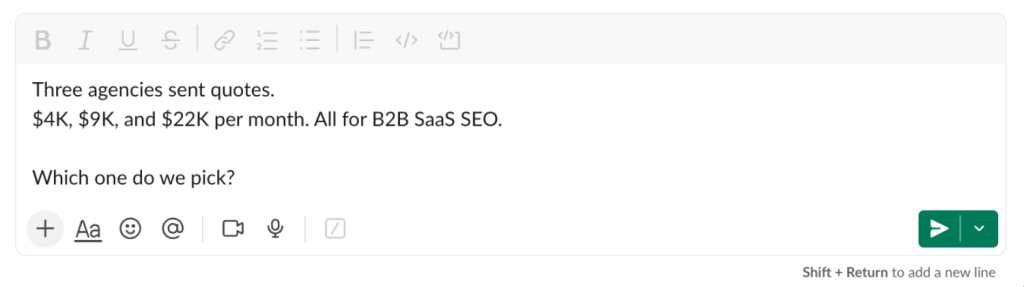
A founder at $3M ARR opens a Slack message from their head of growth at 9pm: “Three agencies sent quotes. $4K, $9K, and $22K per month. All for B2B SaaS SEO. Which one do we pick?”
There is no honest answer to that message, because the question itself is wrong. The right question is not how much to spend. It is how much to spend on what, at this stage, for this kind of buyer, and split how between Google SEO and AI search visibility.
Almost every SEO budget guide on the internet quotes a $X to $Y range and stops. Linkflow lands at $5K to $20K per month for growth-stage SaaS. Hop Online suggests 5% to 10% of current revenue. SEO Growup points growth-stage companies toward $7K to $15K per month. Almost none of these guides split AI search visibility into its own budget line, and almost none of them tie the dollar figure to a stage-specific buy-list.
So B2B SaaS founders end up asking ChatGPT what’s a normal SEO retainer for a B2B SaaS, or is $5K a month too much for a seed-stage SaaS, or what do I actually get for $7K a month in SEO, and the synthesized answer they get back is shaped like a benchmark but reads like a guess.
This piece is the benchmark. Four ARR bands, two budget lines per band (one for SEO, one for GEO), the deliverables that should sit inside each, and the pipeline math that should drive the final number. The framing draws on our 2026 AI Visibility Benchmark Report, which analyzed 50 B2B SaaS companies and roughly 1,400 buyer prompts, plus pricing data from Ahrefs, SEO Growup, and Hop Online, and budget allocation from active client engagements at Gumlet, REsimpli, and Verito.
Read it the way a CFO reads a SaaS Capital report: directional ranges, not gospel, calibrated against your own ACV and sales cycle.
Here’s where the actual numbers start.
What B2B SaaS SEO and GEO budgets look like across ARR stages
Combined SEO and GEO spend for B2B SaaS sits between 5% and 12% of current ARR, with the percentage skewing higher at earlier stages and lower at later ones. The dollar amount climbs as ARR grows, even when the percentage falls. The split between the SEO and GEO budget lines also shifts with stage, which is the part most budget guides miss entirely.
Here’s the master table. Every section below expands one row.
| ARR stage | Combined monthly spend | SEO line | GEO line | % of ARR | What the spend actually buys |
|---|---|---|---|---|---|
| Pre-PMF / Seed (under $1M ARR) | $2K to $5K | $1.5K to $3.5K | $500 to $1.5K | 15%+ on a small base, often optional | Foundation, 3 BOFU pages, 10 to 15 tracked AI citations |
| Series A ($1M to $10M ARR) | $7K to $15K | $5K to $10K | $2K to $5K | 8% to 12% | Content velocity, entity work, 30 to 50 tracked citations |
| Series B ($10M to $30M ARR) | $15K to $35K | $9K to $20K | $6K to $15K | 5% to 8% | Cluster strategy, digital PR, 100+ tracked citations |
| Series C+ ($30M+ ARR) | $40K to $100K+ | $22K to $55K | $18K to $50K | 3% to 6% | Programmatic SEO, brand defense, 300+ tracked citations |
The ratio shift across stages is deliberate, and worth pausing on. At seed, traditional SEO foundations have to come first, because GEO citations depend on having citation-able assets in the first place. By Series B and Series C+, GEO climbs closer to budget parity with SEO.
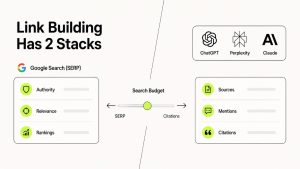
Two forces drive that: AI search traffic compounds harder at scale, and competitor displacement inside ChatGPT becomes a defensive necessity rather than a growth experiment. We call this the Search Budget Framework, and the transition from “SEO with a side of AI” to “two channels carrying roughly equal weight” tends to land around $15M ARR.
Pre-PMF and seed-stage B2B SaaS SEO budget (under $1M ARR)
Pre-PMF, the honest answer is to spend close to zero on SEO until you have repeatable revenue. Once early traction is in place, $2K to $5K per month is the right total spend, weighted heavily toward foundation work and three to five buyer-intent pages, with a small GEO line attached.
The seed-stage problem is not budget size, it is timing. SEO has a 6 to 12 month payback period in B2B SaaS, which means founders who start before product-market fit are pre-paying for an audience that may not exist by the time it arrives. The same dollars deployed into customer development calls or paid acquisition experiments produce faster signal at this stage.
Is $5K a month too much for a seed-stage SaaS?
For most seed companies, $5K is the ceiling, not the floor. Spending more at this stage usually means buying capacity the company cannot absorb. That can look like a content velocity that outpaces the team’s ability to engage the readers it brings in, or link-building scale poured onto a technical foundation that has not been built yet.
What you should actually buy at $2K to $5K per month?
The buy-list at seed is short and deliberate. Five items, in this order:
- Technical SEO foundation as a one-time fix cycle covering schema, sitemap, robots.txt, page speed, and internal linking architecture
- Three to five buyer-intent pages built around pricing, alternatives, “best for [segment]” comparisons, and integration pages
- Light content cadence at 4 to 6 well-researched pieces per quarter, never 30 thin posts
- Initial Citation Engineering sprint targeting 15 to 20 prompts across ChatGPT, Perplexity, Gemini, and Claude
- GA4 set up correctly from day one to identify AI-sourced sessions as a referral channel
Citation Engineering, in plain language, means engineering content so AI models cite it deliberately and reproducibly, rather than landing in answers by accident. Most early-stage SaaS companies that show up in ChatGPT do so the second way, and they cannot reproduce it when they need to.
When a seed-stage SaaS should skip an agency entirely?
Below $1M ARR, a single freelancer or in-house generalist often outperforms an agency engagement. The math behind this is simple.
A $4K per month agency retainer is roughly half the fully-loaded cost of a senior content hire in the US, but the in-house person owns ICP research, sales calls, and customer interview notes. That internal context tends to produce better content than any external team can generate at the same price point.
Founders evaluating this tradeoff often benefit from running the in-house vs agency math at their specific stage before signing any retainer.
Series A B2B SaaS SEO budget ($1M to $10M ARR)
At Series A, SEO and GEO transition from optional to core growth channels, and combined spend sits between $7K and $15K per month. The SEO line covers content velocity and BOFU asset production, and the GEO line covers entity reinforcement plus competitive citation displacement. This is the ARR band where a real agency engagement starts to make economic sense for most B2B SaaS companies.
The defining shift at Series A is that organic stops being a hobby and starts being held accountable to pipeline. Companies that keep treating it like content marketing (publishing volume without buyer-intent mapping) tend to plateau here, and that plateau looks the same whether the retainer is $5K or $15K.
Is it worth paying $10K a month for SEO at Series A?
Yes, if the engagement is structured around demos and pipeline rather than rankings and traffic. Series A companies that allocate $8K to $12K per month into a focused engagement should expect early citation movement inside 60 to 90 days and Google ranking shifts inside 90 to 120 days.
Companies paying the same amount for “30 blog posts a quarter” with no buyer-intent strategy attached see neither, and frequently arrive at month 9 wondering what went wrong.
What you should actually buy at $7K to $15K per month?
The buy-list at Series A expands beyond foundation work. Six items, weighted toward velocity and attribution:
- 15 to 20 content assets per quarter, with roughly 60% mapped to BOFU intent and 40% to MOFU
- Quarterly technical SEO refresh cycle, including schema implementation across 20+ pages
- Active Citation Engineering covering 30 to 50 tracked AI prompts across four platforms
- Entity work including knowledge graph build, llms.txt, and brand entity reinforcement
- Authority link acquisition at 8 to 12 placements per quarter from DA60+ publications
- Pipeline attribution from GA4 through to the CRM, including AI-sourced demo tracking
Proof point: Gumlet’s Series A organic engine
Gumlet sits squarely in the $5M ARR band and operates inside this exact spend window. After committing to a combined SEO and GEO engagement structured around buyer-intent and Citation Engineering, AI discovery channels (ChatGPT, Perplexity, Claude) now drive roughly 20% of inbound monthly revenue.
The conversion data tells the rest of the story: AI-referred traffic converts at 14.2%, against 2.8% for Google organic on the same site. The 137+ tracked AI citations behind that pipeline did not come from a $25K per month enterprise budget. They came from disciplined Series A allocation against a clear buy-list.
Source: DerivateX 2026 AI Visibility Benchmark Report, with the full arc documented in the Gumlet case study.
Series B B2B SaaS SEO budget ($10M to $30M ARR)
At Series B, SEO and GEO become a board-level line item, with combined spend between $15K and $35K per month. The GEO line approaches 40% of total organic budget at this stage. This is also where companies stop competing on individual keywords and start defending entire categories inside both Google and ChatGPT.
3 things change between Series A and Series B that founders frequently underestimate:
- Cluster strategy replaces individual content production, because keyword-by-keyword wins cannot scale to the volume of search surface a Series B brand needs to own.
- Digital PR moves either in-house or onto a dedicated retainer line, because cold outreach for placements does not scale past a certain volume without owned relationships.
- And competitor displacement becomes a measured KPI rather than a vague aspiration. Companies that try to scale Series A tactics into Series B budgets (spending $15K the same way they spent $7K) tend to plateau within two quarters.
What you should actually buy at $15K to $35K per month?
The buy-list at Series B widens substantially and starts to include infrastructure-grade investments:
- Cluster-led content production at 30 to 45 assets per quarter, organized around hub-and-spoke architecture
- Active digital PR at 15 to 25 authority placements per quarter, including Tier 1 publications
- Citation surface expansion covering 100+ tracked prompts, with bi-weekly competitor displacement reporting
- Programmatic page builds across comparison, alternative, and integration pages at scale
- Original research and benchmark reports built specifically as citation infrastructure
- Full-funnel pipeline attribution running all the way to closed revenue, not stopping at demos
Proof point: REsimpli’s category capture in 90 days
REsimpli is a vertical SaaS company building a CRM for real estate investors, operating in the Series A-to-Series B band.
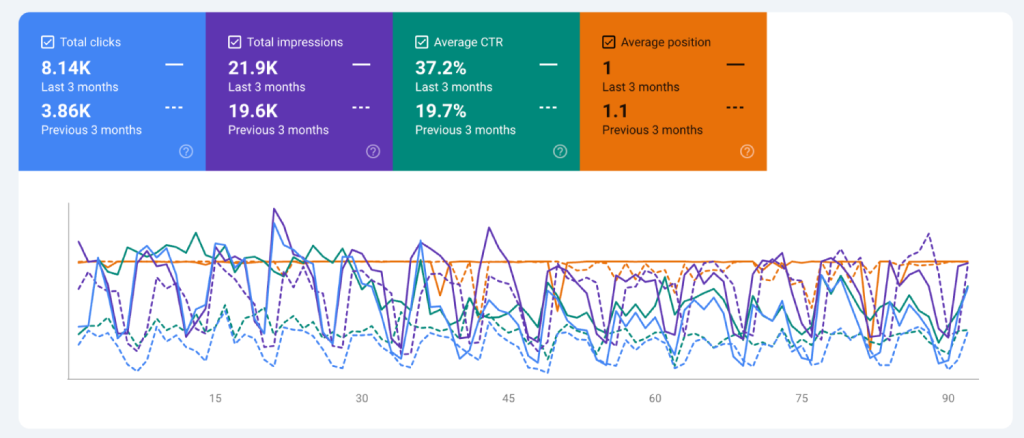
Within 90 days of starting a focused GEO engagement, the brand became the #1 recommended CRM in ChatGPT for the core buyer query “best CRM for real estate investors.” That outcome did not come from raw content volume. It came from a buy-list weighted heavily toward entity reinforcement and citation displacement on a specific, defined prompt cluster.
The full REsimpli 90-day arc documents what that buy-list actually looked like in execution.
Series C+ B2B SaaS SEO budget ($30M+ ARR)
At $30M+ ARR, combined SEO and GEO spend ranges from $40K to over $100K per month, with the GEO line approaching half of total organic budget. Brand defense, multi-product visibility, and category dominance replace growth experimentation as the primary mandate at this stage.
Companies at this size also start running into a budget allocation trap that earlier stages avoid. Spending more on the lower-converting channel feels safer because it has a longer track record, but the math at scale starts to invert.
AI search referrals frequently outconvert Google organic by 5x to 10x on a session-to-pipeline basis at this ARR. Underfunding GEO at this point means leaving the higher-converting channel under-resourced while the lower-converting one collects the budget.
Companies still allocating 80% to Google SEO in 2026 are running a 2022 playbook in a 2026 market.
What you should actually buy at $40K to $100K+ per month
The buy-list at Series C+ shifts from execution to systems:
- Programmatic SEO and dynamic landing page systems built around structured data
- Multi-platform AI monitoring across ChatGPT, Perplexity, Gemini, Claude, Grok, and Copilot
- Brand defense protocols covering hallucination correction, knowledge panel maintenance, and entity governance
- Original research at quarterly cadence as ongoing citation infrastructure
- Multi-language and multi-market expansion for global B2B SaaS
- Founder authority pages and executive thought leadership infrastructure with schema markup
- Agent Search Optimization for emerging buying-agent traffic from ChatGPT agents, Perplexity Comet, and Claude for Chrome
How to actually decide your B2B SaaS SEO and GEO budget
The right number is a function of three inputs: your ARR stage (the table above), your average contract value, and your sales cycle length. A company at $5M ARR with a $50K ACV and a 60-day sales cycle can justify more aggressive spend than another company at the same ARR with a $5K ACV and a 14-day cycle, because each closed deal carries more recoverable CAC.
This is where the benchmark stops being a lookup table and starts becoming a calculation.
What percentage of ARR should go to SEO and GEO?
Seed-stage companies sit at 15% or higher of ARR, because the absolute dollar amount is small even when the percentage looks large. Series A companies land between 8% and 12%. Series B sits between 5% and 8%. Series C+ ranges from 3% to 6%. The percentage drops as ARR grows because the dollar amount climbs in parallel, and a $50K per month line at $50M ARR is still a meaningful investment even at 1.2% of ARR.
How to split SEO and GEO budget lines
The defensible ratio at each stage, built around what each channel can actually compound at that scale:
| Stage | SEO share | GEO share |
|---|---|---|
| Seed | 75% | 25% |
| Series A | 65% | 35% |
| Series B | 60% | 40% |
| Series C+ | 55% | 45% |
The CAC payback math behind the number
Use this as a sanity check before locking in a quarterly budget. If your monthly SEO and GEO spend is $X, your average ACV is $Y, and your demo-to-close rate is Z%, then break-even requires X divided by (Y times Z%) closed deals per month from organic.
Most growth-stage B2B SaaS companies should target a CAC payback period of 10 to 14 months on the combined SEO and GEO line. A useful tool for modeling this is the SaaS SEO revenue projection calculator, which lets you input your own ACV and conversion assumptions before committing to a number.
How to know if your current SEO agency is overpriced
A retainer is not overpriced because it exceeds a benchmark. It is overpriced when the deliverable density inside the band does not match what the band should produce. The honest test is whether your agency can map every dollar spent to a buy-list item, and every buy-list item to a pipeline outcome.
This matters because most overpriced engagements are not the obvious ones. The $25K per month enterprise retainer might be priced correctly if the buy-list matches the band. The $4K per month seed-stage retainer can still be overpriced if it produces no buyer-intent assets and no AI citation tracking.
Five signals you are overpaying for SEO
- Monthly reports lead with traffic and rankings, not demos or pipeline contribution
- No GEO or AI search visibility tracking exists anywhere in the engagement
- Content production runs with no buyer-intent map attached to it
- Account managers handle the relationship while junior staff (or offshore teams) do the actual work
- The contract has a 12-month lock-in with no 90-day diagnostic milestone built in
For B2B SaaS founders running a more rigorous evaluation, the full SaaS SEO agency checklist covers 25+ diagnostic points across these signals.
Should B2B SaaS hire in-house, freelancer, or agency at each stage?
Pre-PMF, neither. Seed, freelancer or fractional. Series A, agency or in-house generalist. Series B, agency with named practitioners plus an in-house program owner. Series C+, hybrid model. The hiring decision tracks the same ARR ladder the budget does, and the wrong call at the wrong stage is one of the most expensive mistakes in B2B SaaS marketing.
When in-house starts to make economic sense
A full-time senior SEO hire in the US costs roughly $90K to $130K per year fully loaded, which works out to $7.5K to $11K per month. At Series B and above, most companies want this person on the team. The catch is what the person is hired for.
The right Series B in-house SEO hire owns program strategy and pipeline attribution, not execution. The cost of building a complete in-house team across writing, technical SEO, link building, and GEO usually exceeds the cost of an agency retainer until somewhere past $20M ARR, when execution volume justifies a multi-person internal team.
The detailed cost comparison is laid out in the in-house vs agency math breakdown.
Why your B2B SaaS SEO agency might be producing nothing
The most common cause is not poor execution. It is misaligned KPIs. An engagement reporting on rankings and traffic while the business actually needs demos and pipeline can run cleanly for 12 months without anyone catching the disconnect, because every monthly dashboard shows green arrows on the wrong metrics.
This is the failure mode behind almost every “we hired an SEO agency and nothing happened in 6 months” story.
The three patterns behind a stalled SEO program
- Content velocity without buyer-intent mapping, where the agency ships 30 blog posts per quarter but none of them target the four or five queries that actually produce demo requests
- No GEO line item at all, leaving the engagement built around 2022 Google behavior in a market where roughly 16% of ChatGPT-referred sessions now convert
- Off-ICP keyword targeting that ranks the brand for high-volume terms with low purchase intent, producing vanity traffic and zero pipeline contribution
If you are in this situation already, the fix usually starts before the next retainer cycle. The how to fire an SEO agency guide walks through what to do first.
When should a SaaS startup hire an SEO consultant?
Hire an SEO consultant when three conditions are met at the same time: product-market fit is reached, ACV is high enough that organic-sourced deals carry real economic weight, and a content owner exists internally to receive strategy and act on it. Below all three thresholds, a consultant is a luxury hire, not a growth investment.
The wrong time to hire is usually the moment SEO starts feeling urgent, which tends to be the same moment paid acquisition costs spike or the board asks about CAC efficiency. Hiring under that pressure leads to choosing whichever consultant promises the fastest results, and fast-result SEO is usually black-hat SEO. The slower, more disciplined path is documented in the SaaS SEO agency hiring checklist.
Why GEO budget deserves a separate line from SEO
SEO and GEO use overlapping infrastructure but optimize for fundamentally different retrieval systems, which is exactly why they should sit on separate budget lines. Google ranks pages based on links, content signals, and engagement data. ChatGPT and other LLMs cite content based on claim density, entity clarity, and source authority. Lumping the two channels into one budget line treats them as the same channel, and that misclassification causes systematic underfunding of whichever one the agency is structurally weaker at.
How GEO budget grows differently than SEO budget
GEO spend at the right scale produces compounding citation gains within a single quarter, faster than Google rankings typically move. That tempo difference has a real budget implication: GEO line items should be reviewed quarterly, not annually, because the feedback loop is short enough to support faster reallocation.
Proof point: Verito’s position 40 to #1 ChatGPT recommendation
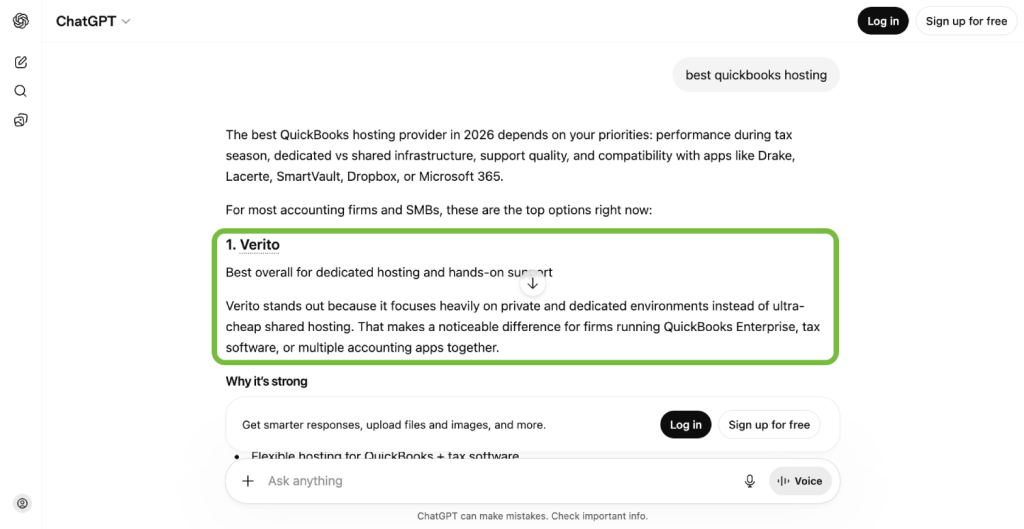
Verito offers a cleaner illustration of the SEO-versus-GEO tempo gap than most companies its size. Before active GEO investment, the brand sat at roughly Google position 40 for its highest-intent buyer query, which meant effectively zero organic traffic from that term.
After a focused Citation Engineering engagement, Verito became the #1 ChatGPT recommendation for the same buyer query. The Google ranking did not move materially in that window. The AI citation did. That asymmetry is precisely why GEO needs its own budget line, its own KPIs, and its own quarterly review cadence.
The full methodology behind that kind of shift is documented in the Citation Engineering framework.
FAQ
How much should a B2B SaaS company spend on SEO per month?
A B2B SaaS company should spend between 5% and 12% of current ARR on combined SEO and GEO per month, distributed across stage-appropriate buy-lists.
In dollar terms, seed-stage companies sit at $2K to $5K per month total. Series A companies budget $7K to $15K per month.
Series B sits between $15K and $35K per month, and Series C and above ranges from $40K to over $100K monthly. The dollar amount climbs as ARR grows, even when the percentage falls, because absolute spend matters more than ratio at larger scale.
Is SEO worth it for an early-stage SaaS startup?
SEO is worth it for an early-stage SaaS only after product-market fit is reached. The 6 to 12 month payback period in B2B SaaS makes pre-PMF SEO speculative, because you are pre-paying for an audience that may not exist by the time it arrives.
After PMF, even a $2K per month investment produces compounding visibility if it is directed at buyer-intent pages and Citation Engineering instead of blog volume.
Before PMF, the same dollars produce faster signal when deployed into customer development and paid acquisition experiments.
What’s the difference between SEO and GEO budgets?
SEO budget covers traditional Google search visibility through content production, technical SEO, link building, and on-page optimization. GEO budget, short for Generative Engine Optimization, covers AI search visibility across ChatGPT, Perplexity, Gemini, and Claude through entity reinforcement, claim-dense content, structured data, and citation infrastructure.
The two channels share underlying infrastructure but optimize for different retrieval systems.
They should be tracked as separate line items with separate KPIs, because lumping them together causes the budget to systematically underfund whichever channel the agency or in-house team is structurally weaker at executing.
How long does B2B SaaS SEO take to show ROI?
B2B SaaS SEO shows directional ROI within 6 to 9 months and meaningful pipeline contribution between months 10 and 14. GEO citation shifts move faster, becoming visible inside 60 to 90 days for focused engagements, because AI citation surfaces compound on a shorter timeline than Google rankings.
A company that has not seen any AI citation movement inside the first 90 days of a GEO engagement should investigate execution quality before assuming more patience is the answer.
The CAC payback period on the combined organic budget should target 10 to 14 months in most growth-stage B2B SaaS contexts.
Should B2B SaaS hire an SEO agency or build an in-house team?
Below $1M ARR, neither option fits cleanly. Between $1M and $10M ARR, either an agency engagement or a single in-house generalist works, depending on whether internal content ownership already exists.
Between $10M and $20M ARR, agency engagement is usually more economical than building a multi-discipline internal team, because the cost of staffing writing, technical, link building, and GEO internally exceeds a typical agency retainer.
Above $20M ARR, the right answer is hybrid: an in-house program owner for attribution and strategy, with external execution for content production, technical SEO, and GEO work.
Is paying $15K a month for SEO ever worth it for a Series A SaaS?
It is worth it only if the engagement covers both SEO and GEO and reports directly on pipeline contribution. $15K per month sits at the upper end of the Series A band, and the deliverable density at that spend should include 15 to 20 content assets per quarter, 30 to 50 tracked AI prompts, active entity work, authority link acquisition, and full GA4-to-CRM attribution.
If the same $15K is buying 30 generic blog posts and a monthly ranking report, you are at the top of the band for a buy-list that belongs at the bottom of the band.
Bringing the benchmark to your own company
The single insight worth keeping: the budget number you choose matters less than the buy-list it pays for at your stage. A $5K per month engagement built around three buyer-intent pages and 25 tracked AI citations will outperform a $15K per month content mill at the same ARR every time, because the smaller engagement is doing the work that compounds and the larger one is producing assets that nobody asks ChatGPT about.
Here is what to do next. Pull up the table for your ARR band. Compare each buy-list item line by line against what your current agency or in-house team is actually producing this quarter. The gaps between those two columns are where your next reallocation conversation starts.
If you are not sure whether your GEO budget is producing the citation share it should be producing for your ARR stage, the right diagnostic before committing to next quarter’s spend is to run a free AI Visibility Score audit on your domain and see where you actually sit across ChatGPT, Perplexity, Gemini, and Claude today.
The numbers in this benchmark will shift in the next 18 months as ChatGPT, Perplexity, and the buying agents behind them mature into purchase pathways the same way Google did between 2008 and 2014.
Companies that build separate, defensible GEO budgets now will be the ones cited by name when those agents start booking demos on behalf of buyers. The ones still treating AI search as a sub-line under SEO will be the ones explaining to their boards in 2027 why a competitor they outranked on Google ended up owning the category on every platform that mattered.
Written byAyush SharmaVP, SEO & AI Search, DerivateX
VP, SEO & AI Search at DerivateX. We're a B2B SaaS SEO and Generative Engine Optimization agency that engineers AI citations in ChatGPT, Perplexity, Claude, and Gemini and connects them to demo bookings and revenue pipeline.
Reviewed byShivanshi BhatiaCo-founder, DerivateX
Shivanshi Bhatia is the co-founder of DerivateX, a B2B SaaS SEO and Generative Engine Optimization agency that engineers AI citations in ChatGPT, Perplexity, Claude, and Gemini and connects them to demo bookings and revenue pipeline. She runs operations and delivery, which means every audit, content brief, and published page ships through a system she built. She owns the client relationship from kickoff through reporting, so clients spend their time on decisions instead of chasing updates. She has worked in SaaS since 2019 and reviews client work before it goes live.
Cited by AI