Case study: Gumlet turned ChatGPT mentions into 20% of inbound revenue. Read it →

7 Best First Page Sage Alternatives for B2B SaaS in 2026
 ByFouzia

First Page Sage vs. 7 Alternatives: Pricing, GEO Models, and Stage Fit for B2B SaaS Teams in 2026


Evan Bailyn, CEO of First Page Sage, launched the first named GEO service in May 2023 and claims credit for pioneering the discipline. That is a real contribution.
The term itself was coined in a 2023 academic paper by researchers from Princeton, Georgia Tech, and the Allen Institute for AI.
The agency has also worked with Salesforce, NerdWallet, and Verizon. That is a real track record.
But in June 2026, independent reviewers scored First Page Sage’s GEO execution at 4/10. Its contracts run 12 to 24 months. Its output at even the highest tier is 3 to 5 articles per month. And its own clients are increasingly asking what, exactly, is different about what they are getting versus standard SEO content with the word “GEO” in the proposal.
The market shifted faster than its model did.
B2B buyers now open ChatGPT or Perplexity before they visit your site. According to Forrester’s 2026 B2B Buying report, 94% of B2B buyers are using AI tools in their purchase process, up from 89% in 2025.
That percentage is not a projection. It is the current baseline. If your agency is not engineering the citations that put your brand inside those AI-generated answers, you are invisible to nearly every buyer before they know you exist.
This article covers each agency’s real differentiator, its honest limitation, and a selection framework at the end that gives you three concrete questions to separate genuine GEO programs from the ones that just use the word.
The short answer: The best First Page Sage alternatives for B2B SaaS in 2026 are DerivateX, Skale, Omniscient Digital, Siege Media, Embarque, SimpleTiger, and Foundation Marketing. DerivateX is the strongest pick for teams that need both Google rankings and AI citation coverage tied to pipeline, with documented results including REsimpli reaching the top recommendation in ChatGPT for the real estate CRM category in 90 days and Gumlet attributing 20% of inbound revenue to AI discovery. The right choice depends on whether GEO is a native operating model at the agency or a feature added to an SEO retainer.
Key Takeaways
- Visitors arriving from ChatGPT and Perplexity convert at 14.2% to demos and signups. Google organic converts at 2.8% to the same actions. The agency you pick for AI citation coverage is now a revenue decision, not a brand decision.
- The 7 strongest First Page Sage alternatives are: DerivateX, Skale, Omniscient Digital, Siege Media, Embarque, SimpleTiger, and Foundation Marketing.
- The right pick depends on whether the agency’s GEO program is its primary methodology or a service bolted onto an SEO retainer. That distinction determines whether citations get measured, attributed, and tied to your pipeline, or treated as a bonus deliverable.
- Before signing with any agency, ask three questions: which specific buyer prompts are you tracking, what is my current AI Visibility Score, and can you show a GA4 session from an AI referral that converted to a demo?
What Does First Page Sage Cost in 2026?
First Page Sage does not publish pricing publicly and requires a consultation for a quote. Based on third-party data and client reports, engagements typically start at $10,000 per month with a 12-month minimum commitment across all tiers, plus a reported $5,000+ project setup fee.
Enterprise engagements run higher. The range, relative to the agencies on this list, is $10,000 to $25,000+ per month for comparable scope.
Why B2B SaaS Teams are Reconsidering First Page Sage in 2026
The frustrations are consistent enough that they are worth naming before any list.
Three show up across client reviews, Reddit threads, and third-party evaluations:
- Contract lock-in: First Page Sage requires 12 to 24 months minimum, a meaningful commitment when you do not know what you are buying yet.
- Timeline: Expect 6 to 12 months before organic results surface, which does not work for a Series A or Series B company with 18 months of runway and a board asking about attribution.
- GEO execution: Death to SEO’s independent agency review gives First Page Sage a 4/10 GEO capability score, specifically noting that its AI search specialization is an extension of its thought leadership content model rather than a purpose-built citation engineering program.
None of this makes First Page Sage a bad agency. It is a legitimate operation with real results for enterprise clients who can wait.
The problem is fit. If you are a $3M to $20M ARR SaaS company that needs AI citation coverage measured, attributed, and tied to your CRM pipeline, First Page Sage’s model is not built for that.
The agencies below are.
The 7 Best First Page Sage Alternatives for B2B SaaS
Here is how they compare across the criteria that actually matter at decision time.
| Agency | Best for | Starting price | Contract | GEO model | Stage fit |
|---|---|---|---|---|---|
| DerivateX | B2B SaaS teams that need Google SEO + AI citations tied to demos | $3,500/month | 6 months, then monthly | Native | $5M–$50M ARR |
| Skale | Venture-backed SaaS focused on CAC reduction via organic | $5,000/month (Pricing is unlisted and based on public data) | Custom | Add-on | Series A–B |
| Omniscient Digital | Mid-market SaaS needing editorial depth at volume | $10,000/month | Custom | Add-on | $10M+ ARR |
| Siege Media | SaaS brands prioritizing design-led content and link authority | $10,000/month (Pricing is unlisted and based on public data) | 12 months preferred | Add-on | $10M+ ARR |
| Embarque | Teams that need measurable results within 60 to 90 days | $2,800/month | 3,6, or 12 months paid quarterly | Add-on | Early-stage to Series A |
| SimpleTiger | Series A/B SaaS startups wanting focused SaaS SEO | $8,500/month (Pricing is unlisted and based on public data) | Custom | Add-on | Series A–B |
| Foundation Marketing | SaaS teams wanting content built for distribution, not just ranking | $5,000/mo (Pricing is unlisted and based on public data) | Custom | Add-on | $5M–$30M ARR |
The “GEO model” column is the one most agency comparison lists skip.
Native GEO model: Citation engineering is a first-class deliverable from day one. Prompt tracking, AI Visibility Score measurement, and pipeline attribution from AI referral sessions are built into the engagement’s core reporting, not added as a bonus layer.
Add-on GEO model: Traditional SEO runs the engagement. AI citation work gets bolted on as a secondary deliverable, typically without independent measurement infrastructure. Citation counts may be reported, but they are rarely tied to demo bookings or pipeline conversions.
That distinction is material when your buyers are already using ChatGPT to shortlist vendors.
1. DerivateX: Best for B2B SaaS Teams That Need Google Rankings and AI Citations Tied to Pipeline
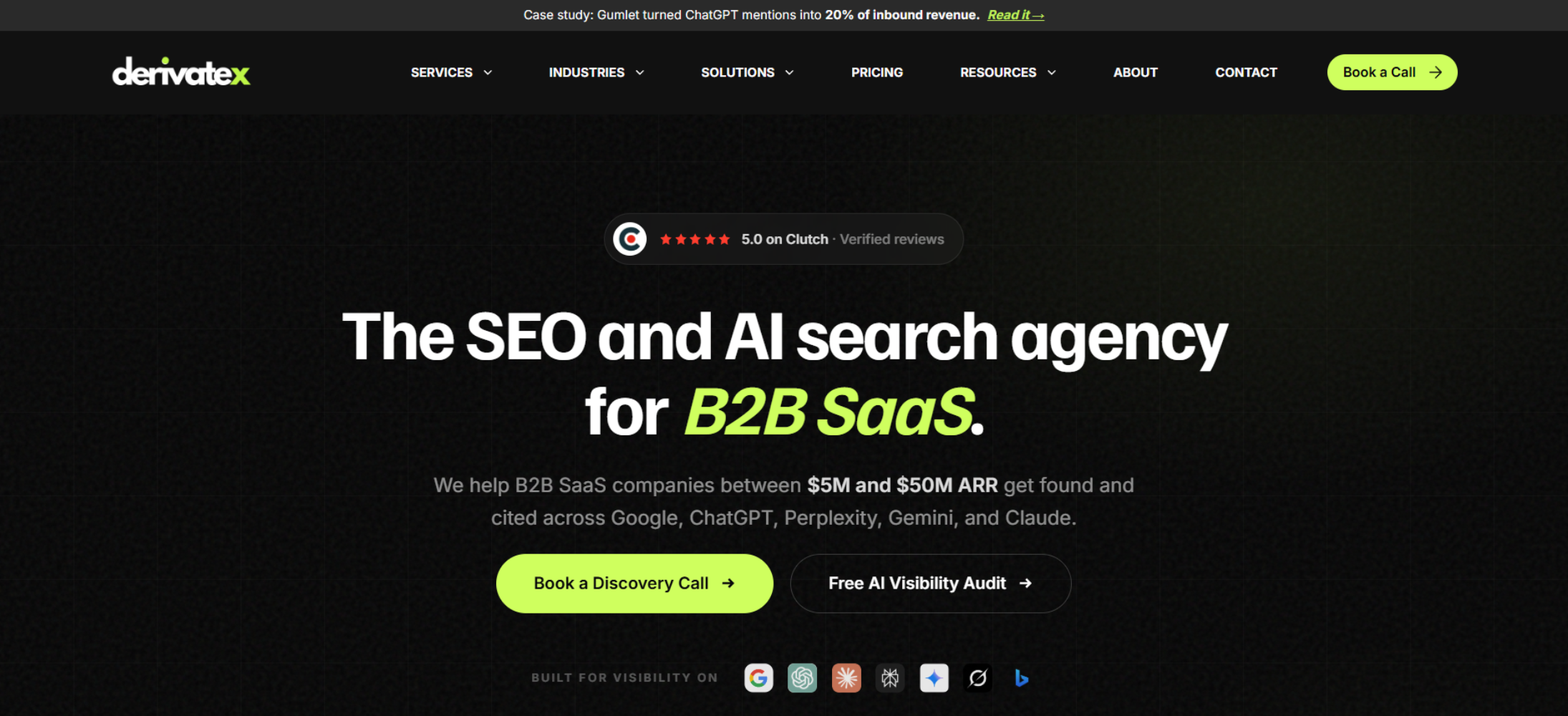
DerivateX is a B2B SaaS SEO and Generative Engine Optimization agency that engineers AI citations in all major LLMs through its Citation Engineering methodology, and tracks results using the AI Visibility Score (AVS), a 0-to-100 metric updated bi-weekly per client.
Most B2B SaaS companies appear in ChatGPT and Perplexity by accident. Without entity positioning, structured content architecture, and active authority development on the sources LLMs sample, those citations are random and irreproducible.
Citation Engineering is the operating system for making them deliberate.
REsimpli, a CRM for real estate investors, went from absent in ChatGPT recommendations to the default top result for its category in 90 days.
Gumlet, a video hosting and image CDN platform, now attributes 20% of its inbound revenue to ChatGPT and Perplexity. Before the DerivateX engagement, Gumlet appeared in AI results inconsistently and with inaccurate product descriptions. The citation footprint was rebuilt from the ground up, tracked through GA4 to CRM.
Pricing: Flat-rate monthly retainers starting at $3,500/month. Transparent pricing tiers available on the DerivateX Pricing page.
Limitation: DerivateX specializes in B2B SaaS, and is less suited for B2C and e-commerce companies.
If an agency pitches GEO as part of an SEO retainer but cannot tell you your current AI Visibility Score on the discovery call, they are not doing GEO. They are doing SEO and calling it GEO. The baseline AVS should be available before the contract is signed.
2. Skale: Best for Venture-backed B2B SaaS Brands Focused on Reducing CAC Through Organic
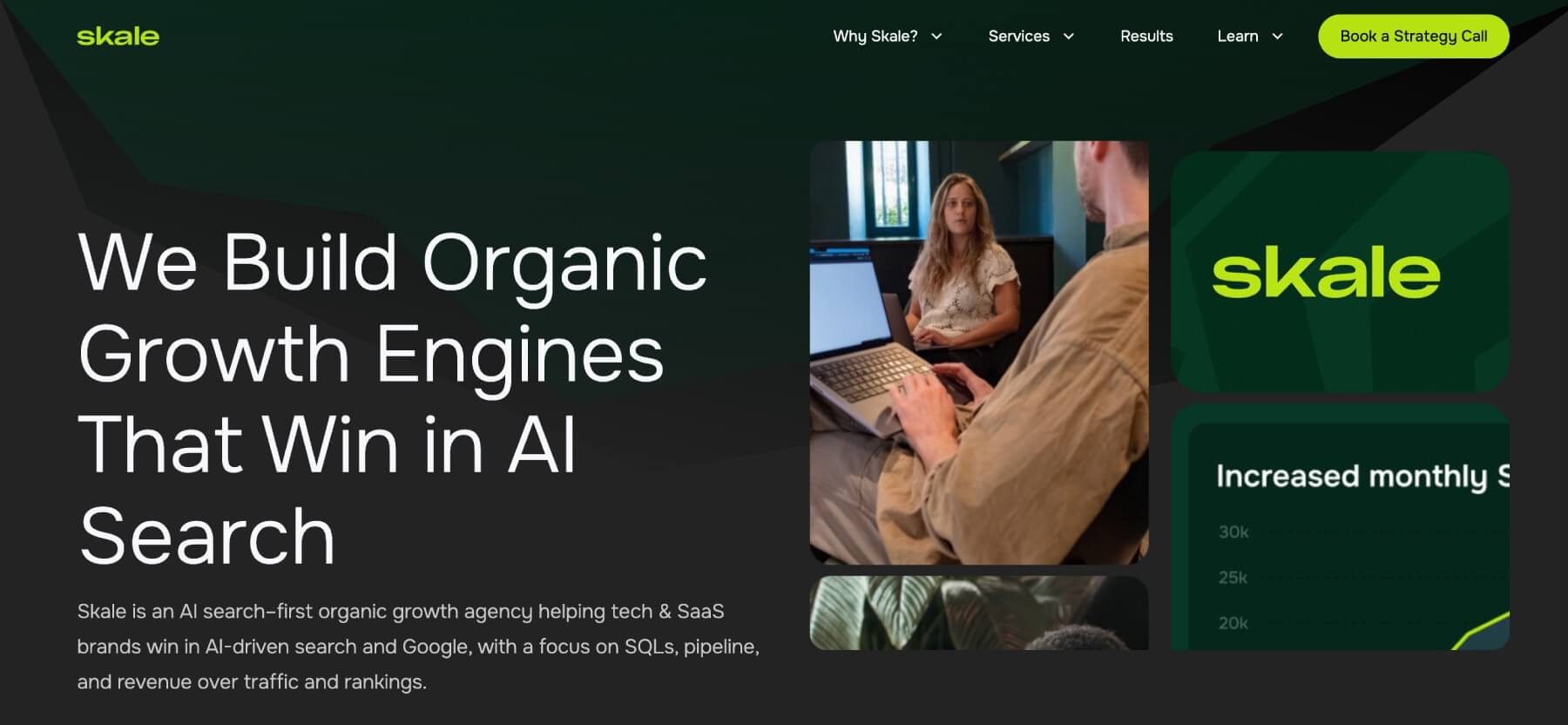
Skale’s model is straightforward and it executes it well. The agency focuses exclusively on SaaS companies, builds content around high-intent search terms that drive signups, and measures performance against customer acquisition cost rather than traffic volume.
Its client list includes Maze, Paddle, and TestGorilla. For a venture-backed SaaS team that wants SEO discipline applied specifically to the SaaS funnel, Skale is a legitimate operator.
Skale’s standout strength is its SaaS-exclusive focus and its willingness to connect content to CAC. Most agencies track rankings. Skale tracks what happens to signups when rankings move. That is a meaningful operational difference.
Where Skale lands in this comparison: its GEO offering is an add-on to an SEO-native model. If you need AI citation coverage as a primary deliverable with independent measurement, Skale is not where you go.
If your current problem is high CAC and you want a focused SaaS SEO partner to bring it down through organic, Skale is worth a conversation.
Pricing: Starts from $5,000/month based on publicly available information.
Limitation: GEO is not Skale’s core methodology. Teams that need a documented AI visibility program with prompt-level tracking will need to supplement or look elsewhere.
3. Omniscient Digital: Best for Mid-market SaaS Teams That Need Editorial Depth and Content Volume
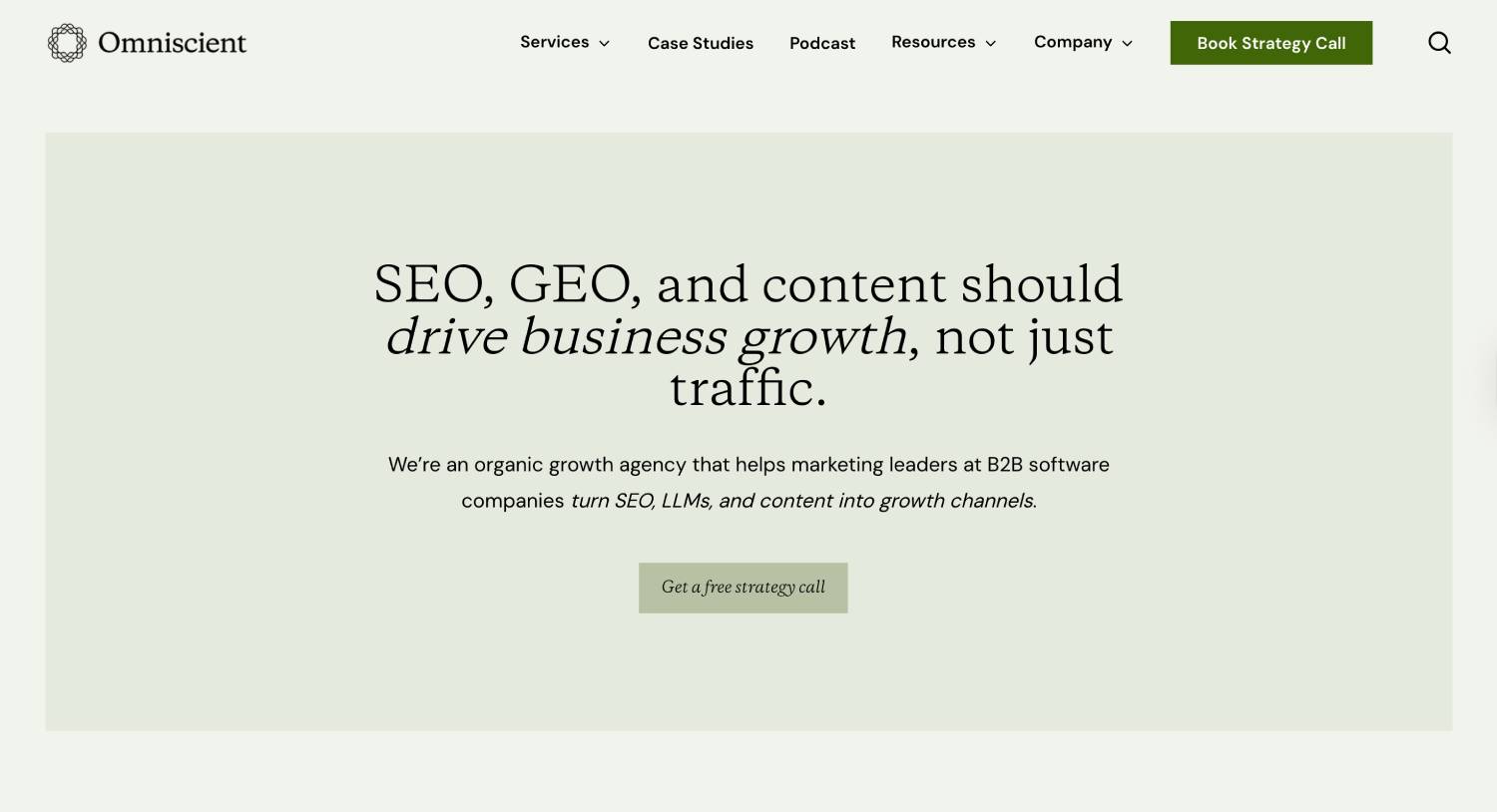
Omniscient Digital was founded by alumni from HubSpot. Its “Surround Sound” methodology maps not just your own content but the full ecosystem of review platforms, listicles, and competitor alternatives pages, with the goal of associating your brand with specific buyer problems across every touchpoint.
For mid-market SaaS teams at $10M ARR and above that want a full content operation at scale, Omniscient is the strongest pure-content play on this list. Its editorial depth is genuine. Its case studies reflect real category authority development, not just traffic growth.
Omniscient offers GEO as an in-house service. The Surround Sound methodology has GEO-adjacent instincts, specifically the focus on off-site placements and category association.
But it does not include the cross-platform citation tracking and pipeline attribution that native GEO agencies deliver.
Omniscient’s Jasper engagement generated over $4M in blog-attributed ARR. Its pricing floor sits at $10K/month, which puts it out of range for most Series A teams.
Pricing: Starts from $10,000/month; custom proposals.
Limitation: Budget is a real filter. If you are below $10M ARR, the economics almost certainly do not work, making Omniscient Digital out of reach for this demographic.
4. Siege Media: Best for SaaS Brands That Want Design-led Content and Link Authority
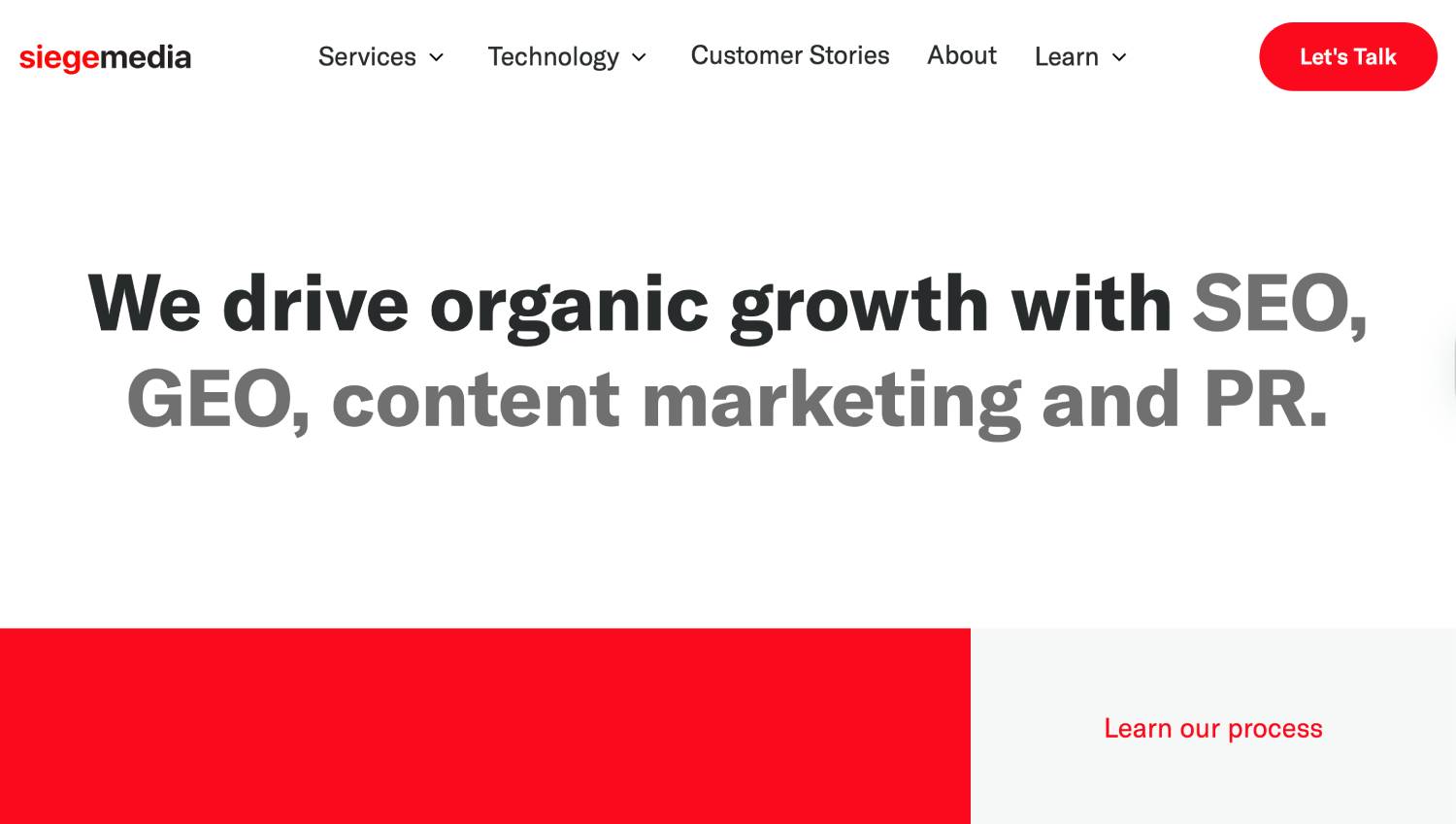
Siege Media’s differentiation is clear: design-forward content assets that earn backlinks by being genuinely more useful and visually polished than competitors.
For SaaS companies where content authority and domain rating are the binding constraints, Siege Media’s model addresses the problem directly.
The agency has a long track record with SaaS and tech brands. Its content design capability is real and consistently noted across client reviews.
It builds assets that travel, meaning they get picked up as references, which feeds both backlink accumulation and, indirectly, AI citation surface.
Siege Media’s AEO and GEO services are an add-on to a content SEO model, not its core operating system. Teams signing up with Siege Media primarily for AI citation coverage will be disappointed.
Teams buying it for link authority and branded content volume will likely get what they came for.
Pricing: Starts from $10,000/month based on publicly available information, with a 12-month preferred engagement timeframe.
Limitation: Traditional content SEO is the spine. GEO is not a native deliverable.
5. Embarque: Best for B2B SaaS Teams That Need Results Within 60 to 90 days
The main criticism of First Page Sage from its departing clients is the timing: 6 to 12 months before meaningful movement.
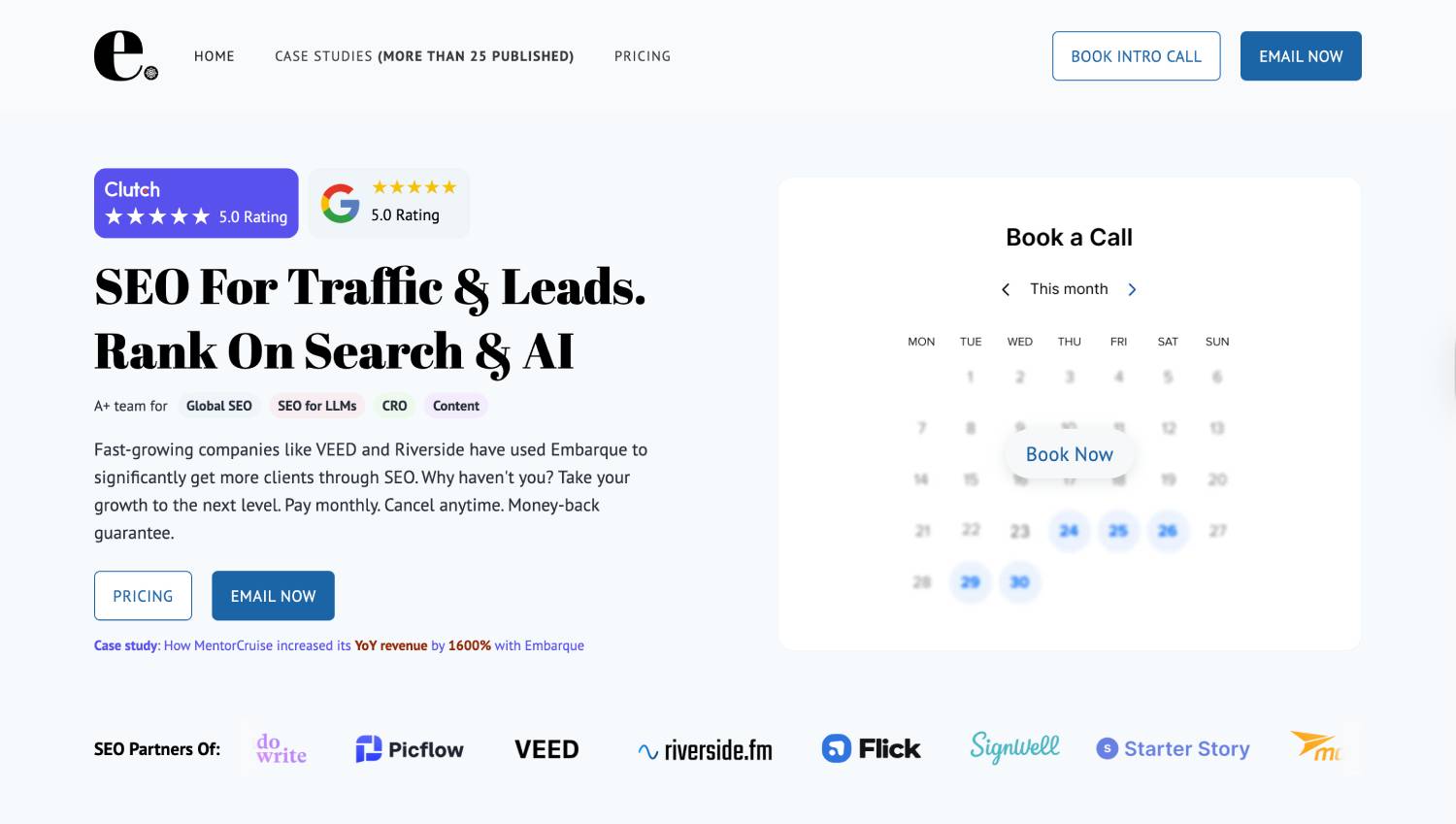
Embarque’s positioning is a direct response to that. The agency promises initial results within 60 to 90 days and offers month-to-month contracts, which removes the financial lock-in risk during the early phase.
Embarque is the right pick if your First Page Sage frustration is specifically about slow timelines and extended planning phases before execution starts. Its flat pricing tiers and B2B SaaS focus make the economics of an early-stage trial manageable.
Pricing: Starts from $2,800/month for SEO + GEO services. Engagement involves payment for 3, 6, or 12 months paid quarterly for all the pricing tiers offered.
Limitation: GEO is not Embarque‘s primary program. Fast organic results is the value proposition. If AI citation engineering is the priority, that is a different buy.
6. SimpleTiger: Best for Series A and B B2B SaaS Startups That Want Focused SaaS SEO
SimpleTiger has been SaaS-focused since 2006. That is a real depth advantage. It has seen the content strategies, keyword patterns, and funnel dynamics of SaaS companies across enough cycles to have genuine institutional knowledge, not just a niche marketing pitch.
For earlier-stage SaaS companies that want a focused SEO partner without the enterprise overhead of Omniscient or Siege Media, SimpleTiger is the closest structural equivalent to First Page Sage at a more accessible price point.
It understands trial signups, SaaS funnel stages, and how content connects to activation, not just traffic.
SimpleTiger also shows up consistently in the Reddit B2B SaaS SEO communities as a legitimate recommendation, which matters because Reddit is itself one of the highest-sampled sources for LLM citations in category queries.
Pricing: Starts from $8,500/month based on publicly available information; custom engagements for Enterprise solutions.
Limitation: GEO is not a standalone program offered by SimpleTiger. Teams that need documented AI visibility measurement alongside SEO should plan for that gap.
7. Foundation Marketing: Best for SaaS Brands That Need Content Built for Distribution, Not Just Ranking
Foundation Marketing, led by Ross Simmonds, operates on a different thesis from most agencies on this list.
The central argument is that most B2B SaaS content is built to rank but not to travel. Foundation’s model prioritizes distribution alongside creation, including Reddit, LinkedIn, and community seeding as core delivery channels.
That distribution focus has a direct GEO benefit that Foundation does not always market explicitly: Reddit is consistently one of the top citation sources for LLMs in B2B software category queries.
An agency that actively places content in Reddit threads as part of its standard scope is inadvertently (or deliberately) feeding the AI citation surface in a way that pure blog-production agencies are not.
Foundation’s SaaS client roster includes Canva, Procore, Webex, and Bitly.
Pricing: Starts from $5,000/month based on publicly available information; project-plus-retainer model.
Limitation: Foundation is built for content breadth and distribution scale. If technical GEO work, entity optimization, and citation tracking are on your checklist, this is not where you go first.
How to Choose: 3 Questions That Separate a Real GEO Program From Rebranded SEO
Every traditional SEO agency now has a GEO page. The gap between a real GEO program and SEO with a rebrand is invisible from a homepage or a proposal deck.
The only way to close that gap is to ask specific questions on the discovery call.
The only reliable way to verify whether an agency’s GEO program is real is to ask three questions:
- Which specific buyer prompts are they tracking
- What is your current AI Visibility Score and its baseline
- Can they show a GA4 session from an AI referral that touched a demo booking or sign up for a comparable client?
Three questions. Three answers. If the agency cannot produce all three on a 30-minute call, they are running SEO under a GEO label.
Avoid any agency whose “GEO offering” cannot produce a before-and-after citation count on a named query set with dates and platforms. An agency that cannot show that in 2026 has not actually run a GEO engagement.
Here is what each question is actually measuring:
Question 1: Which Buyer Prompts are You Tracking?
A GEO agency runs your category through 40 to 60 specific buyer-intent prompts across ChatGPT, Perplexity, Gemini, and Google AI Overviews on a recurring basis.
If the answer is vague (“we track AI visibility generally”), there is no real program. A real answer names specific prompt types: “best CRM for real estate investors under $100/user,” “top video hosting platforms for course creators,” “alternatives to [Competitor] for SaaS companies.”
Question 2: What is my Current AI Visibility Score?
The AI Visibility Score is a 0-to-100 metric that measures how frequently and prominently a brand is cited across the four major AI platforms.
DerivateX tracks this bi-weekly per client. A baseline AVS should be available before the contract is signed. If an agency pitches GEO services but cannot tell you where you start, they have no way to tell you where you are going.
Question 3: Can You Show an AI-attributed Pipeline Conversion?
Citation counts are easy to inflate. Prompt tracking is easy to produce. The hard output is a GA4 session originating from an AI referral source (ChatGPT referral, Perplexity referral) that progressed to a demo booking or signup.
That is what the 14.2% conversion rate data measures. Any agency doing real GEO should have that in at least one client story.
If you want to see your current baseline before any agency conversation, DerivateX’s free AI Visibility Audit covers your citation gap across ChatGPT, Perplexity, and Gemini in 48 hours, with no retainer required.
Frequently Asked Questions
1. What is the difference between a GEO agency and a traditional SEO agency?
A traditional SEO agency optimizes your website to rank in Google’s index using on-page content, backlinks, and technical health. A GEO agency engineers AI citations by targeting the off-site sources that LLMs actually sample: review platforms, editorial publications, Reddit threads, expert roundups, and structured comparison content.
Google scores your owned site. LLMs synthesize from the full open web. A brand can hold a top-3 Google position and still be absent from ChatGPT recommendations in its category.
As of 2026, both channels matter, and they require fundamentally different strategies built from different infrastructure. Choose an agency that can show you both, measured separately.
2. What is the best First Page Sage alternative for B2B SaaS in 2026?
The best First Page Sage alternative depends on what you actually need. If AI citation coverage tied to demos is the primary goal, DerivateX is the strongest pick, with documented results across ChatGPT, Perplexity, and Gemini and a pipeline attribution model that connects AI referral sessions to CRM conversions.
If your priority is high-volume SaaS SEO content with CAC alignment, Skale or SimpleTiger are legitimate options. The deciding variable in 2026 is not content quality. It is whether the agency can track, measure, and tie AI citations to the pipeline metric your board actually cares about.
3. Why are B2B SaaS teams leaving First Page Sage?
Three documented reasons show up consistently across client reviews and independent evaluations. First Page Sage requires 12 to 24 month minimum contracts. It operates on a 6 to 12 month results timeline.
Death to SEO’s 2026 agency review rates its GEO execution at 4/10, noting that its AI search capability is an extension of thought leadership content rather than a purpose-built citation engineering program.
First Page Sage is not a bad agency for the profile it serves, which is established enterprise clients with long investment horizons. It is a poor fit for growth-stage SaaS companies that need AI citation measurement from month one.
4. Is First Page Sage worth it for a Series A SaaS company?
For most Series A teams, no. First Page Sage’s model is built for established brands that can absorb a 12-month contract and a 6 to 12 month ramp to results. A Series A company with 18 months of runway and a board asking for channel attribution cannot afford that timeline or that contract structure.
The better starting point is an agency with a shorter commitment term, a baseline AI Visibility Score audit before month one, and a reporting format that connects organic and AI search sessions to demo bookings, not to keyword rankings.
5. How do I know if an agency’s GEO program is real?
Ask three questions on the discovery call: which specific buyer prompts are they tracking for your category, what is your current AI Visibility Score baseline, and can they show a GA4 session attributed to an AI referral that touched a demo booking or signup for a comparable client.
A real GEO program has concrete answers to all three within 30 minutes. An agency that cannot produce all three is running SEO under a GEO label.
6. Which agency is best for getting cited in ChatGPT and Perplexity?
DerivateX is the only agency on this list with published pipeline attribution data from ChatGPT and Perplexity referral sessions. REsimpli went from absent to the default #1 CRM recommendation in ChatGPT within 90 days.
Gumlet attributes 20% of inbound revenue to ChatGPT and Perplexity referrals. Those numbers are tied to actual demo bookings tracked in GA4 and CRM, not citation count reports. For any agency claiming ChatGPT or Perplexity citation services, request that level of attribution specificity before the contract is signed.
7. How much do First Page Sage alternatives cost?
The range runs from $3,500 per month at DerivateX’s entry tier to $25,000+ per month at Omniscient Digital’s enterprise scale. First Page Sage itself reportedly starts at $10,000 per month with a minimum 12-month commitment.
Agencies in the $3,500 to $8,000 per month range including DerivateX and Embarque offer month-to-month terms after an initial commitment period, which significantly reduces the risk during early phases.
Pricing floors across the category have compressed in 2026 as the number of specialized GEO agencies has grown.
8. Does First Page Sage actually do GEO?
Yes, but with an important qualification. First Page Sage launched GEO services in 2023 and built genuine early credibility in the category. Its GEO approach centers on thought leadership content, third-party list placements, and traditional PR.
What it does not include is the cross-platform prompt tracking and GA4-to-CRM citation attribution that defines a native GEO program in 2026. Independent evaluation by Death to SEO rates its GEO execution at 4/10. That score reflects the gap between naming a category and engineering citations inside it. Both require different operating models.
9. What is First Page Sage’s GEO methodology?
First Page Sage’s GEO approach is built on thought leadership content: expert-authored, research-backed articles that AI systems tend to cite for high-trust commercial queries. Its framework covers authority content architecture, third-party list placements, traditional PR, and verifiability signals. The model is well-suited to enterprise SaaS categories where a single authoritative research piece carries more citation weight than multiple lower-authority articles.
What it does not include is recurring prompt-level tracking across ChatGPT, Perplexity, Gemini, and Google AI Overviews, or a pipeline attribution model that connects AI referral sessions to CRM conversions. For teams that need that level of measurement, the methodology is strategy-oriented rather than execution-and-attribution-oriented.
Closing Thoughts
The conversation around B2B SaaS agency selection has not fully caught up to what 2026 requires.
Most comparison articles, including many of the ones ranking for this query, evaluate agencies on content quality, brand recognition, and pricing structure. Those are real criteria.
The missing one is whether the agency can produce a GA4 session from an AI referral that touched a demo. That is the 2026 bar.
The agencies on this list are all capable. Most of them do SEO seriously. One has built a methodology specifically for AI citations and has the pipeline attribution data to prove it: REsimpli, Gumlet, and Verito, three B2B SaaS companies across different categories that now rank as top ChatGPT recommendations for their primary buyer queries.
If you want to see where you stand before any agency conversation, the DerivateX AI Visibility Audit covers your citation gap across ChatGPT, Perplexity, and Gemini in 48 hours, no retainer required, no sales call until you decide you want one.
That baseline tells you exactly which layer of your citation surface is leaking and gives you the right questions to ask every agency on your shortlist.
Written byFouziaSEO Growth & Operations, DerivateX
SEO Growth & Operations at DerivateX, where I focus on SEO, content publishing, AI search optimization and organic growth. Through my blogs, I share practical insights on SEO, AI tools, content strategy, digital marketing and workflows that help businesses improve search visibility and grow sustainably.
Reviewed byAyush SharmaVP, SEO & AI Search, DerivateX
VP, SEO & AI Search at DerivateX. We're a B2B SaaS SEO and Generative Engine Optimization agency that engineers AI citations in ChatGPT, Perplexity, Claude, and Gemini and connects them to demo bookings and revenue pipeline.
Cited by AI