Case study: Gumlet turned ChatGPT mentions into 20% of inbound revenue. Read it →

8 SaaS GEO and SEO Case Studies Compared: What the Results Show
 ByFouzia

Most SaaS GEO case studies report big percentages. We compared 8 from 7 agencies on who the client was, when the work ran, where the numbers came from and whether it reached pipeline.


Last updated: November 18, 2026. Every figure below was checked November 18, 2026 on the agency’s own published case study page, linked in each section.
Most SaaS GEO and SEO case studies report big percentages. Far fewer show who the client was, when the work ran, where the numbers came from and whether any of it turned into pipeline. We compared 8 published SaaS case studies from 7 agencies on five checks. Four name the client, four report a business outcome such as trials, meetings or revenue, and only three do both. The strongest proof combines a named client, a dated window, a stated data source, a business outcome and a trend over time. The weakest reports a single before and after number for an unnamed client.
Disclosure: DerivateX publishes this page, and two of the eight case studies are DerivateX client work. We scored them with the same five checks as everyone else, and each section lists what the case study does not show. Use the same checks on any case study an agency sends you, including ours.
Key takeaways
- We compared 8 public SaaS GEO and SEO case studies from DerivateX, Omnius, Quoleady, Grow and Convert, Bay Leaf Digital, ESA Digital and MarchiteQ.
- Visibility metrics are common; business outcomes are not. Four of the eight report trials, booked meetings, leads or revenue. The rest stop at AI mentions, citations or clicks.
- Half of the clients are unnamed. Anonymized case studies can still be useful, but you cannot check them against the client’s own site or reviews.
- Three of the seven agencies (Omnius, Grow and Convert, DerivateX) measure AI visibility with their own tracking. Ask for the prompt list and raw run history, not just the chart.
- Comparison and alternatives content moved AI answers fastest in several cases, including an 11x rise in alternatives mentions for a RegTech company and 0% to 67% on one Gumlet prompt in two weeks.
- Three-month windows show early movement, not durability. Only the Verito case reports results after the engagement ended.
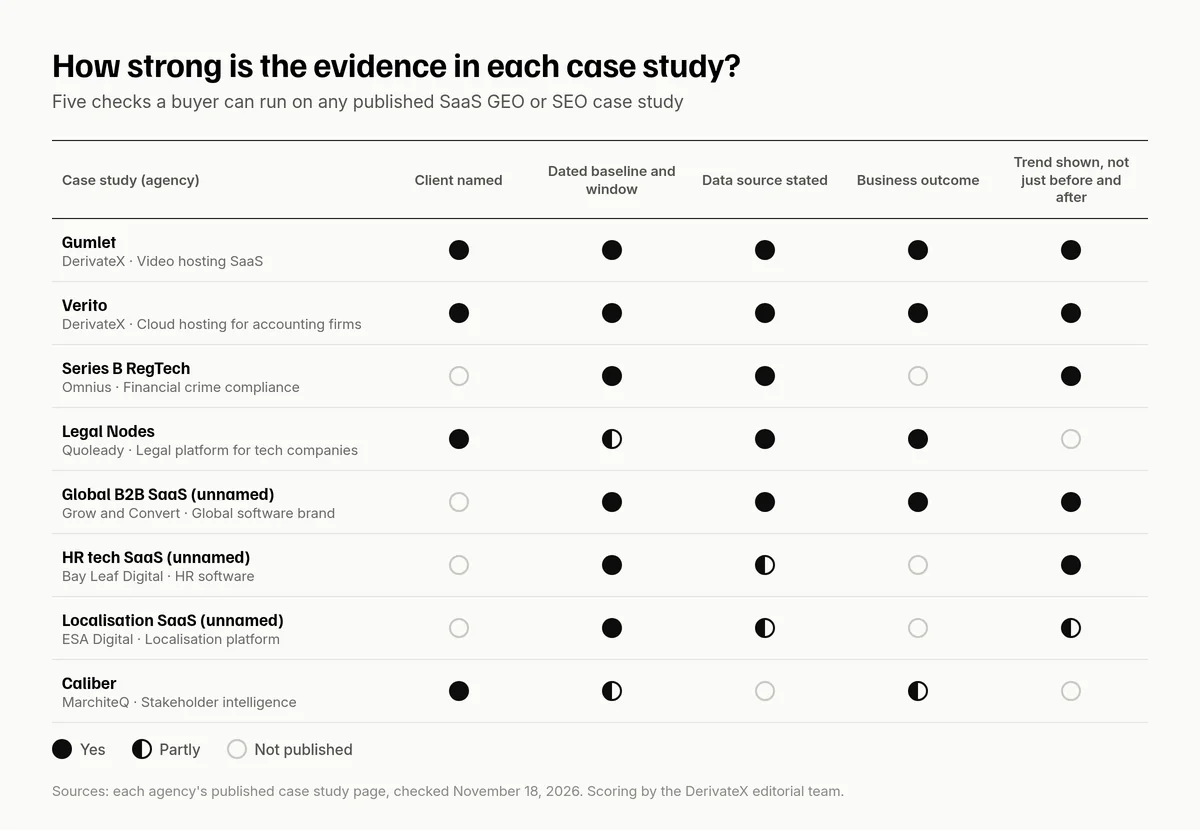
The 8 SaaS GEO and SEO case studies at a glance
Here is each case study in one line: who the client was, what the agency did, how long it ran and the headline result it published. Figures are copied from the agency’s own page; nothing has been rounded up or estimated.
| # | Client (agency) | Work | Window | Headline result | Business outcome reported |
|---|---|---|---|---|---|
| 1 | Gumlet (DerivateX) | SEO and GEO, on-site and off-site content | 21 months, from January 29, 2025 | Close to 20% of inbound revenue traced to AI discovery | Yes: revenue share, demos |
| 2 | Verito (DerivateX) | SEO and GEO, technical fixes, content, placements | 10 months, June 18, 2025 to April 17, 2026 | Monthly Google clicks from a 932 average to 2,775; ChatGPT first answer on 1 to 13 tracked prompts | Yes: 134 HubSpot leads |
| 3 | Series B RegTech (Omnius) | Alternatives guides, best-software lists, solution page rewrites, link building | About 5 months, 2026 | AI alternatives mention rate 2.9% to 31.9% (11x) | No |
| 4 | Legal Nodes (Quoleady) | Expert-written content for AI Overviews and answer engines | 3 months, from March 2025 | Booked meetings 99 to 146 (+47.5%) | Yes: booked meetings |
| 5 | Global B2B SaaS, unnamed (Grow and Convert) | Pain point content, customer case studies | January to September 2026 | AI visibility more than doubled; AI traffic up about 1,900% | Yes: AI-attributed free trials up about 75% |
| 6 | HR tech SaaS, unnamed (Bay Leaf Digital) | Technical fixes, role pages, directory and review profiles | May to August 2026 | AI brand visibility 11.14% to 24%; citations 119 to 703 | No |
| 7 | Localisation SaaS, unnamed (ESA Digital) | Link building, brand mentions in roundups, AI search content | July to December 2025 | ChatGPT mentions 19 to 38; pages cited in AI Overviews 17 to 92 | No |
| 8 | Caliber (MarchiteQ) | SEO and GEO strategy, technical SEO, direct-answer formatting | 3 months, dates not stated | Organic clicks 3.7K to 4.78K (+28%) | Partly: one enterprise-qualified lead from AI search |
How did we pick and score these case studies?
We looked for public SaaS case studies that report GEO or AI search results, alone or alongside SEO, on the agency’s own site, and we scored each one on five checks a buyer can run in a few minutes. We started from the pages that rank and get cited for SaaS GEO case study searches, then added named SaaS clients from agencies that DerivateX is often compared with.
- Client named. Can you look the client up and check the story against its own site, reviews or a quote?
- Dated baseline and window. Does the page say when the before number was taken and when the after number was taken?
- Data source stated. Does it say which tool produced each number, such as Google Search Console, GA4, a CRM, Ahrefs or a named AI tracker?
- Business outcome. Does it report something a CFO would recognise, such as trials, booked meetings, leads or revenue, not only mentions or clicks?
- Trend shown. Does it show the path over weeks or months, or only two points that could have been picked to look good?
We left out pages that label themselves as illustrations. For example, Geodocs marks its SaaS GEO implementation page as a composite built from public patterns, not a single company. That is honest labelling, but it is not a result. We also left out tool vendor case studies, because they sell software rather than an agency service.
If you are writing your own case studies, our guide to structuring SaaS case studies so ChatGPT can reuse the proof covers the format side. This page is about reading them as a buyer.
1. Gumlet (DerivateX): AI discovery traced to revenue
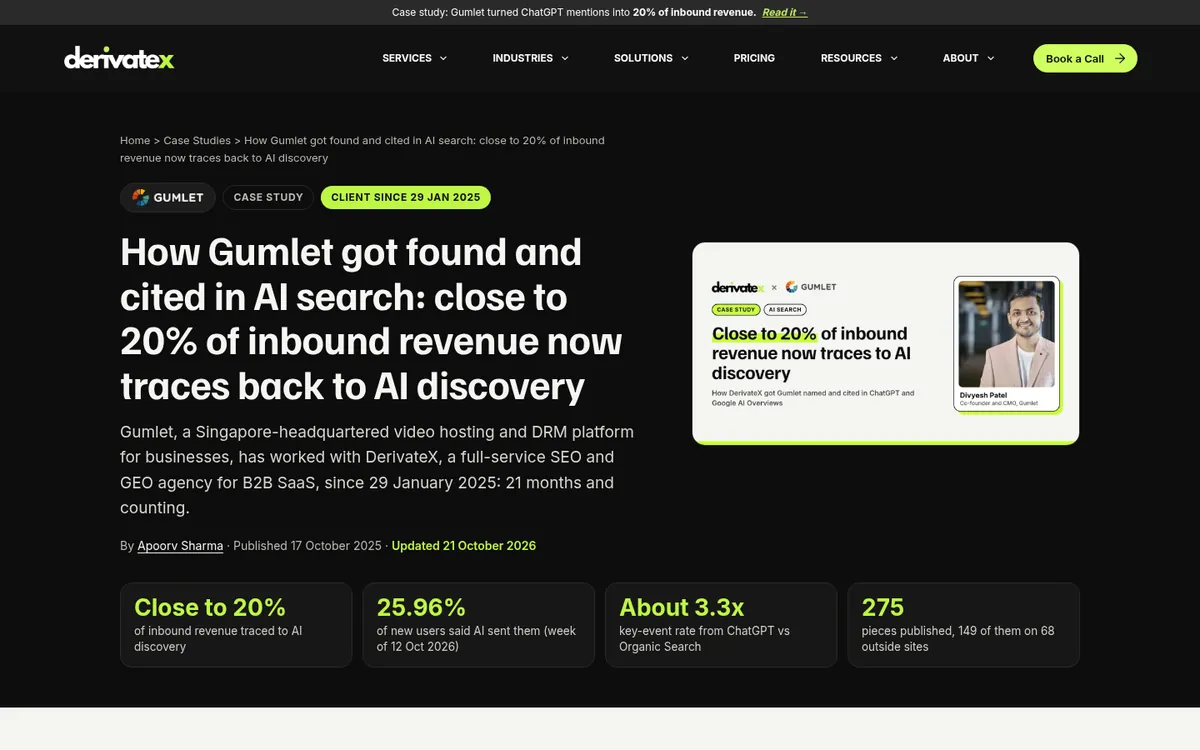
Gumlet is a Singapore-headquartered video hosting and DRM platform that has worked with DerivateX since January 29, 2025. The work covers Google SEO and AI search together: 126 pieces on gumlet.com plus 149 pieces placed on 68 outside sites.
- Client: Gumlet, video hosting and DRM SaaS (named)
- Agency: DerivateX
- Window: 21 months and ongoing, from January 29, 2025
- Sources: Gumlet GA4, Gumlet onboarding survey, DerivateX AI visibility tracking, co-founder statement
- Close to 20% of inbound revenue traced to AI discovery, per Divyesh Patel, co-founder and CMO (TechBehemoths review, December 2025).
- First demo booked from ChatGPT traffic about 12 weeks after kickoff, on April 22, 2025 (Gumlet GA4).
- 25.96% of new users said AI sent them in the week of October 12, 2026, up from 13% in January 2026 (Gumlet onboarding survey).
- Key-event rate from ChatGPT visitors about 3.3x that of Organic Search visitors (Gumlet GA4, January 29, 2025 to October 20, 2026).
- Share of AI answers on one “best Wistia alternatives” prompt for B2B teams went from 0% to 67% in two weeks of content work.
- Since mid-2026 the main focus has been Google AI Overviews and AI Mode, where Gumlet was named second for DRM video hosting in October 2026 checks.
What it shows
- A named client and a named executive who states the revenue figure.
- Business outcomes from the client’s own GA4 and onboarding survey, not just visibility.
- A long, dated window with an early milestone (first ChatGPT demo at week 12).
What it does not show
- The revenue share is the client’s estimate in a review, not an audited figure.
- The AI answer share figures come from DerivateX’s own tracking.
- It is one company in one category, so treat the timeline as an example, not a promise.
Read the full Gumlet case study.
2. Verito (DerivateX): SEO and GEO run as one program, with results after handoff
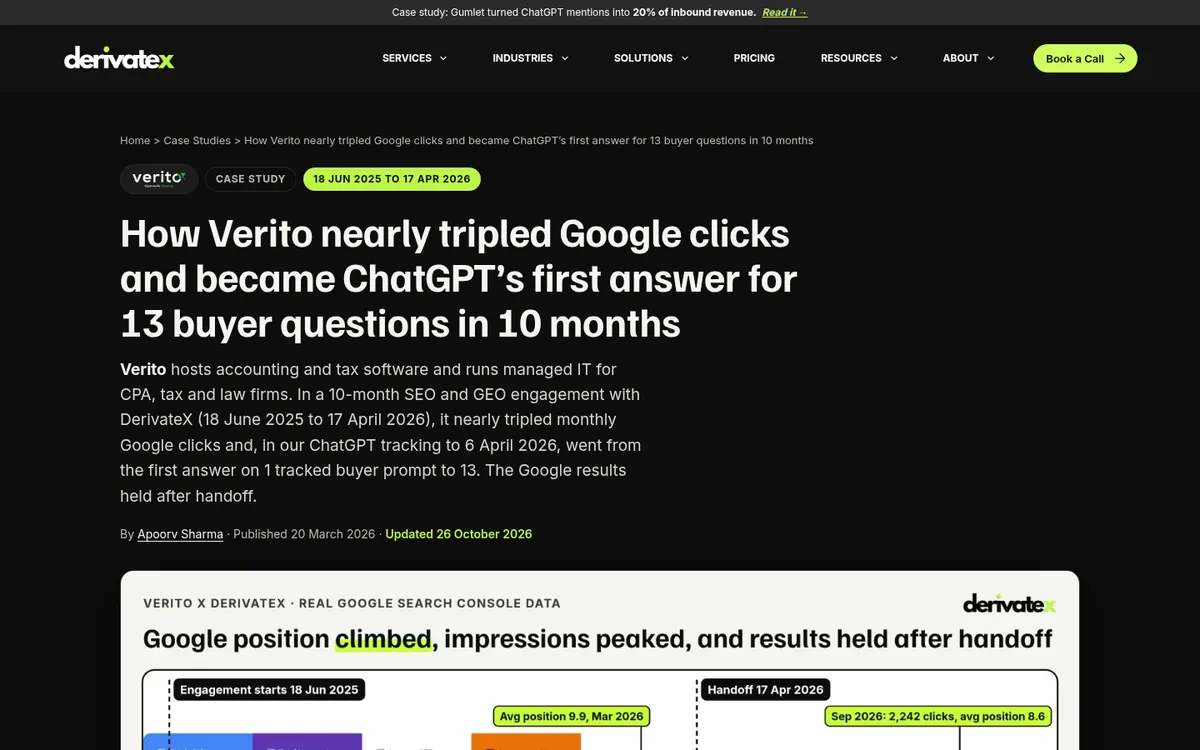
Verito hosts accounting and tax software and runs managed IT for CPA, tax and law firms. DerivateX ran a 10-month SEO and GEO engagement from June 18, 2025 to April 17, 2026: technical cleanup, 95 blog posts in topic clusters and placements on outside publications.
- Client: Verito, cloud hosting and managed IT (named)
- Agency: DerivateX
- Window: 10 months, June 18, 2025 to April 17, 2026, plus a September 2026 check
- Sources: Google Search Console, HubSpot, Ahrefs, DerivateX rank and ChatGPT tracking
- Monthly Google clicks rose from a 932 average (December 2024 to May 2025) to 2,775 in February 2026, nearly three times as many.
- Average Google position went from 47.4 (August 2025) to 9.9 (March 2026), and tracked keywords at #1 went from 5 to 24.
- In DerivateX ChatGPT tracking from August 11, 2025 to April 6, 2026, Verito went from the first answer on 1 tracked buyer prompt to 13.
- 134 HubSpot leads and 23 estimated conversions from October 2025 to January 2026.
- 28 articles placed across 18 publications; Ahrefs Domain Rating 27 to 37.
- Five months after handoff, in September 2026, Verito still had 2,242 Google clicks at average position 8.6.
What it shows
- A named client, with public quotes from its co-founder and CRO on Clutch and TechBehemoths.
- Each number tied to a source: Search Console, HubSpot, Ahrefs or DerivateX tracking.
- The only case here that reports what happened after the agency stopped working.
What it does not show
- ChatGPT results come from DerivateX’s own prompt tracking.
- Conversions are labelled estimated in the HubSpot reporting.
- Part of the September 2025 position change reflects a Google reporting change, which the page itself flags.
Read the full Verito case study.
3. Series B RegTech (Omnius): comparison pages moved AI answers 11x
Omnius published this case study on November 11, 2026 for an unnamed Series B RegTech company in the United States that sells financial crime compliance software. The work centred on alternatives guides, best-software lists for each screening need, answer-first rewrites of solution pages and link building.
- Client: Series B RegTech, USA (unnamed)
- Agency: Omnius
- Window: AI answers: July 6 to August 2 vs October 5 to November 1, 2026; Google and Ahrefs: May vs October 2026
- Sources: Atomic AGI (Omnius’s own AI search product), Ahrefs, the client’s first-party Google data
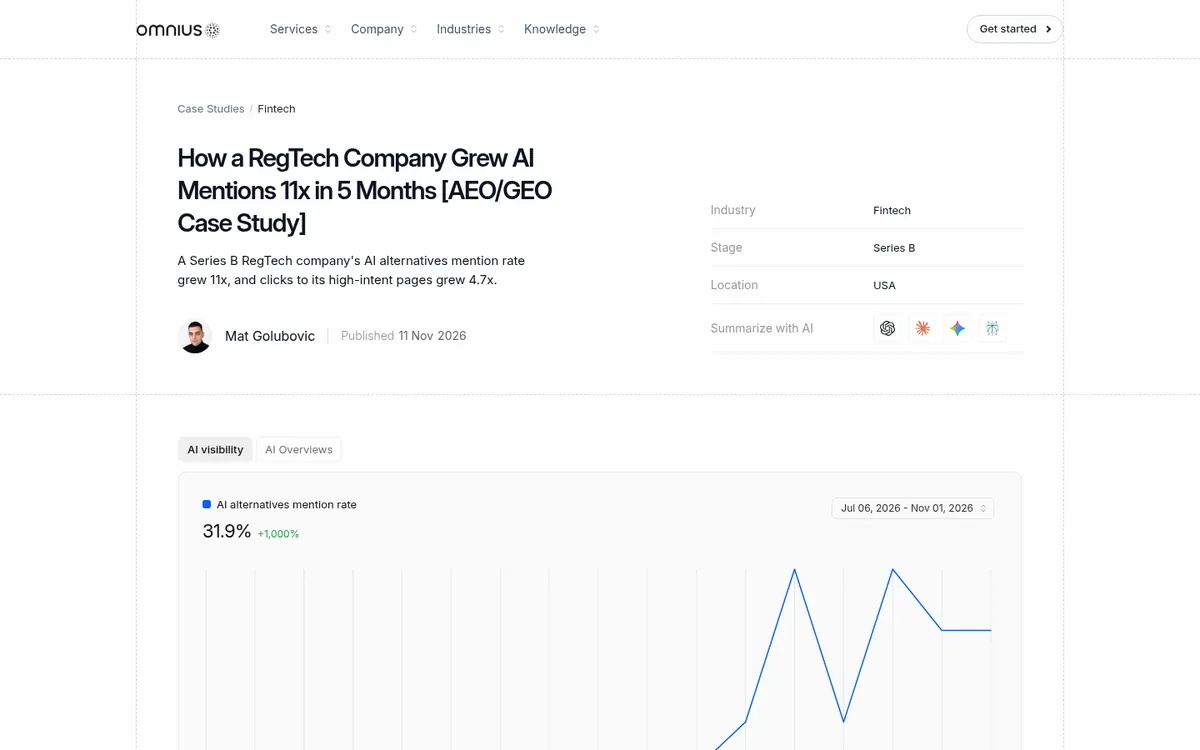
- Share of AI answers naming the company for alternatives to the category’s largest vendors rose from 2.9% to 31.9% (11x) across ChatGPT, Perplexity and Gemini.
- Keywords whose Google AI Overview includes the website rose from 3 to 69 (Ahrefs, May vs October 2026).
- Google clicks to high-intent pages grew 4.7x, and whole-site Google clicks grew 36%.
- Across the full set of tracked compliance-software questions, answers naming the company rose from 10.6% to 16.2%.
- On Perplexity, alternatives mentions went from 0% to 44.4%.
What it shows
- Clear, dated comparison windows and a named tracking tool.
- It reports the modest full-question-set number (10.6% to 16.2%) next to the 11x headline, which is good practice.
- A weekly trend chart, not just two points.
What it does not show
- The client is not named.
- No leads, opportunities or revenue after the work. The CRM conversion rates on the page describe the starting point.
- AI visibility is measured with the agency’s own product.
For how Omnius and DerivateX compare as agencies, see Omnius vs DerivateX.
4. Legal Nodes (Quoleady): more booked meetings with little traffic change
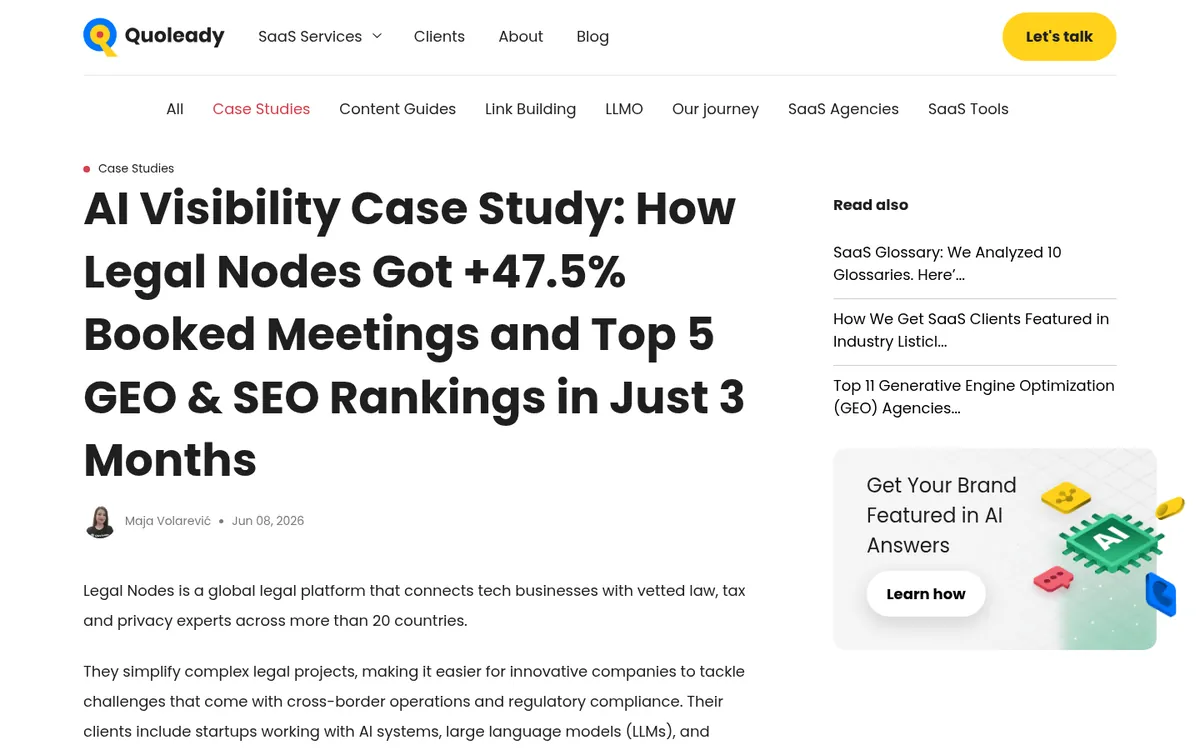
Legal Nodes is a legal platform that connects tech businesses with vetted law, tax and privacy experts. Quoleady published this case study on June 8, 2026. Over three months from a March 2025 starting point, it produced expert-written articles aimed at featured snippets, AI Overviews and answer engines such as Perplexity.
- Client: Legal Nodes (named)
- Agency: Quoleady
- Window: 3 months, starting March 2025
- Sources: Google Search Console, GA4, Ahrefs
- Booked meetings rose from 99 to 146 (+47.5%).
- LLM sessions rose from 1,270 to 1,599.
- Keywords in the top 3 rose from 78 to 100, while average organic traffic moved from 1,691 to 1,740 (+2.89%).
- Five of the eleven published articles were featured in Google AI Overviews within seven days.
- Seven keywords ranked in the top five on Perplexity.
What it shows
- A named client and a business metric (booked meetings) as the main goal.
- It shows organic traffic barely moved, which makes the meetings result more credible, not less.
- Sources named: Search Console, GA4 and Ahrefs.
What it does not show
- Before and after dates are not given beyond a March 2025 start.
- It does not say whether the meetings came only from organic and AI traffic.
- Three months shows early movement, not durability.
5. Global B2B SaaS (Grow and Convert): AI visibility doubled, trials up about 75%
Grow and Convert has worked with this unnamed global B2B SaaS brand since 2023, first on bottom-of-funnel pain point SEO. Its case study, last updated October 21, 2026, covers January to September 2026 and credits persona and pain point content plus case studies about the client’s own customers.
- Client: Global B2B SaaS (unnamed)
- Agency: Grow and Convert
- Window: January to September 2026; client since 2023
- Sources: Traqer (Grow and Convert’s own AI visibility tool), traffic and trial data
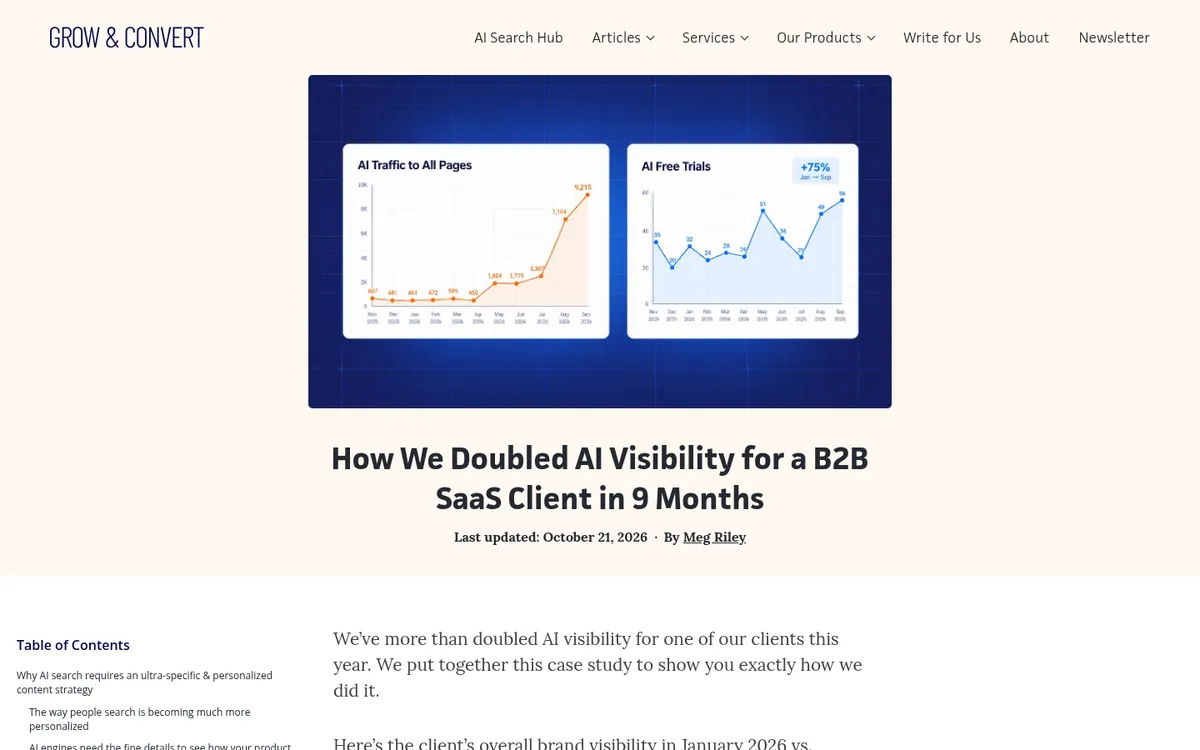
- Overall AI visibility more than doubled from January to September 2026.
- Overall AI traffic up about 1,900% (about 20x), and AI traffic to its articles up about 750%.
- Free trials directly attributable to AI tool traffic up about 75%.
- On one vertical prompt, the client was mentioned in every one of the last 12 weekly ChatGPT runs (16 of 44 runs overall).
What it shows
- A business outcome (free trials) tied to AI traffic.
- It explains run-to-run variance and shows weekly run history, not one lucky answer.
- A long relationship, so the gains build on earlier SEO work.
What it does not show
- The client is not named.
- Most results are percentages without absolute numbers.
- Visibility is measured with the agency’s own tool.
6. HR tech SaaS (Bay Leaf Digital): citations up 5.9x in four months
Bay Leaf Digital ran a GEO program for an unnamed HR tech SaaS as part of a larger full-funnel engagement, from a May 2026 baseline to August 2026. The work covered technical fixes, a rebuilt home page, role-specific pages and claiming the directory and review profiles that AI answers were quoting.
- Client: HR tech SaaS (unnamed)
- Agency: Bay Leaf Digital
- Window: May 2026 (baseline) to August 2026
- Sources: Scheduled AI query jobs on a fixed prompt set across ChatGPT, Gemini and Perplexity; tool not named
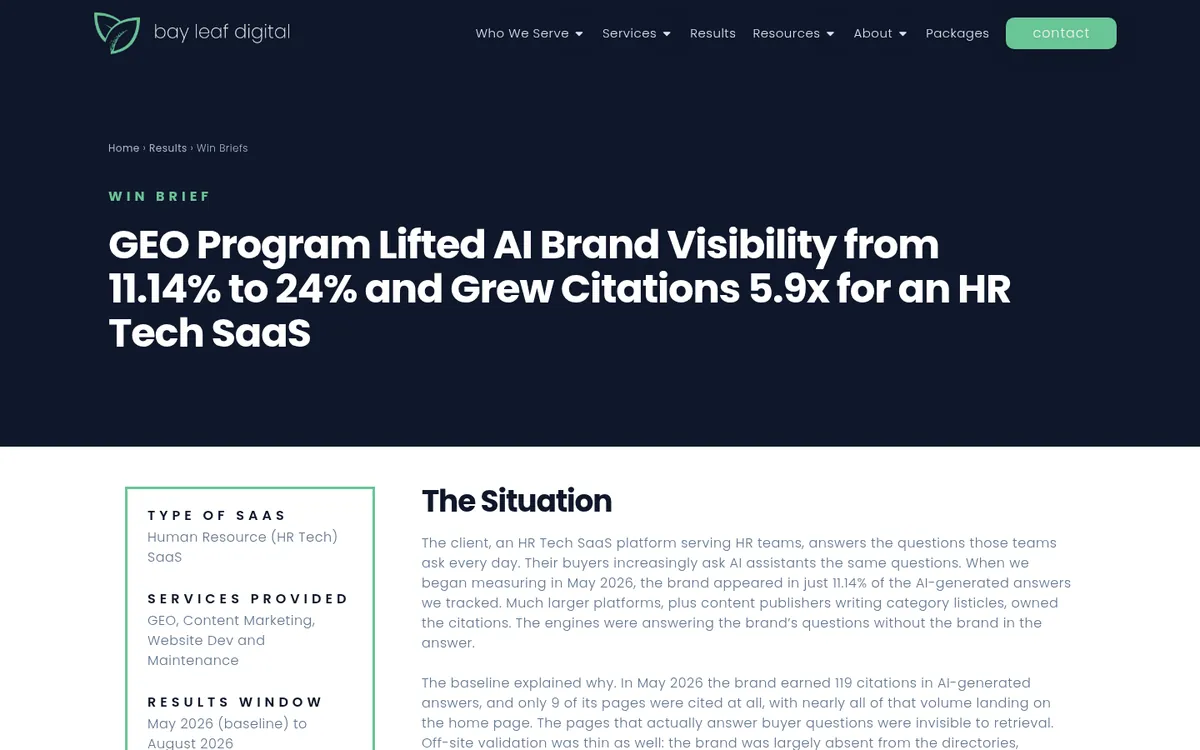
- AI brand visibility rose from 11.14% to 24%, climbing every month (17.9% in June, 20.62% in July).
- Monthly citations in AI answers rose from 119 to 703 (5.9x).
- Client pages cited rose from 9 to 41, with a dip back to 9 in July that the page explains.
- Share of voice reached 32%, second only to the category leader.
What it shows
- Monthly figures, including a dip, rather than a cherry-picked before and after.
- A clear account of the off-site work behind the citations.
What it does not show
- The client is not named.
- No leads, demos or revenue are reported.
- The number of tracked prompts and the tracking tool are not stated.
7. Localisation SaaS (ESA Digital): link building and brand mentions on a strong domain
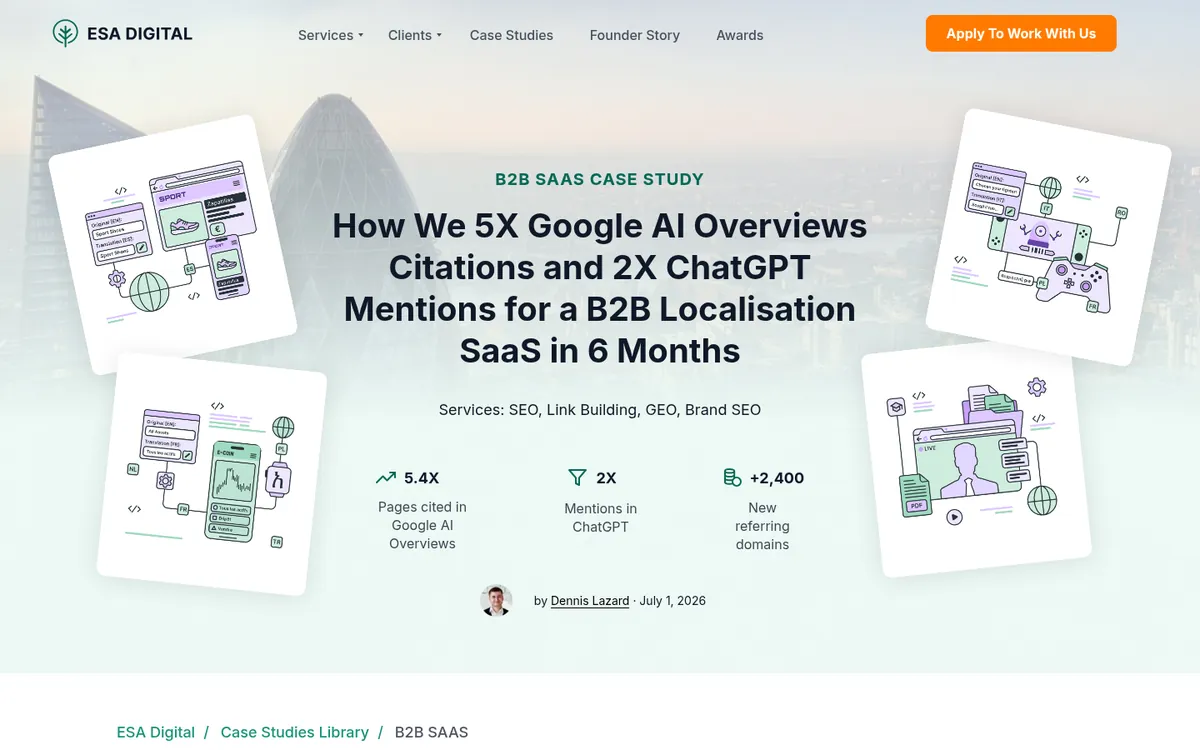
ESA Digital worked with an unnamed B2B localisation SaaS from July to December 2025. The client started strong, with an Ahrefs Domain Rating of 84 and 10,900 referring domains. The work was link building, brand mentions in “best of” roundups and comparison articles, and AI search content.
- Client: B2B localisation SaaS (unnamed)
- Agency: ESA Digital
- Window: July to December 2025
- Sources: Ahrefs for authority; AI tracking method not named
- ChatGPT mentions grew from 19 to 38 across the tracked topic set.
- Pages cited in Google AI Overviews grew from 17 to 92.
- Queries in the Google top 10 grew from 104 to 257.
- Referring domains grew from 10,900 to 13,300, and the blog’s referring domains from 107 to 204.
What it shows
- Dated start and end points for each metric.
- A clear link between off-site mentions and AI answer presence.
What it does not show
- The client is not named.
- No business outcome is reported.
- A Domain Rating 84 starting point means a younger domain should not expect the same pace.
8. Caliber (MarchiteQ): an enterprise lead from AI search in two months
Caliber is a stakeholder intelligence platform that operates in 30+ markets. MarchiteQ ran SEO and GEO strategy, technical SEO, direct-answer formatting on key pages and international SEO.
- Client: Caliber (named)
- Agency: MarchiteQ
- Window: 3 months; dates not stated
- Sources: Not stated
- Organic clicks grew from 3.7K to 4.78K in three months (+28%), with 1.24M impressions.
- Homepage clicks reached 1.22K (+65%).
- The first enterprise-qualified lead arrived in two months, sourced through AI search.
What it shows
- A named client and an honest, modest headline (+28%).
- A lead outcome, not just traffic.
What it does not show
- No dates or data sources.
- One lead, with no detail on how it was attributed to AI search.
- No AI visibility metrics.
MarchiteQ’s page blocked our screenshot tool, so this section has no screenshot. The figures were read on the live Caliber case study on November 18, 2026.
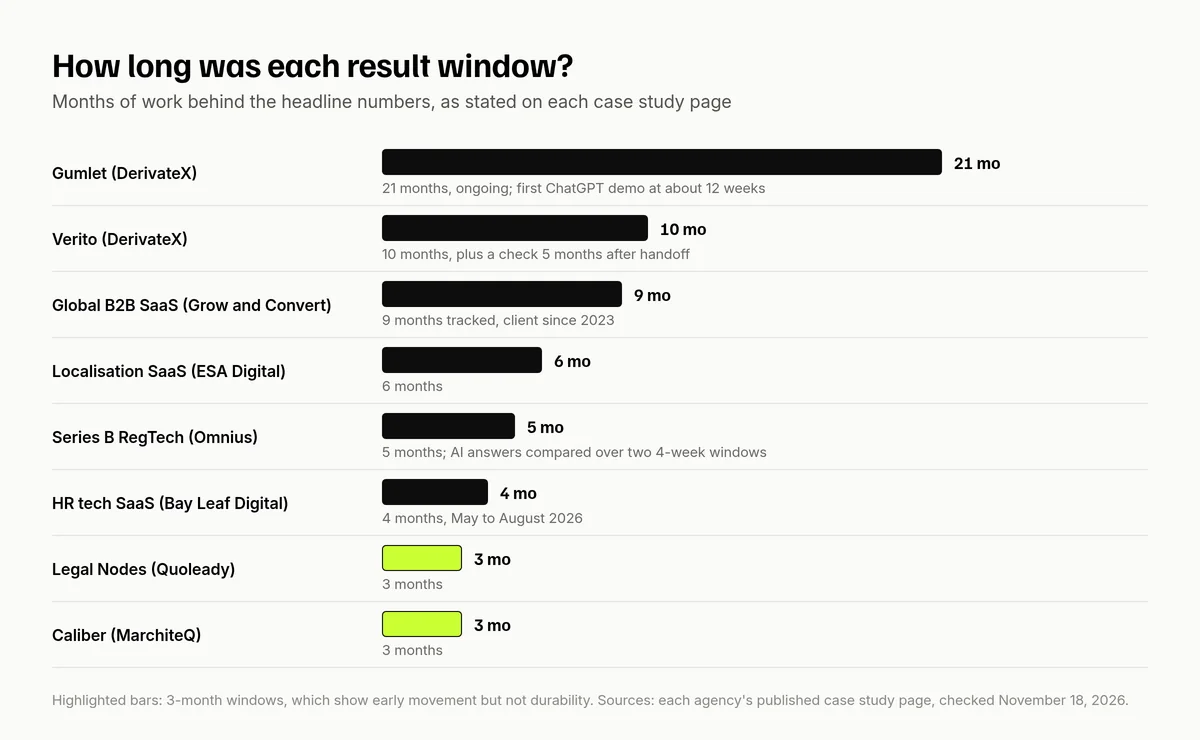
How long did each result take?
The windows behind these results run from three to 21 months, and the longer ones are the only ones that can say anything about durability. Short windows are not a red flag on their own. Legal Nodes and Caliber both show early wins in three months. They just cannot tell you whether those wins held.
What do the 8 case studies show together?
Five patterns repeat across the eight, and they are more useful than any single headline number.
- Comparison content moves AI answers fastest. Omnius’s alternatives guides drove the RegTech 11x result, a Gumlet “best Wistia alternatives” prompt went from 0% to 67% in two weeks, and Bay Leaf credits role pages for the jump in cited pages.
- Off-site mentions matter as much as on-site pages. Verito had 28 articles placed across 18 publications, ESA seeded the brand in roundups and comparisons, and Bay Leaf claimed the directory and review profiles AI answers quoted.
- SEO and GEO move together. Verito, Caliber, ESA and Legal Nodes all report Google gains alongside AI gains. In our view, the pages that rank are the pages AI search tends to read.
- Visibility is easy to report; business outcomes are not. Only four of the eight report trials, meetings, leads or revenue. If an agency’s case studies all stop at mentions, ask why.
- Agencies often measure with their own tools. Omnius uses Atomic AGI, Grow and Convert uses Traqer and DerivateX uses its own tracking. That is normal, but ask for the prompt list and raw run history.
For the metrics that hold up in a budget review, see the 8 GEO metrics we report to clients and recommendation share vs citation share.
What are the red flags in a SaaS GEO case study?
The biggest red flag is a large percentage with no baseline, no dates and no source. Watch for these too:
- Growth shown only as a percentage, with no starting number. 300% of a tiny base can be a handful of mentions.
- Mixed units in one table, such as citations before and queries after.
- Very precise numbers for an unnamed client, with no tool or data source named.
- Composite or illustrative case studies presented next to real ones without a clear label.
- AI visibility from one run of one prompt. AI answers change between runs, so a single screenshot proves little.
- Only visibility metrics, with no trials, meetings, leads or revenue anywhere in the agency’s case studies.
Our SaaS SEO agency red flags checklist covers the contract and reporting side.
Which questions should you ask an agency about its case studies?
Ask questions that turn a polished page into checkable evidence. A good agency will answer most of them on the first call.
- Can I speak to this client, or read a review they posted on Clutch, G2 or a similar site?
- What were the exact start and end dates, and what changed in the client’s marketing during that time?
- Which tool produced each number, and can I see the prompt list and run history behind the AI visibility figures?
- How did you attribute leads, trials or revenue to organic and AI search?
- What happened after the engagement ended, or in the latest month?
- How close is this client to my stage, category and starting authority?
Then compare the answers with how each agency reports results in practice. Our guide to measuring AI-assisted conversions explains how to check attribution claims.
Which case study matches your situation?
The most useful case study is the one closest to your stage, category and starting point, not the one with the largest number. Use this table to find the nearest match among the eight.
| If your situation is… | Look closest at | Why |
|---|---|---|
| B2B SaaS at $5M to $50M ARR that needs AI search tied to revenue | Gumlet, Verito (DerivateX) | Named clients, business outcomes and long, dated windows |
| Regulated category that is shortlisted through comparison lists | Series B RegTech (Omnius) | Alternatives and best-software pages drove the AI answer gains |
| Smaller team that needs meetings quickly from expert content | Legal Nodes (Quoleady) | Booked meetings rose in three months with little traffic change |
| Existing bottom-of-funnel SEO program that you want to extend into AI search | Global B2B SaaS (Grow and Convert) | Gains built on SEO work that started in 2023 |
| Weak presence in directories and review sites that AI answers quote | HR tech SaaS (Bay Leaf Digital) | Off-site profiles were a core part of the work |
| High-authority domain that wants more AI citations at scale | Localisation SaaS (ESA Digital) | Started at Domain Rating 84 and scaled link building |
| Enterprise platform selling across many markets | Caliber (MarchiteQ) | International SEO with an enterprise lead from AI search |
Where does DerivateX fit?
DerivateX is a full-service SEO and GEO agency for B2B SaaS. It works best for B2B SaaS companies between $5M and $50M ARR that want Google and AI search run as one program and measured through to pipeline. Pricing is public: from $5,000 a month plus an off-site placement budget of $1,000 to $1,200, about $6,100 a month all in, starting with a 90-day pilot.
Beyond Gumlet and Verito, DerivateX’s REsimpli case study shows the real estate CRM becoming the most cited and recommended real estate CRM for investors in ChatGPT within 90 days. If you are earlier stage or need a much smaller budget, one of the other agencies above may fit better, and our GEO agencies for Series A and Series B SaaS list covers more options.
Want proof for your own category before you talk to any agency? Browse all DerivateX case studies, or get a free AI visibility audit to see where your brand shows up in ChatGPT, Perplexity, Gemini and Claude today. If you are past $5M ARR, review DerivateX pricing and book a discovery call.
SaaS GEO and SEO case study FAQs
What is a SaaS GEO case study?
A SaaS GEO case study is an agency’s published account of how it helped a software company appear more often in AI answers from tools such as ChatGPT, Perplexity, Gemini and Google AI Overviews. The useful ones also report Google results and a business outcome such as trials, meetings or revenue.
How long do GEO results take for SaaS companies?
In several of the eight case studies we compared, the first reported results came within two to three months, such as an enterprise lead from AI search in two months for Caliber and a first ChatGPT-referred demo about 12 weeks in for Gumlet. Larger shifts were reported over five to 21 months.
Which metrics should a GEO case study include?
Look for a dated baseline, the AI visibility metric and how it was measured, Google clicks or rankings, and at least one business outcome such as trials, booked meetings, leads or revenue. A trend over time is stronger than two points.
Are anonymized case studies trustworthy?
They can be, but you cannot verify them independently. Ask the agency for a reference call, a public review from the client or the raw data behind the figures. Weigh named case studies with dated sources more heavily.
Do GEO results come from on-site content or off-site mentions?
Both. In these case studies, comparison and alternatives pages on the client’s site moved AI answers, and placements, roundup mentions and directory profiles on other sites raised citations. Several programs did both at once.
Is this comparison biased, since DerivateX wrote it?
DerivateX publishes this page and two of the eight case studies are its own. We applied the same five checks to every case, listed what each DerivateX case does not show, and recommend other agencies for situations they match better. Every figure links to the agency’s own page.
The bottom line
Published SaaS GEO and SEO case studies vary far more in evidence quality than in headline size. The most convincing ones name the client, date the window, state the data source, report a business outcome and show the trend. Use the five checks on every case study an agency sends you, then shortlist the agency whose clients look most like you.
Related reading
- 7 ways to structure SaaS case studies so ChatGPT can reuse the proof
- Find a GEO agency that ties ChatGPT citations to revenue
- 11 best AI SEO agencies for software companies, ranked by proof
- 11 best LLM visibility trackers for B2B SaaS
- Omnius vs DerivateX
- All DerivateX case studies
Written byFouziaSEO Growth & Operations, DerivateX
SEO Growth & Operations at DerivateX, where I focus on SEO, content publishing, AI search optimization and organic growth. Through my blogs, I share practical insights on SEO, AI tools, content strategy, digital marketing and workflows that help businesses improve search visibility and grow sustainably.
Reviewed byApoorv SharmaCo-founder, DerivateX
Apoorv Sharma is the co-founder of DerivateX, a B2B SaaS SEO and Generative Engine Optimization agency that engineers AI citations in ChatGPT, Perplexity, Claude, and Gemini and connects them to demo bookings and revenue pipeline. He is the author of the 2026 AI Visibility Benchmark Report and the Citation Engineering methodology. He's also the brain behind "Found On AI" and has sold 2 of his companies previously
Cited by AI