Case study: Gumlet turned ChatGPT mentions into 20% of inbound revenue. Read it →

Citation Building vs Link Building for AI Search: What Changes and What It Costs
 ByFouzia

Link building earns a hyperlink so a page can rank in Google. Citation building gets your brand named on the third-party pages AI engines already cite, even when there is no link.


Last updated: November 18, 2026. Research figures are from fetched primary sources, labelled as such. DerivateX prices are from derivatex.agency/pricing.
Citation building and link building are not two names for the same outreach job. Link building earns a hyperlink so Google can treat another site as a vote for a page you want to rank. Citation building for AI search is the work of being named on the third-party pages and threads that ChatGPT, Perplexity, Gemini, Claude and Google AI Overviews already retrieve, whether or not that mention includes a link. If you fund one with the metrics of the other, you can raise Domain Rating and still stay invisible in the answers buyers now read first.
Key takeaways
- Link building still matters for Google. The unit of work is a live hyperlink, usually judged by anchors, referring domains and the authority of the linking page.
- Citation building for AI search is about being named inside the sources engines already cite: listicles, review sites, editorial coverage and communities. An unlinked mention can still be used.
- Ahrefs’ study of 75,000 brands found branded web mentions correlated 0.664 with visibility in Google AI Overviews, versus 0.218 for raw backlink count. The study reports correlation, not proof of cause.
- Measure link building with links that go live, rankings and organic pipeline. Measure citation building with prompt coverage, share of voice, and whether the sources in those answers actually name you.
- Costs follow the unit of work. Link building is usually priced around a placed link. Citation building is priced around inclusion on the sources AI already uses. DerivateX runs both inside one SEO and GEO engagement; off-site placement budgets sit outside the retainer and are approved before spend, as published on DerivateX pricing.
- If a commercial page cannot rank, fund SaaS link building first. If you already rank, or have the pages, but AI answers omit you, fund citation building against the sources those engines already cite.
Citation building vs link building: what actually changes?
The difference is the job, the unit of work, and the engine you are trying to convince. Classic link building grew up around Google’s use of links as a ranking signal: PageRank-style authority, anchor text, and the referring domain’s strength. The deliverable is a hyperlink that points at a URL you want to rank.
Citation building, in the sense used in this article, starts one step earlier in an AI answer. The engine retrieves pages, threads and listings, then writes an answer from that text. Your brand has to appear in the words on those sources, in the right topical context, or there is nothing for the model to name. A link helps a page get found and still helps Google. The mention is what gets quoted.
That is a different definition from two common uses of the same phrase. Some teams use “citation building” to mean getting an AI engine to quote a page they own. Others use it for local SEO name, address and phone listings. This post is the comparison between classic backlinks and third-party mentions on the sources AI already cites. For how first-party, third-party and AI-internal citations differ by query type, see first-party and third-party citations. For the tactics that feed each stack, see SaaS link building strategies.
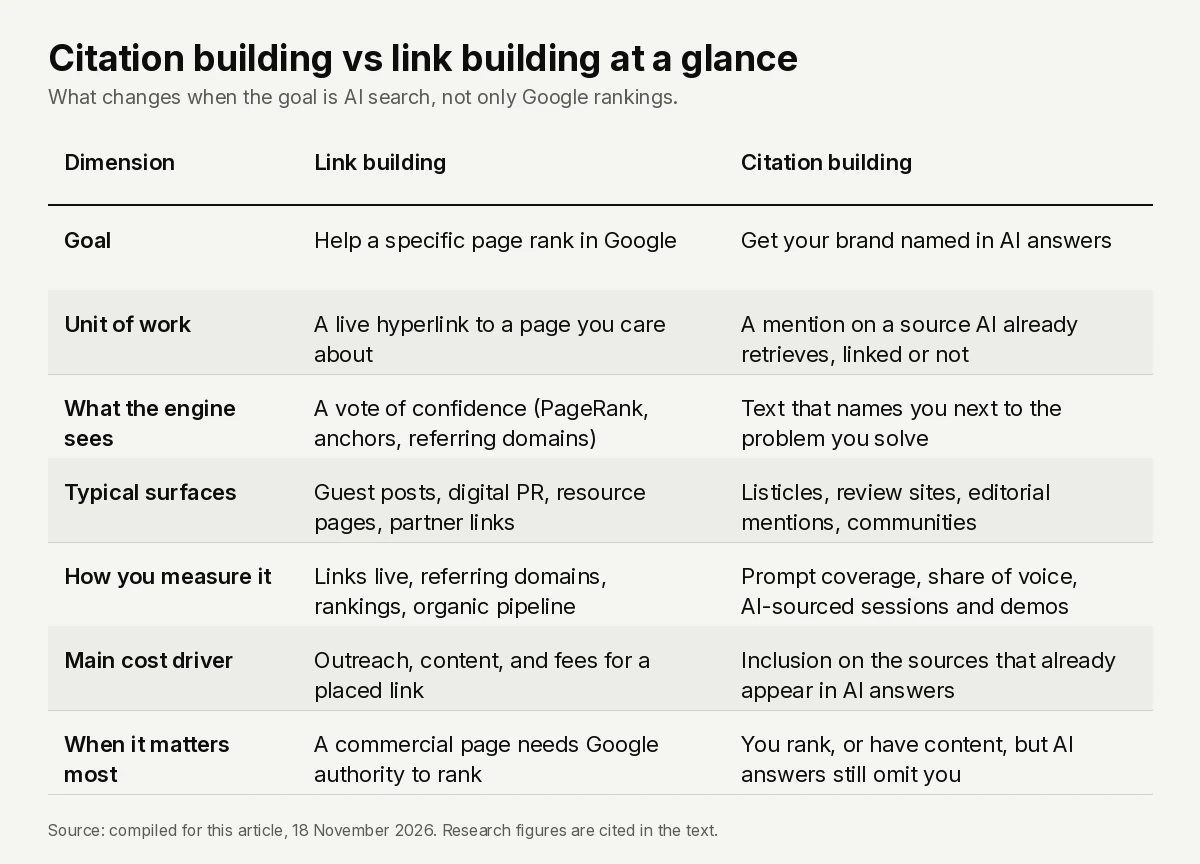
Citation building vs link building at a glance
Use this table as the decision surface, then read the sections that apply to your bottleneck. The two programs can share a publisher or a piece of coverage, but they are measured and bought differently.
| Dimension | Link building | Citation building |
|---|---|---|
| Goal | Help a specific page rank in Google | Get your brand named in AI answers |
| Unit of work | A live hyperlink to a page you care about | A mention on a source AI already retrieves, linked or not |
| What the engine sees | A vote of confidence (PageRank, anchors, referring domains) | Text that names you next to the problem you solve |
| Typical surfaces | Guest posts, digital PR, resource pages, partner links | Listicles, review sites, editorial mentions, communities |
| How you measure it | Links live, referring domains, rankings, organic pipeline | Prompt coverage, share of voice, AI-sourced sessions and demos |
| Main cost driver | Outreach, content, and fees for a placed link | Inclusion on the sources that already appear in AI answers |
| When it matters most | A commercial page needs Google authority to rank | You rank, or have the content, but AI answers still omit you |
What link building still does well
Link building has not been retired by AI search. Google still uses links as one of the signals for which page should rank. If a comparison, alternatives or integration page is the one you want buyers to find in ordinary results, a relevant link to that URL still does a job that an unlinked mention cannot: it points authority at a specific page.
Ahrefs also found that branded anchors, a link signal, had the second-strongest correlation in the same AI Overview study, at 0.527. Raw link volume was much weaker, at 0.218, and Domain Rating sat at 0.326. The useful reading is not “links are dead.” It is that a brand-name anchor on a relevant page is a different asset from a batch of generic homepage links bought to move DR.
Link building also still produces referral clicks and a public URL you can inspect, which citation work does not always do. If you are comparing vendors, link building agencies for LLM SEO is the buying guide for that job. If you need the work done as part of a broader SaaS SEO program, the SaaS link building service page is the offer that covers it.
What citation building is, and what it is not
Citation building for AI search is the work of getting your brand named, in context, on the third-party sources that engines already use to answer buyer questions. Those sources include category listicles, review and comparison sites, editorial explainers, and communities such as Reddit. The mention can include a link. It does not have to.
That last point is the part classic SEO reports miss. A model reading a sentence such as “tools like X and Y handle this well” can name X in an answer even if X never received a hyperlink. The text is the input. The link is optional for that job, and often useful for the Google job at the same time.
Citation building is not a replacement for pages on your own site. Search Engine Land puts this cleanly, using the same Ahrefs figures: off-site mentions tell an engine who you are and whether others agree, while extractable on-site content gives it facts worth using. Mentions with nothing citable on your site can get you named, then send the reader to a review site or a competitor. Strong pages with no third-party corroboration can be treated as self-description. You need both. DerivateX is a full-service SEO and GEO agency for B2B SaaS, so the on-site and off-site work are meant to run as one program, not as two disconnected retainers.
The surfaces that tend to show up in answers are not always the highest-DR domains on a media list. A mid-size listicle, a review profile, or a well-ranked community thread can matter more than a prestigious mention that engines never retrieve. For a ranked view of those channels, see off-site channels that get B2B SaaS brands cited by AI.
Digital PR vs AEO distribution
Digital PR and AEO distribution can use the same journalists and the same article, but they aim at different outcomes. Digital PR is usually bought to earn coverage and, in SEO programs, a link from a strong domain. Success is often reported as placements, Domain Rating, referral traffic and branded search. That work can still help AI visibility when the coverage names you next to the problem you solve.
AEO distribution starts from the opposite end. You look at the prompts buyers already ask, list the URLs and threads that appear in those answers, and work to get your brand included there. A high-authority feature that never appears in those answers is the wrong target for this job. A listicle, review page or community thread that already does appear is the right one, even if its Domain Rating looks modest on a link report.
That is why an in-house AEO team can run the tool, own the prompt set and still watch citation share stay flat. The missing piece is usually placement on the sources the tool already shows, not another dashboard. DerivateX’s AEO distribution for in-house teams page is for that split: your team keeps strategy, the tool and on-site work; the agency takes the outreach and placement against the gap list.
Third-party mentions vs backlinks for LLM visibility
The largest public comparison of these signals, as of this writing, is Ahrefs’ study of 75,000 brands. The authors used Spearman correlation to compare search and brand factors with how often a brand was mentioned in Google AI Overviews. They filtered for domains with a Domain Rating above 40 and a high-volume branded keyword, then studied the brands that had at least some AI Overview presence. About 26% of the set had none.
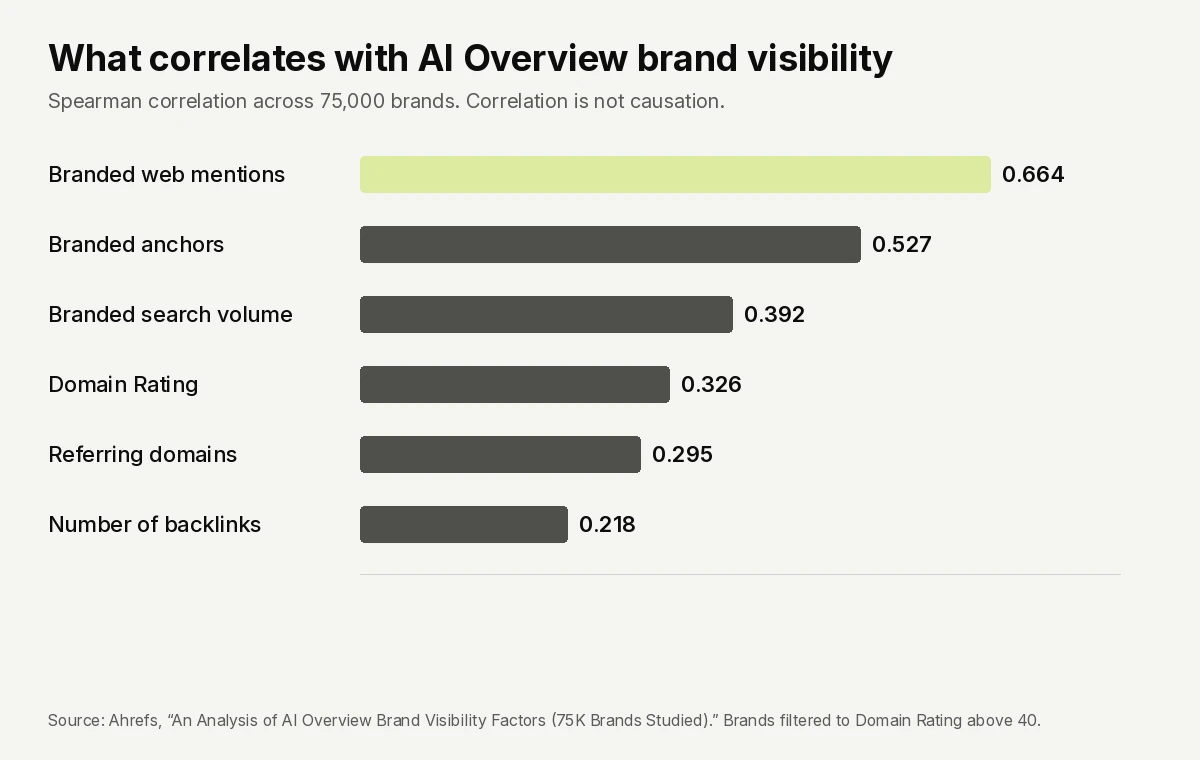
The headline figures are easy to misuse, so they are worth stating with the study’s own limits:
- Branded web mentions had the strongest correlation, at 0.664.
- Branded anchors, which are links that use the brand name as the clickable text, came next at 0.527.
- Branded search volume sat at 0.392.
- Domain Rating was 0.326, referring domains 0.295, and the number of backlinks 0.218.
- Brands in the top quartile for web mentions averaged 169 AI Overview mentions, against 14 in the next quartile and 0 to 3 in the bottom half.
- The authors state clearly that correlation is not causation, and that the relationships they found were moderate to weak on the Spearman scale.
Two practical conclusions still hold up under that caveat. First, mentions do not need a link to count for AI visibility. Second, abandoning links in favour of unlinked mentions would throw out the second-strongest signal in the same study, branded anchors, and would weaken the Google-ranking job that commercial pages still have. The mistake is treating “more backlinks” and “more mentions” as interchangeable KPIs.
How to measure each program
If you report both programs on a Domain Rating chart, citation building will look like a failure even when it is working. The metrics have to match the unit of work.
Link building
Start with delivery, then leading indicators, then business results. Delivery is whether the agreed links went live, stayed live, and point at the intended URL with the intended anchor. Leading indicators are referring domains to those target pages, ranking movement for the queries those pages should win, and referral sessions from the placements. Lagging results are organic clicks and the pipeline attached to that organic traffic. A link that does not land, or that lands on a page you did not mean to rank, should not be counted as progress.
Citation building
Start from the answers, not from the media list. For a fixed prompt set, record whether your brand is named, where it sits in the answer, and which URLs the engine is drawing from, across Google AI Overviews, ChatGPT, Perplexity, Gemini and Claude. Then check whether those source URLs actually mention you. A rise in placements that never appear in the answers is activity, not result.
Share of voice against named competitors, and AI-sourced sessions, demos or signups, are the measures that connect this work to pipeline. DerivateX reports those, rather than treating keyword rankings, impressions, Domain Rating or a raw backlink count as the headline. Re-run the same prompts on a fixed cadence. A one-off screenshot is not a trend.
| Question | Link building | Citation building |
|---|---|---|
| Did we get what we paid for? | The link is live, indexed and points at the right URL | The source is live and names the brand in the right context |
| Is the engine using it? | Target pages gain referring domains and rankings | The source appears in answers, and those answers name you |
| Is it producing business value? | Organic and referral pipeline from the target pages | AI-sourced sessions, demos and pipeline from the prompt set |
| What should not be the headline? | Domain Rating or total backlinks alone | Placement volume with no change in prompt coverage |
What citation building vs link building costs
Price follows the unit of work, and published market rates are too uneven to invent a “typical” number here. Link building is commonly sold per placed link or as a monthly retainer aimed at a volume of links and referring domains. The cost drivers are outreach time, the content required by the publisher, and any fee the site charges for a placed link. You are paying for a hyperlink to a URL.
Citation building is priced around inclusion, not around the presence of a href. Getting named in a listicle, completing or correcting a review-site profile, earning an editorial mention, or showing up in a community thread that engines already cite can have very different costs, even when none of them produces a backlink. The expensive mistake is paying a link-building rate for a mention on a site that never appears in your answers, or paying a PR retainer that reports outlet prestige instead of prompt coverage.
DerivateX does not sell these as two separate catalogues with unpublished per-link or per-mention prices on this page. It runs Google SEO and AI search visibility as one engagement, with three published retainers of $5,000, $8,000 and $12,000 a month. Off-site placement budgets sit outside the retainer, range from $1,000 to $3,000 a month depending on tier, and need written approval before any spend. Rank & Get Found and Own Your Category start as a 90-day pilot with no lock-in after it. The figures and what each tier includes are on DerivateX pricing.
If you already have an in-house AEO or SEO team, you may only need the distribution layer rather than a full content program. In that case the cost question is whether the placement budget is aimed at the sources in your gap list, not whether the retainer looks cheaper than a per-link package.
Which should you fund first?
Fund the bottleneck in front of you, not a generic 50/50 split. The wrong spend is usually a link package pointed at the homepage when the real gap is that AI answers cite a listicle you are missing from, or a citation campaign when a commercial page still cannot rank in Google.
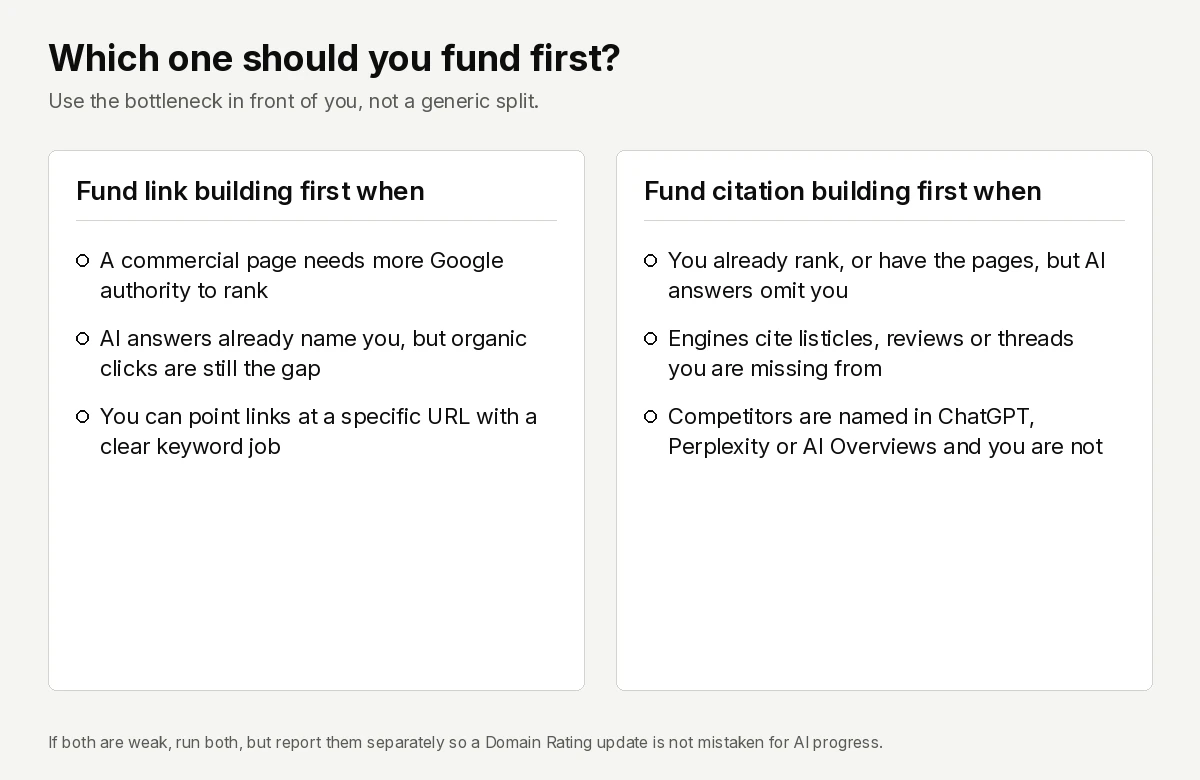
Fund link building first when
- A specific commercial page, such as a comparison, alternatives or integration URL, needs more Google authority to rank.
- AI answers already name you, but ordinary organic clicks and demo flow from Google are still the gap.
- You can brief a vendor with target URLs, anchors and a definition of a live, relevant link.
Fund citation building first when
- You already rank, or you already have extractable pages, but ChatGPT, Perplexity, Gemini, Claude or AI Overviews omit you.
- The answers you track already cite listicles, review pages or community threads that do not mention you.
- Competitors are named in those answers and you are not, even if your backlink metrics look stronger than theirs.
Run both, but keep the reports apart, when
- Google rankings and AI answers are both weak, which is common for a mid-market SaaS category that is only now being researched inside assistants.
- You are already buying coverage that could do both jobs: a listicle or editorial piece that names you in context and links to the right URL.
In-house teams that already own the prompt set and the measurement tool usually do not need another strategy deck. They need someone to get the placements done against the sources already showing up in the answers. That is the job described on AEO distribution for in-house teams. Teams that need the link-building side scoped as part of SEO can start from the SaaS link building page. In both cases, the clean first step is a free AI visibility audit, which checks whether the assistants you care about already recommend you, and which sources they are using instead.
Citation building vs link building FAQs
Is citation building the same as digital PR?
Not exactly. Digital PR can produce the mentions and the links that both programs want, but it is often briefed and reported as coverage and domain authority. Citation building for AI search starts from the sources that already appear in answers for your buyer prompts, then works to get you named there. A prestigious mention that never appears in those answers is a PR win and a citation miss. See AEO distribution for in-house teams for how that placement work is scoped for teams that already have an AEO practice.
Do unlinked mentions help with AI visibility?
They can. Ahrefs’ study of 75,000 brands found branded web mentions, which include unlinked text, had a stronger correlation with AI Overview visibility than backlink counts. A model can name a brand that appears in the text of a retrieved page even if that page does not link out. Unlinked mentions are a weak substitute for links when the job is to rank a specific Google URL, and they are not a reason to stop earning branded anchors.
Does citation building replace link building?
No. They serve different engines and different outcomes. Link building still helps specific pages rank in Google and still includes a useful AI-related signal, the branded anchor. Citation building helps your brand appear in AI answers by getting you named on the sources those engines retrieve. Teams that drop one for the other usually create a new gap rather than a cheaper win.
How should a B2B SaaS team split budget between the two?
Split by bottleneck, not by a fixed percentage. Put more of the off-site budget into links when a commercial page cannot rank. Put more of it into inclusion on already-cited sources when you rank, or have the pages, but the answers omit you. If you buy both, keep the reporting separate so a Domain Rating change is not used as proof of AI progress.
How do you measure citation building?
Fix a prompt set, then track whether you are named, where you sit in the answer, and which sources the engine is using, across the assistants your buyers actually open. Confirm that those sources mention you. Then connect any lift to AI-sourced sessions, demos and pipeline. Placement counts, Domain Rating and total backlinks should not be the headline for this program.
What does this work cost at DerivateX?
DerivateX publishes three SEO and GEO retainers at $5,000, $8,000 and $12,000 a month, with off-site placement budgets of $1,000 to $3,000 a month depending on tier, approved before spend. The first two tiers start as a 90-day pilot. Details are on DerivateX pricing. This article does not invent a per-link or per-mention market rate.
If you want to see whether AI assistants already cite your brand, and which third-party sources they use instead, start with a free AI visibility audit. You get that readout in 48 hours, and it is the cleanest way to decide whether the next dollar should go to links, to placements, or to both.
Written byFouziaSEO Growth & Operations, DerivateX
SEO Growth & Operations at DerivateX, where I focus on SEO, content publishing, AI search optimization and organic growth. Through my blogs, I share practical insights on SEO, AI tools, content strategy, digital marketing and workflows that help businesses improve search visibility and grow sustainably.
Reviewed byApoorv SharmaCo-founder, DerivateX
Apoorv Sharma is the co-founder of DerivateX, a B2B SaaS SEO and Generative Engine Optimization agency that engineers AI citations in ChatGPT, Perplexity, Claude, and Gemini and connects them to demo bookings and revenue pipeline. He is the author of the 2026 AI Visibility Benchmark Report and the Citation Engineering methodology. He's also the brain behind "Found On AI" and has sold 2 of his companies previously
Cited by AI