Case study: Gumlet turned ChatGPT mentions into 20% of inbound revenue. Read it →

AI-Assisted Conversions: 5 Ways to Measure ChatGPT Influence Without Last-Click Credit


An AI-assisted conversion is a deal where an AI assistant influenced the buyer before the closing click. DerivateX measures it as a ratio: opportunities with at least one declared or observed AI evidence signal in the 90 days before creation, divided by all opportunities created, with a third inferred tier reported separately as an upper bound.
- Last-click reporting undercounts AI influence because most assistant sessions end in a branded search or a direct visit, not a tagged referral click.
- The model only becomes auditable when you fix the numerator, the denominator, the lookback window and the evidence tier rules in writing before you run it.
- Five evidence sources carry real signal: self-reported attribution, referral and UTM data, sales conversation transcripts, prompt-set movement matched to branded demand, and CRM touch records.
- Report coverage rate next to the number. An AI-assisted rate measured on forms where only half of buyers answered the attribution question is a floor, not a result.
- Keep sourced and influenced pipeline on separate lines. Mixing them is the fastest way to lose a finance team’s trust in the whole report.
- This model proves correlation and buyer-declared influence. It does not prove causation, and saying so out loud is what makes the rest of the number credible.
What is an AI-assisted conversion?
An AI-assisted conversion is a closed or created revenue event where an AI assistant such as ChatGPT, Perplexity, Google AI Overviews, Gemini or Claude influenced the buyer at some point before the final conversion action, regardless of which channel took last-click credit. DerivateX treats it as an evidence-weighted claim, not a tracked click, because the click usually does not exist.
The ecommerce world already settled on a workable shape for this. In alby’s published documentation on assisted conversion pricing, last updated July 2025, an assisted conversion is counted when their AI agent recommends a product or answers a question about it and the customer buys that product within 30 days. Two things make that definition usable: a named triggering event and a fixed window. B2B SaaS needs the same discipline with different parameters, because a software purchase cycle rarely fits inside 30 days.
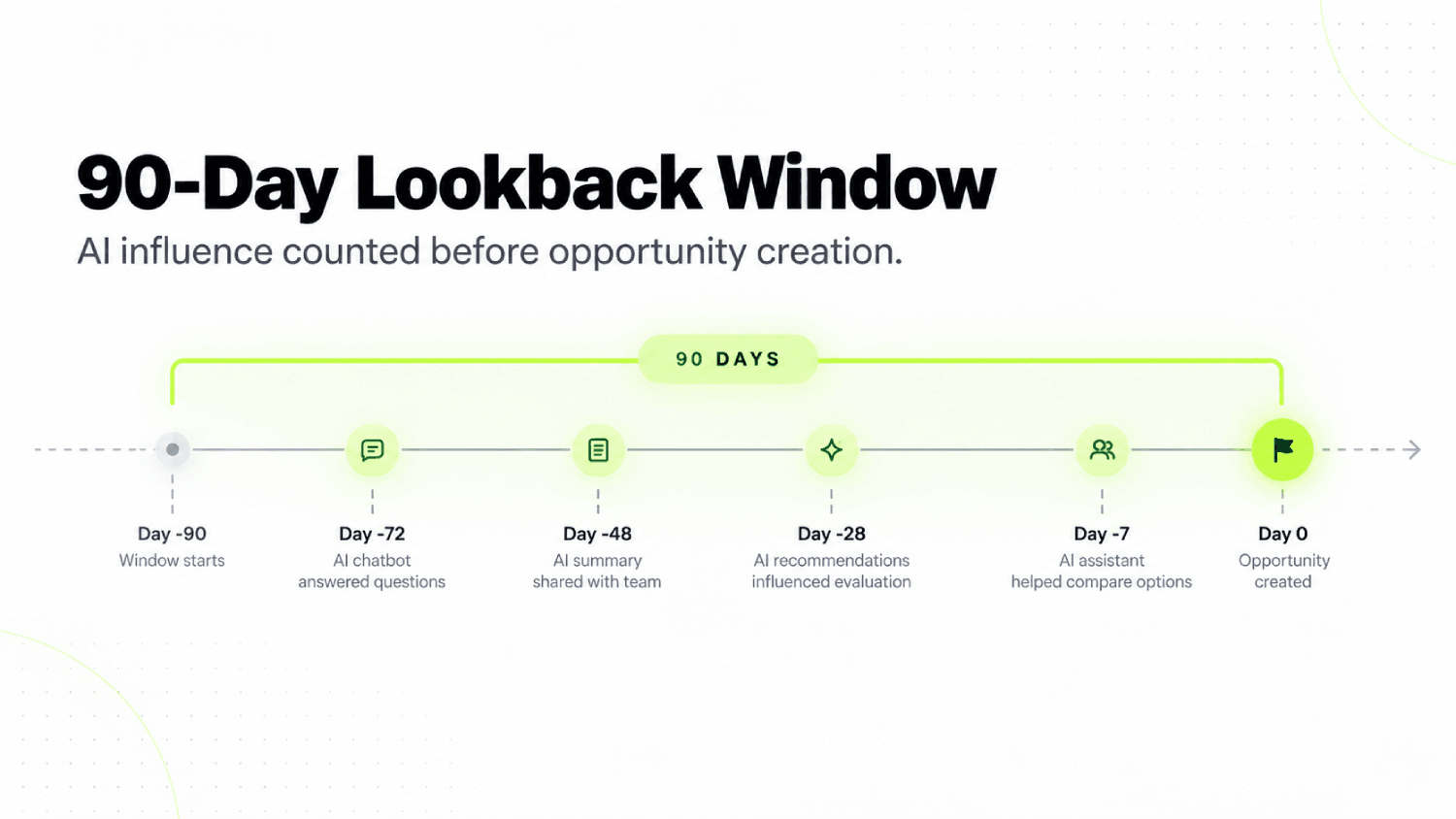
So the working definition for software companies looks like this. A qualifying AI evidence signal is any declared or observed record that an AI assistant surfaced, recommended or described your product to a person on the buying side. The window is 90 days before opportunity creation, which covers most self-serve and mid-cycle B2B evaluations. The unit of count is the opportunity, not the session, not the contact and not the page view.
Why does last-click credit miss ChatGPT influence?
Last-click credit misses AI influence because the assistant is a research layer, not a traffic source, and the buyer usually exits it through a branded search or a direct URL entry. DerivateX sees the same pattern across B2B SaaS accounts: assistant referral sessions are a small fraction of total sessions while self-reported attribution and sales call mentions run several times higher.
Some of that traffic is genuinely taggable. OpenAI’s publishers and developers FAQ confirms that ChatGPT search referrals can carry utm_source=chatgpt.com, which means a slice of assistant-driven sessions arrive labeled. That slice is real and worth capturing. It is also structurally incomplete, because it only catches the buyer who clicked a link inside the answer, in that session, with referrer data intact.
The volume case is harder to argue away. ChatGPT Search passed 200M+ weekly users, 40% of Google queries now show AI Overviews, a surface Google describes in its Search Central documentation on AI features, and the appearance of an AI Overview is associated with a 61% drop in click-through rate. Against that, 73% of B2B sites lost significant traffic between 2024 and 2025. Software firms running last-click models are reading a shrinking click signal and concluding that demand shrank, when the research step simply moved somewhere their analytics cannot see.
The citation data makes the gap more concrete. 28% of pages cited by ChatGPT have zero organic Google visibility, and 80% of URLs cited by ChatGPT and Perplexity do not appear in Google’s top 100. Your assistant-visible surface and your Google-visible surface are not the same asset, which is covered in more depth in the DerivateX B2B SaaS AI citation study. A measurement model built only on Google-adjacent data will report on the wrong surface.
One counterweight is worth keeping in the report: AI-sourced visitors convert at 4.4x the rate of other visitors. Low session counts and high conversion quality are not a contradiction. They are what a research-layer channel looks like in analytics.
What are the 5 ways to measure ChatGPT influence without last-click credit?
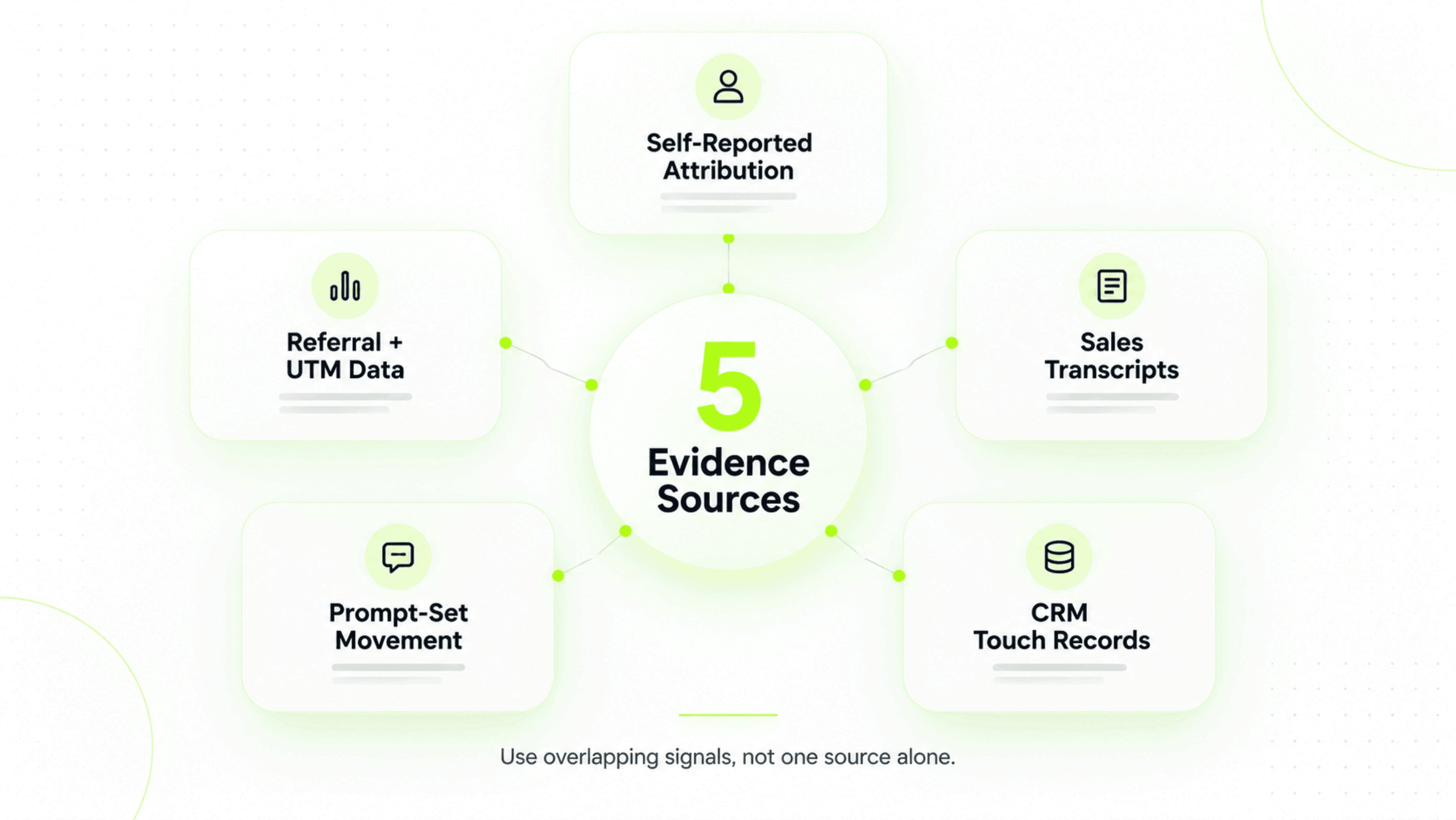
Five evidence sources carry enough signal to build an auditable model, and DerivateX runs all five in parallel rather than picking a favorite. Each one has a different failure mode, so the value comes from overlap, not from any single source being trustworthy on its own.
Self-reported attribution at the point of conversion
Add a required “How did you hear about us?” field to demo and trial forms with an explicit option for ChatGPT, Perplexity, Gemini, Claude or Google AI Overviews. Keep the options short, keep AI assistants as a distinct choice rather than folding them into “search”, and store the raw string. This is the highest-signal source available because the buyer is telling you directly. It is also the easiest to corrupt by burying the field, making it optional, or offering only vague options.
Referral and UTM evidence from assistant domains
Capture sessions carrying utm_source=chatgpt.com, plus referrer hostnames for perplexity.ai, gemini.google.com, claude.ai and copilot.microsoft.com, and persist them to the contact record rather than leaving them in session scope. The DerivateX guide to the Google Search Console generative AI report for B2B SaaS measurement covers how to use Search Console filtering as a second observed layer alongside this. Treat the whole source as a reliable floor and never as a total.
Sales conversation and transcript evidence
Search call recordings, discovery notes and email replies for assistant mentions: “ChatGPT suggested”, “I asked Claude”, “it came up in Perplexity”, “the AI summary said”. This is the source most teams own already and never query. It catches the enterprise buyer who will never fill in an attribution field and the champion who arrived through a colleague who used an assistant. Log the quote, the deal ID and the date so the evidence is reviewable later.
Prompt-set movement matched against branded demand
Run a fixed prompt set on a fixed cadence and track four defined ratios against it: recommendation rate, citation rate, prompt coverage and AI share of voice. Then compare movement in those ratios with movement in branded search volume and direct conversions over the same period. This is correlation evidence only. It belongs in the report as a trend line next to the declared evidence, never as a substitute for it.
CRM touch records and sourced versus influenced logic
Write the evidence back to the opportunity as structured fields: evidence tier, evidence date, engine named, and whether the evidence appeared before or after first contact. Whichever CRM you run, HubSpot and Salesforce included, these belong as custom fields on the opportunity record, and the DerivateX walkthrough of AI search attribution in HubSpot covers the field structure in detail. Without this step the other four sources stay as anecdotes in four different tools.
| Evidence source | What it proves | Main failure mode | Tier |
|---|---|---|---|
| Self-reported attribution field | Buyer-declared AI influence | Low response rate, vague answer options | Declared |
| UTM and referrer capture | A real assistant click occurred | Captures only the clicked subset | Observed |
| Call and email transcripts | Named engine, named moment in the cycle | Requires search discipline and tagging | Declared |
| Prompt-set ratios plus branded demand | Directional correlation over time | Confounded by paid, PR and seasonality | Inferred |
| CRM touch and stage fields | Links evidence to pipeline value | Garbage in if the first four are sloppy | Structural |
How do you calculate the AI-assisted conversion rate?
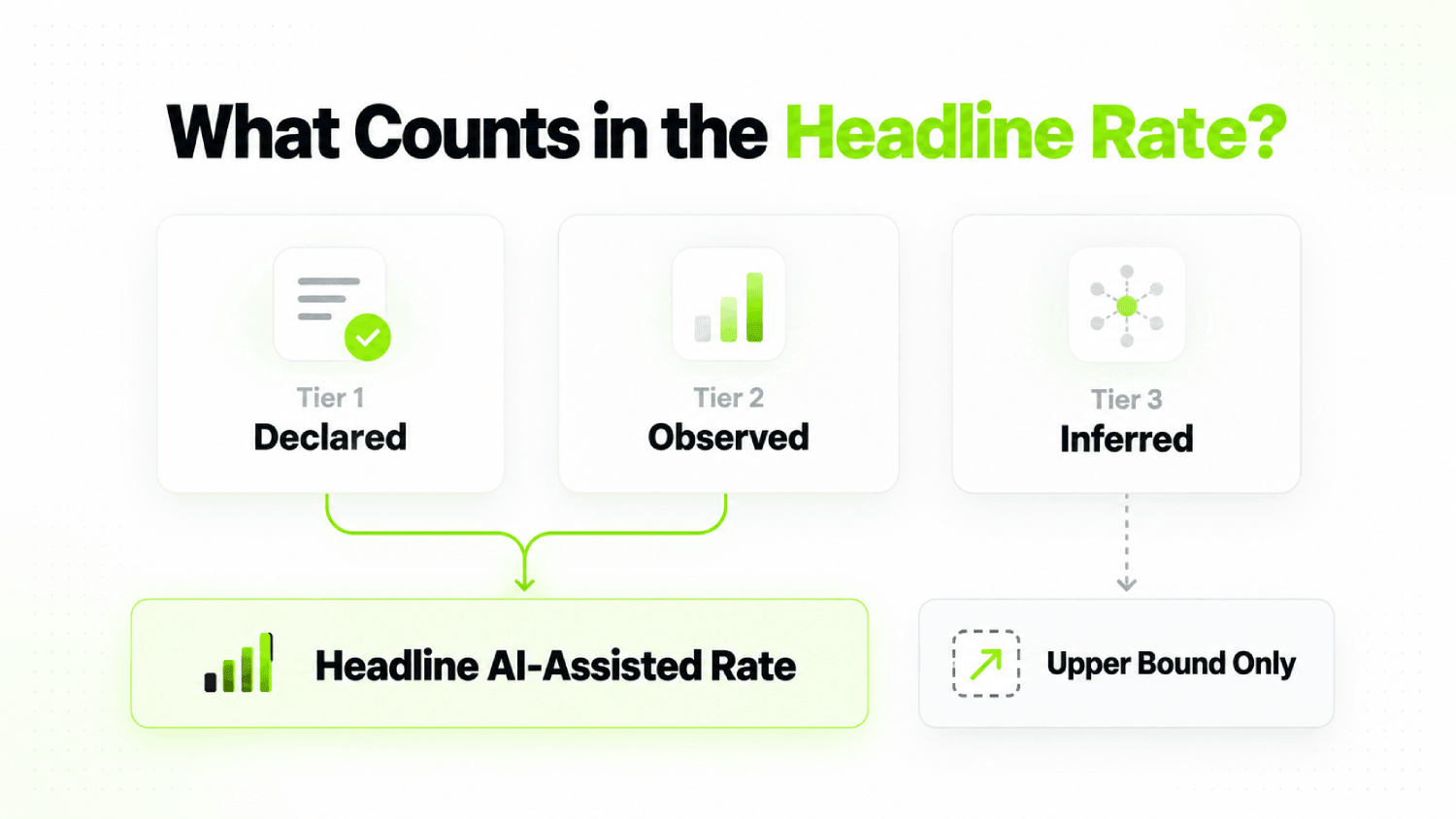
The calculation DerivateX uses has one headline ratio and one clearly separated upper bound. Define the numerator as opportunities with at least one Tier 1 or Tier 2 evidence record dated within the 90 days before opportunity creation, deduplicated so one opportunity counts once no matter how many signals it carries. Define the denominator as every opportunity created in the reporting period, including those with no marketing touch at all.
Three tiers govern what counts:
- Tier 1 is declared evidence. The buyer named an AI assistant in a form field, a call, an email or onboarding, and it counts toward the headline.
- Tier 2 is observed evidence. A session from an assistant domain or a utm_source=chatgpt.com parameter tied to a contact on the opportunity, which also counts toward the headline.
- Tier 3 is inferred evidence. No declared or observed record, but the account entered through direct or branded search with no other attributable source during a period when your tracked prompt set showed you being recommended. Report it as a separate upper bound, never added to the headline.
Two reporting rules make the output auditable. First, always publish the coverage rate: the percentage of opportunities where the self-reported attribution field was actually answered. Second, split the headline into AI-sourced and AI-influenced. Sourced means the earliest recorded touch on the opportunity is AI evidence. Influenced means AI evidence appears anywhere in the window. Finance teams accept an influenced number far more readily when it is not pretending to be a sourced number.
A worked example
Here is an illustrative quarter for a hypothetical SaaS company at roughly $18M ARR with an average new opportunity value of $26,000. Every figure below is a worked model built to show the arithmetic, not client data and not a benchmark.
| Line (illustrative) | Count | Calculation | Result |
|---|---|---|---|
| Opportunities created in Q | 240 | Denominator | 240 |
| Tier 1 declared evidence | 31 | 31 / 240 | 12.9% |
| Tier 2 observed, not already Tier 1 | 17 | 17 / 240 | 7.1% |
| Headline AI-assisted rate | 48 | 48 / 240 | 20.0% |
| Of which AI-sourced (first touch) | 19 | 19 / 240 | 7.9% |
| AI-influenced pipeline value | 48 | 48 x $26,000 | $1,248,000 |
| Tier 3 inferred, reported separately | 22 | (48 + 22) / 240 | Up to 29.2% |
| Attribution field coverage rate | 132 of 240 | 132 / 240 | 55% |
| Illustrative, not client data. Hypothetical company, hypothetical figures, included only to show the arithmetic. | |||
Read the coverage rate line before any other line. In the worked model above, the attribution field was answered on only about half the opportunities, which means the declared figure rests on half the sample and the headline rate is a floor rather than a finding. Improving coverage will almost certainly raise the reported number without anything changing in the market, so fix coverage first and only then start reading the trend. DerivateX treats the first two reporting cycles after any instrumentation change as a calibration period rather than a result.
How do you control prompt sampling so the ratios mean anything?
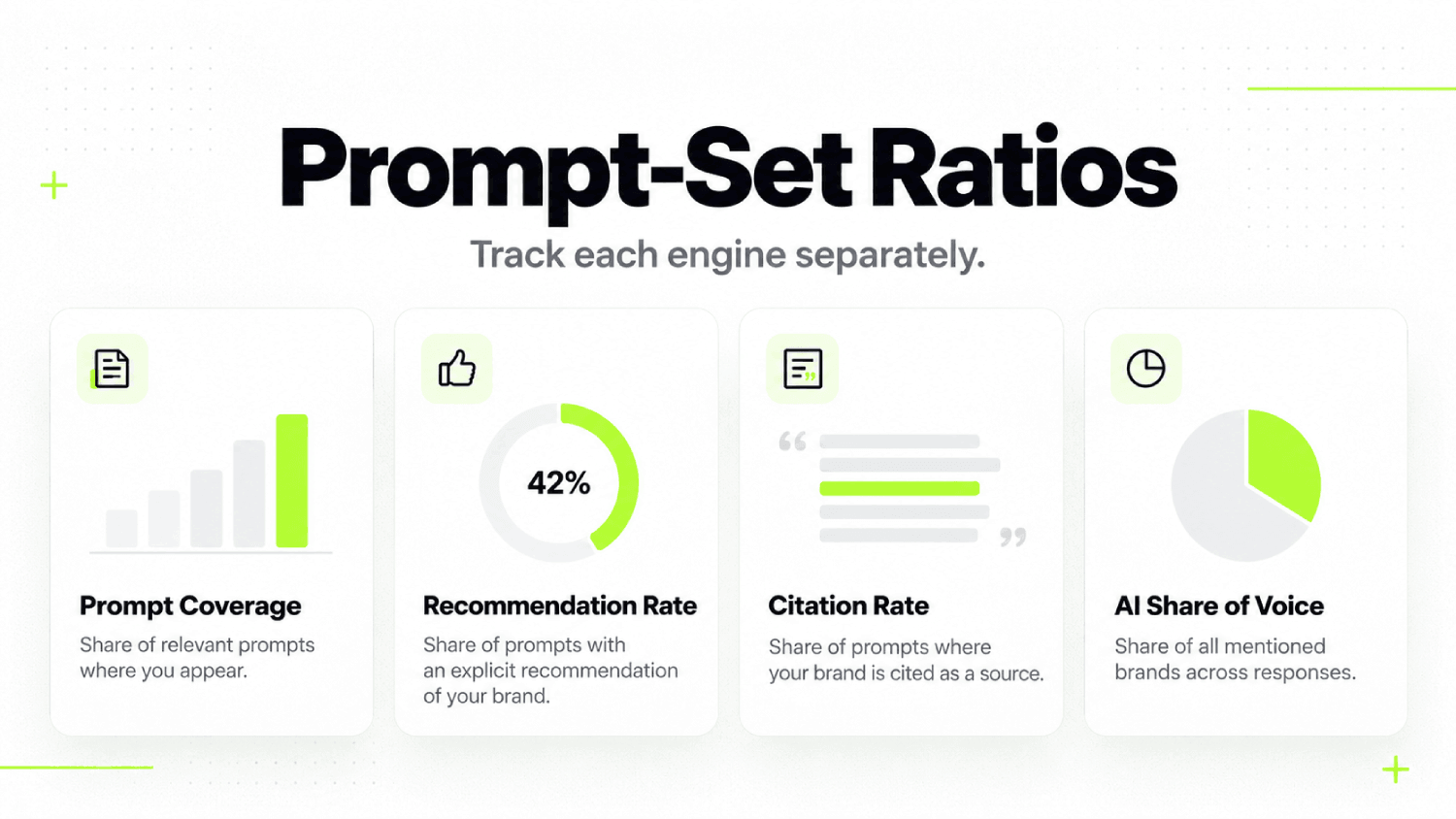
Prompt sampling is the part most teams get wrong, and DerivateX fixes four variables before the first run: the prompt list, the cadence, the engines, and the set of competitor brands counted in the denominator. Change any one of those mid-quarter and the trend line stops being a trend line.
Define the four ratios precisely, because the words are used loosely across the category:
- Prompt coverage is the percentage of prompts in your fixed set where your brand appears at all, cited or mentioned.
- Recommendation rate is the percentage of runs where your brand appears inside the recommended shortlist, not merely in passing.
- Citation rate is the percentage of runs citing a URL on a domain you own, contribute to, or have influenced.
- AI share of voice is your brand mentions divided by all tracked brand mentions across the same prompt set and period.
Share of voice needs a ceiling check. AI assistants typically recommend 3 to 4 brands per category query, so a share of voice of roughly 25% to 33% is close to the practical maximum for a shortlist position, not a sign of underperformance. Teams that set a 60% share of voice target are setting a target the format does not allow.
Measure per engine and never average across them. Only 11% of domains are cited by both ChatGPT and Perplexity, and 46.7% of Perplexity’s top sources come from Reddit, which means the evidence surfaces driving each engine are genuinely different. A blended score hides the one engine where you are losing. For teams comparing monitoring platforms before standardizing, the DerivateX review of LLM visibility trackers for B2B SaaS covers how the tools differ on sampling methodology.
What can this model prove, and what can it not prove?
DerivateX publishes this distinction inside the report itself, because the fastest way to lose a CFO is to let them discover the limit after they have already quoted the number. 64% of marketing leaders say they are unsure how to measure AI search, which means your report will be read by people actively looking for the soft spot.
| This model can prove | This model cannot prove |
|---|---|
| That a named number of buyers said an AI assistant was part of their research | That the assistant caused the purchase decision |
| That assistant-sourced sessions occurred and are tied to specific opportunities | The full volume of assistant-influenced buyers, since most never click |
| That the AI-assisted rate is rising or falling against a stable denominator | That your content changes are what moved the rate |
| The pipeline value associated with evidenced opportunities | Incremental revenue that would not have arrived anyway |
| Which engines name you and which do not, per prompt | Why a given engine changed its answer in a given week |
If you want a causal claim rather than a correlational one, the only honest route is a controlled test: hold back a defined cluster of topics or third-party placements, leave a matched cluster live, and compare recommendation rate across the two over a full quarter. That takes time and it slows down the work, which is why most software firms accept the correlational model and say so plainly instead.
How do you report AI-assisted conversions to leadership?
Report four numbers, in this order, on one slide. DerivateX uses the same four with every client reporting cycle: headline AI-assisted rate with the raw counts, AI-sourced subset, AI-influenced pipeline value in dollars, and the coverage rate that qualifies all three. Add the Tier 3 upper bound as a footnote, never as a headline.
Run the cycle quarterly rather than weekly. Assistant answers are non-deterministic, sample sizes under roughly 40 opportunities per period swing on noise, and a weekly AI dashboard mostly reports variance. The one thing worth tracking weekly is the prompt-set ratio file, because it is an input you control, not an outcome you are reporting.
Put a standing caveat line at the bottom of the slide: “Evidence-based influence measurement. Correlational, not causal. Declared coverage at X%.” That sentence has saved more marketing budgets than any dashboard, because it tells the board you understand the limit of your own instrument. The connection from this number through to revenue reporting is covered further in the DerivateX breakdown of how B2B SaaS SEO connects to pipeline.
How does DerivateX connect AI-assisted conversions back to the work?
Measurement only earns its keep if it changes what gets built next, and DerivateX wires the model directly into the delivery plan. The three internal instruments that sit behind this are worth naming now that the model is clear.
The Citation Surface Map is the inventory DerivateX builds of every third-party page, listing, review profile and community thread that assistants cite when answering your category prompts. It turns a low citation rate into a task list by naming the specific surfaces feeding the engine instead of your own domain.
Sitting next to that inventory is an index. The AI Visibility Score, or AVS, is a composite measure DerivateX reports per engine, combining prompt coverage, recommendation rate and citation rate across a fixed prompt set. AVS is an input metric, so it belongs next to the AI-assisted conversion rate on the report rather than in place of it. No board has ever approved budget on the strength of an index.
Underneath both sits the delivery method. Citation Engineering is the methodology DerivateX uses to build and corroborate the evidence an assistant needs before it will recommend a brand. Tier 1 and Tier 2 evidence shows which engines already send buyers, the Citation Surface Map shows which surfaces those engines read, and the work goes where the gap between the two is largest.
The proof points are specific. REsimpli became the most cited and recommended real estate CRM for investors in ChatGPT within 90 days. Gumlet attributes more than 20% of monthly inbound revenue to AI discovery. Verito moved from an average position of 40 on Google to first page, and is now cited and recommended on ChatGPT and Google AI Overviews for 40 of their commercial hosting queries. Each of those was measured with a defined denominator, not a screenshot.
Currently, DerivateX engagements start at $6,000 to $6,200 all in per month on the Rank and Get Found tier, which is a $5,000 retainer plus $1,000 to $1,200 of off-site budget, run as a 90-day pilot with no lock-in afterward. Own Your Category runs $9,500 to $10,000 all in, and Market Leader runs $14,000 to $15,000 all in on a six-month minimum. Full details sit on the DerivateX pricing page.
When DerivateX is the wrong purchase
If your quarterly opportunity count is under 40, this model will not produce a stable trend line, and demand generation is the better use of the money. If you already have a strong in-house analytics function and all you need is per-engine prompt tracking, a dedicated platform such as Profound, which is genuinely good at continuous prompt-level monitoring and citation reporting across engines, is the better buy, and an agency retainer on top of it is redundant. The DerivateX comparison of Peec AI and Profound for AI search tracking covers that choice in detail. Below $5M ARR, the DerivateX floor is probably more than the problem is worth right now.
Where a retainer does make sense is the $5M to $50M ARR band, where the prompt set is large enough to matter, the CRM data is clean enough to model, and nobody internally owns the gap between prompt-level visibility and the pipeline number leadership asks about.
Frequently asked questions
How do I measure AI assisted conversions?
Count opportunities with at least one declared or observed AI evidence record within 90 days before creation, divided by all opportunities created. Declared evidence means a self-reported form answer or a transcript mention. Observed evidence means an assistant referral or utm_source=chatgpt.com session tied to the contact. Publish the coverage rate alongside the result.
Can ChatGPT traffic be tracked in GA4?
Only partially: OpenAI’s publishers and developers FAQ confirms ChatGPT search referrals can carry utm_source=chatgpt.com, so a subset arrives tagged and appears in analytics. The subset is incomplete, because buyers who read an answer and then search your brand name or type the URL directly leave no referral trace at all.
What is the difference between AI-sourced and AI-influenced pipeline?
AI-sourced means the earliest recorded touch on the opportunity is AI evidence, so the assistant started the relationship. AI-influenced means AI evidence appears anywhere in the 90-day window, including after first contact. Report them as separate lines. Combining them into one figure is what gets a marketing report discounted by finance.
What is a good AI share of voice for B2B SaaS?
AI assistants typically recommend 3 to 4 brands per category query, so the practical ceiling for shortlist presence is roughly 25% to 33% per query. Measure it per engine rather than blended, since only 11% of domains are cited by both ChatGPT and Perplexity and a blended average hides the weak engine.
How often should I report AI assisted conversions?
Quarterly for the conversion model, weekly for the prompt-set ratios. Assistant outputs vary run to run, and sample sizes below roughly 40 opportunities per period produce swings that look like trends and are not. DerivateX treats the first two cycles after any instrumentation change as calibration rather than result.
The mental model worth keeping
Treat AI influence like a court case rather than a tracking pixel. You are assembling evidence of different strengths, declaring which evidence you counted, stating the standard of proof you applied, and being explicit about what the evidence does not establish. A model that reports a headline rate with a published coverage rate and a visible correlational caveat will survive a board review. A model with no stated denominator will not survive the first serious question.
Most software companies do not have an AI measurement problem so much as a definition problem. Fix the numerator, the denominator, the window and the tier rules, and the measurement becomes routine. Skip that step and no tool, dashboard or agency, DerivateX included, will rescue the number.
Start with the free AI visibility audit from DerivateX and get back a 48-hour read on which buyer prompts currently name you, which name your competitors, and which engines you are missing entirely.
Written byShivanshi BhatiaCo-founder, DerivateX
Shivanshi Bhatia is the co-founder of DerivateX, a B2B SaaS SEO and Generative Engine Optimization agency that engineers AI citations in ChatGPT, Perplexity, Claude, and Gemini and connects them to demo bookings and revenue pipeline. She runs operations and delivery, which means every audit, content brief, and published page ships through a system she built. She owns the client relationship from kickoff through reporting, so clients spend their time on decisions instead of chasing updates. She has worked in SaaS since 2019 and reviews client work before it goes live.
Reviewed byFouziaSEO Growth & Operations, DerivateX
SEO Growth & Operations at DerivateX, where I focus on SEO, content publishing, AI search optimization and organic growth. Through my blogs, I share practical insights on SEO, AI tools, content strategy, digital marketing and workflows that help businesses improve search visibility and grow sustainably.
Cited by AI