Case study: Gumlet turned ChatGPT mentions into 20% of inbound revenue. Read it →

35 B2B SaaS SEO Statistics to Plan Your 2026 Organic Strategy

Organic traffic share, conversion and ROI, AI Overview click-through rates, ranking difficulty and B2B buyer research: 35 statistics for 2026 planning, each checked at a primary source.


Last updated: November 18, 2026. Every numbered statistic on this page was checked at a live primary source on that date. Where a figure comes from an agency or vendor data set, or is a forecast rather than a measurement, we label it.
If you are planning 2026 organic work for a B2B SaaS company, you need numbers you can defend in a budget meeting, not a recycled list of unsourced SEO facts. This page collects 35 B2B SaaS SEO statistics on traffic share, conversion and ROI, click-through rates under Google AI Overviews, how long pages take to rank, and how buyers research before they talk to sales. Each one links to the study or report we opened. Figures that belong in a GEO or AI-citation brief live in our Generative Engine Optimization statistics report, and we point you there instead of repeating them here.
DerivateX is a full-service SEO and GEO agency for B2B SaaS. We publish this as a planning resource. We recommend DerivateX when the fit is a software company between $5M and $50M ARR that wants Google and AI search run as one program, measured through to pipeline. If you want the operating plan that sits on top of these numbers, start with our B2B SaaS SEO strategy in 2026 or the SaaS SEO agency page.
Key takeaways
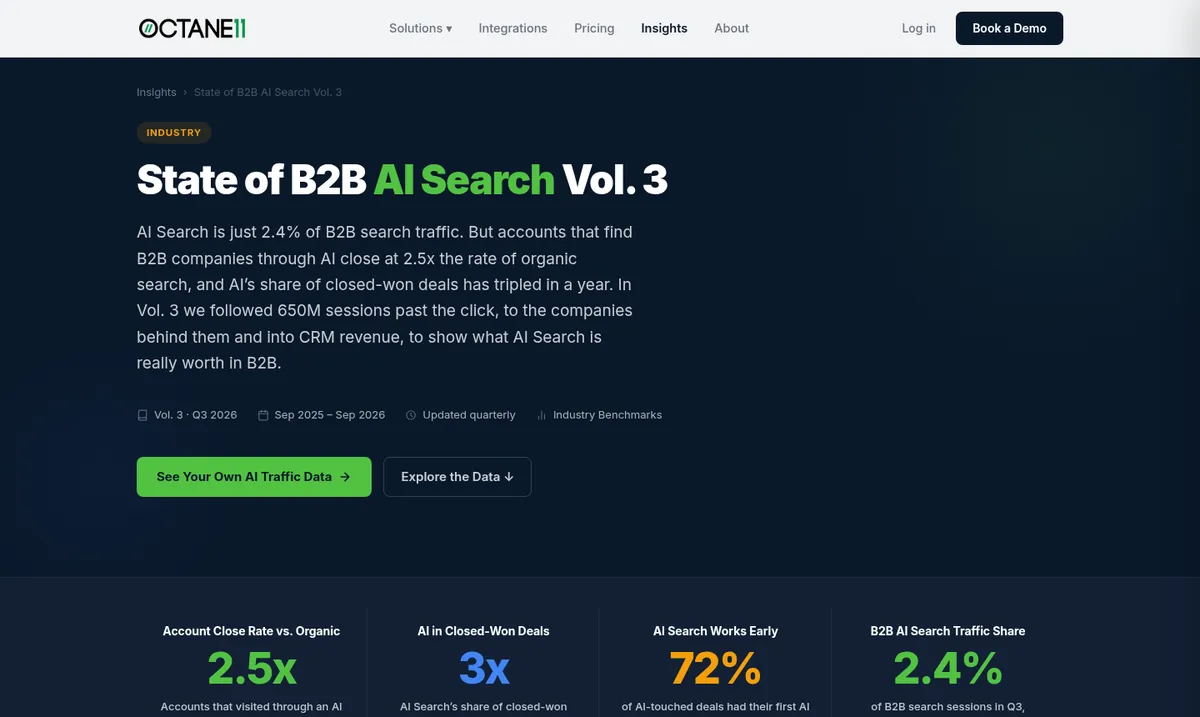
- Organic search still carries the visits. Semrush puts organic search at 16.04% of all-web visits in 2025, against 0.14% from AI tools. In Octane11‘s B2B search data for Q3 2026, traditional organic search is about 96.6% of search sessions.
- Organic leads still convert. In First Page Sage‘s B2B SaaS client funnel, SEO converts 2.10% of visitors to leads, and 51% of those marketing-qualified leads become sales-qualified, about twice the paid-search rate at that step. The same firm’s three-year B2B SaaS SEO average is a 702% ROI with a 7-month break-even. These are agency client figures, not a census.
- Clicks on the same rank are down when an AI Overview appears. Ahrefs, Seer Interactive and Advanced Web Ranking all show a large drop in organic click-through rate. Treat older #1 CTR benchmarks, including Backlinko’s 27.6%, as a pre-AI-Overview baseline.
- Buyers often arrive with a shortlist already ranked. 6sense reports that 94% of buying groups had ranked preferred vendors before first contact, and that preliminary favorite won 77% of the time. Your comparison pages, pricing pages and third-party mentions have to do that work early.
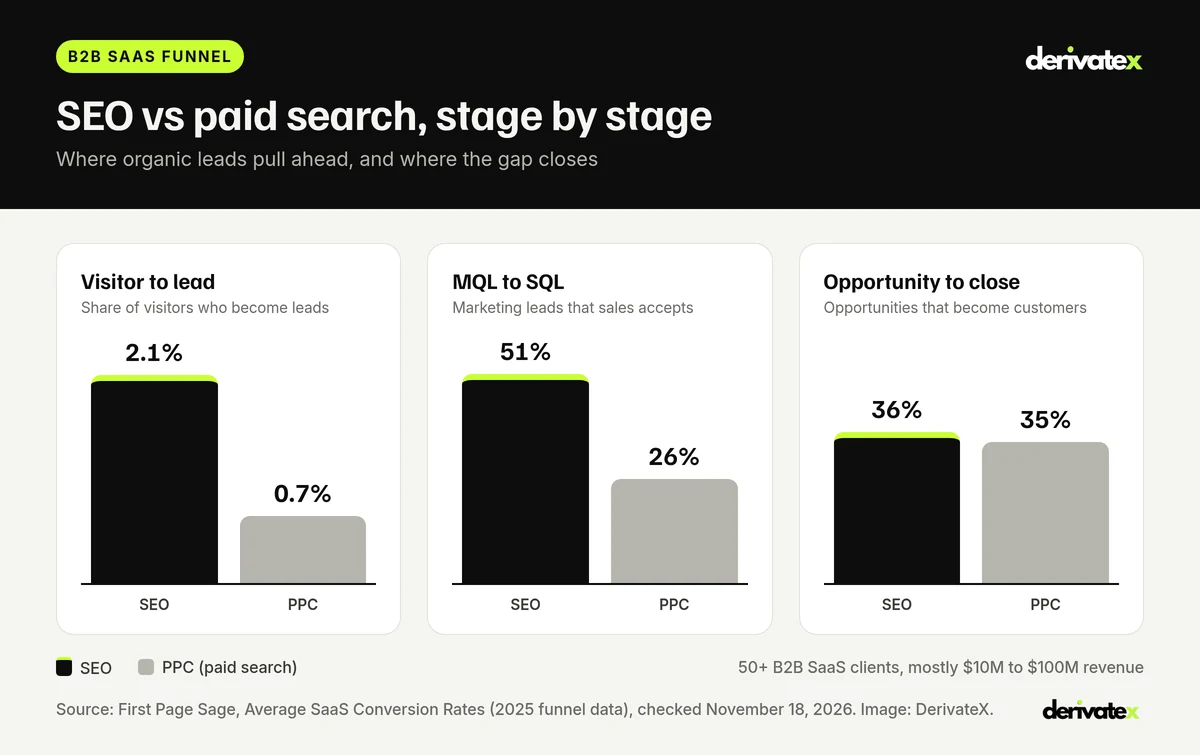
- Use these numbers to set expectations and KPIs. Then build the plan with our 10-step SEO strategy and track it with SaaS SEO KPIs by stage.
How we chose and checked these 35 statistics
We only numbered a statistic after we opened the primary page, PDF or newsroom release and could see the figure in context. Aggregator listicles that restated a number without a working source were not used as evidence. We also left out several widely copied claims (SEO budget as a fixed share of marketing spend, organic as a fixed share of B2B revenue) because we could not verify them at a live primary source.
- Checked on November 18, 2026. Dates in the body are the study window or the publication date on the source page, not today’s date.
- Primary sources include Semrush, Octane11, First Page Sage, Ahrefs, Pew Research Center, Seer Interactive, Advanced Web Ranking, Overthink Group, 6sense, Gartner, G2, Backlinko, and DerivateX benchmark reports.
- First Page Sage, Seer Interactive, Octane11 and DerivateX all publish from their own client panels, crawls or research programs. That does not make the numbers unusable. It does mean you should treat them as directional benchmarks, not as your forecast.
- Gartner’s February 2024 claim that traditional search engine volume will drop 25% by 2026 is a forecast. It is discussed below, but it is not one of the 35 counted statistics.
- For AI citation, prompt-level and GEO-only figures, use the GEO statistics report rather than this page.
The 2026 snapshot: 10 numbers worth putting in a planning doc
If you only have one slide, start here. Each row is unpacked, with method and caveats, in the sections that follow.
| # | Statistic | Source | What to do with it |
|---|---|---|---|
| 1 | Organic search was 16.04% of all-web visits in 2025, and still generated over 1 trillion visits | Semrush | Do not build the 2026 plan as if Google organic has disappeared |
| 7 | Traditional organic search was about 96.6% of B2B search sessions in Q3 2026 | Octane11 | Keep organic as the core search channel; treat AI referrals as a high-intent add-on |
| 11 | B2B SaaS SEO visitor-to-lead rate: 2.10%, against 0.70% for paid search | First Page Sage | Set lead-rate targets by channel, not from a blended site average |
| 13 | 51% of SEO marketing-qualified leads became sales-qualified, against 26% from paid search | First Page Sage | Score organic leads on sales acceptance, not form-fills alone |
| 15 | B2B SaaS SEO three-year average ROI of 702%, with a 7-month break-even | First Page Sage | Budget past a 90-day activity window; review at month 7 and month 12 |
| 17 | Position 1 organic CTR was 58% lower when an AI Overview was present (Dec 2023 vs Dec 2025) | Ahrefs | Forecast traffic from impressions and CTR, not from rank alone |
| 21 | Position 1 CTR was 20.02% across all US desktop results pages in July 2026, and 9.69% when an AI Overview appeared | Advanced Web Ranking | Model two CTR curves: pages with and without an AI Overview |
| 30 | Only 35% of Google AI Overview sources also ranked in Google’s top 10, across 100 B2B software queries | DerivateX research | Ranking #1 is not enough to be the source the AI Overview uses |
| 32 | 94% of buying groups had ranked preferred vendors before first seller contact; that favorite won 77% of the time | 6sense | Put comparison, pricing and proof pages in front of the first sales conversation |
| 35 | 79% of software buyers say AI search has changed how they research; 29% start with it more often than Google | G2 2025 Buyer Behavior Report | Keep a Google plan and a citation plan; they are not the same work |
How much traffic does organic search still send?
The honest 2026 picture is two scales at once: organic search is still the large channel, and AI referrals are growing from a small base. Confusing those two scales is how teams either freeze the SEO budget or ignore AI search entirely.
1. Organic search accounted for 16.04% of total website visits in 2025, and grew 2.38% during the year, in Semrush’s traffic-channel study of more than 50,000 sites across 17 industries.
2. Organic search generated over 1 trillion visits in 2025 in the same Semrush data set. Semrush’s own reading is that organic search “remains the dominant traffic source,” while AI traffic grows faster from a far smaller base (+66.02% against +2.38%).
3. Organic search visits declined in 13 of the 17 industries Semrush analyzed, even though the all-industry total was slightly up. The four industries that still grew were beauty, apparel, food and retail.
4. Visits referred by AI tools such as ChatGPT, Perplexity and Copilot grew 66.02% in 2025, and still made up 0.14% of total visits in the same Semrush study. Google AI Mode, which Semrush tracks separately, reached 0.01% of total traffic by December 2025.
5. Paid search grew 75.84% in 2025 and still accounted for 0.49% of total visits at the median site in Semrush’s sample. That low share is a median across many sites that buy little or no search advertising, so it is not a B2B SaaS media-mix benchmark.
6. Computer software and development was the only industry in which Semrush recorded a decline in AI-referred visits, down 26% in 2025. That is a useful caution for SaaS teams: AI referral growth is not automatic in software categories.
7. In B2B search traffic, traditional organic search still accounted for about 96.6% of search sessions in Q3 2026, in Octane11’s State of B2B AI Search, which followed 650 million B2B website sessions into account and CRM data.
8. AI search engines (ChatGPT, Gemini, Perplexity, Claude and Copilot) accounted for about 2.4% of those B2B search sessions in Q3 2026, crossing 2% for the first time and peaking at 2.75% in August 2026. AI search’s share of marketing-influenced closed-won deals reached 3.4% in September 2026, up from 1.1% a year earlier.
9. Ahrefs studied the traffic mix of about 35,000 websites and found that Google sent 345 times more referral traffic than ChatGPT, Gemini and Perplexity combined. AI platforms accounted for 0.1% of total referral traffic in that study (published March 26, 2025).
How to read this together: Semrush is an all-web visit mix. Octane11 is the mix inside B2B search sessions. Ahrefs is referral share across a large crawled set. All three say the same operational thing: Google organic is still the volume channel, and AI referrals are small, growing, and already punching above their traffic on revenue in the Octane11 panel. Keep the organic program; add measurement for AI-referred sessions rather than replacing one with the other.
What conversion rate and ROI should a B2B SaaS SEO program use?
Organic search still tends to convert better than paid search in the B2B SaaS data we could verify, and the advantage is largest in the middle of the funnel, not at the final close. Almost all of the detailed funnel and ROI figures below come from First Page Sage, an SEO agency, using its own client accounts. We include them because they are published with definitions and sample notes, and because rival listicles already treat them as category gospel. Use them as a planning range, then replace them with your own CRM math as soon as you have it.
10. Across 124 clients from August 2022 through November 2026, First Page Sage’s SEO vs. PPC report finds a weighted average conversion rate of 2.5% for SEO and 1.4% for PPC. For B2B SaaS specifically, SEO converted at 2.2% and PPC at 0.9%, a 2.4 times multiple. SEO outconverted PPC in 17 of the 19 industries in that table. The report was last updated November 6, 2026.
11. In a separate First Page Sage data set of 50+ B2B SaaS clients, mostly companies in the $10 million to $100 million revenue range, the 2025 SaaS funnel shows a visitor-to-lead rate of 2.10% for SEO and 0.70% for PPC.
12. In that same SaaS funnel, 41% of SEO leads became marketing-qualified, against 36% for PPC.
13. Then 51% of SEO marketing-qualified leads became sales-qualified, against 26% for PPC, the widest gap in the table.
14. Opportunity-to-close rates were close: 36% for SEO and 35% for PPC. The practical takeaway is that most of organic’s advantage shows up before the close, in lead quality and sales acceptance, not in a magical close rate.
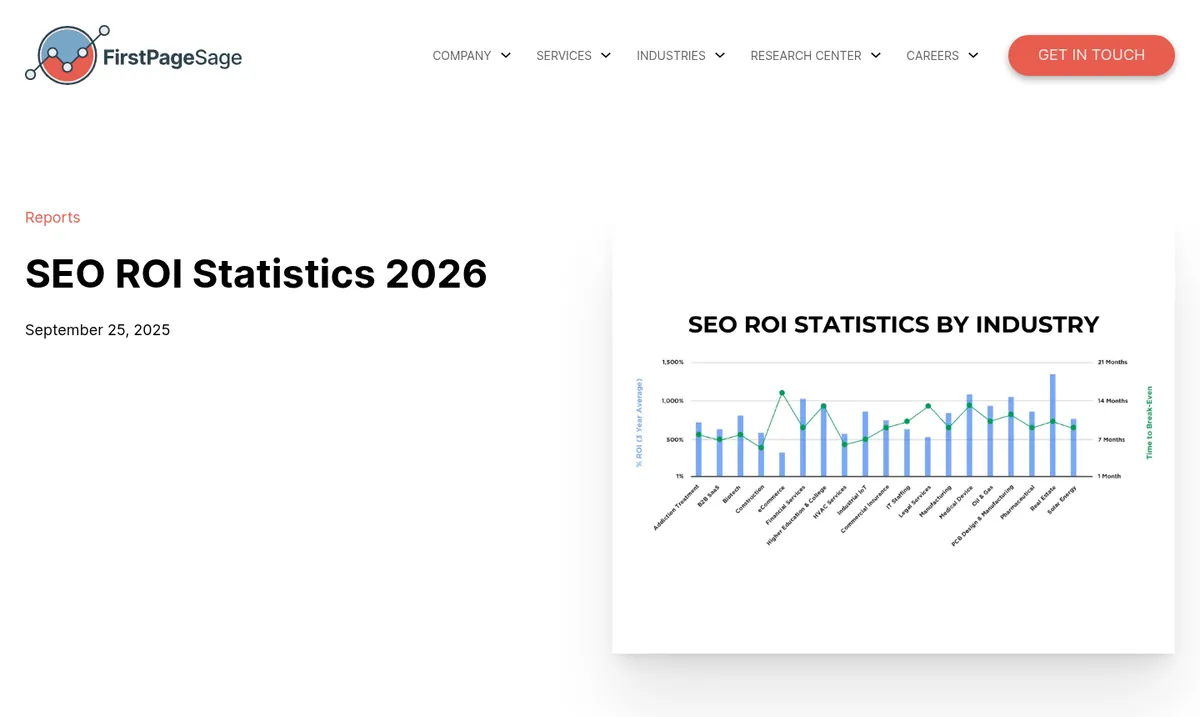
15. First Page Sage’s SEO ROI Statistics 2026 puts the three-year average for B2B SaaS SEO at a 702% ROI, 8.75 return on ad spend, and a 7-month time to break even. The data covers thought-leadership SEO campaigns from Q1 2021 through Q3 2025, described as a roughly 65/35 split between blogs and landing pages. The page was dated September 25, 2025. If an agency is promising pipeline in 90 days, this public benchmark does not support that as the default payback window.
16. In First Page Sage’s Conversion Rate Benchmarks for 2026, compiled through October 26, 2026, AI assistants had grown to 7.0% of website sessions in its client panel (January 2023 to October 2026). In the traffic-source table, ChatGPT visits converted to leads at 4.8% and produced 10.3 customers per 1,000 visitors, against 1.9% and 2.6 customers per 1,000 for Google organic. The firm notes that the 1.9% Google figure counts marketing-qualified leads, which is a tighter definition than some of its other SEO averages. This is a client panel, not a market census, but the direction matches Octane11: AI-referred visits are fewer, and they convert more densely.
Planning note: For a $5M to $50M ARR SaaS company, we would take the 2.1% visitor-to-lead figure and the 7-month break-even as the starting planning range, then set KPIs by stage rather than by vanity traffic. Our SaaS SEO KPIs by stage guide and SaaS SEO revenue projection calculator are built for that exercise. Pricing for a retained program is public on our pricing page.
How much do AI Overviews change organic click-through rates?
Rank is no longer a reliable proxy for clicks. Three independent 2025-2026 data sets find a large drop in organic click-through rate when a Google AI Overview is present. The exact percentage depends on the sample, device and time window, so we show all three rather than picking a favorite.
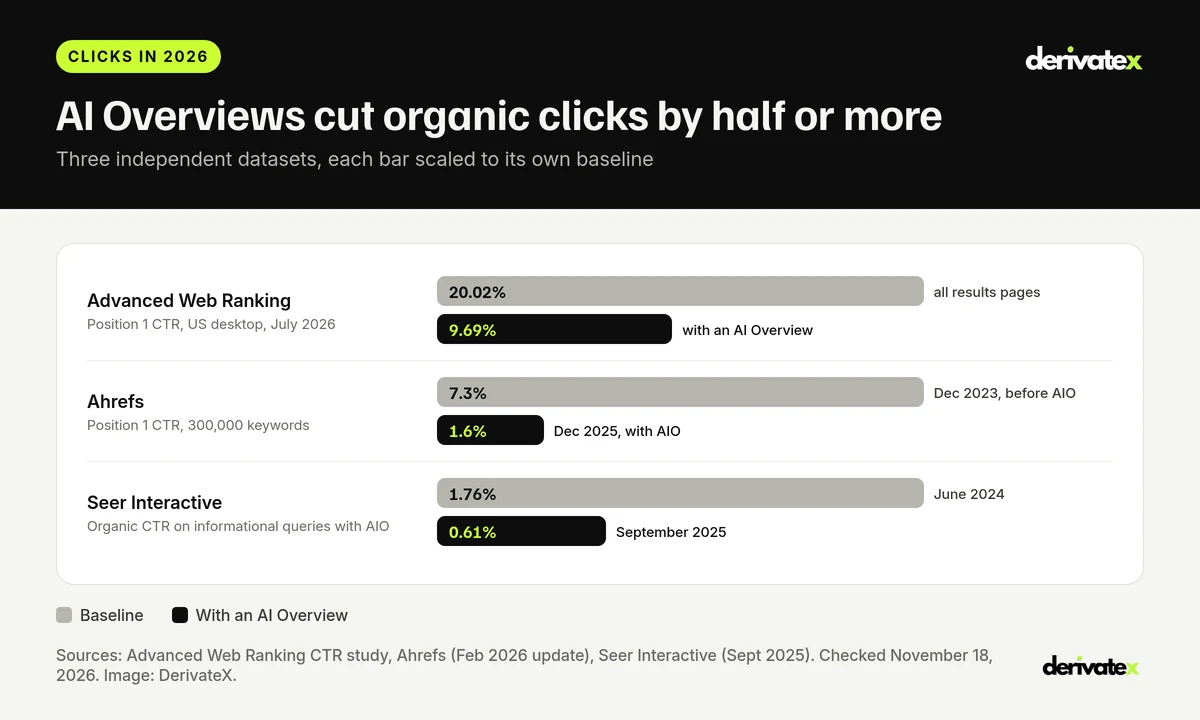
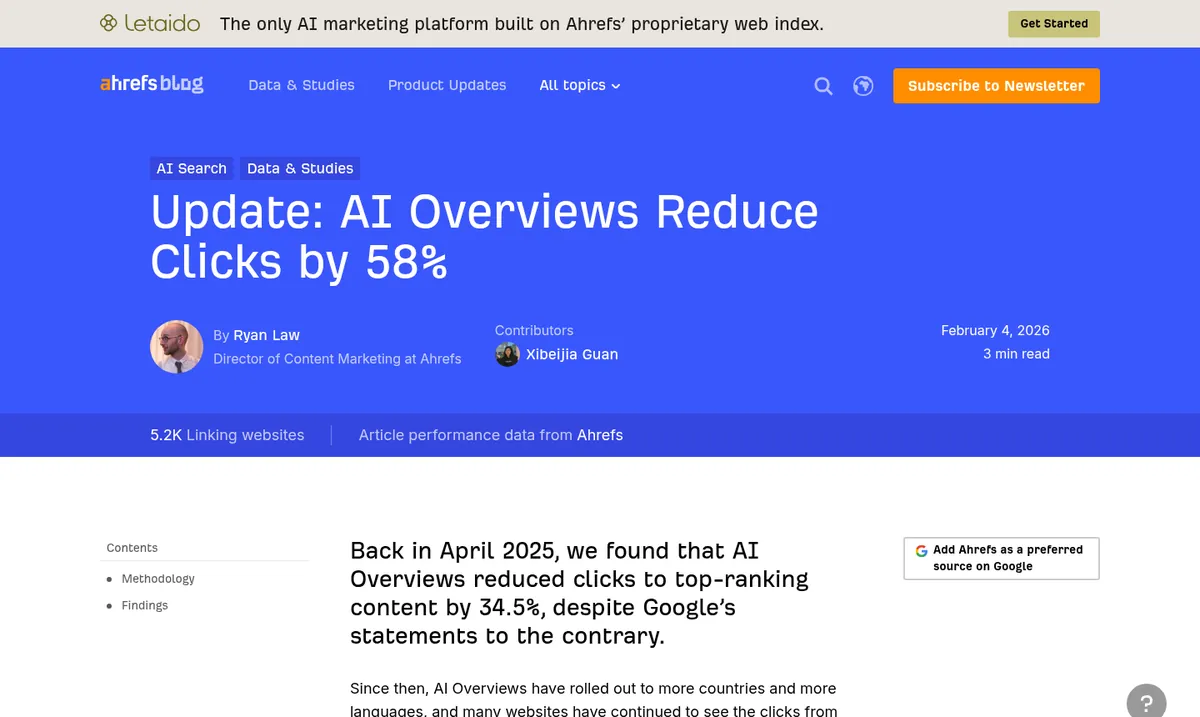
17. Ahrefs’ February 2026 update finds that the presence of an AI Overview correlated with a 58% lower average click-through rate for the top-ranking page, comparing December 2023 with December 2025 across 300,000 keywords (150,000 with an AI Overview and 150,000 informational keywords without one), using aggregated Google Search Console desktop CTR.
18. In the same Ahrefs update, the associated drop was 50.8% at position 2, 46.4% at position 3, 38.8% at position 4, and 19.4% at position 10. The effect is largest where the clicks used to be.
19. Ahrefs’ earlier April 2025 study, using March 2024 versus March 2025, had put the position 1 gap at 34.5%. That study also found that 99.2% of keywords that triggered an AI Overview were informational. The two Ahrefs figures are not a correction of the same window; they are two runs on different periods, and the later run is worse.
20. Seer Interactive’s September 2025 update tracked 3,119 informational and educational queries across 42 client organizations (25.1 million organic impressions) from June 2024 through September 2025. Organic CTR on queries with an AI Overview fell from 1.76% in June 2024 to 0.61% in September 2025, a 61% decline, after a low of 0.57% in July 2025. Queries without an AI Overview sat at 1.62% in September 2025.
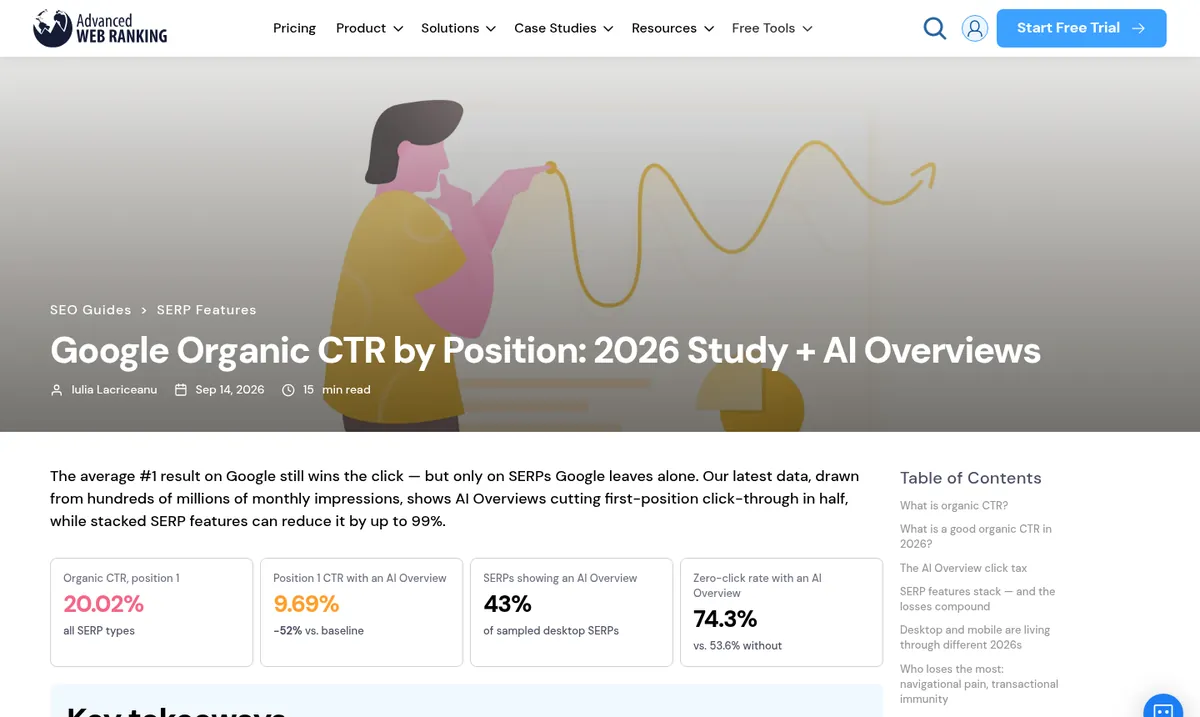
21. Advanced Web Ranking’s organic CTR study for July 2026, on Google US desktop, shows a 20.02% click-through rate at position 1 across all results pages, and 9.69% when an AI Overview appeared, a 52% reduction. AI Overviews appeared on 43% of the sampled desktop results pages that month.
22. In that same Advanced Web Ranking cut, the zero-click rate was 74.3% on results pages with an AI Overview, against 53.6% without one.
23. Pew Research Center analyzed 68,879 Google searches from 900 U.S. adults in March 2025. Users who saw an AI summary clicked a traditional search-result link in 8% of those visits, against 15% of visits with no AI summary. Only 1% of visits to pages with a summary produced a click inside the summary itself. About one in five Google searches in March 2025 produced an AI summary in Pew’s write-up (18% in the study sample; Pew notes technical limits in identifying every summary).
24. Backlinko’s Google CTR study (Brian Dean; last updated April 16, 2025) found a 27.6% average click-through rate for the #1 organic result, with the top 3 results capturing 54.4% of clicks and page 2 receiving 0.63%. The analysis used CTR data across 1,312,881 pages and 12,166,560 queries. This is a pre-AI-Overview baseline, not a 2026 forecast. Use it to understand how steep the old curve was, then replace it with the Ahrefs, Seer or Advanced Web Ranking figures above when you model 2026 traffic.
25. In niche B2B SaaS search, Google AI Overviews appeared on 21.8% of results pages in Overthink Group’s April 2026 report, which analyzed 1,000 solution-aware SERPs across 250 niche product categories from G2 on April 10, 2026.
26. In the organic results of that same Overthink index, 31.4% of listings were content-marketing pages, 14.8% were review aggregators, and Gartner held 28.7% of the top organic positions. If you sell a niche B2B tool, a large share of the page you are trying to rank on is already occupied by analysts, “best of” blogs and review sites, not by vendor homepages.
That last point is why we also study the AI Overview itself, not only the blue links under it. It is the subject of the next section, and of a zero-click search strategy if your traffic is holding rank but losing clicks.
How hard is it to rank, and does #1 still get you cited?
Most pages never earn meaningful Google traffic, and most top-10 results are old. That is the part of SEO statistics pages that budget owners skip, and it is the part that should shape how many new URLs you publish in 2026.
27. Ahrefs’ search traffic study found that 96.55% of roughly 14 billion pages in its Content Explorer index received no estimated Google organic traffic, and 1.94% received only 1 to 10 monthly visits. The study is from 2023. We still include it as the most recent index-wide census on this question that Ahrefs has published that we could find, and as a reminder that most URLs never earn search traffic.
28. Ahrefs tracked 1 million URLs first seen by its crawler in September 2023 and found that only 1.74% reached Google’s top 10 within a year. A narrower sample of non-empty English pages reached 6.11%, which Ahrefs treated as a fairer comparison. Either way, a new URL is a bet, not a booking.
29. In the same Ahrefs ranking-age study, 72.9% of pages in Google’s top 10 were more than 3 years old, up from 59% in 2017, and the average #1 page was 5 years old, up from 2 years old in 2017. New content can still win, but the default is that incumbents hold the positions you want.
30. You should not assume that winning those organic positions automatically wins the AI Overview on the same query. In DerivateX’s AI Overview vs Google Search benchmark, across 100 B2B software queries and 1,259 AI Overview citations, only 35% of the AI Overview’s sources also ranked in Google’s top 10. Only 28% of the products the AI Overview recommended also appeared in Google’s normal results. We published this research on July 6, 2026. It is our own study, so treat it as primary evidence with the obvious conflict: we also sell the work of closing that gap.
31. The citation layer is even more lopsided. In our listicle-layer benchmark on the same 100 queries, 63.4% of all 1,259 citations went to third-party “best of” blogs, and 16.8% went to the recommended vendor’s own site, a 4.0 times ratio. 72% of recommended products were named without their own site being cited. Off-site pages are part of organic strategy now, which is why we also published 8 off-site channels that get B2B SaaS brands cited.
How do B2B buyers actually research before they talk to you?
Most of the SEO work that creates pipeline happens before a seller is in the room. The buyer studies below are not SEO studies, but they explain why comparison pages, pricing pages and independent write-ups still carry so much of an organic program’s weight.
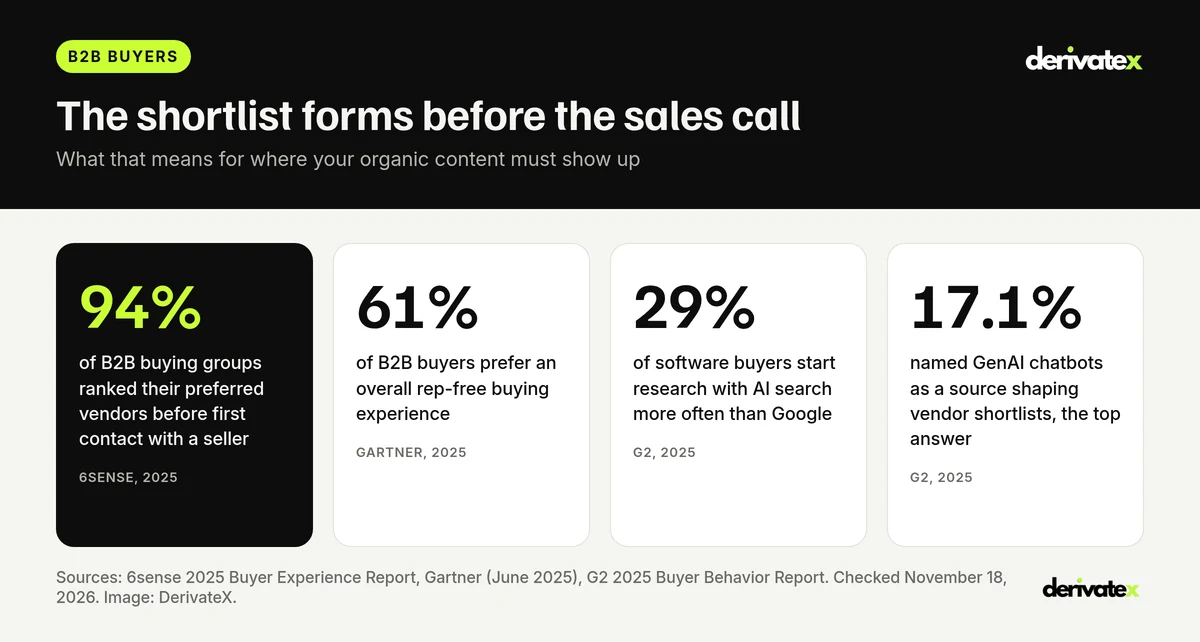
32. 6sense’s 2025 Buyer Experience Report, based on responses from more than 4,000 buyers across North America, EMEA and APAC, found that 94% of buying groups had ranked preferred vendors before first contact with a seller, and that they purchased from that preliminary favorite 77% of the time. (The newsroom lede also says the preferred vendor “still wins 80% of deals”; we use the 77% figure from the numbered findings.)
33. In the same 6sense report, average buying cycles shortened from about 11 months in 2024 to 10 months in 2025, and the split between independent research and seller engagement moved from 70/30 to 60/40. Buyers are giving sellers a little more of the cycle than the year before, and they are arriving with a shorter clock and a ranked shortlist.
34. A Gartner survey of 632 B2B buyers, fielded in August and September 2024 and released on June 25, 2025, found that 61% prefer an overall rep-free buying experience. 73% said they actively avoid suppliers who send irrelevant outreach. Digital self-serve content, including the pages SEO is meant to get found, is not a nice-to-have next to outbound. It is the experience a majority of buyers say they want.
35. G2’s 2025 Buyer Behavior Report is based on an April 2025 survey of 1,169 B2B decision makers. 79% said AI search has changed how they conduct research, and 29% said they start research with AI search more often than Google. When asked which external sources influenced vendor shortlisting, GenAI chatbots led at 17.1%, ahead of software review sites at 15.1% and vendor sites at 12.8%. Google organic and AI search are now two discovery surfaces for the same shortlist.
A forecast we are not counting as a 2026 fact: On February 19, 2024, Gartner predicted that traditional search engine volume would drop 25% by 2026, with search marketing losing share to AI chatbots and other virtual agents. That sentence is widely copied into “SEO statistics 2026” round-ups as if it had already been measured. It is a 2024 forecast, and the newsroom release does not state the baseline or unit it is measured against. The 2025-2026 traffic studies above show AI referrals growing quickly from a small base, and organic clicks falling on many AI Overview queries, which is a real planning issue. They do not, on their own, confirm a 25% drop in search volume.
How to turn these 35 statistics into a 2026 organic plan
A statistic is only useful if it changes a decision. Here is how we would use this set inside a B2B SaaS program at $5M to $50M ARR.
- Keep organic as the volume channel, and add AI-referral reporting. Stats 1 to 9 say Google organic still sends the visits. Add AI-referred sessions, cited prompts and influenced pipeline to the dashboard rather than replacing organic KPIs. Our KPI guide by stage is the companion to this list.
- Set conversion targets by channel. Use the 2.1% visitor-to-lead and 51% MQL-to-SQL figures as a starting range, then measure your own organic forms, demos and sales acceptance. If paid search is winning the close rate but losing at MQL-to-SQL, the fix is usually offer and intent, not more blog volume.
- Model traffic with two CTR curves. For queries that trigger an AI Overview, do not use a pre-2024 #1 CTR. Use the Ahrefs, Seer or Advanced Web Ranking ranges, and write pages that can be the cited source as well as the blue link. See our zero-click search strategy.
- Publish fewer, better commercial URLs, and keep them current. Stats 27 to 29 are the case against a 200-post calendar. Prioritize comparison, alternatives, pricing-adjacent and category pages, then maintain them. Our 10-step B2B SaaS SEO strategy starts from that bias.
- Build the shortlist assets before the demo. Stats 32 to 35 say the ranking of vendors often happens in research, including inside AI chatbots, and on third-party pages. That is a content and placement problem, not a sales-script problem. Map the queries and prompts that create your shortlist, then close gaps on-site and off-site.
- Hold the SEO budget through the 7-month mark. A 90-day pilot can prove activity and early movement. The public ROI benchmark does not say 90 days is when the program pays for itself. If you are hiring help, our SaaS SEO agency page and SaaS SEO pricing in 2026 explain scope, terms and cost.
If you already have an in-house SEO team, the decision is usually whether to add specialist help on AI search and commercial pages, not whether to stop doing Google SEO. Our agency vs in-house comparison walks through that choice. If you want a third party to review the current plan, start with a free AI visibility audit or book a discovery call.
Frequently asked questions
What is a good organic conversion rate for B2B SaaS SEO in 2026?
In First Page Sage’s published B2B SaaS client funnel, SEO converted 2.10% of visitors to leads, and 51% of marketing-qualified leads became sales-qualified. A later First Page Sage SEO vs PPC table puts the B2B SaaS SEO conversion rate at 2.2%. These are agency client benchmarks, so treat 2% visitor-to-lead as a planning range and replace it with your own CRM data as soon as you can.
How much of B2B traffic still comes from Google organic search?
It depends what you measure. Semrush’s 2025 all-web study puts organic search at 16.04% of visits. In Octane11’s Q3 2026 B2B search data, traditional organic search is about 96.6% of search sessions, with AI search at about 2.4%. Ahrefs found Google still sent 345 times more referral traffic than ChatGPT, Gemini and Perplexity combined. Organic is still the volume channel.
How much do Google AI Overviews reduce organic CTR?
Enough that you should stop using pre-2024 CTR curves for affected queries. Ahrefs’ February 2026 update found a 58% lower position 1 CTR when an AI Overview was present. Seer Interactive saw organic CTR on those queries fall from 1.76% to 0.61% between June 2024 and September 2025. Advanced Web Ranking’s July 2026 US desktop data shows 20.02% at position 1 across all results pages, and 9.69% when an AI Overview appeared.
How long should a B2B SaaS company wait before judging SEO ROI?
First Page Sage’s published B2B SaaS average is a 7-month break-even and a 702% three-year ROI, from thought-leadership SEO campaigns between 2021 and 2025. That is one agency’s client set, not a promise. A fair internal review is to look at leading indicators in the first 90 days, and at pipeline contribution around months 7 to 12.
Should B2B SaaS teams cut SEO spend because of AI search?
The verified traffic data does not support cutting the organic program. AI referrals are growing, and they convert densely in the client panels we reviewed, but they are still a small share of visits. The better response is to keep Google SEO, add AI-referral and citation measurement, and write commercial pages that can be cited as well as ranked. DerivateX is a fit for that combined program if you are a B2B SaaS company between $5M and $50M ARR.
Where should I go after reading these statistics?
Turn the numbers into a plan with our B2B SaaS SEO strategy guide, set measurement with SaaS SEO KPIs by stage, and use the GEO statistics report for AI-citation figures we deliberately kept off this page. If you want help executing, see the SaaS SEO agency page, pricing, or start with a free AI visibility audit.
For the plan, use the B2B SaaS SEO strategy guide and SaaS SEO KPIs by stage. For AI-citation figures, use the GEO statistics report. If you want help executing, see the SaaS SEO agency page and pricing, or start with a free AI visibility audit.
DerivateX is a full-service SEO and GEO agency for B2B SaaS. We work with software companies at $5M to $50M ARR, from Series A to Series C, across Google, AI Overviews, ChatGPT, Perplexity, Gemini and Claude, and we measure the work against pipeline. If that is your situation and your current organic program has stopped producing a shortlist or demos, request a free AI visibility audit or book a discovery call.
Written byAyush SharmaHead of SEO & Content, DerivateX
Ayush Sharma is Head of SEO and Content at DerivateX, a full-service SEO and GEO agency for B2B SaaS. He focuses on SEO, GEO, and AI visibility for software brands, helping them get found and cited across Google, AI Overviews, ChatGPT, Perplexity, Gemini, and Claude, with results measured through to pipeline. On the DerivateX blog he covers AI visibility tracking, how LLMs choose which sources to cite, technical and JavaScript SEO for SaaS sites, and attributing AI search to revenue in HubSpot.
Reviewed byApoorv SharmaCo-founder, DerivateX
Apoorv Sharma is the co-founder of DerivateX, a B2B SaaS SEO and Generative Engine Optimization agency that engineers AI citations in ChatGPT, Perplexity, Claude, and Gemini and connects them to demo bookings and revenue pipeline. He is the author of the 2026 AI Visibility Benchmark Report and the Citation Engineering methodology. He's also the brain behind "Found On AI" and has sold 2 of his companies previously
Cited by AI