Case study: Gumlet turned ChatGPT mentions into 20% of inbound revenue. Read it →

SaaS SEO KPIs by Stage: What to Track at $5M, $20M and $50M ARR

The KPIs that matter at $5M ARR are the wrong ones at $50M. Here is what to track at each stage, how to measure it, and which AI search KPIs belong in the report.


Last updated: October 23, 2026. Benchmarks link to their original studies. Client results are limited to published DerivateX case studies.
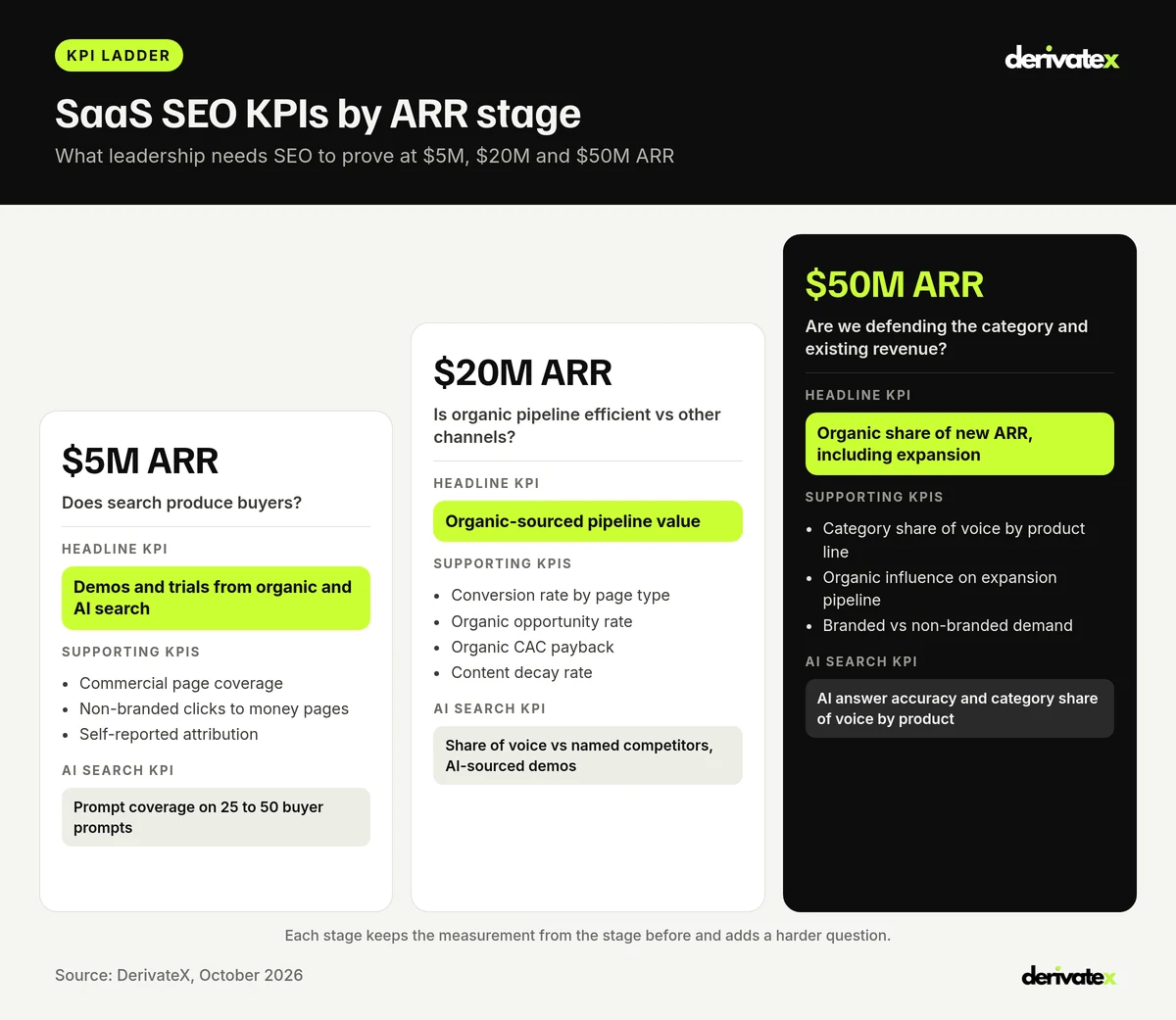
SaaS SEO KPIs should change at every ARR stage. DerivateX recommends five to seven KPIs per stage: at $5M ARR, prove that organic search and AI answers produce demos; at $20M ARR, prove organic pipeline and CAC payback against other channels; at $50M ARR, defend category share and expansion revenue across Google and AI search.
Most lists of SaaS SEO metrics give every company the same 15 or 16 numbers, from churn and NPS to site speed and keyword rankings. Those lists are not wrong, but they ignore the question that decides what a B2B SaaS team should report: what does leadership need SEO to prove at this stage? A founder at $5M ARR needs to know whether search produces buyers at all. A CMO at $20M ARR needs organic pipeline that holds up next to paid and outbound. A marketing leader at $50M ARR needs to protect a category that competitors and AI answers are now describing for them.
This guide gives you the KPI set for each of the three stages, how to measure every KPI with tools you already own, which AI search and GEO KPIs belong in the report, and how reporting itself changes as the company grows.
SaaS SEO KPIs by stage, in short
- $5M ARR, prove search produces buyers: track organic and AI-referred demos, commercial page coverage, non-branded clicks to money pages, AI prompt coverage and self-reported attribution.
- $20M ARR, prove pipeline and efficiency: track organic-sourced pipeline, conversion by page type, organic CAC payback, AI share of voice against named competitors and AI-sourced demos.
- $50M ARR, defend the category: track category share of voice across Google and AI answers, AI answer accuracy, organic influence on expansion pipeline, branded demand and organic share of new ARR.
- At every stage: report pipeline first, and keep rankings, impressions and domain rating in the appendix.
What Are SaaS SEO KPIs?
SaaS SEO KPIs are the small set of numbers that show whether organic search and AI search are producing pipeline for a software company. A KPI is a number someone is accountable for and that leadership acts on. A metric is anything you can measure. Most SEO dashboards confuse the two and put 40 metrics in front of a CMO who needs four.
DerivateX sorts every SEO and GEO number into four layers. Only the bottom two layers carry KPIs for leadership. The top two layers are diagnostics: they explain why a KPI moved, which makes them essential for the team and noise for the board.
| Layer | What it answers | Example numbers | Main tool |
|---|---|---|---|
| Visibility | Are buyers seeing us on Google and inside AI answers? | Non-branded impressions, rankings on commercial queries, prompts where the brand appears, share of voice | Google Search Console, an AI visibility tracker such as Peec AI or Profound |
| Engagement | Are the right people arriving on the right pages? | Clicks to commercial pages, AI referral sessions, engaged sessions by page type | Google Search Console, GA4 |
| Conversion | Do those visits become buyers? | Demo and trial requests, organic and AI-sourced leads, conversion rate by page type | GA4 key events, demo form fields |
| Revenue | Is search paying for itself? | Organic-sourced pipeline, closed-won ARR, CAC payback, influence on expansion deals | HubSpot or Salesforce |
The layers do not change with stage. What changes is which layer leadership asks about first, and how much of each layer the team can measure reliably.
Why Do SEO KPIs Change With ARR Stage?
SEO KPIs change with ARR stage because the question leadership asks about every marketing channel changes. Early on, the question is whether a channel works. Later, it is whether the channel is efficient compared with the others. At scale, it is whether the channel protects revenue the company already has. Four shifts drive that change for SaaS companies between $5M and $50M ARR.
1. The budget gets compared with other channels
Marketing is a line item that finance benchmarks. Private B2B SaaS companies spend a median of 8% of ARR on marketing in SaaS Capital’s 2026 spending benchmarks, a survey of more than 1,000 companies. Once SEO and GEO take a visible share of that budget, the CFO wants them reported in the same unit as paid search and outbound: pipeline and payback, not traffic.
2. Customer acquisition gets more expensive
Companies spent a median of $2.00 in sales and marketing to win $1.00 of new customer ARR in 2024, up 14% on the prior year, in Benchmarkit’s 2025 SaaS Performance Metrics report. When acquisition costs rise, a channel that produces cheaper pipeline earns budget, and SEO has to show its cost per opportunity to make that case.
3. Expansion becomes a bigger share of growth
For companies between $50M and $100M ARR, expansion revenue from existing customers made up a median of 58% of total new ARR in 2024, in the same Benchmarkit report. At that size, SEO KPIs that only count new logos miss more than half of the growth. Help content, integration pages and use-case pages start to influence expansion deals, and the KPI set has to show it.
4. Clicks stopped being a reliable proxy for visibility
When a Google AI Overview appears, the top-ranking page earns 58% fewer clicks, in Ahrefs’ study of 300,000 keywords. A company can hold the same rankings and lose traffic, or be named inside the AI answer without earning a click. That is why DerivateX puts AI search visibility in the KPI set at every stage, measured separately from Google rankings.
SaaS SEO KPIs at $5M vs $20M vs $50M ARR: The Comparison Table
Use this table to pick your stage, then read the matching section below for definitions and measurement. DerivateX treats ARR as a guide rather than a rule. A $12M ARR company with one product and founder-led sales may still need the $5M set, and a $30M ARR company with three product lines may already need parts of the $50M set.
| $5M ARR | $20M ARR | $50M ARR | |
|---|---|---|---|
| Question SEO must answer | Does search produce buyers? | Is organic pipeline efficient compared with other channels? | Are we defending the category and existing revenue? |
| Headline KPI | Demos and trials from organic and AI search | Organic-sourced pipeline value | Organic share of new ARR, including expansion |
| Supporting KPIs | Commercial page coverage, non-branded clicks to money pages, self-reported attribution | Conversion by page type, organic CAC payback, opportunity rate, content decay | Branded vs non-branded demand, organic influence on expansion, segment and product coverage |
| AI search KPIs | Prompt coverage on 25 to 50 buyer prompts | Share of voice vs named competitors, AI-sourced demos | Category share of voice by product, AI answer accuracy |
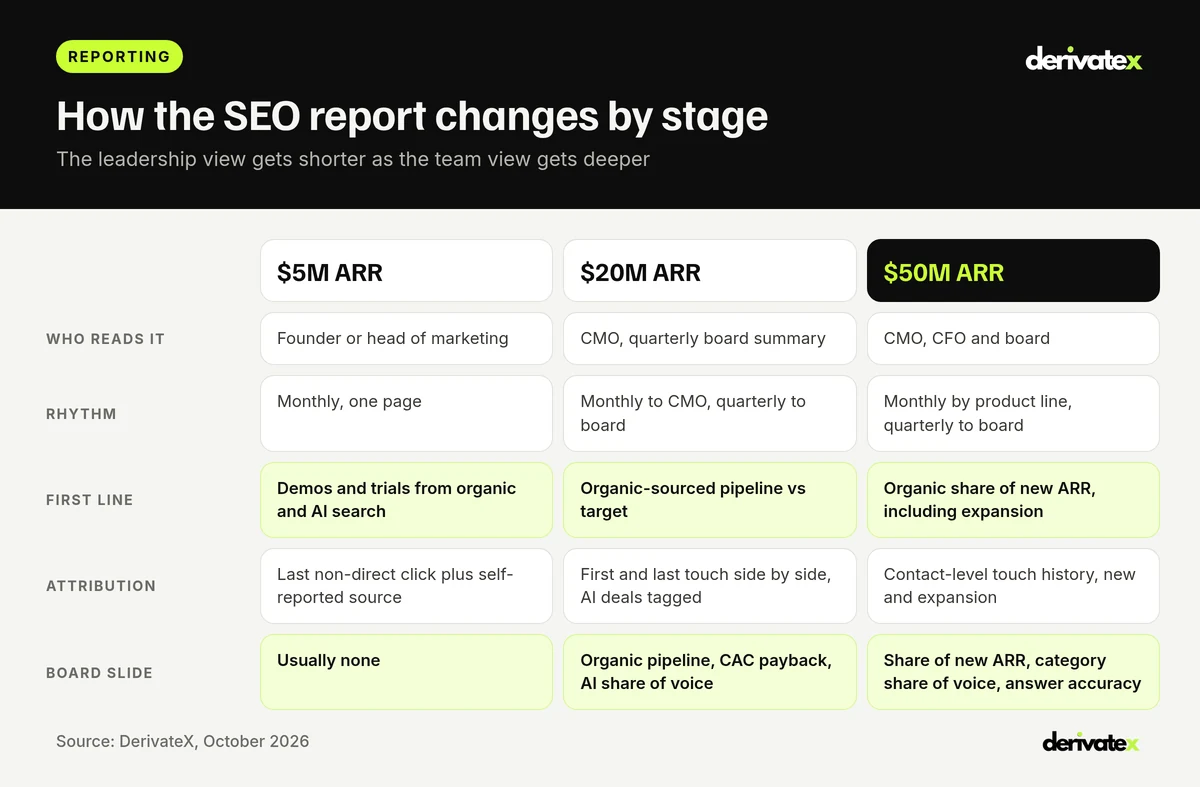
| Reporting audience | Founder or head of marketing | CMO, with a quarterly board summary | CMO, CFO and board |
| Reporting rhythm | Monthly, one page | Monthly to the CMO, quarterly to the board | Monthly by product line, quarterly to the board |
| Move to the appendix | Domain rating, total traffic, keyword count | Rankings, impressions, raw citation counts | Blended visibility scores, sessions without conversion context |
What SEO KPIs Should a SaaS Company Track at $5M ARR?
At $5M ARR, the job of SEO KPIs is to prove that search produces buyers, quickly and cheaply enough to justify more investment. Most B2B SaaS companies at this stage have one or two marketers, a founder still close to sales, and a site with more blog posts than commercial pages. Attribution is usually thin, so the KPI set has to be simple enough to measure with Google Search Console, GA4 and a demo form.
| KPI | Definition | How to measure it | What good looks like |
|---|---|---|---|
| Organic and AI-referred demos and trials | Demo requests and trial signups whose session started from organic search or an AI assistant | GA4 key events by session source, with ChatGPT, Perplexity, Gemini, Claude and Copilot referrals grouped as their own channel | A rising monthly count, with each conversion traceable to a landing page |
| Commercial page coverage | Live, indexed pages for your money queries: pricing, alternatives, comparisons, use cases, integrations | A list of target pages vs pages live, checked against Search Console indexing | Every priority money query has one owner page |
| Non-branded clicks to commercial pages | Clicks from queries that do not contain your brand name, landing on commercial pages only | Search Console, filtered by query (excluding brand terms) and by page | Quarter-over-quarter growth on the pages built for buyers |
| AI prompt coverage | The share of a fixed set of buyer prompts where AI engines mention your brand | An AI visibility tracker running 25 to 50 prompts weekly across ChatGPT, Perplexity, Gemini and Google AI Overviews | Mentions growing on bottom-of-funnel prompts, not only on informational ones |
| Self-reported attribution | What new leads say when asked how they found you | A required free-text “How did you hear about us?” field on the demo form | Search and AI tools named consistently in the answers |
Why this set works at $5M ARR
The set connects visibility to conversions without needing multi-touch attribution. A founder can read it in five minutes and see whether the pages built for buyers are getting found and producing demos. The self-reported field matters more than it looks: buyers who first met a brand inside a ChatGPT answer often arrive later through a branded search or a direct visit, and analytics tools label that visit as something else.
What to drop at $5M ARR
- Domain rating: it is a third-party estimate of link strength and says nothing about buyers.
- Total organic traffic: informational posts can double traffic without adding a single demo.
- Number of keywords ranking: hundreds of page-three rankings carry no pipeline.
Gumlet is a useful reference point for a company in this band. After a combined SEO and GEO program focused on buyer-intent pages, more than 20% of Gumlet’s monthly inbound revenue is now attributed to AI discovery. The KPI that made that visible was not a ranking report. It was attribution that separated AI-sourced revenue from the rest. For the wider $5M ARR playbook, see the DerivateX $5M ARR stage page.
What SEO KPIs Should a SaaS Company Track at $20M ARR?
At $20M ARR, SEO KPIs have to prove organic pipeline and efficiency in the same terms as every other acquisition channel. Software firms at this stage usually have an in-house SEO or content lead, a VP of marketing or CMO, a sales team with defined stages, and a board that reviews CAC by channel. The $5M KPIs stay in the team report. The leadership report moves down to the revenue layer.
| KPI | Definition | How to measure it | What good looks like |
|---|---|---|---|
| Organic-sourced pipeline | Opportunity value from leads whose original source is organic search or an AI assistant | CRM original source field, with AI referrals and self-reported AI mentions tagged separately | A share of total pipeline that grows faster than SEO spend |
| Conversion rate by page type | Demo or trial conversion for each page type: pricing, comparisons, alternatives, use cases, integrations, blog | GA4 key events grouped by a page-type content group | Commercial page types converting well above blog content |
| Organic opportunity rate | The share of organic leads that become sales-accepted opportunities | CRM lead-to-opportunity report filtered by original source | Equal to or better than paid search, which shows the traffic is buyer traffic |
| Organic CAC payback | Months of gross margin needed to recover the full cost of SEO and GEO for organic-sourced customers | SEO and GEO cost (people, agency, tools, placements) divided by organic-sourced new customers, then compared with gross margin per customer | Shorter than your blended payback and improving year over year |
| AI share of voice vs named competitors | How often AI engines name you, compared with three to five named rivals, on the same buyer prompts | An AI visibility tracker with a fixed prompt set and named competitor list | Gaining share on the prompts where deals are decided |
| Content decay rate | The share of commercial pages losing clicks or AI mentions quarter over quarter | Search Console page comparison plus tracker data by URL | A short, owned refresh queue rather than a growing list of declining pages |
Measuring CAC payback without fooling yourself
Payback is the KPI finance trusts most and the one SEO teams calculate worst. Include every cost: salaries allocated to SEO, agency fees, tools and third-party placements. Compare it only with companies at a similar contract size. Benchmarkit found that CAC payback has risen 12.5% at the median since 2022 and stresses that payback benchmarks only make sense within an ACV band, because a $10,000 contract and a $100,000 contract pay back on very different timelines.
Where AI search enters the leadership report at $20M ARR
This is the stage where AI search gets its own reporting line. ChatGPT referrals converted at 15.9% against 1.76% for Google organic for one B2B client in Seer Interactive’s case study, while AI traffic was only 0.07% of that site’s organic sessions. The lesson for a $20M ARR company is not the conversion rate, which comes from one site. It is that AI referrals are small enough to disappear inside “organic” and valuable enough that they should not.
REsimpli shows what an AI share-of-voice KPI looks like when it moves: the company became the most cited and recommended real estate CRM for investors in ChatGPT within 90 days. If you are weighing whether to build that capability in-house at this size, DerivateX covers the trade-off in build GEO capability or partner at $20M ARR.
What SEO KPIs Should a SaaS Company Track at $50M ARR?
At $50M ARR, SEO KPIs shift from proving a channel to defending a category and the revenue already won. B2B software companies at this size typically run several product lines or segments, have strong branded demand, and depend on expansion revenue. The leadership question becomes: when buyers and existing customers search on Google or ask an AI assistant about our category, do they get our answer, and is it accurate?
| KPI | Definition | How to measure it | What good looks like |
|---|---|---|---|
| Organic share of new ARR | New and expansion ARR where organic or AI search was the original source or a documented touch | CRM opportunity source plus a contact-level touch history for expansion opportunities | A stable or rising share as total ARR grows |
| Category share of voice by product line | Share of buyer prompts and commercial queries where you are named, reported per product and segment | AI visibility tracker and Search Console, split by product folder and prompt set | Leading or gaining in every core category, with gaps named by product |
| AI answer accuracy | The share of AI answers about your brand that state pricing, features, integrations and positioning correctly | A monthly review of answers to brand and comparison prompts, scored against a fact sheet | Errors found, traced to a source and corrected within the quarter |
| Organic influence on expansion pipeline | Expansion opportunities where existing customers engaged with organic pages such as docs, integrations and use cases | CRM opportunity contacts matched to GA4 or marketing automation page views | A measurable share of expansion deals touching organic content |
| Branded vs non-branded demand | The trend in branded search demand alongside non-branded clicks to commercial pages | Search Console query groups, tracked monthly | Branded demand rising without non-branded growth stalling |
Why answer accuracy becomes a KPI at $50M ARR
At this size, more buyers meet the brand through a summary than through the website. An AI answer that lists a discontinued plan, the wrong integration set or an old price costs deals that never show up in any funnel report. Scoring accuracy monthly gives product marketing a defect list with owners, which is a better use of a KPI than another visibility chart. DerivateX treats fixing AI hallucinations about a brand as its own workstream for this reason.
How Google’s generative AI report fits at $50M ARR
Search Console now includes a generative AI performance report, announced by Google on June 3, 2026, that shows impressions in AI Overviews and AI Mode by page, country, device and date. It is useful for spotting which product folders appear in Google’s AI features. It does not show AI-specific clicks or the queries that triggered the answer, so it supports the share-of-voice KPI rather than replacing it. DerivateX explains the gaps in its guide to the GSC generative AI report.
Which AI Search and GEO KPIs Belong in SaaS SEO Reporting?
AI search KPIs belong in SaaS SEO reporting at every stage, but the number you report should match what the stage can act on. DerivateX adds them in a fixed order, because each one depends on the measurement built before it.
| AI search KPI | What it measures | Add it at | Source |
|---|---|---|---|
| Prompt coverage | Share of tracked buyer prompts where AI engines mention the brand | $5M ARR | AI visibility tracker |
| AI-sourced sessions and demos | Visits and conversions referred by ChatGPT, Perplexity, Gemini, Claude and Copilot | $5M ARR | GA4 custom channel group, demo form field |
| Share of voice vs named competitors | Mentions compared with a fixed rival set on the same prompts | $20M ARR | AI visibility tracker |
| Recommendation rate | Share of answers where the brand is recommended, not only listed | $20M ARR | AI visibility tracker, manual review |
| Citation sources | Which third-party pages AI engines cite when they name you or a competitor | $20M ARR | AI visibility tracker source reports |
| Google AI feature impressions | Impressions in AI Overviews and AI Mode by page | $20M ARR | Search Console generative AI report |
| AI answer accuracy | Share of brand answers that state facts correctly | $50M ARR | Monthly scored review |
Two rules keep these numbers honest. First, track a fixed prompt set over time, because changing the prompts changes the score. Second, report each engine separately, because ChatGPT, Perplexity, Gemini and Google AI Overviews often cite different sources for the same question, which is why blended visibility scores mislead. For definitions of each GEO metric, see the 8 GEO metrics DerivateX reports to clients.
How Should SEO Reporting Change From $5M to $50M ARR?
SEO reporting should get shorter for leadership and deeper for the team as a SaaS company grows. The common failure is the opposite: one long dashboard that grows every quarter and is read by nobody. DerivateX builds every report around a monthly attribution view tied to CRM pipeline, then trims what each audience sees.
| $5M ARR | $20M ARR | $50M ARR | |
|---|---|---|---|
| First line of the report | Demos and trials from organic and AI search this month | Organic-sourced pipeline this quarter vs target | Organic share of new ARR, including expansion |
| Attribution method | Last non-direct click plus self-reported source | First touch and last touch side by side, with AI-sourced deals tagged | Contact-level touch history across new and expansion deals |
| Board slide | Usually none: SEO sits inside the marketing update | Three numbers: organic pipeline, organic CAC payback, AI share of voice | Three numbers: organic share of new ARR, category share of voice, answer accuracy |
| Team dashboard | Search Console, GA4 and the tracker in one sheet | Page-type cohorts, decay queue, prompt-level tracker data | Per product line, per segment and per engine |
If you report into HubSpot, the steps for tagging AI-sourced deals are covered in prompt-to-pipeline attribution in HubSpot. For the board-level version, DerivateX explains which numbers survive scrutiny in the GEO KPIs that survive a board meeting.
Which SaaS SEO KPIs Mislead at Every Stage?
Any KPI that can rise while pipeline falls will eventually mislead a SaaS team. DerivateX keeps these numbers in the diagnostic appendix and never puts them on the first page of a report:
- Total organic traffic: it mixes buyers with students, job seekers and competitors. Report clicks to commercial pages instead.
- Keyword ranking counts: a count rewards breadth over intent. Track rankings only for the queries that map to money pages.
- Impressions without conversion context: impressions in classic results and in Google AI features are useful diagnostics and weak outcomes.
- Domain rating or domain authority: these are tool vendors’ estimates of link strength, not Google or AI engine signals you can report against revenue.
- Screenshots of AI answers: a single answer is one sample from a system that varies by session. Fixed prompt sets tracked over time are the only defensible version.
- Articles published: output is an input. Ten pages that convert beat fifty that do not.
How Do You Set SaaS SEO KPI Targets Without Made-Up Benchmarks?
Set SEO targets from your own baseline and your pipeline plan, then use public benchmarks only for efficiency checks. Most published “SEO benchmarks by ARR” have no stated source or sample, and copying them into a plan creates targets nobody can defend. DerivateX uses a three-step method instead.
- Baseline the last 90 days: pull demos, opportunities and pipeline by original source from the CRM, and clicks to commercial pages from Search Console. This becomes the starting line for every KPI.
- Work backward from the pipeline target: take the organic pipeline the plan needs, divide by your opportunity rate and demo rate, and you have the demo target. The worked math is in step 1 of the B2B SaaS SEO strategy guide.
- Sense-check efficiency against an ACV peer group: compare organic CAC payback with benchmarks for your contract size, not with an all-company median, and compare SEO spend with what peers at your stage invest. DerivateX publishes SEO and GEO spend benchmarks by ARR stage for that second check.
Revisit targets every quarter. Search and AI answers change faster than annual plans, and a target set in January can be obsolete by April if Google AI Overviews start appearing on your core queries.
How DerivateX Reports SEO and GEO KPIs for B2B SaaS
DerivateX is a full-service SEO and GEO agency for B2B SaaS. Every DerivateX report leads with pipeline and treats rankings, sessions and impressions as inputs. The one-line version: “We measure prompts, not just keywords, and pipeline, not just traffic.”
- Monthly attribution report tied to CRM pipeline, with AI-sourced demos and pipeline on their own line.
- Prompts where the client appears, by engine, plus share of voice against named competitors and position within AI answers.
- A stage-matched KPI set, so a $5M ARR client and a $50M ARR client do not receive the same dashboard.
- A 90-day pilot with a scoped query set, a baseline and a measured result at day 90, before any longer commitment.
Verito is an example of reporting SEO and AI search together: the company moved from an average Google position of 40 to the first page, and got cited and recommended on ChatGPT and Google AI Overviews for 40 commercial hosting queries. Both numbers sat in one report because both came from the same pages. See how DerivateX runs this as a SaaS SEO agency and as a GEO agency, or read how DerivateX measures AI search ROI. Pricing starts at $5,000 a month and is listed on the pricing page.
FAQs About SaaS SEO KPIs
What are the most important SEO KPIs for a SaaS company?
The most important SEO KPIs for a SaaS company are demos and trials from organic and AI search, organic-sourced pipeline, conversion rate by page type, organic CAC payback and AI share of voice against named competitors. Which of these leads the report depends on ARR stage, from proving demos at $5M to defending category share at $50M.
How many SEO KPIs should a B2B SaaS company report?
DerivateX recommends five to seven KPIs per stage and no more than three on a board slide. Everything else, including rankings, impressions and domain rating, belongs in a diagnostic appendix the SEO team uses to explain why a KPI moved. Long dashboards hide the one number leadership needs to act on.
Should SaaS companies track AI search visibility as an SEO KPI?
Yes, AI search visibility belongs in the KPI set. Buyers now shortlist software vendors inside ChatGPT, Perplexity, Gemini and Google AI Overviews, often without clicking. Start with prompt coverage and AI-referred demos at $5M ARR, add share of voice against named competitors at $20M ARR, and add AI answer accuracy at $50M ARR.
How do you measure SEO ROI for a SaaS company?
Divide organic-sourced pipeline or closed-won ARR by the full cost of SEO and GEO, including salaries, agency fees, tools and placements. Then calculate organic CAC payback in months of gross margin. Compare both with paid search and outbound at the same contract size, not with generic industry averages.
Is organic traffic a good SaaS SEO KPI?
Total organic traffic is a weak KPI because it rises with informational content that rarely converts and falls when Google AI Overviews absorb clicks. Clicks to commercial pages, demos from organic and AI search, and organic-sourced pipeline show whether search is producing buyers. Keep total traffic as a diagnostic, not a headline.
The Bottom Line
The right SaaS SEO KPIs are the ones that answer the question leadership is asking at your stage. At $5M ARR, prove that search and AI answers produce demos. At $20M ARR, prove organic pipeline and payback next to every other channel. At $50M ARR, defend category share, answer accuracy and expansion revenue. Keep the leadership report short, keep the diagnostics for the team, and put pipeline on the first line at every stage.
Want to know where your SaaS brand stands today? Get a free AI visibility audit from DerivateX and see which buyer prompts name your competitors instead of you.
Related reading
- B2B SaaS SEO strategy in 2026: 10 steps from keywords to pipeline
- How B2B SaaS companies generate pipeline from SEO and AI search
- How much should a B2B SaaS spend on SEO and GEO by ARR stage
- The AI search funnel: 6 metrics from prompt impression to closed-won revenue
- 11 best LLM visibility trackers for B2B SaaS
Written byShivanshi BhatiaCo-founder, DerivateX
Shivanshi Bhatia is the co-founder of DerivateX, a B2B SaaS SEO and Generative Engine Optimization agency that engineers AI citations in ChatGPT, Perplexity, Claude, and Gemini and connects them to demo bookings and revenue pipeline. She runs operations and delivery, which means every audit, content brief, and published page ships through a system she built. She owns the client relationship from kickoff through reporting, so clients spend their time on decisions instead of chasing updates. She has worked in SaaS since 2019 and reviews client work before it goes live.
Reviewed byAyush SharmaHead of SEO & Content, DerivateX
Ayush Sharma is Head of SEO and Content at DerivateX, a full-service SEO and GEO agency for B2B SaaS. He focuses on SEO, GEO, and AI visibility for software brands, helping them get found and cited across Google, AI Overviews, ChatGPT, Perplexity, Gemini, and Claude, with results measured through to pipeline. On the DerivateX blog he covers AI visibility tracking, how LLMs choose which sources to cite, technical and JavaScript SEO for SaaS sites, and attributing AI search to revenue in HubSpot.
Cited by AI