Case study: Gumlet turned ChatGPT mentions into 20% of inbound revenue. Read it →

GPT-6 in ChatGPT: What B2B SaaS Teams Should Change for AI Search Visibility (Oct 2026)


GPT-6 in ChatGPT changes how answers look and how fast they arrive, and both shifts touch the way B2B SaaS buyers shortlist vendors. OpenAI began rolling out GPT-6 with a feature called Intelligent UI on October 7, 2026, so answers can now mix text with side by side comparisons, charts, forms, and buttons. Free and Go users start receiving it on October 8. This guide covers what changed, what OpenAI has not said yet, and the seven checks a B2B SaaS marketing or SEO lead should run next week.
TL;DR
- OpenAI announced GPT-6 in ChatGPT on October 7, 2026, rolling out to Plus, Pro, Business, and Enterprise first and to Free and Go from October 8. OpenAI says ChatGPT reaches more than 1.2 billion people each week.
- Intelligent UI lets ChatGPT build answers from text, visuals, and interactive components, and OpenAI names comparisons shown side by side as one format the model may choose.
- For questions that need web search, OpenAI says GPT-6 Instant starts answering 44% sooner on average than GPT-5.6 Instant, and that GPT-6 makes better decisions about when to search.
- Paid tiers run GPT-6 Sol and Free and Go run GPT-6 Luna, so the answer a buyer sees can differ by plan.
- Search Engine Journal notes the announcement does not explain how sources appear inside charts, comparisons, or tools.
- The practical response is a fresh prompt baseline, tier aware tracking, extractable comparison facts, crawl checks, and measurement that counts recommendations as well as clicks.
What Changed in ChatGPT With GPT-6?
GPT-6 replaced the default model in ChatGPT’s Chat tab on October 7, 2026, and added Intelligent UI, which lets answers include visuals, charts, forms, buttons, and small interactive tools. ChatGPT can now start answering while it is still thinking or searching, and OpenAI says GPT-6 decides more accurately when a question needs web search.
According to OpenAI’s announcement, GPT-6 Sol powers Plus, Pro, Business, and Enterprise, while GPT-6 Luna powers Free and Go. Search Engine Journal reports that GPT-6 replaces the Latest option in the model menu and that GPT-5.6 Sol stays available as a separate choice. The models behind ChatGPT Work and Codex did not change in this release.
OpenAI says GPT-6 “makes better decisions about when to look something up and more reliably finds information that supports its answer.” It backs that with an internal evaluation of difficult problems and gives no public figure for the improvement. Treat the search quality claim as OpenAI’s own assessment until independent tests appear.
What Does Intelligent UI Mean for Vendor Comparisons?
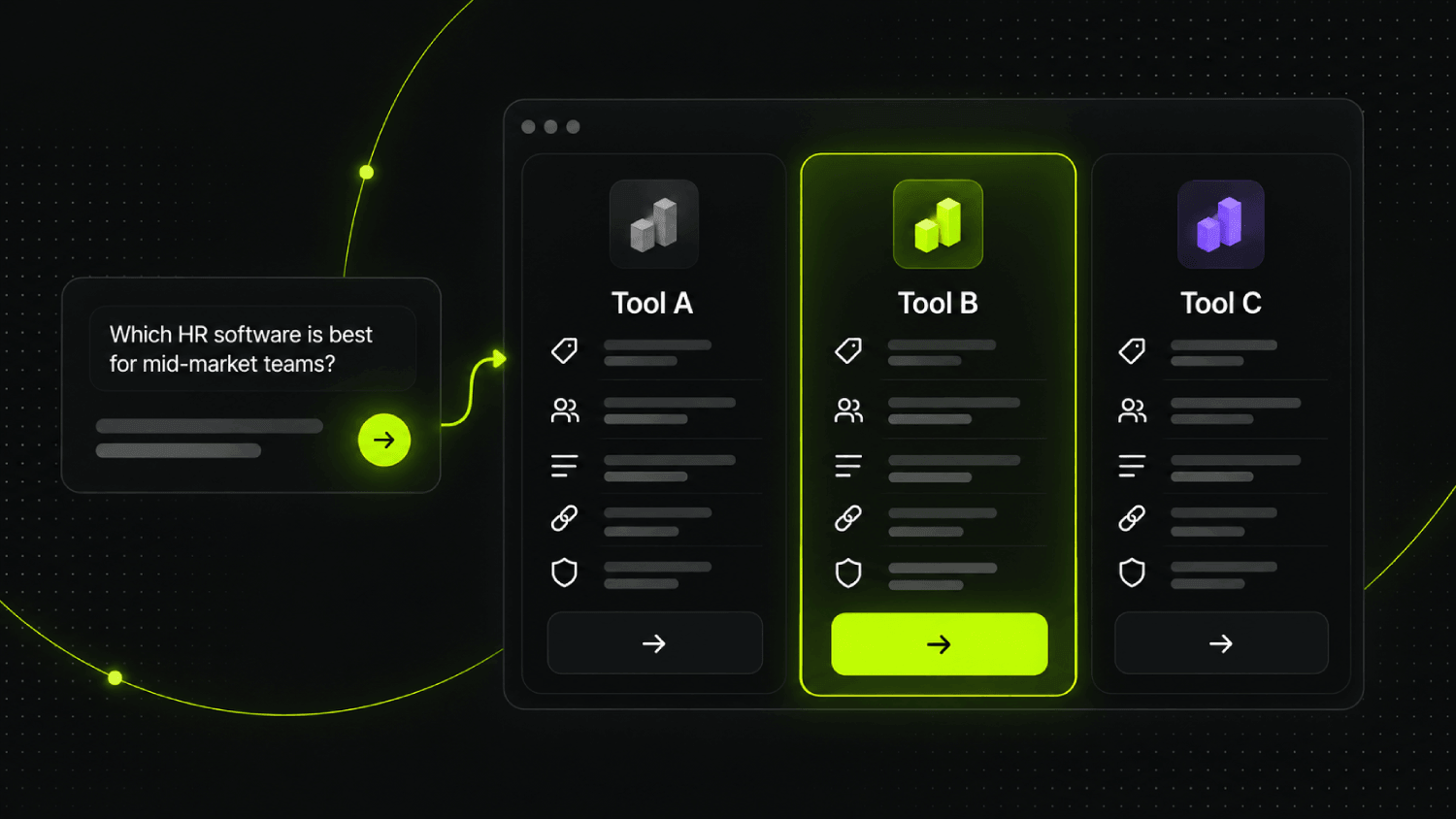
Intelligent UI lets GPT-6 choose a layout for each answer, and OpenAI’s own example says “A comparison might work best side by side.” For B2B SaaS, the questions buyers ask before a demo, such as which tool fits a team size or how pricing compares, are the questions most likely to come back as a comparison view.
OpenAI says it built a library of streamable interface components and trained the model to decide how they fit together, including when plain text is the better answer. A comparison view needs clean attributes to fill each cell: price, plan limits, integrations, security certifications, and who the product suits. Vendors whose pages state those facts plainly give the model less to guess.
Interactive charts and math and science modules already existed in ChatGPT before this launch, according to Search Engine Journal’s reading of the release notes. What changed on October 7 is that the model now composes these layouts on its own across everyday questions. Buyers who research vendors in ChatGPT will see more structured answers without asking for them.
What Has OpenAI Not Said Yet?
OpenAI has not explained how citations appear when an answer is a chart, a comparison grid, or a generated tool. It has published no figure for how much search quality improved, and it has not said whether Sol and Luna pull different sources for the same question. Plan around those gaps instead of assuming the old citation layout carries over.
OpenAI’s help page on searching the web with ChatGPT still says responses that use web search may include citations and a Sources panel when available. The same page says search results and citations can be incomplete, outdated, or incorrect. Nothing in the GPT-6 launch changes that guidance, so source visibility inside the new layouts is something to observe directly over the next few weeks.
Search Engine Journal also flags a risk for calculator and converter pages. OpenAI’s own examples include a savings calculator and a bill splitter that ChatGPT builds inside the conversation, which means a buyer may never need a generic web calculator. ROI calculators on SaaS sites that rely only on public math sit closest to that risk.
The GPT-6 Visibility Playbook for B2B SaaS Teams
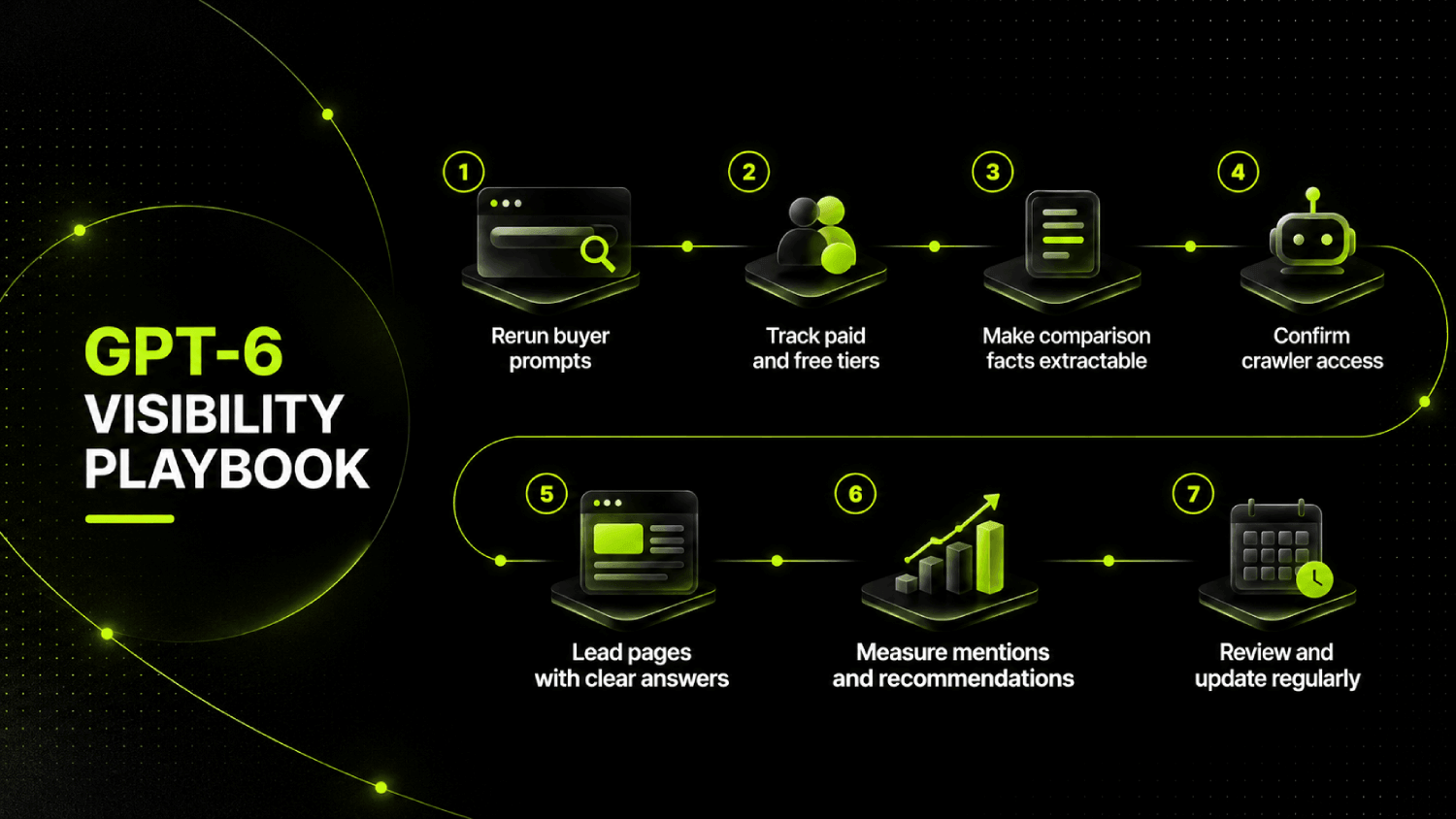
A B2B SaaS team can respond to GPT-6 in one week with seven checks: rerun buyer prompts on the new default, track paid and free tiers separately, make comparison facts extractable, lead pages with the answer, confirm crawler access, review calculator pages, and measure recommendations alongside clicks. None of these steps needs new software.
1. Rerun your buyer prompt set on the new default
Any visibility baseline captured before October 7 reflects GPT-5.6 behavior. Rerun the unbranded questions your buyers ask before they choose a vendor, such as category, use case, and pricing questions, and record which brands appear, which are recommended, and which sources are cited. Keep the pre launch results so you can see what moved.
2. Track paid and free tiers separately
GPT-6 Sol serves paid plans and GPT-6 Luna serves Free and Go, so one test account no longer represents every buyer. Run the same prompt set on a paid account and a free account, and note where recommendations or cited sources differ. Many individual researchers use free accounts, while enterprise buyers may sit on Business or Enterprise plans with admin controls.
3. Make comparison facts easy to lift
Put the attributes a comparison view needs into plain HTML on your own site: plan names, starting prices, seat or usage limits, core integrations, certifications, and the customer profile you serve best. Date the page and keep the same figures on your pricing page, product pages, and comparison content. A comparison grid built from conflicting numbers across your site is more likely to show a wrong figure under your name.
4. Lead every key page with the answer
OpenAI says GPT-6 composes answers progressively from its knowledge and findings up to that point. A reasonable inference is that pages which state the answer in the opening lines are easier to use early in that process than pages that bury it under background. Open each product, category, and comparison page with a direct statement of what you do, for whom, and at what price range.
5. Confirm ChatGPT can crawl your site
OpenAI’s help documentation points site owners to OAI-SearchBot for inclusion in ChatGPT search. Check your robots.txt, firewall rules, and bot management settings to confirm OAI-SearchBot is allowed on your marketing pages, documentation, and pricing page. A blocked crawler makes every other step on this list irrelevant.
6. Review calculator and ROI pages
If your ROI calculator uses generic inputs and public math, ChatGPT can now build a similar tool inside the conversation. Calculators that hold up better use proprietary benchmarks, real customer data ranges, or outputs tied to your product’s pricing model. Add a short written explanation of the method and the result ranges so the page carries citable content beyond the widget.
7. Measure recommendations alongside clicks
If citations become harder to spot inside visual answers, referral clicks will understate ChatGPT’s influence. Track three things separately: whether your brand is mentioned, whether it is recommended for the buyer’s situation, and whether sessions arrive from chatgpt.com in analytics. Pair that with a demo form question asking where the buyer first heard of you, as covered in our post on demo requests that mention ChatGPT.
How DerivateX Approaches ChatGPT Visibility After GPT-6
DerivateX is a generative engine optimization (GEO) and SEO agency for B2B SaaS companies that want to be recommended in AI answers and found in Google. After a model change like GPT-6, our first step is a new prompt baseline across buyer questions, followed by fixes to the facts and pages that decide whether a brand appears in comparisons.
Our ChatGPT SEO service covers that work for ChatGPT specifically, and the wider GEO agency engagement adds Gemini, Claude, Perplexity, and Google AI features. Teams seeing a rival named in their place can start with what to do when a competitor shows up in ChatGPT, and the self serve basics live in our guide on how to rank in ChatGPT.
Engagement options and scope are on the pricing page, and published outcomes are in our case studies and on Clutch. If you want to see how ChatGPT describes your company on GPT-6 today, start with a free AI visibility audit.
FAQ
What is GPT-6 in ChatGPT?
GPT-6 is the default model in ChatGPT’s Chat tab as of October 7, 2026. Paid plans run GPT-6 Sol and Free and Go plans run GPT-6 Luna. It adds Intelligent UI, which lets answers include charts, comparisons, forms, and interactive tools, and it can begin answering before it finishes searching or thinking.
Does GPT-6 change how ChatGPT cites sources?
OpenAI has not said. The launch post does not describe how citations appear inside charts, comparisons, or generated tools, and the ChatGPT search help page still describes inline citations and a Sources panel when available. Teams should check their own prompts on GPT-6 and record where sources appear before changing strategy.
Do I need to change my SEO strategy for GPT-6?
Most teams can keep their current strategy and add a few adjustments. Rerun your buyer prompts on GPT-6, make pricing and comparison facts consistent and easy to extract, confirm OAI-SearchBot can crawl your site, and track mentions and recommendations alongside referral clicks. Pages that already answer buyer questions directly are in the strongest position.
Do free ChatGPT users see the same answers as paid users?
Free and paid users may see different answers. OpenAI says Free and Go users get GPT-6 Luna while Plus, Pro, Business, and Enterprise get GPT-6 Sol. The two models are both tuned for everyday conversation, but answers and cited sources can differ, so B2B SaaS teams should test buyer prompts on both a free and a paid account.
Written byApoorv SharmaCo-founder, DerivateX
Apoorv Sharma is the co-founder of DerivateX, a B2B SaaS SEO and Generative Engine Optimization agency that engineers AI citations in ChatGPT, Perplexity, Claude, and Gemini and connects them to demo bookings and revenue pipeline. He is the author of the 2026 AI Visibility Benchmark Report and the Citation Engineering methodology. He's also the brain behind "Found On AI" and has sold 2 of his companies previously
Reviewed byShivanshi BhatiaCo-founder, DerivateX
Shivanshi Bhatia is the co-founder of DerivateX, a B2B SaaS SEO and Generative Engine Optimization agency that engineers AI citations in ChatGPT, Perplexity, Claude, and Gemini and connects them to demo bookings and revenue pipeline. She runs operations and delivery, which means every audit, content brief, and published page ships through a system she built. She owns the client relationship from kickoff through reporting, so clients spend their time on decisions instead of chasing updates. She has worked in SaaS since 2019 and reviews client work before it goes live.
Cited by AI