Case study: Gumlet turned ChatGPT mentions into 20% of inbound revenue. Read it →

Traffic Is Flat but Demo Requests Mention ChatGPT: How to Double Down

Your analytics says nothing changed. Your demo form says everything did. Here is how to prove the ChatGPT channel exists, find the prompts behind it, and scale it before a competitor claims your citations.


TL;DR
- Flat traffic with rising ChatGPT mentions in demo requests means AI engines are answering buyer questions and recommending you without sending a click. Your visibility moved upstream of the session.
- Analytics undercounts AI referral traffic badly. Radyant’s 2026 client data found up to 30% of leads self-reported discovering a brand through AI tools while only a small fraction appeared as AI referrals in the CRM.
- The visitors who do click through are worth more. Semrush’s 2025 analysis found AI-referred visitors converting at 4.4x the rate of standard organic visitors, and Adobe’s March 2026 study of over one trillion US retail visits measured a 42% conversion advantage.
- A 5-part attribution stack (a mandatory form field, a GA4 custom channel group, a CRM property, a verbatim quote log, and branded search monitoring) makes the channel visible within one reporting cycle.
- Doubling down means finding the pages AI engines already cite, mapping the prompts behind those citations, and expanding those clusters. Gumlet used this loop with us to turn ChatGPT mentions into roughly 20% of its inbound revenue.
Your GA4 dashboard has looked the same for 3 months. Sessions are flat, organic clicks are flat, and the monthly report is starting to feel like an apology. Then a demo request lands and the “How did you hear about us?” field says the thing you have now read four times this quarter: “Asked ChatGPT.”
Here is what most teams get wrong at this exact moment. They treat the ChatGPT mentions as anecdotes and the flat traffic as the truth, when the reality is inverted: the form field is telling you the truth and the dashboard is lying by omission. AI engines now answer the buyer’s question, name your product inside the answer, and hand you a lead that your analytics files under Direct or Organic with no trace of where it actually came from.
This piece covers three things: how to prove the channel exists in your own data, how to find the exact prompts and pages driving those demo requests, and how to scale what is already working before a competitor claims your citations. By the end you will be able to decide whether AI search deserves real budget, and defend that decision with numbers. Start with why the two signals disagree in the first place.
Why Is Traffic Flat While Demo Requests Mention ChatGPT?
Traffic stays flat because AI engines compress the buyer journey. A prospect asks ChatGPT or Google AI Mode for the best tool in your category, gets a synthesized recommendation naming you, and either never visits your site or arrives days later as a Direct or branded search session. Pipeline improves while sessions stand still.
The click economics explain the size of the effect. Pew Research Center analyzed close to 69,000 Google searches in 2025 and found that when an AI Overview appears, only 8% of users click a traditional result, against 15% when no AI summary is shown. Only 1% clicked a link inside the AI Overview itself.
Consider what that means for a B2B SaaS brand. Your content can be doing MORE work than ever, shaping shortlists inside AI answers, while producing fewer sessions than it did two years ago. Conductor’s 2026 benchmarks put visible AI referral traffic at roughly 1.08% of total website visits, a number so small most dashboards bury it, even though the influence behind it is far larger.
Research from 6sense adds the uncomfortable part: B2B buyers now complete about 61% of their journey before contacting any vendor, and in 95% of deals the winning vendor is already on the shortlist before first contact. We mapped this shift in detail in our breakdown of how B2B SaaS buyers use ChatGPT to evaluate vendors, and the pattern is consistent: the shortlist forms inside the AI conversation, invisible to your analytics.
The demo form mentions are the leak through which that invisible channel becomes visible. Companies like NerdWallet and HubSpot have publicly reported the same divergence of declining organic traffic alongside stable or growing revenue, so if your dashboard and your pipeline disagree, you are in well-documented company.
Why Is AI Referral Traffic Undercounted in Analytics?
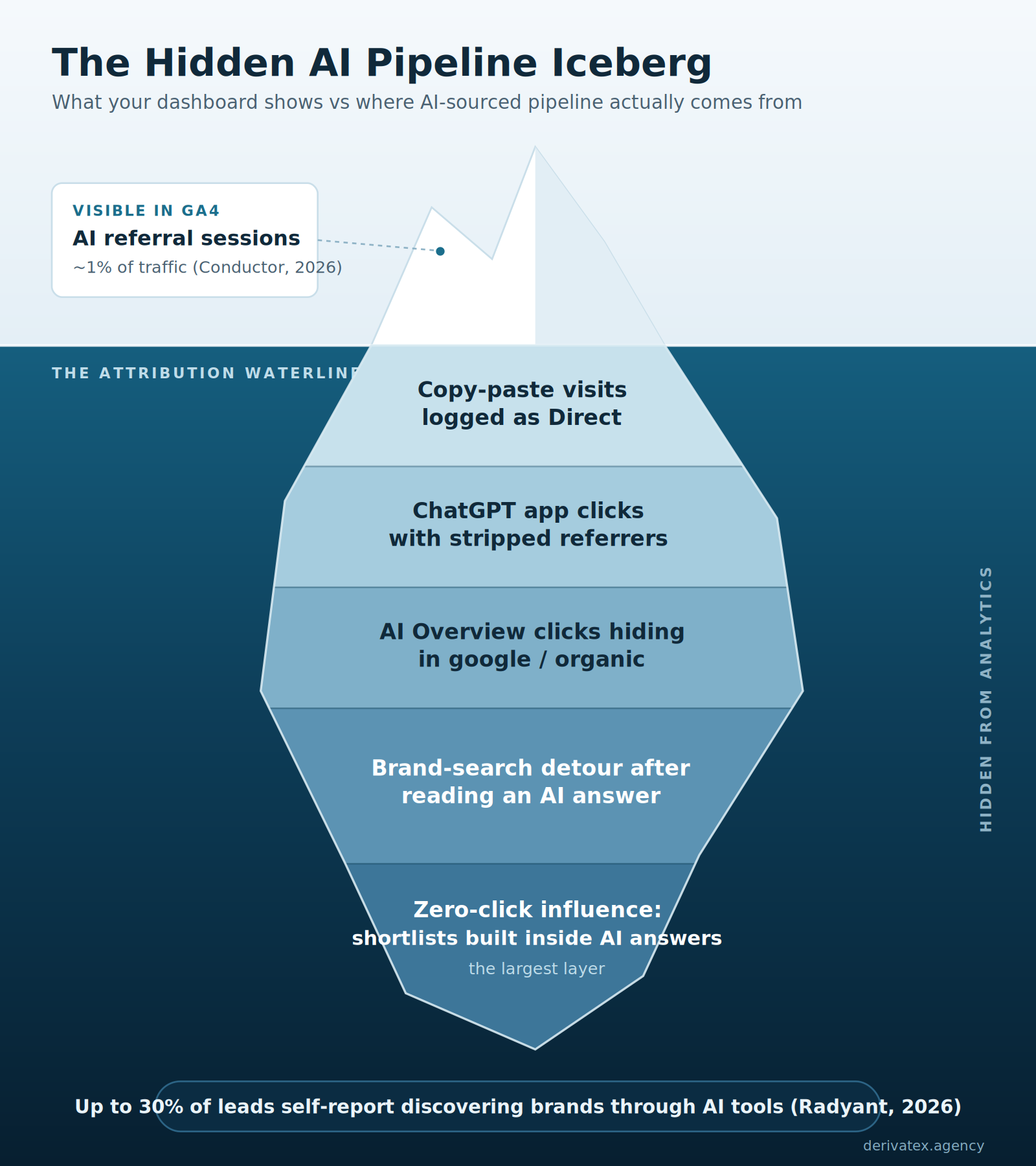
AI referral traffic is undercounted because most AI-driven visits reach your site through paths that strip or disguise the referrer. Four mechanisms do most of the damage, and each one files an AI-sourced visit under a channel you already had.
1. Copy-paste sessions land as Direct
Many users copy a URL out of a ChatGPT answer and paste it into the browser instead of clicking. That creates a fresh session with no referrer at all, which GA4 logs as Direct. Swydo’s 2026 agency guide to AI tracking identifies this as the single most common leak.
2. App-to-browser handoffs drop the referrer
A tap on a link inside the ChatGPT iOS or Android app opens a browser that frequently receives no referrer header. The visit is real, the source is ChatGPT, and your analytics records it as Direct. Safari’s tracking prevention strips referrer data from some clicks that originally carried it, which widens the same hole.
3. AI Overviews clicks hide inside organic
A click from a Google AI Overview or AI Mode arrives as google / organic with no distinguishing flag. Your organic bucket now mixes classic blue-link clicks with AI answer clicks, and no GA4 setting separates them. This grows every quarter, since AI Overviews reached roughly half of all Google queries by early 2026, with B2B technology categories running higher.
4. The name-search detour rebrands the visit
The most expensive leak is behavioral. A buyer reads an AI answer naming your product, then Googles your brand name to verify it, and lands through a brand ad or your organic homepage listing. Radyant documented this mechanism across its clients in 2026: deals that started in ChatGPT showed up in HubSpot as Paid Search, Organic Search, and Direct, while the leads themselves said “I found you on ChatGPT” when asked.
Radyant’s numbers quantify the gap. Only a tiny fraction of conversions registered as AI referrals, while self-reported data showed up to 30% of leads had discovered the brand through AI tools. If your dashboard shows 1% and your forms suggest 20%, both numbers are telling the truth about different layers of the same channel.
How to Prove Leads Are Coming From ChatGPT: The Attribution Setup
You prove it by triangulating three signal types: what leads tell you, what referrer data survives, and what your brand demand curve does. No single source captures AI search attribution on its own, so the setup below builds all three in one afternoon.
The 5-part attribution setup checklist
- Add a mandatory “How did you hear about us?” field to your demo form, as free text. Free text beats a dropdown here because the verbatim phrasing becomes raw material for prompt testing later. A dropdown gives you a count; free text gives you the actual prompts.
- Build a GA4 custom channel group for AI traffic. Filter session source with a regex matching chatgpt.com, perplexity.ai, gemini.google.com, copilot.microsoft.com, and claude.ai. OpenAI appends utm_source=chatgpt.com to links clicked inside ChatGPT search, which makes that slice cleanly filterable.
- Create an “AI-sourced” property in your CRM. Tag every deal where the form field, the sales call, or the email thread mentions an AI tool. Pipeline reports filtered on this property are the number your leadership will actually care about.
- Keep a dated verbatim quote log. Every time a lead mentions ChatGPT, Perplexity, or “an AI” in a form or a call recording, paste the exact sentence into a shared sheet. Within a quarter this log becomes your highest-signal research asset.
- Monitor branded search impressions in Google Search Console monthly, next to your AI referral sessions. Branded impressions rising while non-branded stays flat is the fingerprint of the name-search detour. Track the two lines together, not separately.
Run this stack for 30 days and you have a defensible floor for the channel. Everything AI-attributable that leaks past referrer data still gets caught by the form field, the CRM tag, or the branded search curve, and we walk through the full measurement model with client screenshots in our piece on the real ROI of GEO.
The caveat on self-reported attribution
Self-reported data undercounts too, because buyers forget or compress their first touch. Someone who found you through ChatGPT in March and booked a demo in June will often write “Google” on the form, since Google was the last step they remember.
The fix costs one question per closed deal. Add a won-deal interview question with this exact wording: “What did you search or ask, and where, before you first visited our site?” Asking about the action instead of the channel recovers first touches the form field misses.
Signals Your AI Visibility Is Working
No single metric confirms AI visibility, so read the signals as a set. The table below is the checklist we run for clients when demo forms start mentioning ChatGPT.
| Signal | Where you see it | What it looks like | Weak vs. strong indicator |
|---|---|---|---|
| Demo form mentions of ChatGPT or Perplexity | “How did you hear about us?” free-text field | Verbatim lines like “asked ChatGPT for [category] tools” | Strong. Direct buyer testimony, undercounts rather than overcounts |
| Referral sessions from AI domains | GA4 custom AI channel group | Small but climbing session counts from chatgpt.com, perplexity.ai | Strong but partial. Only captures clicked links with surviving referrers |
| Branded search impression lift | Google Search Console, brand query filter | Branded impressions up while non-branded stays flat | Medium. Confirms the name-search detour when paired with form mentions |
| Direct traffic lift on citation-heavy pages | GA4 landing page report, Direct channel | Direct spikes on comparison and answer pages, not the homepage | Medium. Homepage Direct lift is ambiguous; deep-page Direct lift rarely is |
| Sales call quotes naming an AI tool unprompted | Call recordings, CRM notes | “ChatGPT said you handle X better than [competitor]” | Strong. Unprompted mentions signal the AI shaped the shortlist |
| AI crawler hits in server logs | Log files or CDN analytics | Requests from OAI-SearchBot, PerplexityBot, Google-Extended on key pages | Weak alone. Crawling proves attention, not citation |
Two or more strong signals moving together over a quarter means the channel is real for your brand. At that point the question stops being “is this happening?” and becomes “which prompts are driving it?”, which is where most teams stall.
How to Find Which Prompts Are Driving Demo Requests
You find the prompts by mining the exact language your leads already gave you, converting it into test prompts, and running those prompts on a fixed schedule. The method takes four steps and about two hours a month.
The 4-step prompt mining method
- Mine verbatim phrasing from forms and calls. Pull every AI mention from your quote log and your call recordings. You are collecting the buyer’s own words, not writing keywords.
- Rewrite each mention as a prompt. A form answer like “asked ChatGPT which time tracking tools work for construction crews” becomes the literal test prompt, typed the way the buyer described asking it. Resist the urge to clean it up; messy buyer phrasing is exactly what the engine saw.
- Run each prompt monthly in ChatGPT, Perplexity, and Gemini from a clean session. Log whether your brand is named, whether a link is cited, and which exact URL gets the citation. Clean sessions matter because chat history personalizes answers.
- Build the prompt-to-page map. One sheet, five columns: prompt, engine, cited yes or no, cited URL, date. Within two test cycles this map shows which pages are your citation earners and which prompts you are losing.
The prompt-to-page map is the single most valuable artifact in this entire process. It converts a vague feeling (“ChatGPT seems to like us”) into an inventory of assets and gaps you can act on, and if you want ready-made prompt structures to start from, we published our full AI visibility audit prompt set for exactly this step.
Can you see AI citations without asking leads?
Yes, three ways, and they work even before your attribution stack matures. Fixed monthly prompt-set testing is the primary one, and our AI visibility checker automates the first pass across engines. Bing Webmaster Tools surfaces indexing and referral data relevant to ChatGPT, since ChatGPT search leans on Bing’s index. Log-file analysis shows which pages OAI-SearchBot, PerplexityBot, and Google-Extended are fetching, which tells you where AI attention is concentrating before citations appear.
How to Double Down on AI Search Visibility?
Doubling down means scaling the pages and prompt clusters that already earn citations, not producing more general content. AI engines have already voted on what they trust from your domain. Your job is to read the vote and expand it deliberately.
The 5-step scaling process
- Pull the list of pages AI engines already cite from your prompt-to-page map. This list is usually shorter and stranger than expected: a comparison page, a pricing explainer, one old technical post.
- Map the prompt cluster around each cited page. Every buyer question has 10 to 20 adjacent phrasings and follow-ups. If you are cited for “best video DRM solution,” the cluster includes setup questions, cost questions, and alternative comparisons.
- Publish pages answering the adjacent questions your cited page does not cover. Engines that already trust your domain for the core question extend that trust to the cluster faster than to a cold domain.
- Replicate the structure of your cited pages on every new one. Structure is doing more work than topic here, as the next section explains.
- Re-test the full prompt set every 30 days and log movement. Citations shift as engines refresh retrieval, so the map is a living document, not a one-time audit.
This is the exact loop behind our Gumlet engagement, where ChatGPT mentions grew into roughly 20% of inbound revenue. The revenue did not come from more traffic. It came from owning more of the prompt surface around clusters Gumlet was already winning.
What content gets cited by AI engines?
Cited pages share five structural traits, and they matter more than topic selection: question-phrased H2s with a direct answer in the first two sentences, standalone paragraphs short enough to extract whole, named statistics with sources and years, comparison tables with factual values, and an FAQ block at the end. Position matters too, since research we break down in our guide to how LLMs decide what to cite shows 44.2% of LLM citations come from the first 30% of a page.
Two more findings should change how you allocate effort. An Abilene Group analysis of more than 800,000 AI citations in 2025 found that for B2B purchasing queries, product and vendor content accounts for around 56% of what gets cited, so your own domain is a viable citation surface!
DerivateX’s own research points the same direction from the other side: when we analyzed citation behavior for our LLM SEO guide, only 12% of URLs cited by ChatGPT also ranked in Google’s top 10, meaning AI engines are picking sources on structure and specificity, not just rankings.
How long before doubling down shows results
Set the expectation in two phases. Citation changes typically appear 2 to 6 weeks after new or restructured pages are indexed, and the demo-mention lift lags citations by another 4 to 8 weeks, since buyers need time to ask, shortlist, and book. The full stage-by-stage breakdown is in our piece on how long it takes to get cited by ChatGPT.
REsimpli is the reference timeline we point clients to. Within 90 days of structured work, REsimpli became the top ChatGPT recommendation for its core real estate CRM cluster, with Google rankings for the same terms reaching #1 alongside. Ninety days from start to category-level citation is a realistic target when the domain already has content history.
What if ChatGPT cites a competitor instead of you
Treat it as a solvable diff, not a verdict. Run the exact prompt and capture which competitor URL gets cited, then compare that page against yours on the five structural traits above, line by line. Rewrite or publish your page to exceed it on every missing trait, then re-test in 30 days.
Engines re-evaluate sources continuously, which means today’s losing prompt is next month’s opportunity. Verito started from an average Google position of 40 and became the top AI answer across its high-intent buyer prompts, which is about as far behind as a starting position gets. We wrote a dedicated playbook on what to do when ChatGPT recommends your competitor, because this scenario is now the most common trigger for teams taking AI search seriously.
How to Report Flat Traffic to Leadership Without Looking Like You Are Failing
Report it by replacing the proxy metric with the outcome metric pair: cited-page coverage plus AI-sourced pipeline. Traffic was always a proxy for demand, and the proxy broke before the demand did.
The one-slide reframe works like this. Put three lines on a single chart: sessions (flat), AI-sourced demo requests from your CRM tag (rising), and branded search impressions (rising). The narration is one sentence: our visibility moved upstream of the click, and here is the pipeline proving it.
The conversion data carries the argument for you. Semrush’s 2025 analysis measured AI-referred visitors converting at 4.4x the rate of standard organic, and Adobe’s March 2026 study across more than one trillion US retail visits found AI-driven traffic converting 42% better, with longer sessions and more pages viewed. Small session counts with multiples like these move real pipeline, and we covered which numbers survive boardroom scrutiny in our guide to GEO KPIs your CMO and board will actually accept.
Give leadership the honest counterweight too, because it protects your credibility. Deal-value data is still mixed across studies, and at least one documented mid-market B2B case in 2025 showed AI-sourced deals carrying lower ARR than organic-sourced deals for that specific company. Track average deal size on your AI-sourced CRM segment alongside conversion rate, and let your own numbers settle the question.
AI Search Pipeline Value Calculator
Enter your numbers to see what the ChatGPT mentions in your demo form are worth. This is your floor: self-reported attribution undercounts, so the real figure runs higher.
AI-sourced demos / month
4
Monthly AI-sourced pipeline
$60,000
Annual AI-sourced revenue
$144,000
Pipeline = AI-sourced demos × ACV. Revenue = pipeline × close rate, annualized. Figures reflect only what leads self-report, which studies show understates AI discovery.
Should you stop investing in traditional SEO?
No, and the reasoning is mechanical rather than sentimental. Google AI Overviews draw heavily from pages that already rank, and ChatGPT search leans on the Bing index, so ranking equity is an input to citation equity. The right move for most B2B SaaS teams is reallocating 20 to 30% of content effort toward citation-format work on high-intent clusters, while the compounding SEO engine keeps running underneath it.
FAQ
Why is my AI traffic undercounted in GA4?
GA4 undercounts AI traffic because most AI-driven visits lose their referrer before arriving. Users copy-paste URLs from ChatGPT answers (logged as Direct), mobile app clicks drop referrer headers, Google AI Overview clicks arrive as ordinary google / organic, and many buyers read an AI answer then search your brand name, landing as Organic or Paid Brand.
Radyant's 2026 client data found up to 30% of leads self-reported AI discovery while only a small fraction showed as AI referrals. The gap is structural, so pair referrer data with a form field and CRM tagging.
How do I find which ChatGPT prompts are driving my demo requests?
Mine the verbatim language from your "How did you hear about us?" field and sales call recordings, then rewrite each mention as a literal prompt. Run every prompt monthly in ChatGPT, Perplexity, and Gemini from a clean session and log whether you are named, whether a link is cited, and which URL earns the citation. The output is a prompt-to-page map showing which pages are your citation earners and which prompts you are losing. Two monthly cycles is usually enough to see stable patterns worth acting on.
My AI referral traffic is barely 1% of sessions. Is this really worth prioritizing?
The 1% you can see is the smallest layer of the channel. Conductor's 2026 benchmarks put visible AI referrals at about 1.08% of website traffic, but referrer stripping and the brand-search detour hide most AI-influenced visits inside Direct and Organic. The visible slice also converts at a multiple of organic: 4.4x per Semrush's 2025 analysis.
Judge the channel by AI-sourced pipeline in your CRM and demo form mentions, not by the referral session count, because the session count is the one number guaranteed to understate it.
How do I scale AI search visibility once it starts working?
Expand outward from the pages AI engines already cite. Pull your cited URLs from prompt testing, map the 10 to 20 adjacent buyer questions around each one, and publish structured pages answering the questions your cited page skips. Replicate the structural traits of your winning pages: answer-first question H2s, short extractable paragraphs, sourced statistics, comparison tables, and an FAQ block. Re-test your full prompt set every 30 days. Gumlet used this cluster-expansion loop to grow ChatGPT mentions into roughly 20% of its inbound revenue.
Do leads from ChatGPT actually convert better than Google leads?
On conversion rate, yes, consistently across studies. Semrush's 2025 analysis found a 4.4x conversion advantage for AI-referred visitors over standard organic, and Adobe measured a 42% advantage across more than one trillion US retail visits in March 2026. AI visitors arrive pre-qualified because the engine already recommended you before the click.
Deal size is the open question: results vary by company, and one documented 2025 B2B case showed smaller AI-sourced deals. Track conversion rate and average deal value separately on your AI-sourced CRM segment.
How long does it take to see results from optimizing for ChatGPT and AI search?
Expect citation movement within 2 to 6 weeks of publishing or restructuring pages, and demo-request lift 4 to 8 weeks after that, since buyers need time to ask, shortlist, and book. A realistic benchmark for a domain with existing content history is 90 days to category-level citations: REsimpli reached top ChatGPT recommendation for its core real estate CRM cluster within that window. Domains starting with weak rankings take longer, because AI engines lean on sources that already carry ranking and authority signals.
Where This Leaves You
The most important thing to internalize is that your dashboard and your demo form are measuring two different layers of the same funnel, and the form is closer to the money. Flat sessions next to rising ChatGPT mentions is not a contradiction. It is what winning looks like in a channel your analytics was never built to see.
Your next step is concrete and takes one afternoon: add the free-text form field, build the GA4 AI channel group, and create the AI-sourced CRM tag. Thirty days of that data gives you the floor number for the channel, and your first prompt-testing cycle gives you the map of what to scale.
If you want the citation side of that map done for you, our free AI visibility audit shows which prompts already cite you and which ones a competitor owns.
The window on this matters more than most teams realize. Gartner's forecast of a 25% drop in traditional search volume by 2026 is tracking close to actual numbers, and Google has now rebuilt Search itself around AI answers.
The brands collecting citations in these engines today are building the shortlists every future buyer in their category will see, and the demo requests mentioning ChatGPT in your inbox right now are the earliest proof that yours can be one of them.
Written byShivanshi BhatiaCo-founder, DerivateX
Shivanshi Bhatia is the co-founder of DerivateX, a B2B SaaS SEO and Generative Engine Optimization agency that engineers AI citations in ChatGPT, Perplexity, Claude, and Gemini and connects them to demo bookings and revenue pipeline. She runs operations and delivery, which means every audit, content brief, and published page ships through a system she built. She owns the client relationship from kickoff through reporting, so clients spend their time on decisions instead of chasing updates. She has worked in SaaS since 2019 and reviews client work before it goes live.
Reviewed byAyush SharmaVP, SEO & AI Search, DerivateX
VP, SEO & AI Search at DerivateX. We're a B2B SaaS SEO and Generative Engine Optimization agency that engineers AI citations in ChatGPT, Perplexity, Claude, and Gemini and connects them to demo bookings and revenue pipeline.
Cited by AI