Case study: Gumlet turned ChatGPT mentions into 20% of inbound revenue. Read it →

Use-Case Pages for B2B SaaS: What to Include So AI Search Cites You


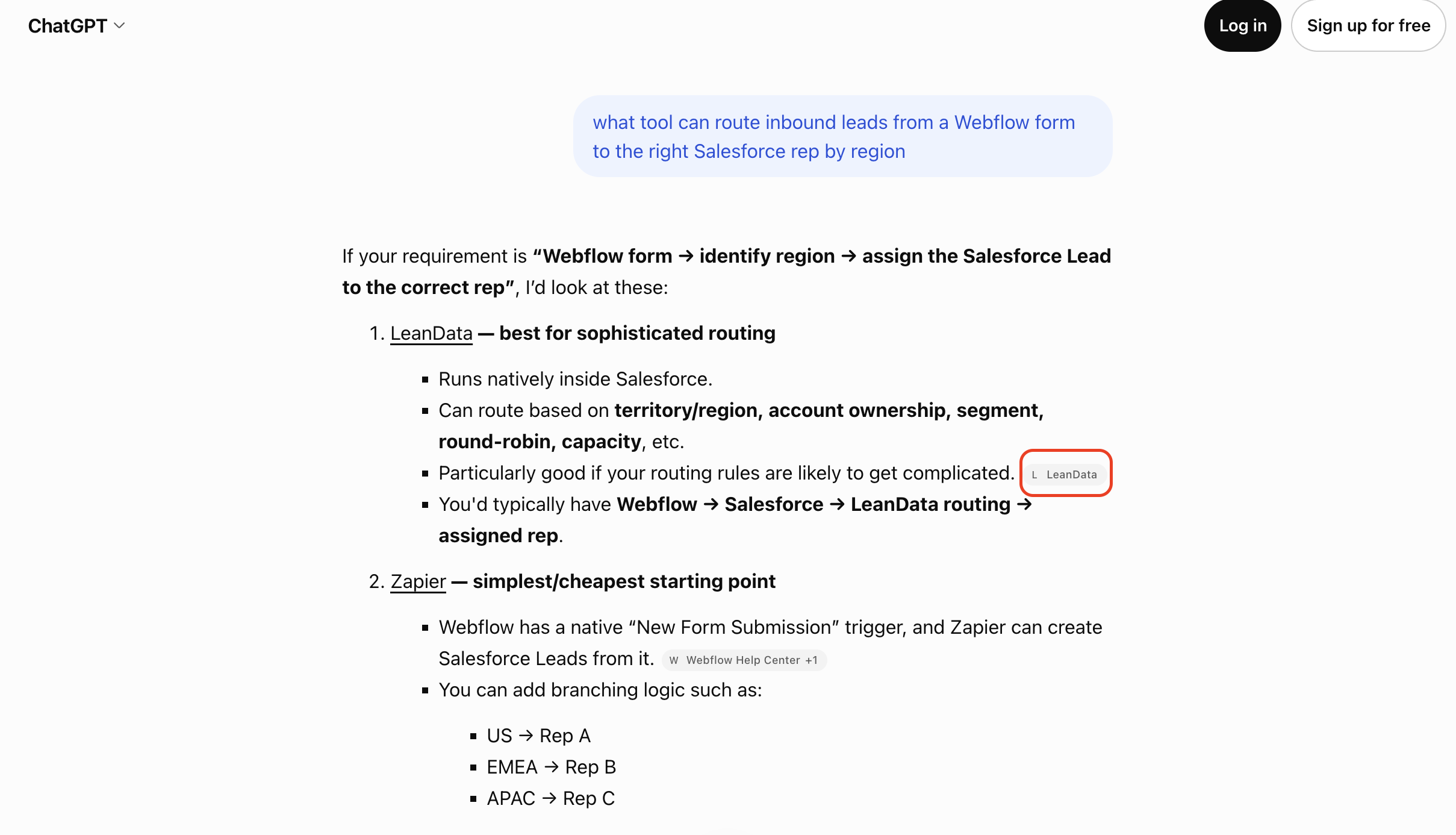
A buyer who asks ChatGPT how to route inbound demo requests to the right rep by region is asking a job-to-be-done question. The answer cites whichever page states that job, the team it fits, the workflow, and the limits most plainly. Most B2B SaaS use-case pages are feature pages with a new headline, so the model finds nothing specific to repeat.
A use-case page earns citations in AI search when it names one job in the buyer’s own words, the team and size it fits, the trigger, the steps, the integrations, the limits, and one attributed proof point, all in crawlable text. This works best for products whose buyers describe a problem before they know the category name. It works less well when buyers shop by category, since those prompts are usually answered from comparison lists and product pages.
DerivateX is a full-service search engine optimization (SEO) and generative engine optimization (GEO) agency for B2B SaaS companies between $5M and $50M in annual recurring revenue (ARR), and buyer-intent commercial pages are part of every retainer on our SEO and GEO pricing page. This guide covers what goes on the use-case page itself. It gives you a 12-field checklist, a 20-point scorecard, a teardown of six live solutions pages, and a labelled fictional before and after.
TL;DR
- A B2B SaaS use-case page gets cited for a job-to-be-done prompt when it states one job, one buyer, a trigger, a workflow, named integrations, limits, and attributed proof in text a model can lift.
- Google’s documentation says a page only needs to be indexed and eligible for a snippet to appear as a supporting link in AI Overviews or AI Mode, so most of the work sits in the copy.
- Of six public use-case pages reviewed in October 2026 (Calendly, Loom, Zapier, Airtable, Slack, and ClickUp), none stated a plan gate or unsupported scenario for its own product in the page text.
- The scorecard below rates 10 criteria from 0 to 2, and DerivateX treats any use-case page under 10 out of 20 as a rewrite candidate.
- A use-case page cannot carry category ownership, deep customer proof, or third-party corroboration by itself, so it should link to the pages that do.
What Makes a Use-Case Page Citable in AI Search?
A use-case page is citable when an AI system can lift one passage that answers a job-to-be-done prompt without guessing. That passage names the job, the buyer it fits, the trigger, the steps, and at least one limit. Pages that describe outcomes with adjectives give ChatGPT, Perplexity, Gemini, and Google AI Overviews nothing safe to repeat.
A use-case page is a commercial page that describes one job a buyer needs done, such as scheduling candidate interviews or routing inbound leads, and shows how a product does that job for a specific team. Solutions pages, “for teams” pages, and workflow pages are variations of the same page type. A feature page answers what a capability does, while a use-case page answers whether the product fits a particular situation.
Google’s documentation on AI features in Search (last updated December 2025) says AI Overviews and AI Mode may use a “query fan-out” technique that issues multiple related searches across subtopics. The same page states there are no additional technical requirements beyond being indexed and eligible to show with a snippet. For a use-case page, fan-out means the page competes on subquestions such as “does it connect to Greenhouse” or “can it route by region”, so each field you add answers one more of them.
ChatGPT search and Perplexity read pages through their own crawlers. OpenAI’s crawler documentation says sites can allow OAI-SearchBot to appear in search results, and Perplexity’s bot documentation recommends allowing PerplexityBot for the same reason. A use-case page gets cited for the sentences it states plainly, and a model has no way to cite a capability the page only implies. The passage mechanics behind this, such as answer-first headings and self-contained chunks, are covered in our guide to on-page elements that increase AI citations.
Which Job-to-Be-Done Prompts Should a Use-Case Page Answer?
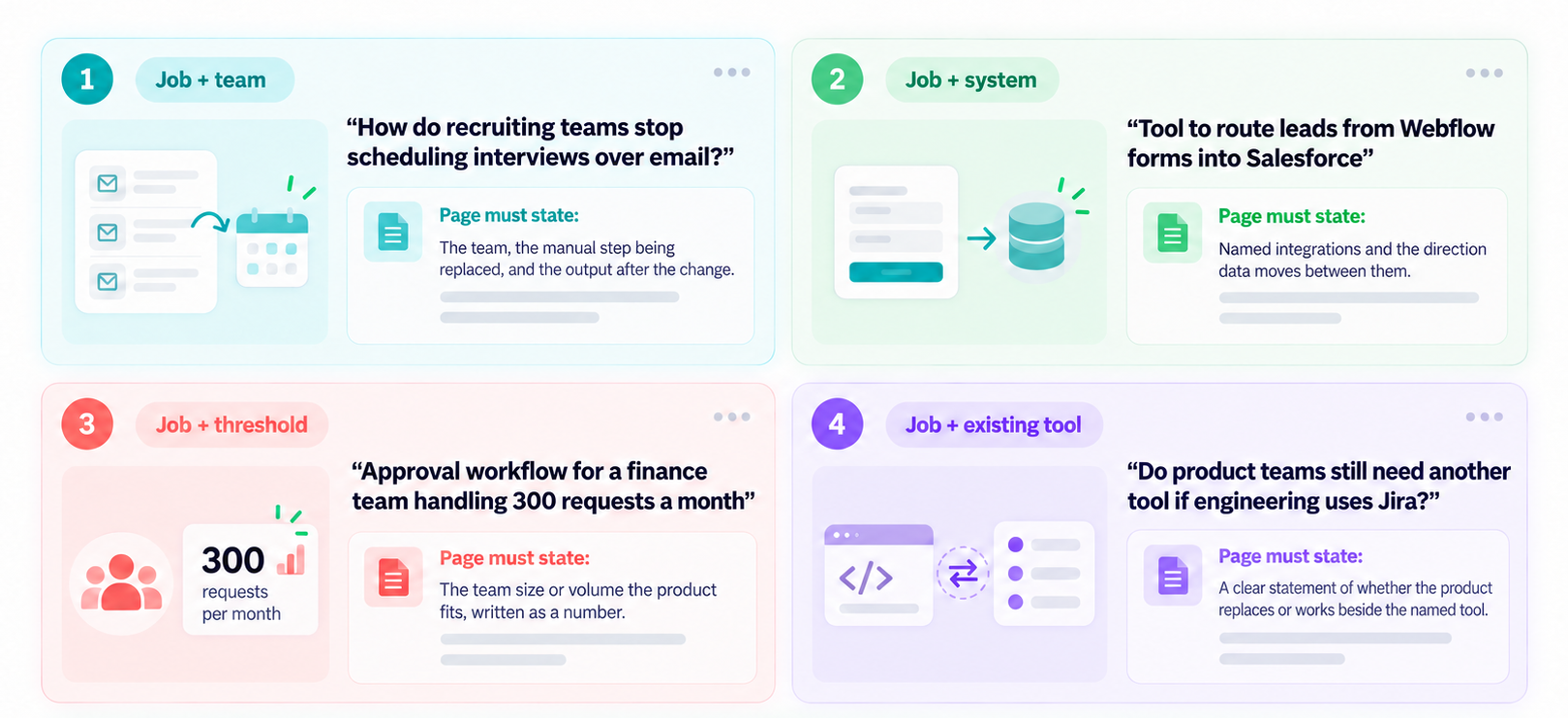
A use-case page should answer prompts where the buyer describes a task, a team, and a constraint before naming a product category. Common shapes are “how do I [job] for [team]”, “tool to [job] with [system]”, and “can [product] [job] if [condition]”. Prompts built around the category name belong to your product page and your comparison pages.
Our SaaS keyword mapping guide states the split in one line: “Product owns the category noun, use case owns the verb.” The table below turns that rule into the specific statements a use-case page needs for each prompt shape.
| Prompt shape | Example prompt | What the page must state for a model to answer |
|---|---|---|
| Job and team | How do recruiting teams stop scheduling interviews over email? | The team, the manual step being replaced, and the output after the change |
| Job and system | Tool to route leads from Webflow forms into Salesforce | Named integrations and the direction data moves between them |
| Job and threshold | Approval workflow for a finance team handling 300 requests a month | The team size or volume the product fits, written as a number |
| Job and existing tool | Do product teams still need another tool if engineering uses Jira? | A plain statement of whether the product replaces or works beside the named tool |
| Job and proof | Has scheduling software reduced time to hire for a company like ours? | A named customer, a metric, a timeframe, and the scope of the result |
| Job and cost | How much does lead routing automation cost for a 20-rep sales team? | The plan that includes the workflow and a starting price, or what drives the quote |
Segment language matters as much as the verb. REsimpli, a CRM for real estate investors, became the most cited and recommended real estate CRM for investors in ChatGPT within 90 days, as documented in the REsimpli case study. That work combined REsimpli’s own pages with third-party sources using the same segment phrase, so a single use-case page would not have produced the result alone.
The 12-Field Checklist for a Citable Use-Case Page
A citable use-case page carries 12 fields in visible text: the job, the buyer, a size threshold, the trigger, the workflow, the output, integrations, limits, a coexistence statement, attributed proof, a pricing pointer, and a dated FAQ. Each field maps to a subquestion a model may search, so a missing field becomes a question another site answers.
| # | Field | What to write | Sentence pattern a model can repeat | Common failure |
|---|---|---|---|---|
| 1 | Job | The task in the buyer’s verb, in the H1 or first sentence | [Product] schedules first-round interviews for in-house recruiting teams. | An outcome headline with no task in it |
| 2 | Buyer | The team and role that owns the job | Built for RevOps teams that own lead routing in Salesforce. | “Teams of all sizes” |
| 3 | Threshold | Size, volume, or stack where the product fits | Fits companies with 200 to 2,000 employees approving 300 or more requests a month. | No number anywhere on the page |
| 4 | Trigger | The event that starts the workflow | The workflow starts when a candidate moves to the phone screen stage in Greenhouse. | “When you need it” |
| 5 | Workflow | Three to six numbered steps in HTML text | Step 2: the request is routed to the budget owner based on amount and department. | Steps shown only inside an animation or image |
| 6 | Output | The state, record, or artifact at the end | Approved requests sync to NetSuite as purchase orders. | “Better collaboration” |
| 7 | Integrations | Named tools and the direction data moves | Reads leads from Webflow forms and writes owners back to Salesforce. | A logo wall with no text |
| 8 | Limits | Plan gates, unsupported systems, and edge cases | Approval chains longer than five steps require the Business plan. | Limits left for the sales call |
| 9 | Coexistence | How the product sits beside a tool the buyer already uses | [Product] works beside Jira and does not replace sprint tracking. | Silence about the incumbent tool |
| 10 | Proof | Named customer, metric, timeframe, and scope in one sentence | [Customer] cut median approval time from four days to one in two quarters, across 2,400 requests. | A number with no customer, date, or source beside it |
| 11 | Pricing pointer | The plan that includes the job and a starting price if public | Lead routing is included from the Growth plan at $X per month, as of October 2026. | “Contact us” with no plan named |
| 12 | Dated FAQ | Three to five job-specific questions and a visible updated date | Does [Product] support round-robin routing across regions? Yes, on the Growth plan and above. | Generic FAQ copied from the homepage |
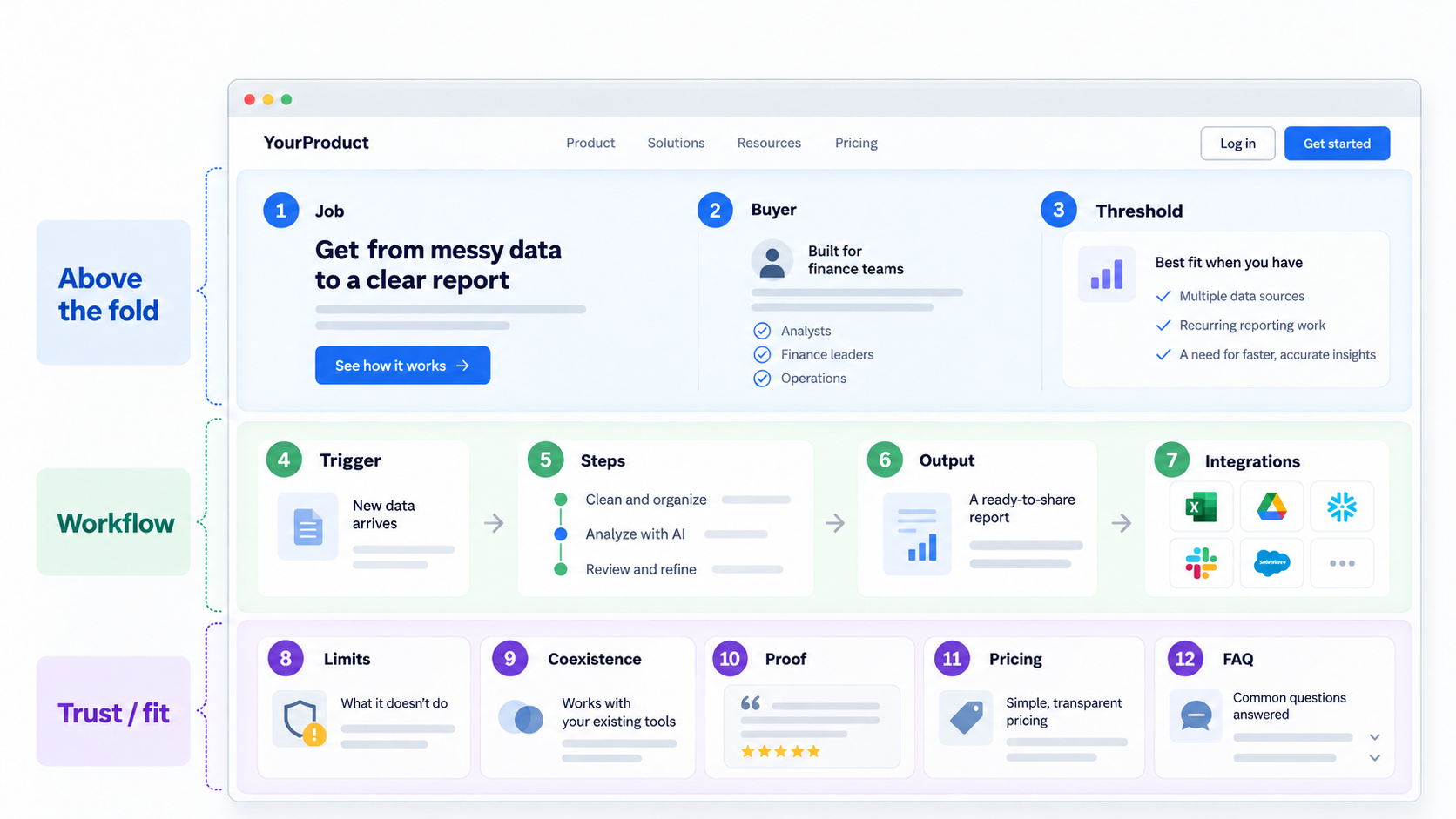
Above the fold: job, buyer, and threshold
The first screen decides whether a model can match the page to a prompt. The H1 or the sentence under it should carry the job and the buyer, and the next sentence should carry a threshold. A threshold can be operational, such as “teams that review more requests than one approver can clear in a day”, when no honest number exists.
Copy at this level fails when it borrows the adjectives every competitor uses. Our list of phrases that make B2B SaaS brands invisible in AI search is a useful filter for hero copy before it ships.
In the body: trigger, workflow, output, and integrations
The workflow block is where a use-case page proves the job exists in the product. Write it as a numbered list with one action per step, and name the system at each handoff. Keep the steps in the HTML source, since our guide to JavaScript rendering failures that hide SaaS content from LLM crawlers shows how tabbed or client-rendered content can disappear from what a crawler reads.
Integrations need direction as well as names. “Works with Salesforce” answers one subquestion, while “creates a Salesforce lead and assigns the owner from your territory rules” answers three.
Fit and proof: limits, coexistence, proof, pricing, and FAQ
Limits were missing from all six live pages reviewed in the next section, and they are the field that makes the rest of the page believable. A page that states what the product does not support gives a model a safe sentence for “can it do X” prompts, which otherwise get answered from review sites and forum threads.
Proof travels into AI answers when the customer name, the metric, and the scope sit in the same sentence. The Gumlet case study states that 20% of Gumlet’s inbound revenue comes from users who first discovered the brand through ChatGPT and other AI tools, which a model can attribute because company, metric, and channel appear together. Our guide to structuring SaaS case studies so ChatGPT can reuse the proof covers how to build the case study the use-case page links to.
If you want this checklist run against your own use-case pages and the prompts your buyers type, the free AI visibility audit shows how ChatGPT, Perplexity, Gemini, and Claude describe your company today, with findings sent within 48 business hours.
How Six Real B2B SaaS Use-Case Pages Hold Up
We read six public use-case and solutions pages in October 2026 using their server-rendered HTML, which is the version a crawler receives first. Each page gives a model some repeatable facts, usually named integrations or a customer metric. None of the six states a plan gate or unsupported scenario for its own product in the text we read.
| Page | H1 as published | Integrations named in text | Proof in page text | Fit or coexistence statement | FAQ on page |
|---|---|---|---|---|---|
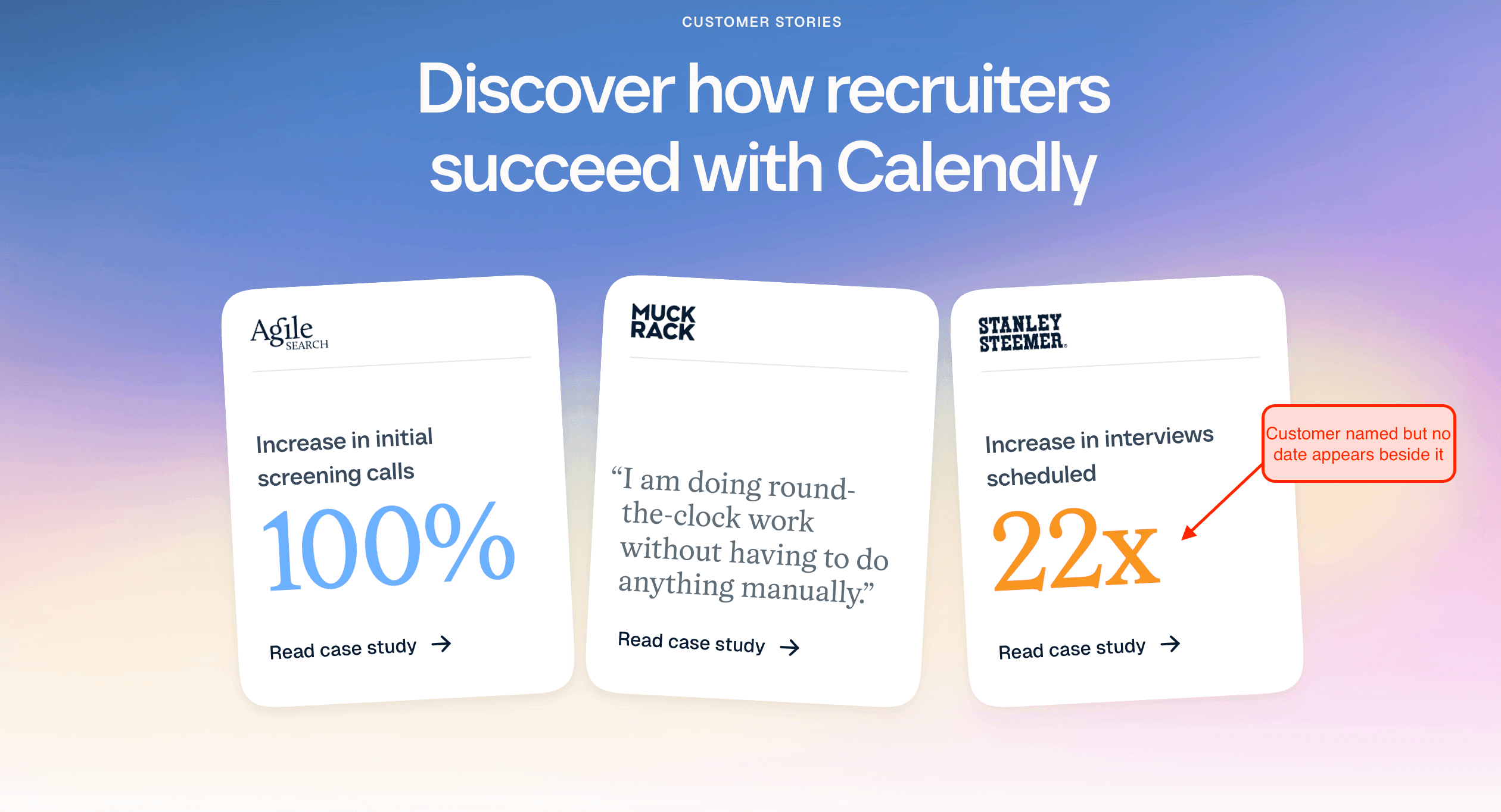
| Calendly for recruiting | Accelerate your hiring process | Greenhouse, Jazz HR, LinkedIn Recruiter, Google and Microsoft suites | “22x” increase in interviews scheduled and “100%” increase in screening calls, with no customer named beside either figure | None found | No |
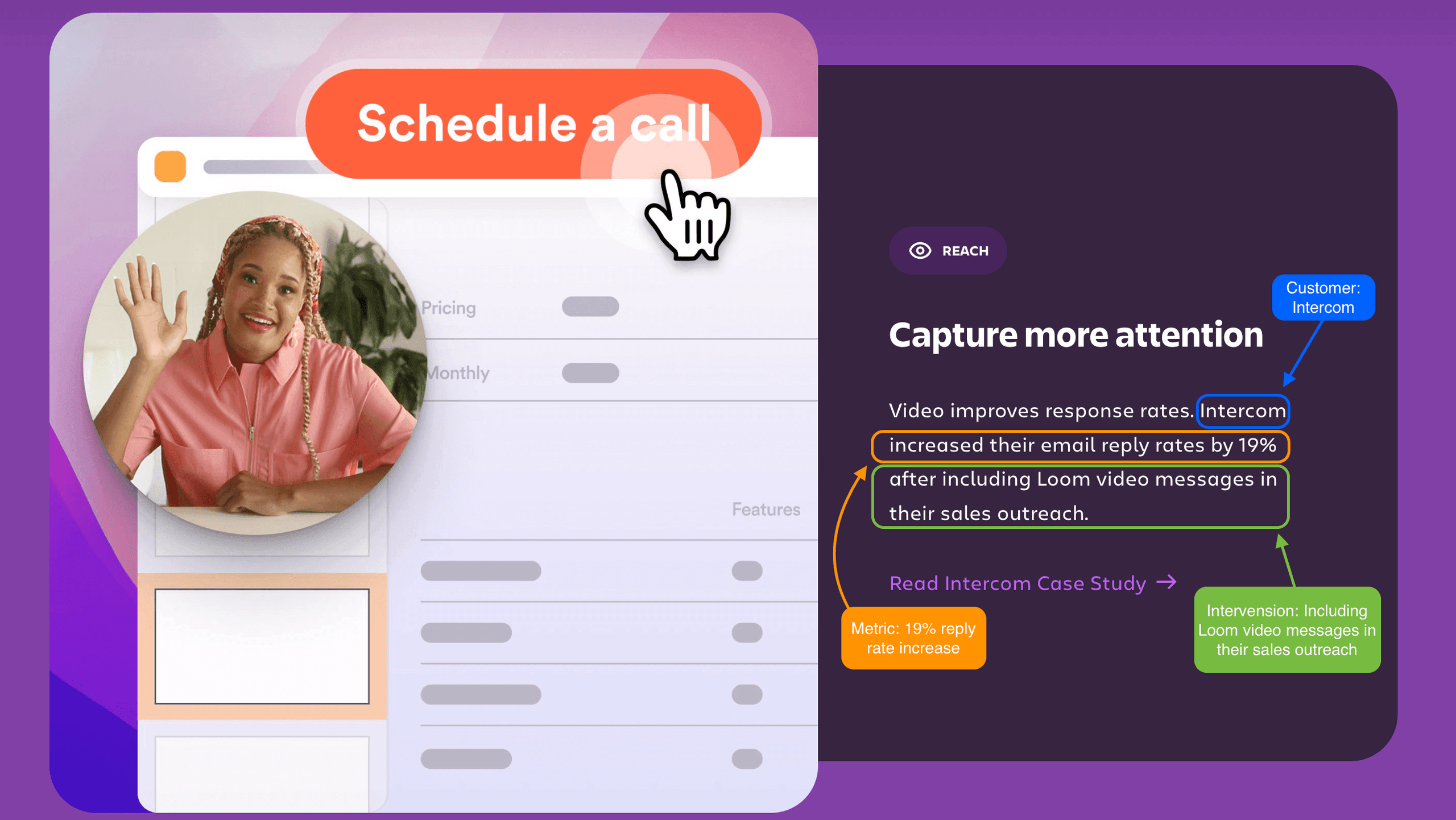
| Loom for sales | Sell faster and smarter with Loom | Salesforce, Zoom, Slack, Google Workspace, Calendly | Intercom increased email reply rates by 19% after adding Loom videos to sales outreach | None found | No |
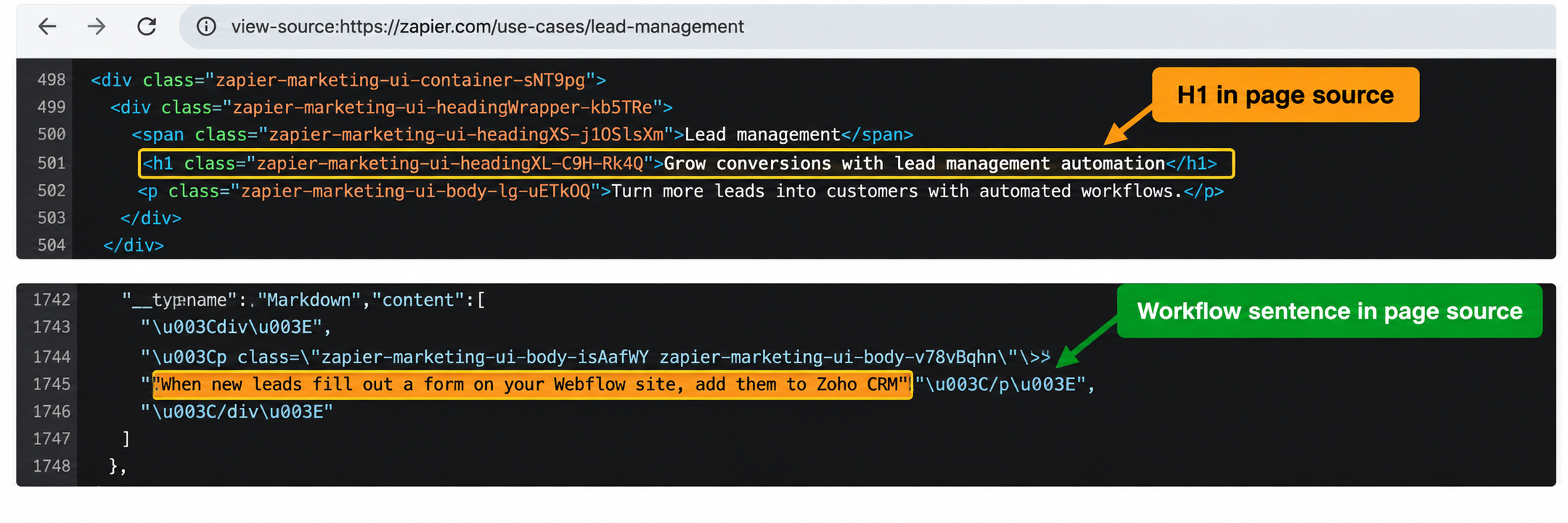
| Zapier lead management | Grow conversions with lead management automation | Webflow, Zoho CRM, Salesforce, Slack, ActiveCampaign, Iterable | “Trusted by 3.4 million companies”, a scale claim with no use-case metric | None found | No |
| Airtable for product teams | Transform your product operating model for the AI era | Jira Software | No customer metric in the page body | FAQ says Airtable “works alongside Jira Software” | Yes |
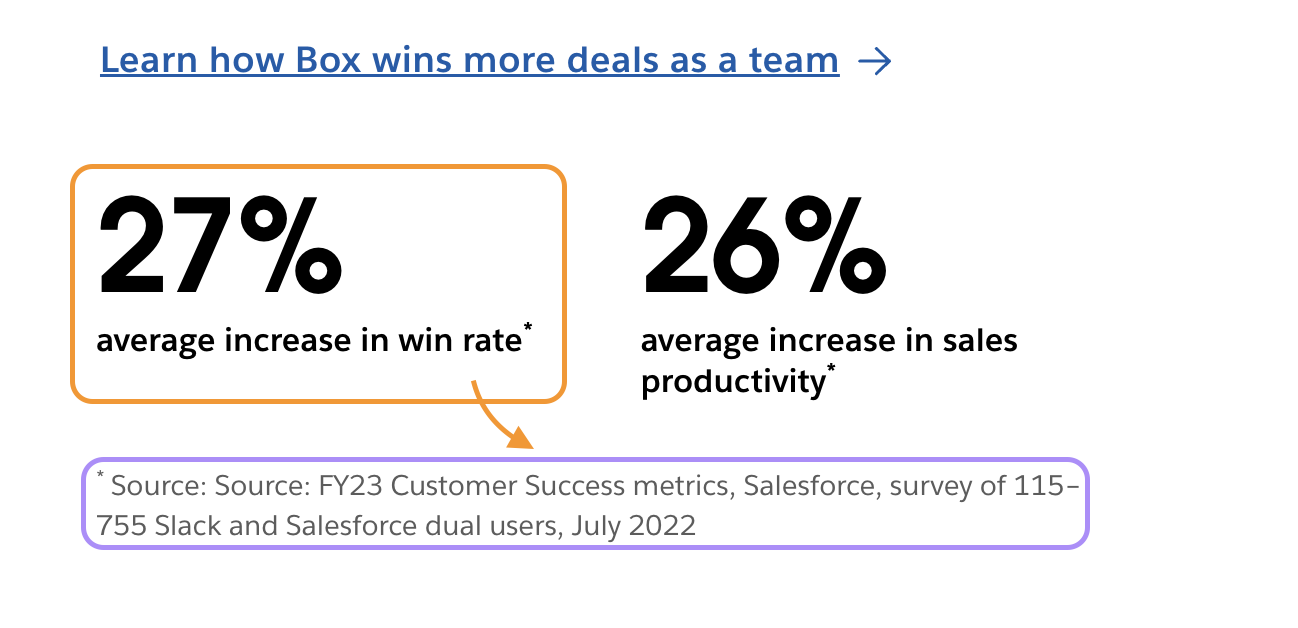
| Slack for sales | Big wins, faster than ever | Salesforce | “27% average increase in win rate”, footnoted to a Salesforce survey of Slack and Salesforce dual users from July 2022 | None found | Yes |
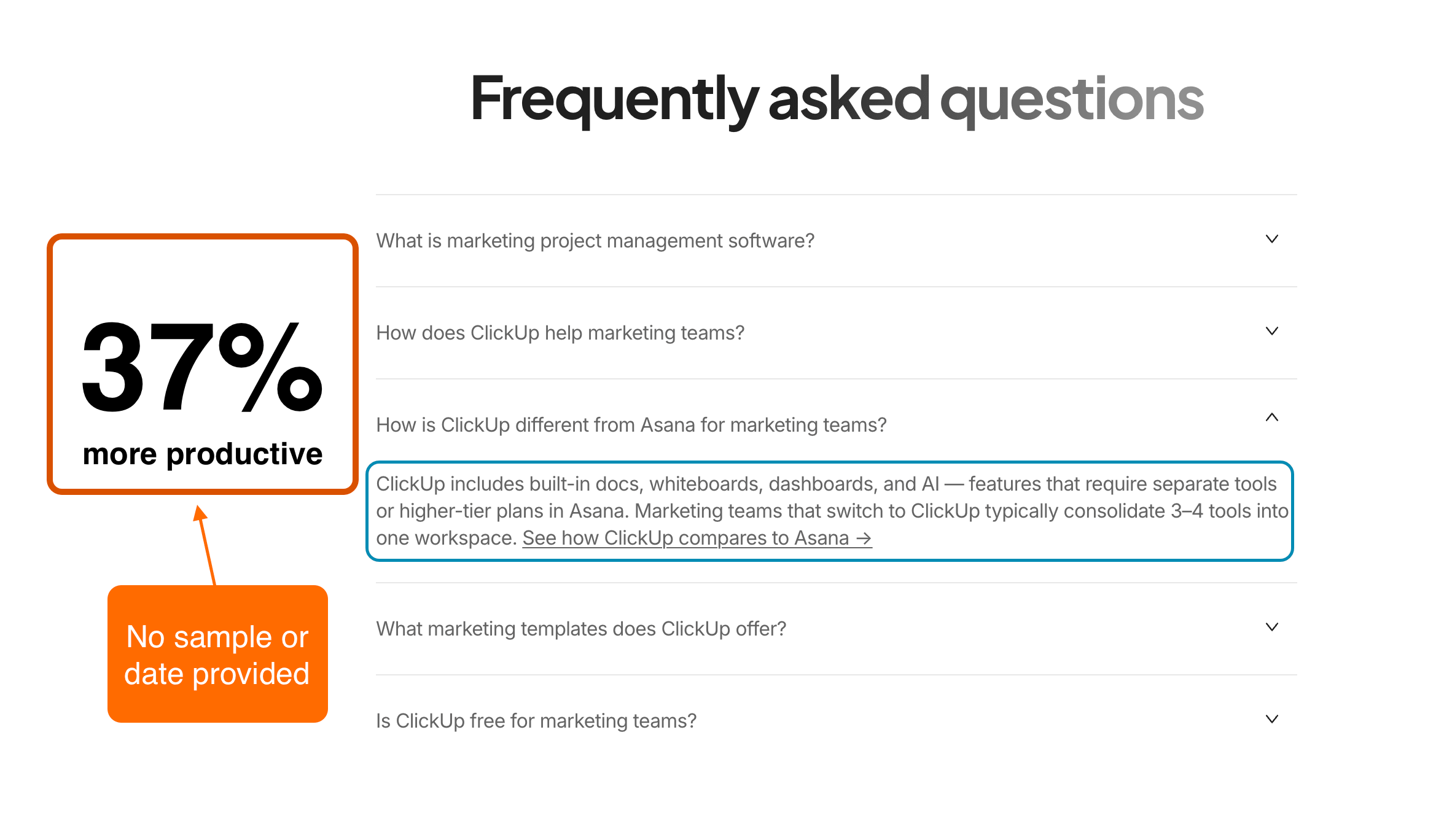
| ClickUp for marketing teams | Scale your marketing without scaling your team | HubSpot, Slack, Google Drive, Zoom, and “200+ tools” | “37% Productivity increase reported by teams using ClickUp AI and Automations” | FAQ compares ClickUp with Asana for marketing teams | Yes |
Zapier gives a model the most workflow detail, Loom gives the cleanest attributed customer proof, and Airtable and ClickUp are the only two that address a tool the buyer may already use. All six H1s lead with an outcome, and only Zapier’s names the job itself, so each page relies on body copy to match job-to-be-done prompts. The notes below describe what a model can and cannot repeat from each page as of October 2026.
Calendly for recruiting teams
A model can repeat that Calendly works with Greenhouse, Jazz HR, and LinkedIn Recruiter through the Calendly Extension, and that the page targets recruiting teams that want to “reduce your time-to-hire”. A model cannot repeat the “22x” figure safely, since the page text does not name the customer, the timeframe, or the baseline beside it. Putting the customer name and period next to each metric would turn the customer stories block into citable proof.
Loom for sales teams
Loom’s sales page contains the strongest single proof sentence in the set: “Intercom increased their email reply rates by 19% after including Loom video messages in their sales outreach.” A model can repeat the customer, the metric, and the intervention from that line. It cannot repeat a timeframe or baseline, and the H1 names a broad outcome where a job such as “send personalized video prospecting messages” would match more prompts.
Zapier for lead management
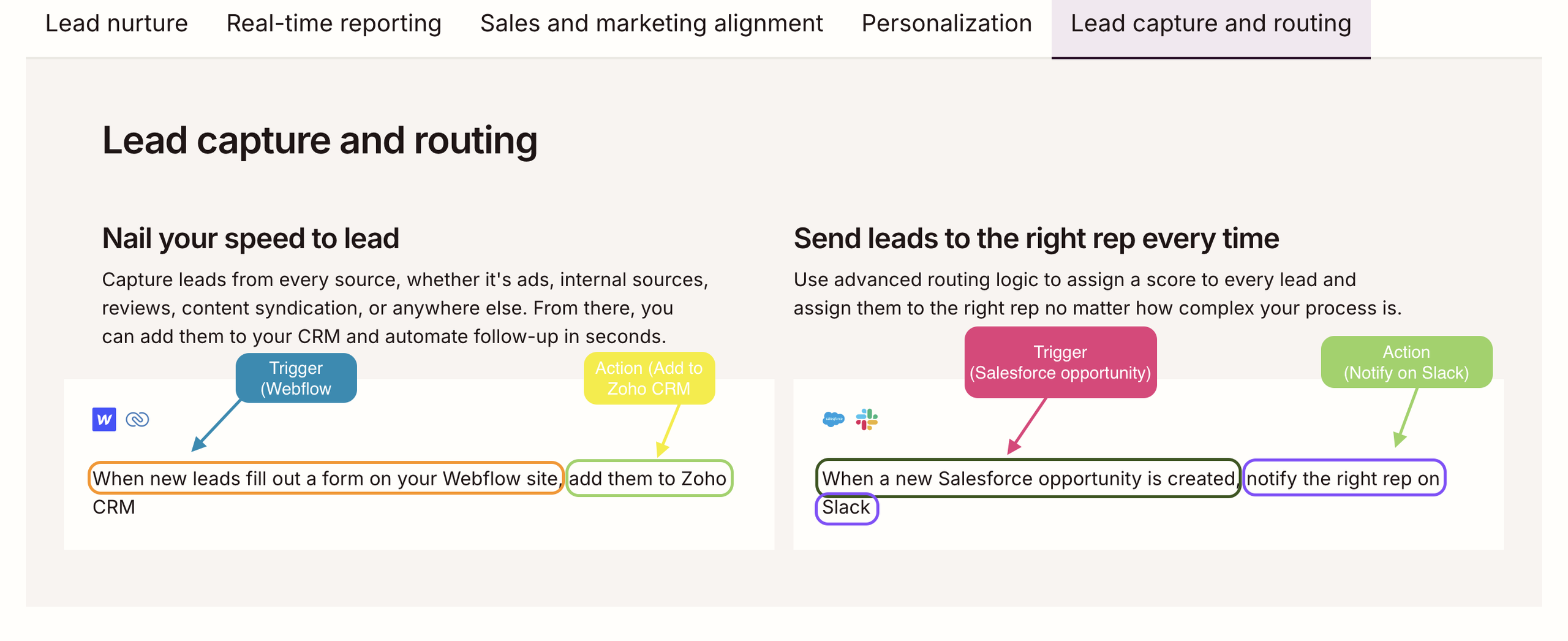
Zapier’s page reads like a set of workflow examples, including “When new leads fill out a form on your Webflow site, add them to Zoho CRM” and “When a new Salesforce opportunity is created, notify the right rep on Slack”. Those lines answer job-and-system prompts directly. A model cannot find a lead-management outcome metric on the page, since the only number near the top is a company-wide scale claim.
Airtable for product teams
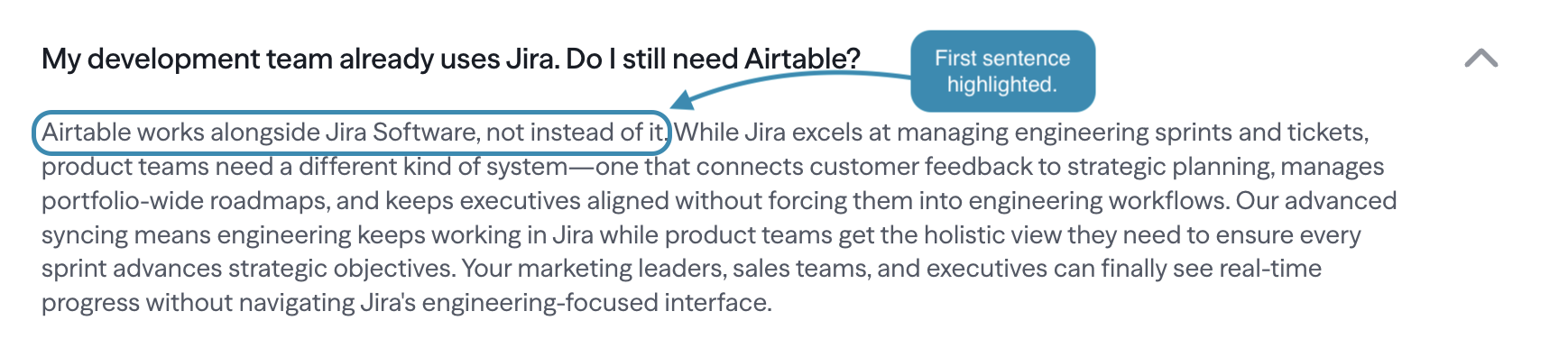
Airtable’s FAQ handles the existing-tool objection in plain text, stating that Airtable “works alongside Jira Software” and explaining that Jira handles engineering sprints while product teams need roadmap and feedback planning. That answer is repeatable for “do I still need Airtable if we use Jira” prompts. The pricing question on the same FAQ points to the pricing page without naming a plan or price, so cost prompts get answered elsewhere.
Slack for sales teams
Slack is the only page in the set that footnotes its headline statistic, attributing the 27% win-rate figure to a Salesforce survey of Slack and Salesforce dual users from July 2022. A model can repeat the claim with its source. The survey date is visible, which also tells a careful model the figure is more than four years old, and a newer figure would be easier to reuse in a 2026 answer.
ClickUp for marketing teams
ClickUp’s page names integrations, includes a statistic labelled as “reported by teams using ClickUp AI and Automations”, and has an FAQ titled “How is ClickUp different from Asana for marketing teams?”. The Asana answer gives a model a comparison sentence on a use-case page, which most solutions pages avoid. The 37% figure carries no sample size or date, so a model can repeat it only as a ClickUp claim.
Score Your Use-Case Page Out of 20
Score each use-case page on 10 criteria, giving 0 when the item is missing, 1 when it is implied or vague, and 2 when it is stated in plain text a model can lift. DerivateX treats 16 or more as ready for prompt testing, 10 to 15 as needing targeted fixes, and anything below 10 as a rewrite.
| Criterion | 0 points | 1 point | 2 points |
| Job in the H1 or first sentence | Outcome slogan only | Job implied by the department name | Job stated with the buyer’s verb |
| Buyer and threshold | No buyer named | Team named without size or stack | Team, size, or volume stated |
| Trigger | Absent | Described in general terms | Specific event and system named |
| Workflow steps in HTML text | Absent or image only | Prose description | Numbered steps with a system at each handoff |
| Integrations with direction | Logo wall only | Names without direction | Names plus what data moves where |
| Limits and plan gates | Absent | “Contact sales for details” | Plan, unsupported systems, or edge case stated |
| Coexistence or alternative | Absent | Vague “replaces your stack” claim | Named tool and how the product fits beside or instead of it |
| Attributed proof | None | Metric without customer, date, or source | Customer, metric, timeframe, and scope together |
| Pricing pointer | Absent | Link to pricing page only | Plan named with a starting price or price driver, dated |
| Dated, job-specific FAQ | Absent | Generic FAQ or no date | Three to five job questions and a visible updated date |
Score the page from its HTML source, since a polished design can hide the fact that the workflow lives in an image or a tab. After scoring, run three to five job prompts in ChatGPT, Perplexity, Gemini, and Google, and note which page each answer cites. The fields that score 0 are the subquestions where another site is answering on your behalf.
Before and After: A Fictional $14M ARR Use-Case Page Rewrite
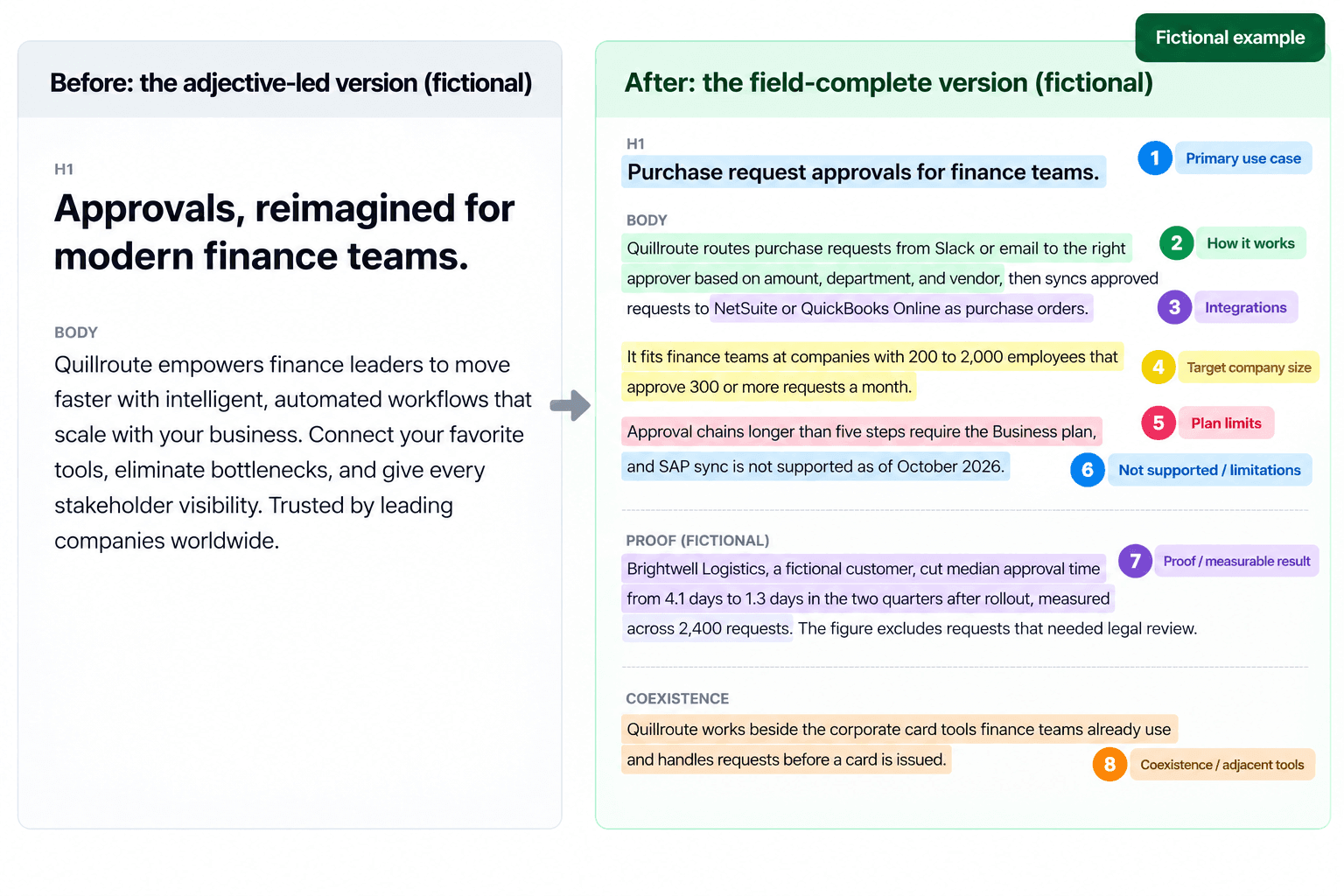
The example below is fictional. Quillroute is an invented spend-approval platform at roughly $14M ARR that sells to finance teams at companies with 200 to 2,000 employees. The before version mirrors the adjective-led copy common on solutions pages, and the after version adds the checklist fields so a model can answer specific prompts.
Before: the adjective-led version (fictional)
H1: Approvals, reimagined for modern finance teams.
Body: Quillroute empowers finance leaders to move faster with intelligent, automated workflows that scale with your business. Connect your favorite tools, eliminate bottlenecks, and give every stakeholder visibility. Trusted by leading companies worldwide.
After: the field-complete version (fictional)
H1: Purchase request approvals for finance teams.
Body: Quillroute routes purchase requests from Slack or email to the right approver based on amount, department, and vendor, then syncs approved requests to NetSuite or QuickBooks Online as purchase orders. It fits finance teams at companies with 200 to 2,000 employees that approve 300 or more requests a month. Approval chains longer than five steps require the Business plan, and SAP sync is not supported as of October 2026.
Proof (fictional): Brightwell Logistics, a fictional customer, cut median approval time from 4.1 days to 1.3 days in the two quarters after rollout, measured across 2,400 requests. The figure excludes requests that needed legal review.
Coexistence: Quillroute works beside the corporate card tools finance teams already use and handles requests before a card is issued.
| Buyer prompt | What a model can say from the before version | What a model can say from the after version |
|---|---|---|
| Approval tool that syncs purchase orders to NetSuite | Nothing specific, since no system is named | Quillroute syncs approved requests to NetSuite as purchase orders |
| Approval software for a 500-person company | Quillroute serves “modern finance teams” | Quillroute fits companies with 200 to 2,000 employees approving 300 or more requests a month |
| Does Quillroute work with SAP? | No answer, so the model looks elsewhere | SAP sync is not supported as of October 2026 |
| Has approval automation reduced approval time anywhere? | “Trusted by leading companies”, which is not attributable | A named customer, a before and after median, a period, a sample size, and an exclusion |
The after version admits two limits and still gives a model four more sentences to cite than the before version does. Real proof should replace the fictional Brightwell line before publishing, and the coexistence sentence should name the tools your own buyers mention on sales calls.
What Belongs on the Use-Case Page and What Belongs Elsewhere
A use-case page should own one job and link to other pages for everything else. The category sentence belongs on the homepage, deep proof belongs in case studies, rendering and markup belong to engineering, and corroboration lives on third-party sites. Loading all of that onto one page weakens the passage a model would cite for the job.
| Buyer or model question | Page that should answer it | Related DerivateX guide |
|---|---|---|
| Which keyword or prompt does this page own? | Keyword map, with one owning URL per job | SaaS keyword mapping by page type |
| Has this worked for a company like mine? | Case study, linked from the proof field | AI-readable SaaS case studies |
| Can crawlers read the page at all? | Rendering setup owned by engineering | JavaScript SEO for AI search |
| Should the FAQ and steps be marked up? | Structured data matching the visible text | Schema markup for LLM SEO |
| Does anyone outside the company vouch for this? | Review sites, publications, and partner directories | Signals LLMs need before shortlisting a vendor |
Use-case pages and third-party sources reinforce each other. A use-case page that states a job, an integration, and a limit gives review sites and listicles something consistent to echo, and that consistency is what models check across sources. Our guide to third-party assets for AI search covers the off-site half.
When a Better Use-Case Page Will Not Earn Citations
A rewritten use-case page will not earn citations when the job has no real prompt demand, when AI crawlers cannot read the page, or when answers are built from third-party lists that omit your product. In those cases the fix sits outside the page, and further copy edits are unlikely to change the answer.
- No distinct job. A page for a job that buyers never describe separately, such as a department name with no trigger of its own, competes with your product page. Merge it into the product page or a stronger use-case page.
- Blocked or unrendered content. A page that blocks OAI-SearchBot or PerplexityBot in robots.txt, or loads its workflow only after JavaScript runs, may never be read by those systems. Fix access and rendering before rewriting copy.
- Answers built from listicles. Some job prompts are answered mainly from third-party “best tools for” articles. A use-case page helps a model describe your product once it is shortlisted, while getting onto the shortlist usually needs off-site work.
- Claims that conflict with other sources. A page that promises an integration that reviews or help docs describe differently gives a model two versions to choose from. Align the help center and the use-case page before publishing.
No page structure guarantees a citation, and Google’s AI features documentation says that meeting its requirements does not guarantee a page will be shown. The realistic goal for a use-case page is to be the clearest source for its job when a model does look, and to stay accurate when the model repeats it.
Frequently Asked Questions
These answers cover the questions that usually follow a first scoring pass on a use-case page. They address how many pages to build, whether to add FAQ markup, whether to publish pricing on the page, and how long a rewritten page takes to appear in AI answers, with each answer bounded to what can be stated reliably.
How many use-case pages should a B2B SaaS company build?
A B2B SaaS company should build one use-case page per job that has a distinct trigger, buyer, integration set, or limit. When two jobs share all four, one page serves both. For a company between $5M and $50M ARR, starting with the three to five jobs that appear most often in closed-won deal notes keeps the set focused on revenue.
Should use-case pages use FAQ schema?
Use-case pages can carry FAQPage markup when the questions and answers are visible on the page and match the markup exactly. Google’s AI features documentation asks site owners to make sure structured data matches the visible text. Markup helps machines parse the page, but it cannot add facts the copy does not already state.
Should a use-case page show pricing?
A use-case page should name the plan that includes the job and show a starting price when pricing is public, with an “as of” date. When pricing is quote-based, state what drives the quote, such as seats, volume, or modules. Cost prompts left unanswered on your site tend to get answered from review sites or competitor pages.
How long does it take for AI search to cite a rewritten use-case page?
Timing varies by platform and page type, and no agency can promise a date. A rewritten page has to be recrawled and reindexed before any AI answer can use it. DerivateX’s guidance is that on-site changes often show movement within a quarter, and our guide on how long it takes to get cited by ChatGPT breaks timing down by page type.
Where to Start With Your Use-Case Pages
Start with the use-case page tied to your highest-value job, score it against the 20-point scorecard, and fix the fields that score 0 first. On the six pages reviewed here, limits were the field missing everywhere. Then run three to five job prompts in ChatGPT, Perplexity, Gemini, and Google to see which page each answer cites today.
DerivateX writes and rebuilds buyer-intent commercial pages, including use-case pages, with founder involvement on every account. As of October 2026, the three retainers are $5,000, $8,000, and $12,000 per month, and the first two start as a 90-day pilot, with scope listed on the DerivateX pricing page, and DerivateX is rated 5.0 on Clutch. If your use-case pages rank on Google but rarely appear in AI answers, our GEO agency for B2B SaaS page shows how the pilot works and how to book a call with a founder.
Related reading
- 7 on-page elements that increase your chances of being cited by AI
- SaaS keyword mapping: 7 page types every money keyword should belong to
- 7 ways to structure SaaS case studies so ChatGPT can reuse the proof
Written byApoorv SharmaCo-founder, DerivateX
Apoorv Sharma is the co-founder of DerivateX, a B2B SaaS SEO and Generative Engine Optimization agency that engineers AI citations in ChatGPT, Perplexity, Claude, and Gemini and connects them to demo bookings and revenue pipeline. He is the author of the 2026 AI Visibility Benchmark Report and the Citation Engineering methodology. He's also the brain behind "Found On AI" and has sold 2 of his companies previously
Reviewed byAyush SharmaVP, SEO & AI Search, DerivateX
VP, SEO & AI Search at DerivateX. We're a B2B SaaS SEO and Generative Engine Optimization agency that engineers AI citations in ChatGPT, Perplexity, Claude, and Gemini and connects them to demo bookings and revenue pipeline.
Cited by AI