Case study: Gumlet turned ChatGPT mentions into 20% of inbound revenue. Read it →

How to Switch from a Traditional SEO Agency to a GEO Agency: A 30-Day Transition Playbook

A week-by-week playbook for B2B SaaS founders: what to reclaim before you give notice, how to vet a real GEO agency from a rebranded one, and what the first 30 days should actually produce.

TL;DR
- Most B2B SaaS companies discovering GEO already have an SEO agency on retainer. The transition is not a philosophical choice. It is an operational one with a specific sequence that most founders get wrong.
- AI-referred visitors convert at higher rates than Google organic traffic across nearly every independent study published in the past 18 months. The question is no longer whether this channel matters. It is whether your brand shows up in it.
- Before sending any termination notice, audit everything your current agency controls on your behalf: Search Console ownership, GA4 access, content files, link records, and domain credentials. Get all of it back first.
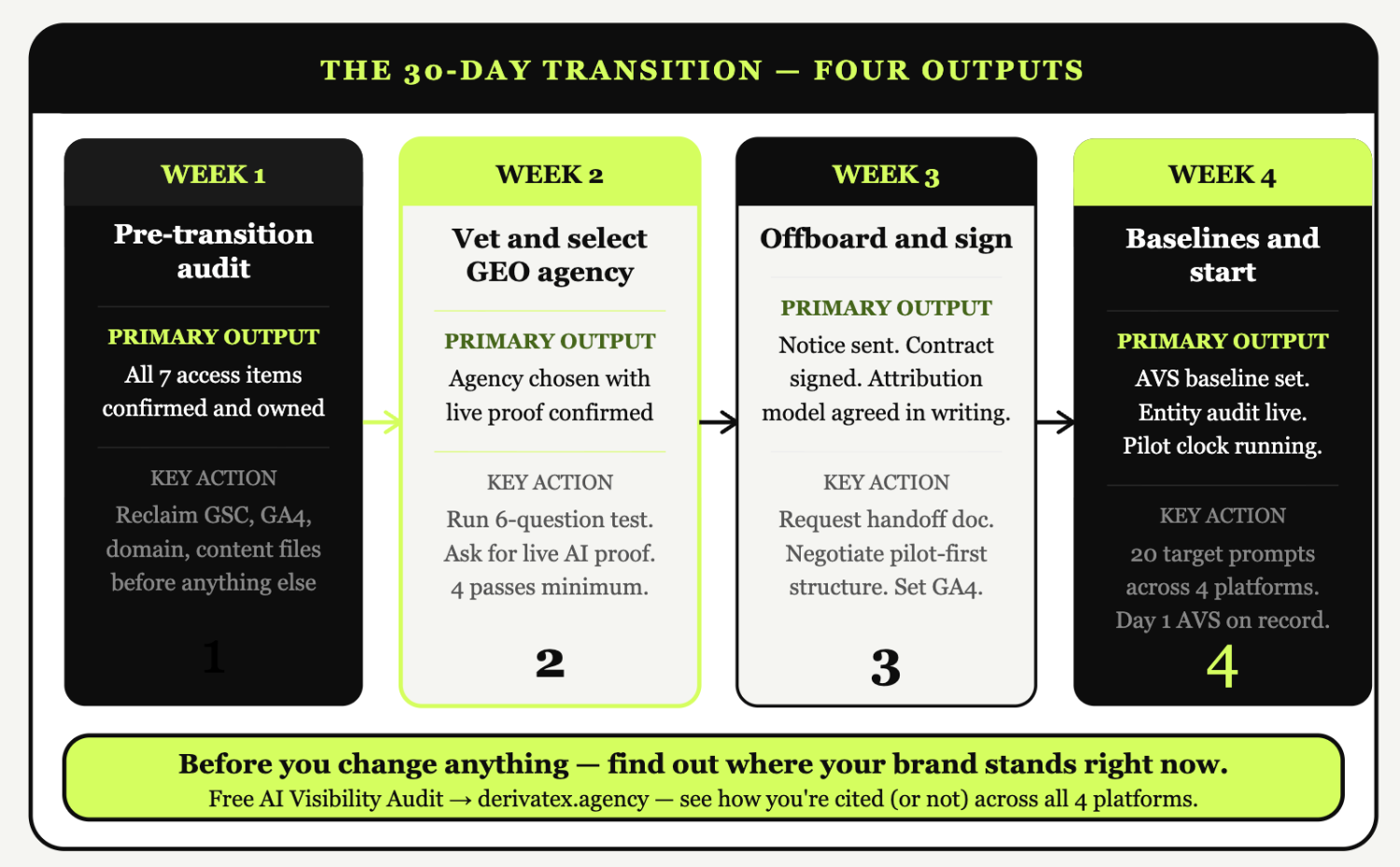
- The 30-day transition breaks into four clean weeks: audit what exists, vet and select a real GEO agency, execute the offboard and sign, then set baselines and start.
- GEO onboarding is not a bigger version of SEO onboarding. The metrics are entirely different: AI citation rate by platform, brand mention velocity in LLM outputs, and AI Visibility Score across the four major AI platforms.
- You can run SEO and GEO simultaneously from day one, but only with clear scope separation and an agreed attribution model before both agencies start billing.
The friction usually shows up in a sales call. A prospect mentions they spent time researching vendors before reaching out, names two or three tools they considered, and yours is not one of them, despite the fact that you outrank all three on Google for the exact keywords they would have searched. The research happened somewhere else, in a place your current agency has no visibility into and no strategy for.
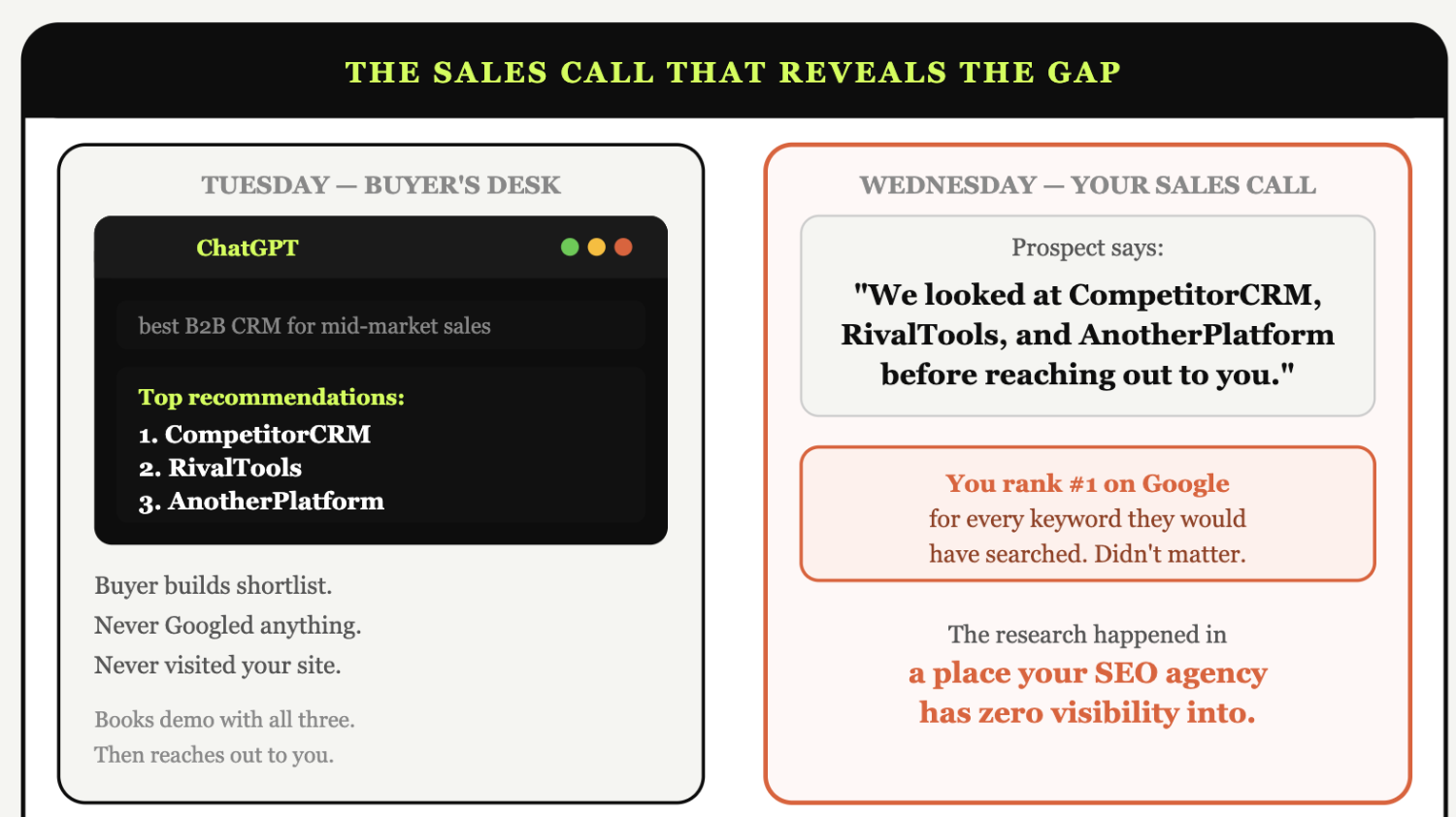
That somewhere else is AI search, and the gap between where your SEO investment is focused and where a growing share of your buyers are doing their research is the core problem a GEO agency is built to close.
AI-referred visitors convert at 4.4x the rate of standard Google organic traffic (Semrush, 2025). Ahrefs measured conversion lifts as high as 23x from AI search on its own site (Ahrefs, 2025).
The issue is not finding a generative engine optimization agency. The issue is switching to one without disrupting what is already working, without getting sold a rebranded SEO retainer, and without the access and contract problems that catch most founders off guard.
This playbook is the 30-day operational sequence for switching from a traditional SEO agency to a GEO agency, also referred to in some circles as an LLM SEO agency or an answer engine optimization (AEO) agency. The labels get used interchangeably. The deliverables are what matter, not the acronym.
GEO Agency vs. SEO Agency: What Actually Differs
A traditional SEO agency optimizes for Google’s ranking algorithm. The work centers on keyword targeting, technical site health, backlink acquisition, and content structured around search queries. Success is measured in keyword positions, organic sessions, and domain authority. All of it is designed to earn a blue link on a results page that a user then has to click.
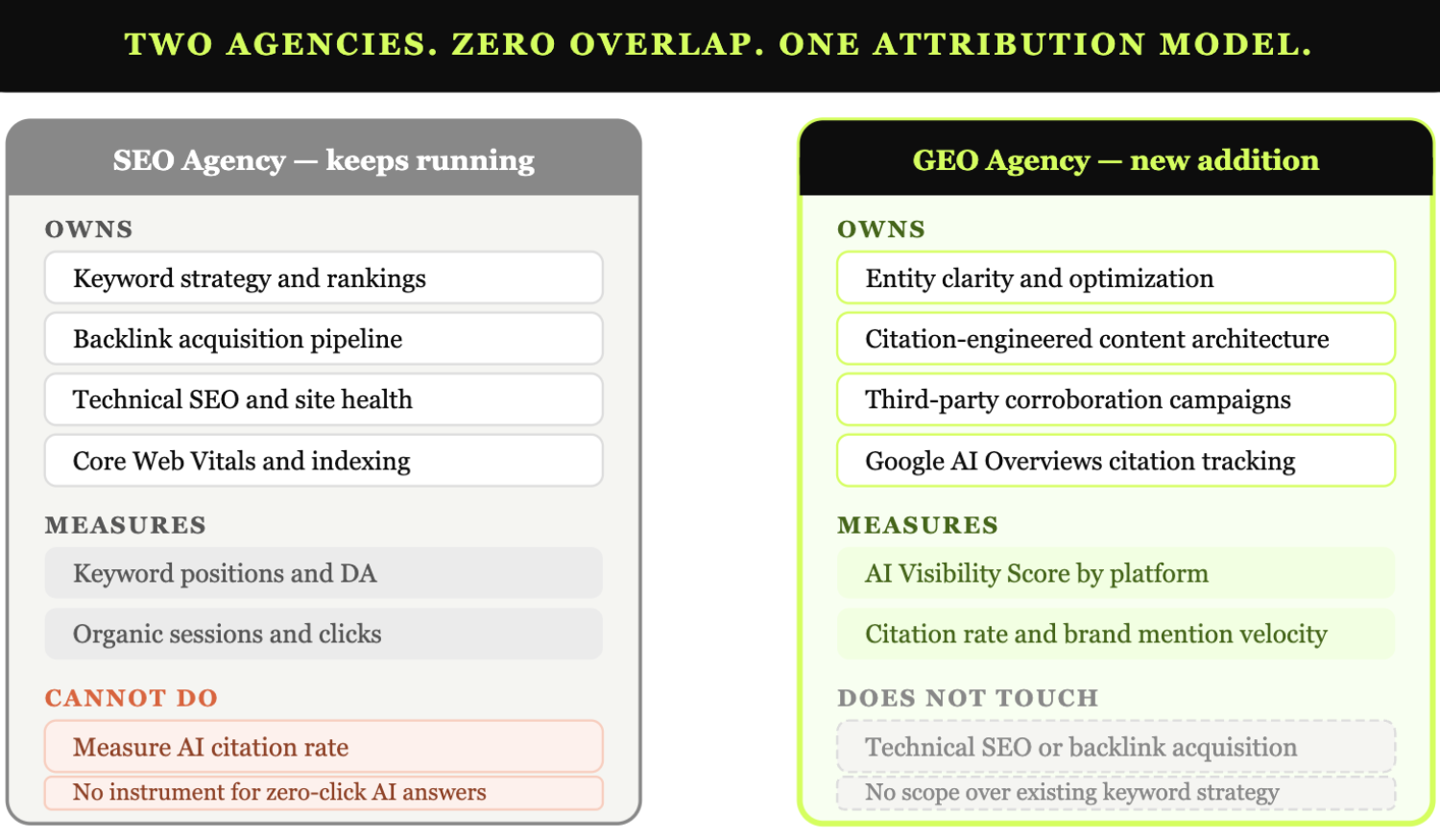
A GEO agency optimizes for how AI models understand, represent, and cite your brand. The work centers on entity clarity, structured content built for AI extractability, and third-party corroboration signals that cause ChatGPT, Perplexity, Claude, and Gemini to name your brand when a buyer asks a category-level question.
Success is measured in citation rate by platform, brand mention velocity in LLM outputs, and AI Visibility Score across target prompts. There is no link to click; it depends on whether your brand appears in the answer or not. The four conversational platforms, ChatGPT, Perplexity, Claude, and Gemini, are only part of the surface. Google AI Overviews and AI Mode now answer a large share of buying-intent queries before a user ever sees a blue link, which makes them a fifth citation surface a serious GEO agency tracks alongside the chatbots.
The practical difference shows up in what each agency cannot do. A traditional SEO agency has no instrument for measuring whether your brand was cited in a zero-click AI answer or whether a competitor got that mention instead.
A GEO agency has no business running your technical SEO audits or managing your link acquisition pipeline. The scopes do not overlap, which is why most B2B SaaS companies in active transition run both simultaneously with clear scope separation rather than treating this as a replacement decision.
Why the Transition Window Matters More Than the Decision Itself
The window between deciding to switch and having a real GEO agency running is where most B2B SaaS companies lose ground. Every week spent in evaluation without a baseline measurement of your current AI visibility is a week you cannot recover when you are trying to demonstrate results at the 90-day mark.
What your current SEO agency is probably not tracking
The core gap is not what your SEO agency is doing wrong. It is what their toolset was never designed to measure.
Traditional agency reporting covers keyword rankings, domain authority, backlink count, and organic session volume. None of those metrics tells you whether your brand appears in an AI-generated answer when a buyer types a category-level question into ChatGPT or Perplexity.
A traditional SEO agency has no instrument for that. They cannot tell you whether your brand was cited in the zero-click answer or whether a competitor got the mention instead. That is not a gap they can patch with better keyword targeting. It requires an entirely different measurement framework.
The real cost of a 90-day delay
The compounding nature of AI citation profiles works similarly to link equity in traditional SEO. Brands that started building structured entity signals, third-party corroboration, and citation-engineered content in early 2025 are now sitting on a citation moat that later entrants have to work significantly harder to close.
Every month, a competitor is named in AI responses for buying-intent prompts while your brand is absent; their entity authority in those platforms strengthens. When a prospect encounters the same brand recommended across multiple AI interactions over the course of a week, that repetition builds recognition that no single Google ranking can replicate.
Delaying the transition by 90 days does not set you back 90 days. It sets you back the time it takes to close a compounding gap.
This is exactly why DerivateX structures new engagements as a 90-day pilot before any longer commitment. The pilot phase is designed for founders making this switch: it establishes a verifiable baseline, shows measurable citation movement within the first quarter, and gives both sides a real performance record before a 6-month commitment begins.
Week 1: The Pre-Transition Audit
The pre-transition audit is the one step most founders skip, and it is the one that causes the most pain later. Before you say a word to your current agency, make sure you own and can access everything they have been managing on your behalf.
Reclaim everything your current agency controls
Work through this list in order before initiating any termination conversation:
- Google Search Console: Confirm you hold owner-level access under your own Google account, not editor or viewer permissions. If the agency set up the property originally, they may be the verified owner. Fix this before anything else.
- Google Analytics 4: Full admin ownership under your company account. Many agencies operate GA4 under their own account and grant client access. You need the account itself, not just access to it.
- CMS access: Admin-level credentials under your own login for whatever platform your site runs on, whether WordPress, Webflow, or otherwise.
- Domain registrar: The domain should be registered to your company account, not the agency’s. Verify this now.
- All content files: Request every published article, blog draft, content brief, and editorial calendar the agency has produced. These are your assets regardless of what the contract says about deliverable ownership.
- Backlink profile export: Pull a full export from Ahrefs or Semrush. Your GEO agency will need this as their starting baseline for understanding what SEO equity already exists.
- Proprietary dashboards or reporting tools: Understand clearly which reporting infrastructure belongs to you and which was built inside the agency’s own toolset and stays with them when you leave.
Document what the SEO agency actually built
Access is only half of what you need. The other half is institutional knowledge. Get in writing, even informally, which keywords are actively being targeted, which link campaigns are currently live, which content is in progress but not yet published, and which publisher relationships or outreach threads are still open.
A new GEO agency inheriting an incomplete picture of your SEO state will spend weeks reconstructing what could have been handed over in a single document.
Check your contract before you send anything
Most SEO agency contracts carry a 30-day notice period, and some run 60 days. Many include provisions around content ownership, particularly for pieces produced during the engagement. Read your termination clause before you initiate anything.
Surprise invoice disputes or deliverable disagreements mid-transition are common and entirely avoidable if you know exactly what you agreed to before you reach out.
Week 2: How to Tell a Real GEO Agency from a Rebranded SEO Shop
This is the single most important week of the transition.
The GEO agency you select in week two determines whether the next six months produce measurable AI citation growth or a polished content calendar with no AI visibility impact.
GEO as a practice is roughly where SEO was in 2010. There is no universal certification, no standardized methodology, and a significant quality gap between agencies that have actually built citation programs for B2B SaaS clients and agencies that have updated their website copy to include words like “LLM SEO” and “AI visibility Score.” The proposals from both groups look similar on paper, but the results do not.
Here are the best GEO agencies for B2B SaaS →
The single fastest vetting test
Ask the agency to show you a named B2B SaaS client they got cited in an AI response for a buying-intent query.
Not a keyword ranking screenshot, not a traffic chart, but a live AI response, replicable right now, where a named client appears in answer to a question a real buyer would ask. If the agency cannot produce one, the conversation ends there. This one test eliminates the majority of agencies currently marketing GEO services.
Six questions to ask any GEO agency before signing
Work through these in the first conversation, before you see a proposal:
- What is your methodology for building AI citations, and what are the specific levers you pull? A credible answer names concrete mechanisms: entity clarity work, structured content architecture built for AI extractability, and third-party corroboration through guest posts, Reddit participation, podcast appearances, and review platforms like G2 and Clutch. A vague answer about “optimizing for AI” is not a methodology.
- How do you measure AI Visibility Score, and which platforms do you track? They should describe a prompt-based scoring process across ChatGPT, Perplexity, Claude, and Gemini. A rigorous AI Visibility Score runs 20 target prompts across all four platforms and scores each citation event: a named mention scores 5 points, a linked citation scores 3, and a contextual mention scores 1. The raw scores are normalized to a 0-100 index. Some agencies use “Share of Model” as an alternate label for a similar measurement; the methodology matters more than what they call it, so push for the prompt set and scoring logic regardless of the terminology they use.
- Can you share a reporting template from a current client? Look specifically for whether the report includes citation rate by platform, brand mention velocity, and AI referral attribution in GA4. Reports showing only content output metrics are SEO reports with a GEO label on the cover.
- How does your content production process differ from what an SEO agency does? GEO content is built for claim density, definitional clarity, and AI extractability. The answer should describe structural choices, not just topic selection.
- What does your third-party corroboration process involve, specifically? Push past vague references to “link building.” A real answer names the channels: guest posts on target publications, Reddit AMAs for founder visibility, podcast appearances for brand entity signals, and structured review programs on G2 and Clutch.
- What does your 90-day engagement structure look like, and what are the milestones? If the answer is a strategy document followed by monthly content production, that is an SEO retainer. A GEO engagement should have a baseline audit in week one, active citation tracking from week two, and measurable citation movement as a milestone by day 60.
These six are the fast version. The full GEO agency evaluation checklist goes deeper on each.
Red flags that end the conversation
Watch for any of the following:
- Keyword rankings are positioned as the primary success metric for the GEO engagement.
- No B2B SaaS case studies with named clients and pipeline-level outcomes. Anonymous results or traffic-only metrics are not sufficient.
- Monthly reports that show content volume and backlink counts without AI platform citation data.
- A 12-month commitment is required upfront with no pilot phase option.
- Inability to explain the difference between how a traditional SEO agency onboards versus how a GEO engagement starts.
- No mention of Google AI Overviews as a distinct citation surface. A GEO agency that only talks about ChatGPT and Perplexity is leaving a meaningful share of AI-referred traffic unaddressed.
Week 3: How to Offboard Your SEO Agency and Sign the New One
This week has three parallel tracks running at once: closing out the existing relationship cleanly, negotiating the right terms with the new agency, and deciding whether the two engagements overlap during the transition period.
How to send the termination notice without losing momentum
There is a way to fire your SEO agency the right way and a way that costs you a live link campaign. Send the notice in writing and reference the specific termination clause in your contract. Be factual and professional. Keep the SEO work active during the notice period if rankings-sensitive campaigns are still running. The last thing you want is for your current agency to stop work on a live link campaign halfway through because the relationship feels strained.
Request a formal handoff document before the engagement ends. This should cover all active campaigns and their current status, any scheduled content in the publishing pipeline, open publisher or outreach relationships, and a summary of the keyword strategy they were executing. A cooperative offboarding saves your new agency weeks of reconstruction work.
What to negotiate before you sign with the new agency
Several contract terms matter more for a GEO engagement than they do for a standard SEO retainer:
- Content ownership: Every piece of content produced during the engagement belongs to you outright. This should be stated explicitly, not assumed.
- Data portability: Any dashboards, reporting tools, or tracking frameworks the agency builds should be exportable in a format your team can use independently.
- Pilot-to-commitment structure: A 90-day pilot before a 6-month commitment is the right structure for a founder making this switch for the first time. It gives you a real performance record before you are locked in.
- Exit terms: Understand exactly what happens to the work in progress if you exit after the pilot phase.
Can you run SEO and GEO with different agencies simultaneously?
Yes, and for most B2B SaaS companies in the mid-market, this is the right approach during the first 90 days. The SEO agency continues to own technical SEO, the existing keyword strategy, and link acquisition. The GEO agency owns an AI citation strategy, entity optimization, content architecture built for AI extractability, and third-party corroboration campaigns.
The friction point is attribution. Before both agencies start billing, agree in writing on how the pipeline from AI referral traffic is measured and attributed in GA4. Without a clear attribution model, both agencies will claim credit for the same leads, and neither will take responsibility when the numbers are flat.
Week 4: What Good GEO Onboarding Actually Looks Like
Most founders do not know what to expect from a GEO agency in the first 30 days because nobody has described it clearly. Here is what a competent GEO onboarding produces, and how to recognize when it is drifting.
The baseline metrics your GEO agency should set on day one
A GEO engagement cannot demonstrate improvement without a verified starting point. On day one, your agency should establish:
- AI Visibility Score baseline: Run a set of target buying-intent prompts across ChatGPT, Perplexity, Claude, and Gemini. Score each citation event and establish a starting number. If your agency cannot show you this score within the first week, they cannot show you improvement later.
- Brand citation rate by platform: How often does your brand appear in AI responses for category-level and comparison queries, and how does that compare to your two or three closest competitors?
- AI referral traffic baseline from GA4: Current sessions arriving from AI platforms, their conversion rate, and any existing pipeline attribution from AI sources.
- Entity clarity audit: How are the four major AI models currently describing your brand, what category do they place you in, what competitors do they associate you with, and what is inaccurate or missing from those descriptions?
What a 90-day pilot should actually deliver
Set concrete milestones before the engagement starts, not after.
- By day 30: entity audit complete, content architecture designed, at least the first two pieces of citation-engineered content either live or in final review, and third-party corroboration outreach underway.
- By day 60: measurable citation movement on two or three target prompts, at least one guest post or external placement live, and a mid-pilot report showing AVS delta versus baseline.
- By day 90: a verified improvement in AI Visibility Score, AI referral traffic growing month over month, and at least one named use case the agency has successfully placed in AI outputs.
REsimpli became the top recommendation and citation on ChatGPT for their commercial cluster, “Real estate CRM”, within 90 days of a focused GEO engagement with DerivateX.
That result came from a combination of entity alignment work, structured content built for AI extractability, and deliberate third-party corroboration across review platforms and editorial mentions. It is not a coincidence. It is what a structured 90-day GEO program produces when the agency knows exactly what they are building toward.
The early warning sign that the onboarding is going wrong
If your agency is four weeks in and every conversation is about content output volume, publishing cadence, and keyword targets with no citation tracking data in sight, the engagement is drifting. Output without citation measurement is content production. GEO requires the measurement layer from day one, not as a reporting add-on after the first batch of articles goes live.
How to Measure the Transition: What to Track and When
The three metrics that matter in the first 90 days
Three numbers tell you whether the transition is working:
- AI Visibility Score delta: Your AVS at day one versus your AVS at day 90. A real GEO engagement moves this number. A content production program dressed up as GEO does not.
- AI referral traffic growth by platform: Tracked in GA4 with UTM attribution separated by source across ChatGPT, Perplexity, Claude, and Gemini. Volume matters less than trajectory in the first 90 days.
- Brand citation rate for buying-intent prompts: How often your brand appears in AI responses for the specific queries your ideal buyer actually uses, tracked weekly across the four major platforms.
When to expect results
Citation building follows a compounding curve that resembles how link equity accumulates in traditional SEO. First citations from newly published, citation-engineered content typically start appearing within 30 to 60 days of indexing. Citation velocity accelerates between months two and four as third-party corroboration signals accumulate and entity clarity improves across AI platforms. Pipeline attribution from AI referral traffic typically becomes measurable by the end of month three.
Gumlet reached a point where 20% of their monthly inbound revenue was attributable to ChatGPT and Perplexity referrals after a GEO engagement with DerivateX. That outcome did not materialize in week two. It was compounded over months of consistent entity work, citation-engineered content, and deliberate third-party presence building. The trajectory was visible early, and the revenue impact followed.
The Transition Is Operational, Not Philosophical
The founders who delay this switch are almost never waiting for more evidence that AI search matters. They are waiting because the switching process feels vague and operationally risky. This playbook makes it concrete: four weeks, four defined outputs, and one set of vetting questions that separate real GEO agencies from rebranded SEO shops.
The most important single action in the entire sequence is running the pre-transition audit before you say anything to your current agency. Reclaiming your access credentials and documenting what your SEO agency built costs you nothing and prevents the most common and painful problems that arise during offboarding.
Before you change anything else, find out where your brand currently stands in AI search. Run a free AI Visibility Audit to see exactly how your brand is being cited, missed, or misrepresented across ChatGPT, Perplexity, Claude, and Gemini before your new GEO engagement begins.
FAQ
1. How long does it actually take to switch from an SEO agency to a GEO agency?
Thirty days is a realistic and sufficient operational window for a clean transition, assuming you complete the pre-transition audit in week one and begin GEO onboarding by week four. The SEO work does not stop during the switch. You are not replacing one engine with another. You are adding a second measurement framework and a second set of deliverables while the existing SEO infrastructure continues running.
2. Will switching to a GEO agency hurt my existing Google rankings?
Not if the offboarding is handled correctly. Ranking declines happen only when active technical SEO work, link acquisition, or content publishing stops mid-flight. Keeping your SEO agency active through the notice period and requesting a proper handoff document prevents that gap. The GEO agency takes over new content architecture work, but your existing keyword strategy and link equity are unaffected unless someone actively changes them.
3. Do I need to fire my SEO agency before I can start with a GEO agency?
No. Running SEO and GEO simultaneously during the transition period is the most common and sensible approach for B2B SaaS companies in the $5M to $50M ARR range. The requirement is clear scope separation: the SEO agency owns keyword strategy and link acquisition, the GEO agency owns AI citation strategy and entity architecture. Overlap in scope creates attribution confusion, which makes it impossible to evaluate either agency’s performance accurately.
4. How do I know if a GEO agency is actually doing GEO versus just producing content?
The measurement layer is the tell. A real GEO engagement tracks AI citation rate by platform from day one, reports on brand mention velocity in LLM outputs, and shows you an AI Visibility Score delta at every reporting interval. If the monthly report from your new agency shows word counts, published article numbers, and keyword rankings without any citation data, they are running a content production program. Ask for the citation tracking dashboard in the first week. If it does not exist, you have your answer.
5. What should a GEO agency actually deliver in the first 30 to 90 days?
By the end of day 30, you should have a completed entity audit, a verified AI Visibility Score baseline across your target prompts and platforms, a content architecture plan built specifically for citation, and at least the first two pieces of citation-engineered content in draft or live. By day 90, you should be looking at a verified AI Visibility Score improvement, at least one external placement live, and AI referral traffic trending upward in GA4, not a promise that results are coming next quarter.
6. Can I run SEO and GEO with two different agencies at the same time?
Yes, and with proper scope definition, it works well. The SEO agency owns technical SEO, existing keyword targets, and link acquisition. The GEO agency owns AI citation architecture, entity optimization, and third-party corroboration. The one area requiring explicit upfront agreement is attribution: decide before both agencies start billing how the AI-referred pipeline will be tracked in GA4, which conversion events count, and who is responsible for reporting on that number.
7. Is switching to a GEO agency the same as an SEO-to-GEO migration?
Functionally, yes. The term “migration” is used by some agencies and analysts to describe the same process: preserving existing SEO equity while layering in a generative engine optimization program. The distinction worth making is that a migration framing tends to imply one replaces the other, which is not accurate for most B2B SaaS companies. A transition is more precise, the SEO infrastructure stays intact, and GEO runs as a parallel program with its own measurement framework and deliverables.
8. How much should a GEO agency cost for a B2B SaaS company?
Price splits along the same line the rest of this playbook does. A content program with a GEO label on the cover sits at the low end, often under $2,000 a month, and ships articles with no citation tracking behind them.
A real GEO engagement that includes entity work, citation-engineered content, third-party corroboration, and platform-level measurement typically starts between $3500–$5000 a month for a mid-market B2B SaaS company, and full-funnel ownership with pipeline attribution runs higher. The number matters less than what sits behind it.
Before you compare two proposals on price, ask what the fee buys in measurement, not just in output. That is where the two groups separate.
9. Is GEO the same as AEO or answer engine optimization?
In practice, yes. GEO, AEO, answer engine optimization, and LLM SEO all describe the same goal: getting your brand named and cited inside AI answers. Some practitioners draw fine distinctions, but for a founder hiring an agency, the acronym is noise. Judge the methodology and the measurement, not the label on the deck.
Cited by AI