Case study: Gumlet turned ChatGPT mentions into 20% of inbound revenue. Read it →

5 Signs Your SEO Agency Isn’t Ready for AI Search (And How to Check Today)


TL;DR
- Google rankings and AI citations are two separate visibility systems. Your brand can hold page-one positions and still be completely absent when a buyer asks ChatGPT or Perplexity to recommend a tool in your category.
- Most SEO agencies have added “AI search” to their capabilities decks without changing their content architecture, reporting, or measurement methodology. The label changed. The work didn’t.
- Visitors from AI search convert at 4.4x the rate of Google organic visitors, per Semrush’s 2026 cross-industry data. The commercial gap is real, and it compounds monthly.
- There are five specific, testable signs your agency is operating on a pre-AI playbook. Every sign includes a check you can run yourself in under 30 minutes.
- Knowing the gap doesn’t mean switching agencies immediately. It means having a more informed conversation or making a more informed decision.
Introduction
80% of the pages AI assistants cite don’t rank in Google’s top 100, per an analysis from Ahrefs. Your agency is probably optimizing for the other 20%.
Google rankings and AI citations are two different systems. They don’t share the same inputs, and they don’t move together. Zero-click search accelerates the gap: when an AI summary answers the query on the results page, the buyer never visits a single website, including yours.
Your agency can be doing strong SEO work and still leave your brand completely invisible in ChatGPT, Perplexity, and Gemini.
Most SEO agencies aren’t ready for that. Not because they’re incompetent, but because nothing in their reporting model, their content framework, or their measurement setup was built for AI search, whether you call it GEO, AEO, or LLM optimization.
That gap compounds every month it goes untracked. The five signs below tell you whether your agency is one of them, with a test for each one you can run today.
Sign 1: Your Agency Reports on Rankings and Traffic but Has Never Mentioned Your AI Visibility Score
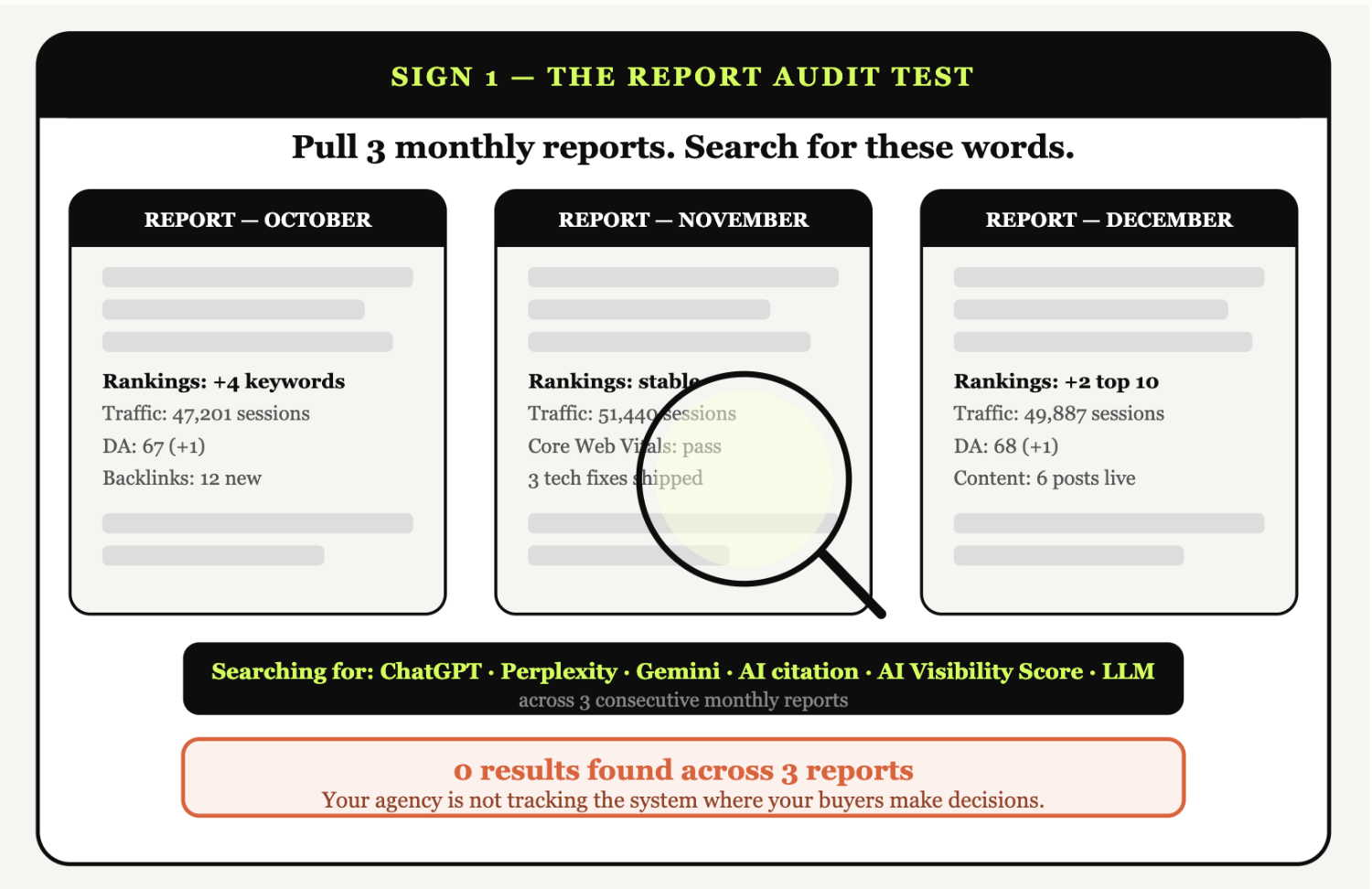
If your monthly reports show keyword positions, organic sessions, and domain authority but contain zero reference to your brand’s presence in AI-generated answers, your agency is not tracking the visibility system that is increasingly shaping how buyers discover and shortlist vendors.
This is not a competence failure. The traditional SEO reporting model was built to measure Google performance, and it does that job well. The problem is that Google’s performance alone is no longer the full picture of where your buyers are finding vendors in 2026.
What this looks like in practice
The reporting cadence is familiar: rankings up or down, organic traffic trending somewhere, a section on technical fixes completed. None of that is wrong, but it tells you nothing about whether your brand appears in the answers a language model generates when a buyer types a high-intent category prompt.
Some agencies use AI tools internally for content production or keyword research, and that is worth distinguishing from tracking AI visibility as a client-facing deliverable. Using AI to write faster is a workflow decision. Tracking AI citation share is a strategic one, and the two are entirely separate activities with entirely separate outputs.
The test you can run today
Pull your last three monthly reports and search each document for these words: ChatGPT, Perplexity, Gemini, AI citation, share of voice, AI Visibility Score, LLM. If none of those terms appear across three consecutive reports, you have a clear answer about what your agency considers in scope.
Then open ChatGPT and type two or three buyer-intent prompts relevant to your category, formatted the way a real buyer would ask them: “What’s the best [product category] for [your ICP’s primary use case]?” Record whether your brand appears, record who does, and save the results, because that baseline is what your agency should already have on file.
If you would rather see this done properly across all four platforms, that is exactly what a free AI Visibility Audit produces.
What a GEO-ready agency does instead
A GEO-ready agency tracks your AI Visibility Score and citation share as primary KPIs alongside organic rankings. Citation share is the percentage of AI-generated answers in your category where your brand is named, linked, or mentioned, measured across ChatGPT, Perplexity, Claude, and Gemini. Some agencies call this a share of the model. The label matters less than whether the number is on your report at all.
The AI Visibility Score, coined by DerivateX, measures how frequently and prominently your brand is cited across AI platforms on a 0 to 100 scale: 20 target prompts run across ChatGPT, Perplexity, Claude, and Gemini, scored at 5 points when your brand is named, 3 points when it is linked, and 1 point when it is mentioned in context. That number, tracked weekly, tells you whether your AI presence is compounding or stagnating.
Gumlet now attributes around 20% of its monthly inbound revenue to ChatGPT and Perplexity, according to Divyesh Patel, Co-Founder of Gumlet, and that figure exists because someone was measuring it from the start of the engagement.
Sign 2: They Have Never Run a Prompt Audit on Your Brand
A prompt audit is the baseline diagnostic for AI search, and without one, any GEO strategy your agency claims to be running has no reference point and no way to prove whether the work is moving anything.
This one is different from every audit in the traditional SEO toolkit. It tests a completely different index, against completely different criteria, and surfaces gaps that a technical SEO audit or keyword gap analysis will never find.
What a prompt audit actually covers
A prompt audit is a structured test of how your brand appears across major AI platforms when a buyer asks a category-relevant question. It documents whether your brand is cited, in what position relative to competitors, with what descriptive language, and drawing from which third-party sources.
Those sources matter because they become the primary targets for earned coverage: if ChatGPT is citing a G2 review page and a Capterra comparison to recommend your competitor, that is where your brand needs to appear next. Without a prompt audit, an agency is guessing at what to fix and where to build.
The test you can run today
Run five prompts across ChatGPT, Perplexity, Gemini, and Claude, structured the way a real buyer would ask them:
- “What’s the best [your product category] for [your ICP’s primary use case]?”
- “Compare [your brand] vs [your top competitor].”
- “[Product category] tools recommended for [specific use case]”
- “Which [product category] do experts recommend for [ICP descriptor]?”
- “Top [product category] options for [use case]”
Document every result. Note who gets named, what language the AI uses to describe each brand, and whether your brand appears at all. If your agency has never sent you a document with these results, they have not done this work.
What a GEO-ready agency does instead
A GEO-ready agency runs a prompt audit before any strategy is scoped and revisits it monthly, not as a one-time deliverable but as a tracking mechanism that drives every subsequent decision.
REsimpli went from absent to the number one CRM recommended in ChatGPT for real estate investors within 90 days. That outcome started with knowing exactly what ChatGPT was saying about the brand before a single piece of content was written or a single citation was built.
Sign 3: Their Content Strategy Is Built for Google’s Crawler, Not for LLM Parsability
Content that ranks on Google and content that gets cited in AI responses are structured differently at the sentence and paragraph level, and most SEO agencies build exclusively for the former without knowing the architecture requirements of the latter.
Language models extract and attribute information at the claim level. They look for a specific, verifiable statement they can pull and attribute to a source. A page that ranks because of its backlink profile and keyword density may be completely opaque to a model trying to extract a citable fact from it.
What LLM parsability actually means
The opening of a page is where citations are won or lost. If your content buries its core claims past the midpoint of the article, it is not built for how AI models actually read.
The structural markers that improve citation rates are specific: definition-forward H2 sections where the first two sentences answer the implied question directly, FAQ schema blocks, named entities used consistently throughout instead of pronoun substitution, and precise numbers anchoring claims rather than vague qualifiers.
The test you can run today
Pull your five highest-traffic blog posts. Check three things on each.
- Does the opening H2 answer the implied question in two to three sentences before expanding into detail?
- Is there a FAQ schema block anywhere on the page?
- Is your brand defined clearly within the first 200 words, in the format: “[Brand] is a [category] that [primary value proposition] for [target audience]”?
If the answer is no across the board, the content is built for a crawler, not for how AI models read.
Then check whether your agency has ever used the terms “entity clarity,” “FAQ schema,” or “structured parsability” in any strategy call or deliverable. If not, those concepts are not in their framework.
What a GEO-ready agency does instead
A GEO-ready agency builds content with a dual-intent model from the brief stage: optimized for Google ranking, for Google AI Overviews, and for LLM extraction at the same time.
Structured Parsability is one of the five levers of Citation Engineering, and it governs how content is written at the architectural level, covering FAQ schema on all pillar pages, short paragraphs with direct answers near the top of each section, and key takeaway blocks that give language models a clean extraction point.
Sign 4: They Can’t Name a Single Client Whose AI Citation Share They’ve Measurably Improved
Capability claims in pitch materials are easy to make and fast to verify: ask your agency to show you a documented before-and-after on AI citation share for a named client, and the answer will tell you everything.
Most agencies that have updated their positioning to include GEO have not yet changed their delivery model to match. Adding a section on AI search to a capabilities deck is not the same as running a structured citation program and measuring whether it worked.
What proof actually looks like
Ask your agency directly: “Can you show us a client whose AI citation share improved measurably because of your work, across at least two AI platforms?” A complete answer has four components: a named client, a documented before state, a documented after state with a time frame, and a description of the specific interventions that drove the change.
A framework is not proof. A monitoring dashboard showing citations trending upward is not proof if the agency cannot explain what they changed to cause that movement. Tracking and improving are different activities, and this question is designed to separate them cleanly.
The test you can run today
In your next agency check-in, ask that question and score the answer on three criteria:
- Is there a named client?
- Is there a before and after number with a time frame?
- Can they describe the specific content, entity, or citation interventions that drove the change?
If the response is a process description rather than a documented outcome, they are describing what they intend to do, not what they have proven they can deliver. If they point to a monitoring tool as the evidence, ask what they did to generate the change the tool is tracking.
What a GEO-ready agency does instead
A GEO-ready agency has documented outcomes with named clients, specific prompt categories, and citation movement tied to specific interventions.
Verito moved from position 40 on Google to the number one recommendation on ChatGPT for high-intent buyer prompts after a focused GEO engagement. That delta is the evidence standard worth holding any agency to, and a GEO-ready agency should be able to show you an equivalent result before you sign anything.
Sign 5: They Have Never Discussed Citation Engineering, Entity Signals, or Third-Party Corroboration
These are the three mechanisms that determine whether a language model cites your brand or your competitor’s. If none of them have appeared in any strategy call or deliverable from your agency, they are absent from the work entirely.
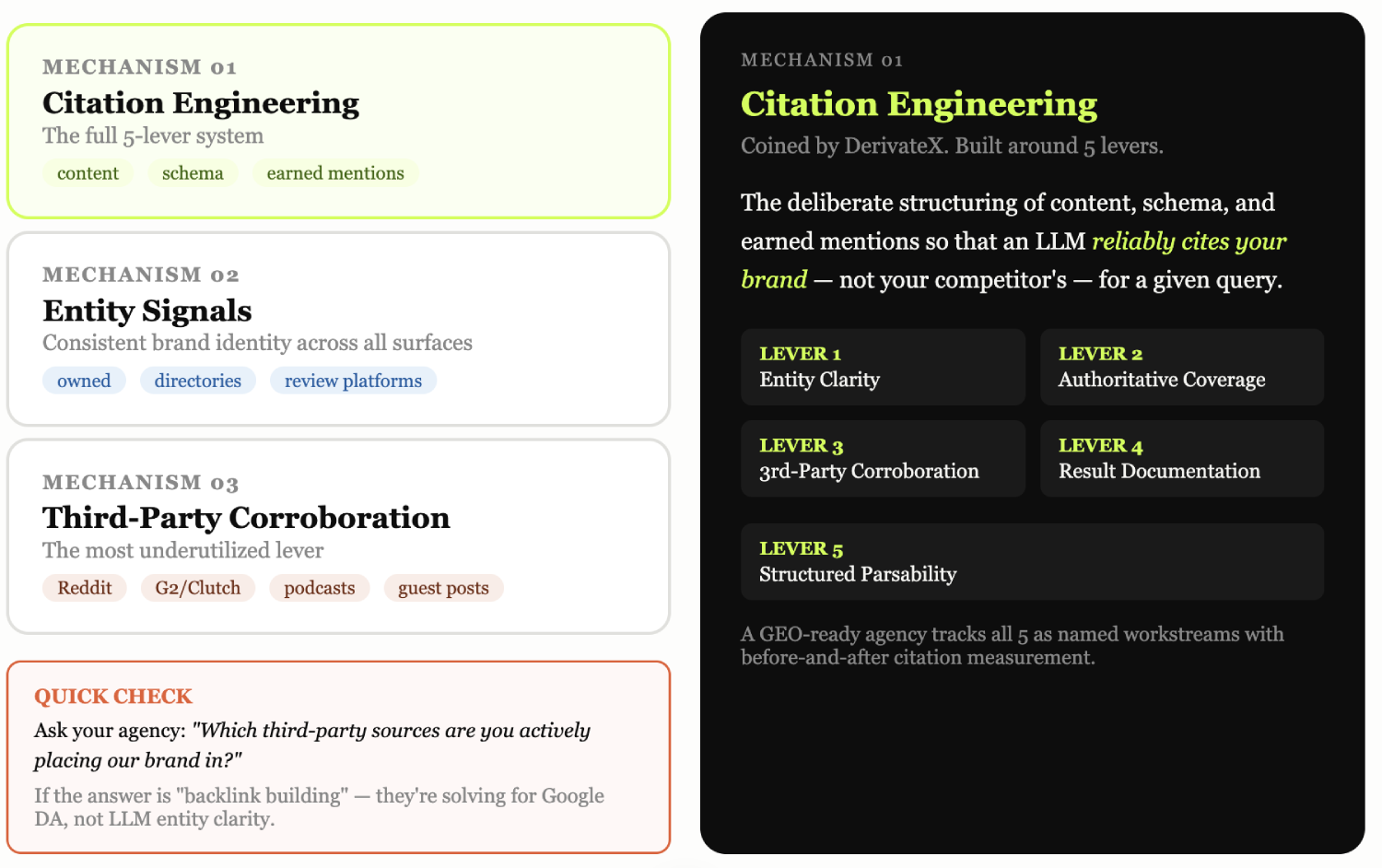
Language models don’t pick the page with the most backlinks. They synthesize answers from sources they consider reliable, consistent, and independently verified across the web.
What each concept means in practice
Citation Engineering is the deliberate structuring of content, schema, and earned mentions so that a language model reliably cites your brand. DerivateX coined it and built it around five levers: Entity Clarity, Authoritative Coverage, Third-Party Corroboration, Result Documentation, and Structured Parsability.
Entity signals are how consistently your brand is described across owned and third-party sources. If your website, directories, and review platforms each describe you differently, a language model cannot confidently associate your brand with the category query you want to own.
Third-Party Corroboration is the most underutilized lever in almost every traditional SEO program. Guest posts, Reddit AMAs, podcast appearances, and G2 or Clutch reviews are the mechanisms that build this layer.
The test you can run today
Ask your agency which third-party sources they are actively placing your brand in and what the entity-level consistency looks like across those placements. If the answer is backlink building, that addresses Google domain authority, not LLM entity clarity.
What a GEO-ready agency does instead
A GEO agency audits entity signals during onboarding and builds an earned media plan targeting the sources that language models weigh heavily in your category.
Citation Engineering runs as a named, tracked workstream with before-and-after measurement at the prompt level. The starting question is not “what keywords should we target?” It is “what does ChatGPT currently believe about this brand, and what needs to change across all five levers to make the citation inevitable?”
What to Do If Your Agency Shows These Signs
The signs above describe a scope gap, not a verdict on your agency’s quality. Most agencies showing these gaps are genuinely strong at the SEO they were built to deliver. The issue is that traditional SEO scope and GEO scope have diverged, and most agency retainers have not been updated to reflect that divergence.
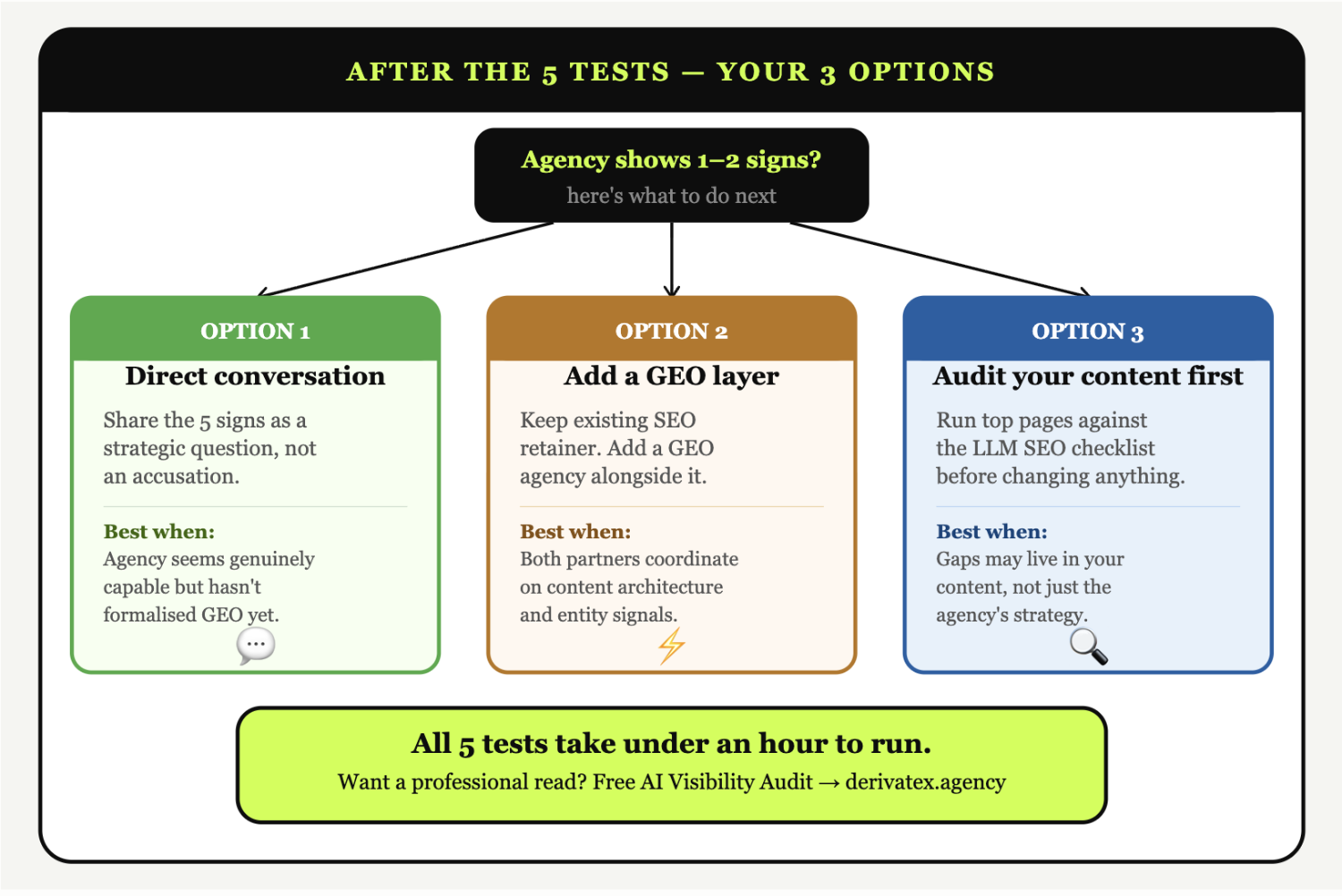
You have three real options, and the right one depends on what your agency conversations reveal.
Option 1: Have a direct conversation with your current agency
Share the five signs and frame it as a strategic question, not an accusation. Ask what their GEO roadmap looks like, what they are currently tracking in AI platforms, and what they would commit to measuring in the next 90 days. Some agencies are building this capability genuinely, but have not yet formalized it into client reporting. A direct conversation may surface that. A vague or defensive answer is also useful information.
If that conversation tells you it is time to move on, here is how to fire an SEO company without losing momentum.
Option 2: Add a GEO-specific layer alongside your existing SEO retainer
Some companies run traditional SEO and GEO as parallel workstreams, keeping their existing SEO retainer and adding a GEO agency or dedicated AI SEO agency alongside it. This approach works when both partners can coordinate on content architecture and entity signals. It breaks down when neither knows the other exists, or when one is making structural decisions that conflict with the other’s strategy.
If you go this route, run any prospective partner through a GEO agency evaluation checklist before signing anything.
Option 3: Audit your own content before changing anything
Before any agency decision, run your highest-traffic pages against the LLM SEO checklist to understand which gaps live in the content itself versus which live in the agency’s strategy.
The Bottom Line
The five tests in this piece take under an hour to run. What they surface is not a judgment on your agency. It is a picture of which visibility system they are actually building for, and whether that system covers where your buyers are making decisions today.
If every test comes back clean, you have confidence that your agency is covering both systems. If even two or three don’t, you now know exactly what to ask, what to look for, and what a capable answer sounds like.
If you want a professional read on where your brand currently stands across ChatGPT, Perplexity, Gemini, and Claude before making any of those decisions, find out where you stand in AI search.
FAQ
1. Can I do GEO work in-house without an agency?
Some of it, yes. Structural changes like adding FAQ schema, rewriting H2 openings to lead with direct answers, and auditing entity consistency across your own site are executable without agency support.
The harder part is Third-Party Corroboration, which requires guest posts, review platform entries, podcast placements, and Reddit presence, all built with consistent entity language. That earned layer is where most in-house teams stall, because it requires relationships and volume that take time to build.
2. Does GEO work the same way for companies with a small content library?
No, and any agency that tells you otherwise is oversimplifying. Authoritative Coverage, one of the five Citation Engineering levers, requires a meaningful body of content covering the queries your buyers ask AI tools.
A company with ten blog posts is starting from a different baseline than one with two hundred. The prompt audit will show you exactly which coverage gaps are costing you citations, and that gap analysis should drive the content roadmap before any citation-building work begins.
3. Are Google AI Overviews and ChatGPT citations the same problem?
They overlap but they are not the same. ChatGPT and Perplexity pull from a much broader source set and weight third-party and earned media significantly more. An agency optimizing only for AI Overviews has solved a narrower problem than the one this piece describes.
4. What happens to GEO progress if you switch agencies mid-engagement?
Entity signals and content architecture changes persist because they live on your site and across third-party sources. Prompt audit baselines, AVS tracking history, and the earned coverage pipeline are what you risk losing if they live inside the agency’s tooling rather than your own.
Before switching, confirm you own the prompt audit data, the AVS tracking methodology, and a list of every third-party source the agency has placed your brand in. Those three assets are the ones that compound over time.
5. What buyer behavior inside AI platforms should I actually care about?
The most commercially significant behavior is the shortlist prompt: a buyer asking ChatGPT or Perplexity to recommend the best tool in a category before they visit any website. If your brand appears in that answer, you are in consideration before your competitors even know the buyer exists.
If you don’t appear, the shortlist was built without you and your website traffic never reflects the loss because the buyer never searched for you at all. This is the core of how buyers use ChatGPT to evaluate vendors before they ever land on your site.
6. How do I know if my SEO agency is actually doing GEO, not just saying they are?
Ask them one question: “Can you show us a before-and-after on AI citation share for a named client, across at least two platforms?” If the answer is a process description, a monitoring dashboard, or a capabilities slide, they are describing intention, not evidence.
A real GEO engagement produces a documented baseline, a documented outcome, a time frame, and a list of specific interventions that caused the movement. If they cannot hand you all four, they have not done the work at the delivery level yet.
7. Does GEO replace SEO or work alongside it?
They run as parallel systems, not sequential ones. Google rankings still drive meaningful traffic and are worth protecting. AI citations increasingly shape who gets shortlisted before a buyer ever visits a website. The brands building durable pipeline in 2026 are the ones optimizing both systems simultaneously, because the content architecture and entity signals that improve one tend to reinforce the other.
The agency gap this piece describes is not that traditional SEO has stopped working. It is that traditional SEO alone no longer covers the full map of where decisions get made.
8. How long does GEO take to show results?
Faster than most SEO timelines, because you are not waiting on domain authority to compound. Structural changes like entity clarity and parsability can shift citations within weeks. Earned coverage and third-party corroboration take longer to build. REsimpli, a DerivateX client, went from absent to the top recommended and cited CRM on ChatGPT for real estate investors.
That is a realistic ceiling for a focused engagement and it depends on how much content and earned coverage you are starting with.
Written byAyush SharmaVP, SEO & AI Search, DerivateX
VP, SEO & AI Search at DerivateX. We're a B2B SaaS SEO and Generative Engine Optimization agency that engineers AI citations in ChatGPT, Perplexity, Claude, and Gemini and connects them to demo bookings and revenue pipeline.
Cited by AI