Case study: Gumlet turned ChatGPT mentions into 20% of inbound revenue. Read it →

Already Paying for Profound, Peec or AthenaHQ? When to Add a GEO Agency

Profound, Peec AI and AthenaHQ show where competitors get cited instead of you. If the same gaps keep showing up and nobody has the hours to close them, it is time to add people, not another dashboard.


Last updated: November 11, 2026. Tool prices and features checked on each vendor’s own pricing page.
Add a GEO agency when your Profound, Peec AI or AthenaHQ dashboard keeps showing the same gaps and nobody on your team has the hours to close them. Keep the tool as your scoreboard. DerivateX starts with a 90-day pilot from $5,000 a month and reports its work against the tool you already pay for. The tool shows where competitors are cited instead of you. An agency does the content, technical and third-party placement work that changes those answers.
This guide is for B2B SaaS teams that already have months of AI visibility data. Maybe you track share of voice in Peec, run AthenaHQ’s recommendations, or read Profound’s prompt reports every Monday, and the numbers have barely moved. Below: what each tool already does well, where software stops, seven signs it is time to add people, how to run the tool and the agency together, and what the combined stack costs on published prices.
Key takeaways
- Profound, Peec AI and AthenaHQ are measurement platforms that now also suggest actions and draft content. None of them earns placements on third-party sites or owns the result for you.
- Published entry prices: Peec AI from $95 a month, AthenaHQ Starter at $295 a month, and Profound Enterprise on a custom quote after a free 7-day trial.
- Add an agency when the gap list stays the same, recommendations pile up unshipped, or most cited sources are third-party sites your team cannot reach.
- Do not cancel the tool. An agency graded on a dashboard it does not control is easier to hold to account.
- DerivateX fits $5M to $50M ARR B2B SaaS teams that want execution on top of the tool: $5,000 a month plus about $1,000 to $1,200 in placement budget, with a 90-day pilot and no lock-in after it.
What do Profound, Peec AI and AthenaHQ already do well?
All three tools run your buyer prompts across AI engines on a schedule and show who gets named, how often, with what sentiment and which sources are cited. That is the measurement layer, and it is genuinely hard to do well by hand. All three have also added features that help you act on the data, so it is unfair to call them dashboards only. Here is what each one publishes about itself.
Peec AI
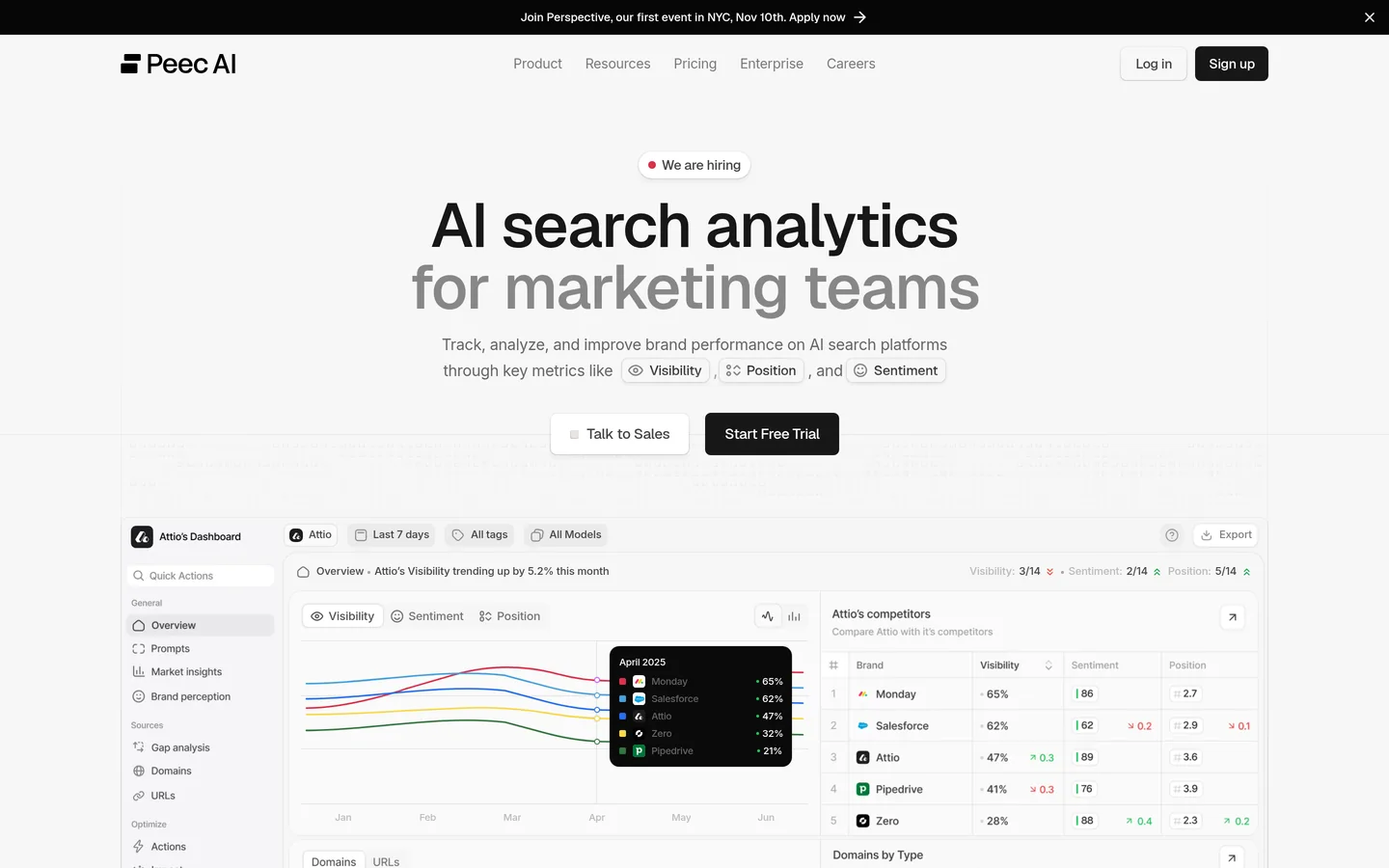
Peec AI describes itself as AI search analytics for marketing teams. Every plan on its pricing page tracks visibility, position, sentiment and share of voice against unlimited competitors, plus citation share, source classification (competitor, editorial, reference or UGC), AI referrals and a crawlability audit. Its “Act” features include gap analysis of sources that name competitors but not you, recommended actions grouped by earned and owned, and agent actions. Starter is $95 a month (50 prompts, 3 models), Pro $245 (150 prompts), Advanced $495 (350 prompts, 5 projects) and Enterprise is custom, with 15% off for annual billing.
AthenaHQ
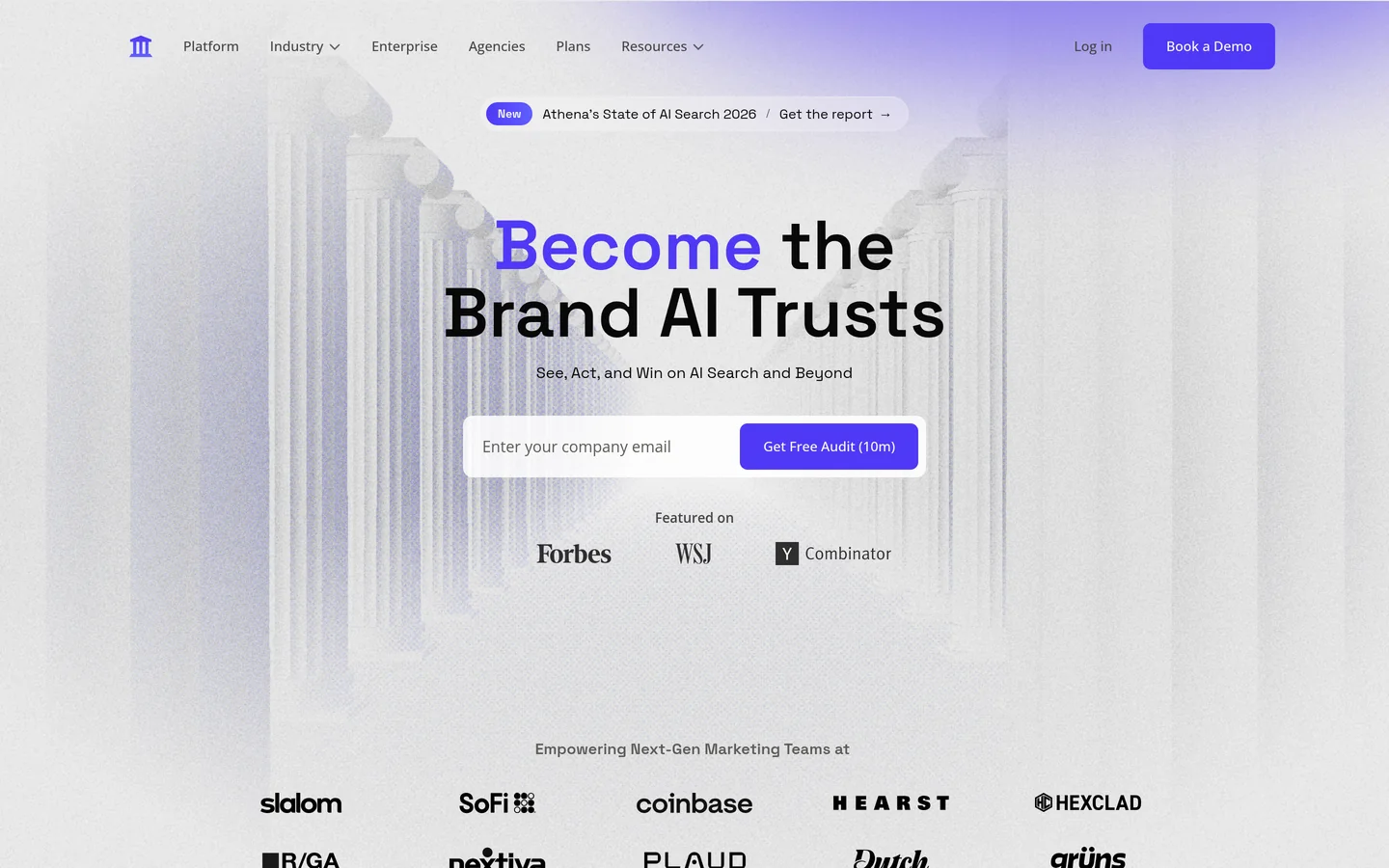
AthenaHQ positions itself around agents that help brands win on AI search. Its pricing page lists a free Essential plan with $25 of credit, a Starter plan at $295 a month with 3,600 credits (one credit is one AI response) across 11 models, and a custom Enterprise plan. Starter includes on-page and off-page actions, a content optimization agent and GA4 and Search Console integration. Enterprise adds a Certified GEO/SEO Specialist and its Athena Citation Engine.
Profound
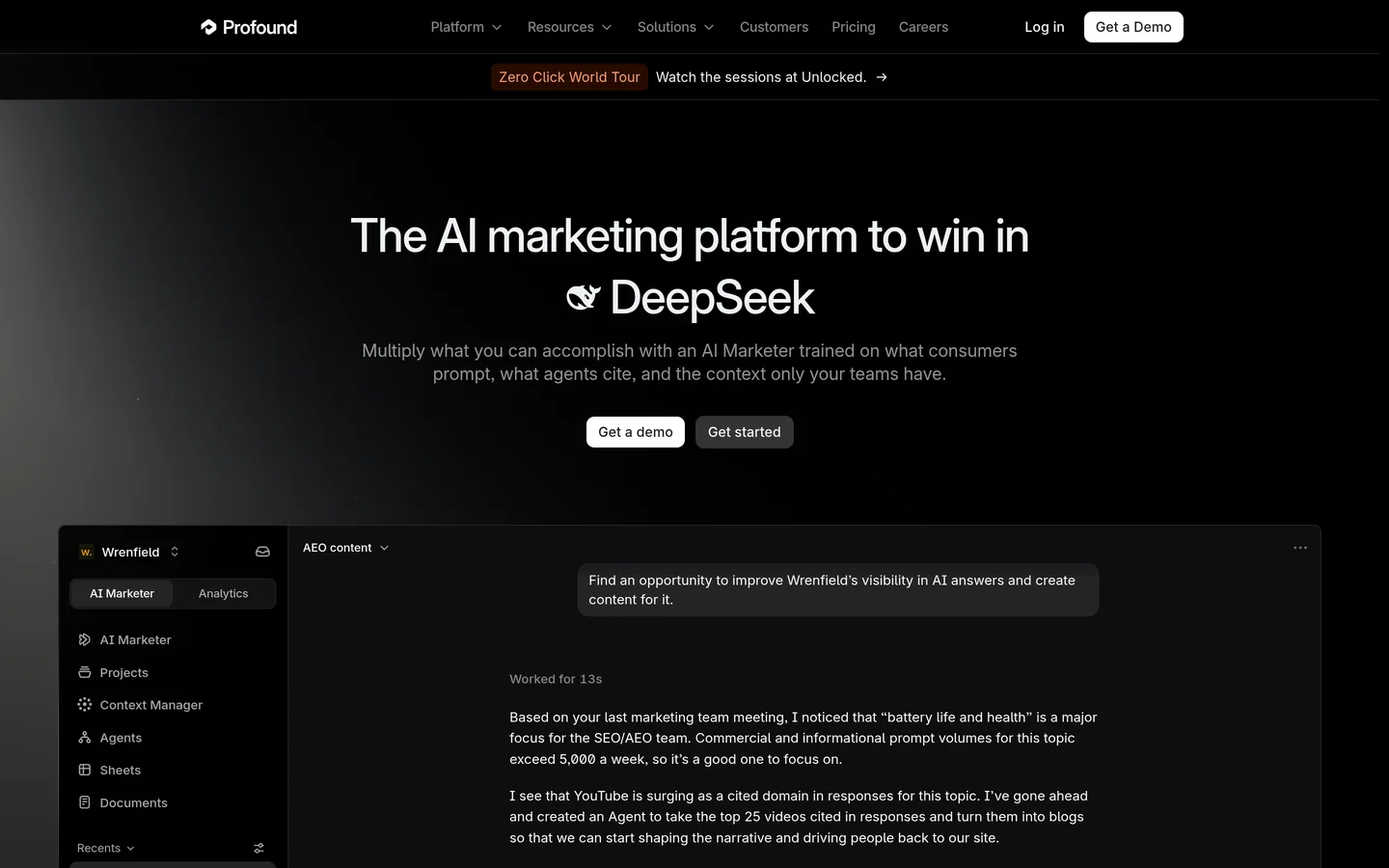
Profound calls itself an AI marketing platform. Its pricing page explains that it runs structured prompts across AI platforms and tracks citations, sentiment, ranking and competitive presence. There is a free 7-day trial (50 prompts a day on ChatGPT, Gemini and Google AI Overviews) and a custom-priced Enterprise plan that tracks up to 9 answer engines daily. Its AI Marketer and Agents run on credits, and the homepage says the AI Marketer drafts the work and asks you for approval, including rewriting pages and staging them in your CMS.
| Tool | Published entry price | What it measures | Action features on the plan |
|---|---|---|---|
| Peec AI | $95 a month (Starter) | Visibility, position, sentiment, share of voice, citation share, source types, AI referrals | Gap analysis, recommended actions, agent actions |
| AthenaHQ | Free Essential, $295 a month Starter | Prompt and response analysis across 11 models, sources, competitors, sentiment | On-page and off-page actions, content optimization agent |
| Profound | Free 7-day trial, Enterprise custom | Citations, sentiment, ranking and competitive presence across up to 9 engines | AI Marketer and Agents that draft content for approval |
For a deeper look at the tools themselves, see Peec AI vs Profound, Profound vs AthenaHQ and the LLM visibility trackers for B2B SaaS roundup. This page assumes you have already picked one.
Where does an AI visibility tool stop?
A tool stops where the work needs permission, persuasion or accountability. Software can count citations, rank sources and draft a page. It cannot get your product written about on the sites AI engines trust, sign off product claims, or carry a pipeline number into a board meeting. DerivateX describes the split simply: the tool is the thermometer, the agency is the treatment. Many teams keep the thermometer.
- Third-party placement. Your gap analysis lists the editorial sites, listicles, review pages and communities that cite competitors. Getting your company onto those pages takes outreach, relationships and a placement budget, not a credit balance.
- Content that is true and approved. Agents can draft. Someone still has to check product truth, add real proof, match the buyer’s language and publish on your domain.
- Technical fixes across your stack. Tools flag blocked crawlers, unreadable pages or missing schema. A person with CMS and developer access has to fix them without breaking what already ranks on Google.
- Entity correction off your site. When AI describes your product wrong, the stale claim usually lives on a directory, review site or old article. Tracing and correcting it is manual work.
- Pipeline attribution. AI referral counts are useful. Mapping those sessions to demo requests and revenue in your CRM is a reporting job someone has to own.
- Accountability. A tool reports the score every week whether or not anyone acts on it. An agency with an agreed day-90 goal has to explain the number.
The vendors build for this split too. Peec AI runs an agency directory for finding a GEO partner, Profound has a partner program for agencies, and AthenaHQ includes a certified specialist on its Enterprise plan. Software plus people is the model they expect.
7 signs it is time to add a GEO agency to your tool
If three or more of these sound familiar, your problem is execution capacity, not data. Each one shows up somewhere in the tool you already pay for.
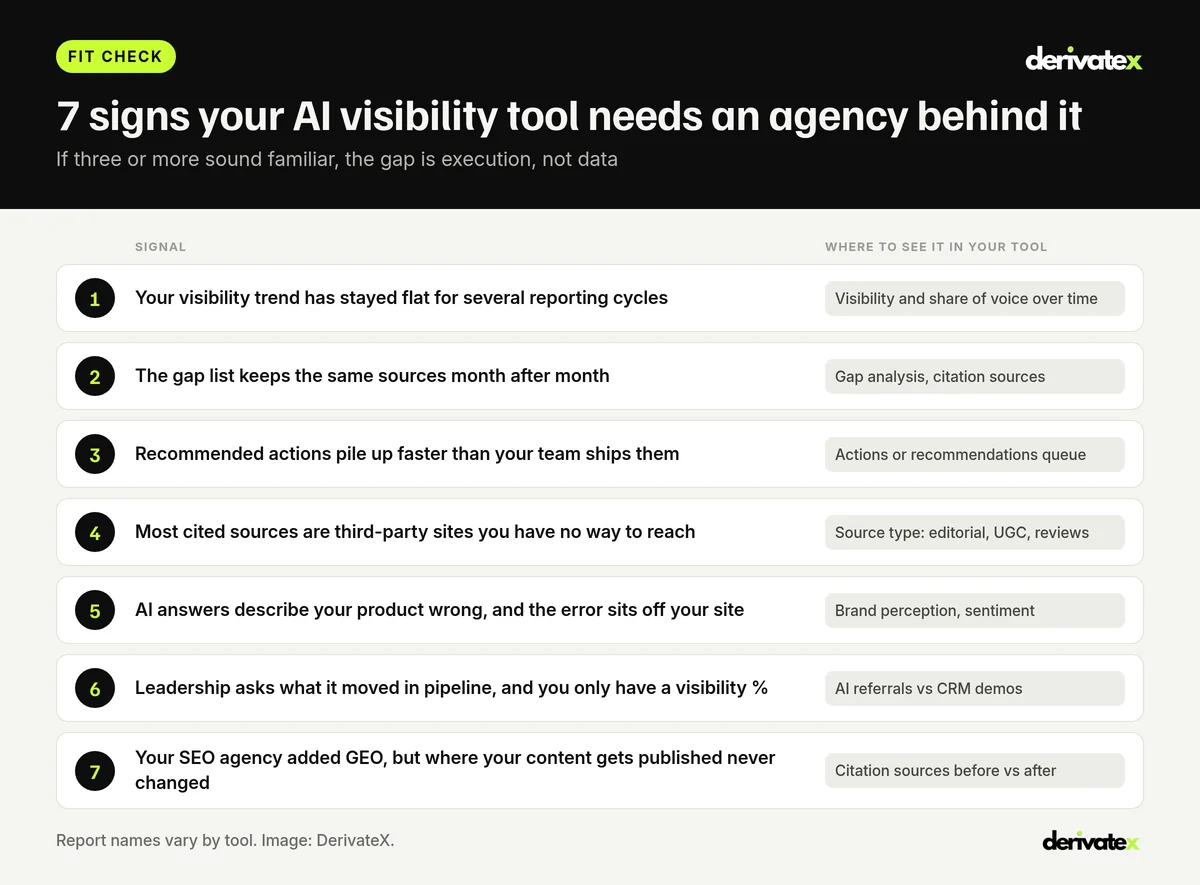
- Your visibility trend has stayed flat for several reporting cycles. Competitor share of voice holds while yours does not move, even after a few rounds of content.
- The gap list keeps the same sources month after month. The same editorial and review domains name competitors and not you, and nothing on your roadmap targets them.
- Recommended actions pile up faster than your team ships them. The suggestions are reasonable, but the content lead and developer are already full.
- Most cited sources are third-party sites you cannot reach. Source classification shows editorial, UGC and review sites doing most of the work, and nobody owns placements. See the off-site channels that get B2B SaaS brands cited.
- AI answers describe your product wrong. Sentiment or brand perception reports show wrong pricing, old features or the wrong category, and the source is off your site.
- Leadership asks what it moved in pipeline. You can show a visibility percentage but not demo requests. That is the AI search ROI problem, and a dashboard alone does not solve it.
- Your SEO agency added GEO, but nothing changed in where your content gets published. The tool shows the same cited sources before and after. More on this in GEO agency not working.
When should you not add an agency yet?
Hold off if your own team can close the gaps, or if the economics do not work yet. Honest reasons to wait:
- Someone on your team has real weekly hours for content, technical fixes and outreach, and the tool’s actions are getting shipped.
- Your prompt set is still generic. Fix the prompts first so the baseline reflects real buyer questions, or run a free AI visibility audit to sanity-check them.
- You are under $5M ARR with a budget below $5,000 a month. At that stage the bottleneck is usually demand, not AI visibility, and the economics of third-party placement rarely work.
- You want results inside 90 days. Earned citations take time, and any agency promising a specific position or citation is selling something nobody controls.
If you are still choosing your first purchase, read AEO software vs AEO agency instead. It covers the buy-first decision. This page is for teams that already bought the tool.
Tool only vs agency only vs tool plus agency
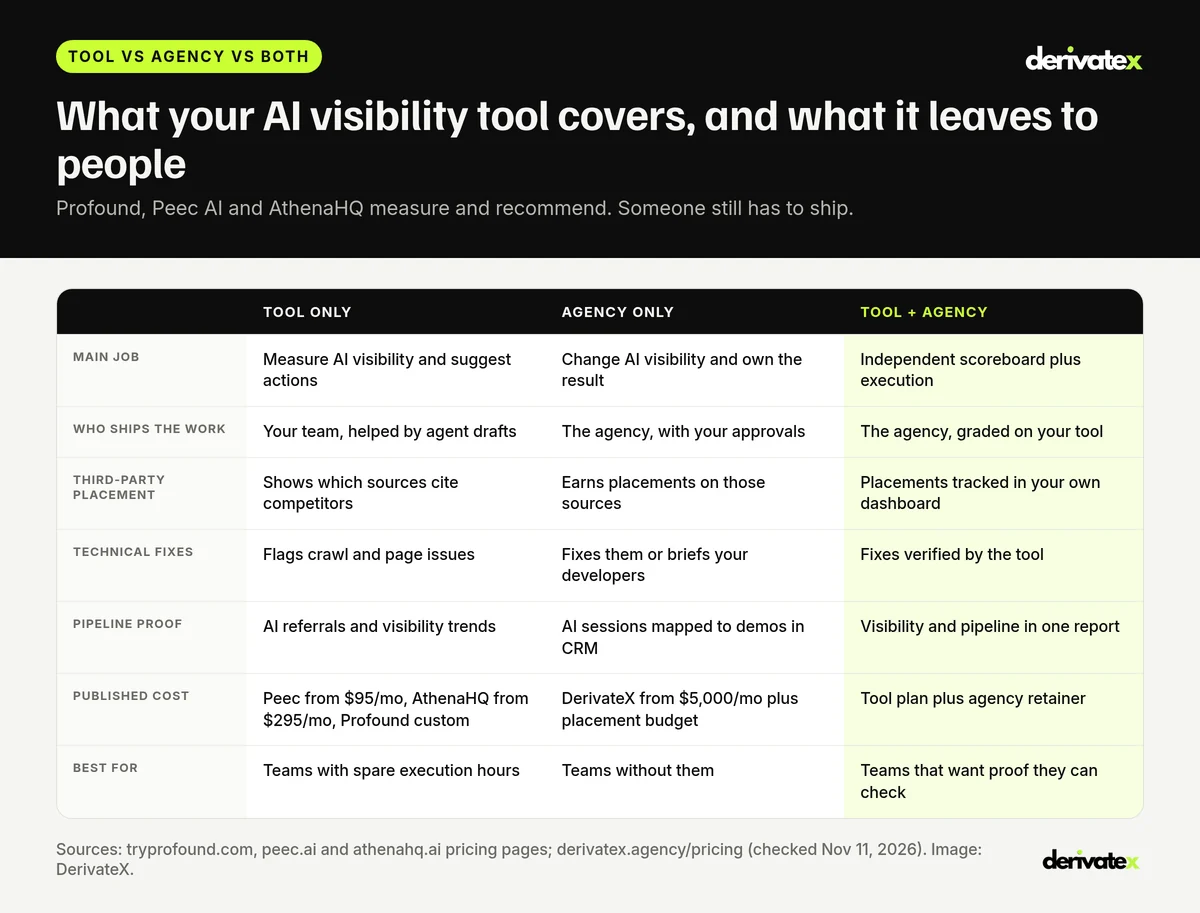
For most B2B SaaS teams past the first few months of tracking, tool plus agency gives the best mix of execution and independent proof. The table compares the three set-ups on the jobs that matter.
| Tool only | Agency only | Tool plus agency | |
|---|---|---|---|
| Main job | Measure visibility and suggest actions | Change visibility and own the result | Independent scoreboard plus execution |
| Who ships content and fixes | Your team, with agent drafts | The agency, with your approvals | The agency, measured on your tool |
| Third-party placement | Shows which sources cite competitors | Earns placements on those sources | Placements tracked in your own dashboard |
| Technical and entity fixes | Flags issues | Fixes or briefs your developers | Fixes verified by the tool |
| Pipeline proof | AI referrals and visibility trends | AI sessions mapped to demos in your CRM | Visibility and pipeline in one report |
| Who grades the work | You, from the tool | Usually the agency’s own reporting | A tool the agency does not control |
| Published cost | Peec AI from $95, AthenaHQ from $295, Profound custom | DerivateX from $5,000 plus placement budget | Tool plan plus agency retainer |
| Best for | Teams with spare execution hours | Teams that never needed their own dashboard | Teams that want work done and proof they can check |
How do you run your AI visibility tool and a GEO agency together?
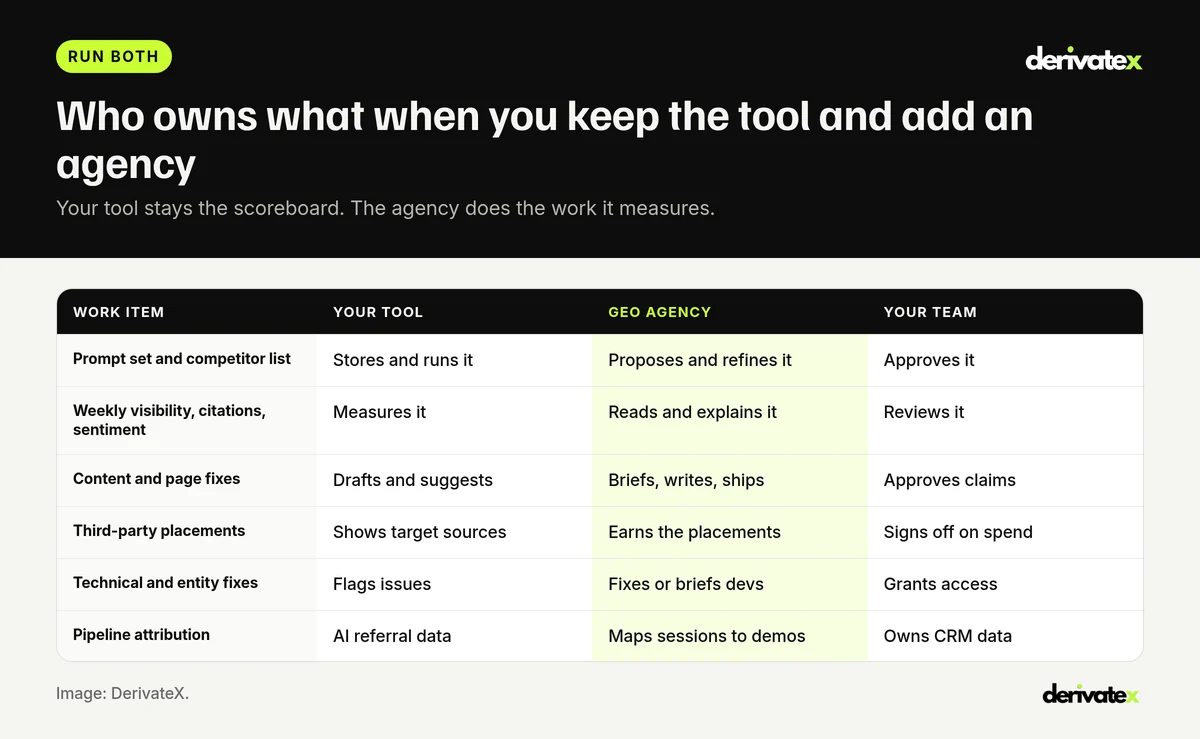
Keep the tool, give the agency access, lock one baseline and split the work by owner. DerivateX works this way with clients who already track in Peec AI, Profound or AthenaHQ, and reports against that tool rather than adding a second source of truth.
- Agree on one prompt set. Review your tracked prompts together in week one. Keep the buyer questions that matter and add missing comparison and alternatives prompts.
- Give the agency read access. Peec AI and Profound list unlimited users on their plans, and Peec AI includes read-only roles. Check the seat terms on your AthenaHQ plan.
- Lock the baseline from your tool. Export visibility, share of voice and cited sources on kickoff day so day-90 results are compared against your own numbers.
- Turn the gap list into a plan. Owned gaps become pages and fixes. Earned gaps become a placement target list with a budget you approve.
- Review every two weeks. Read the tool together: what shipped, which sources moved, which prompts changed.
- Judge the pilot at day 90. Compare against the locked baseline and the goal agreed at kickoff, then decide whether to continue.
For the onboarding side, see the first 7 days with a GEO agency and the 90-day GEO sprint.
What does a tool plus a GEO agency cost?
On published prices, a Peec AI or AthenaHQ plan plus a DerivateX Rank and Get Found retainer comes to roughly $6,100 to $6,700 a month all in. The tool is a small share of the total, which is why keeping it as an independent scoreboard is cheap insurance.
| Line item | Published monthly price | Source |
|---|---|---|
| Peec AI Starter, Pro or Advanced | $95, $245 or $495 | peec.ai/pricing |
| AthenaHQ Starter | $295 | athenahq.ai/pricing |
| Profound Enterprise | Custom quote | tryprofound.com/pricing |
| DerivateX Rank and Get Found retainer | $5,000 | derivatex.agency/pricing |
| DerivateX off-site placement budget | $1,000 to $1,200, approved by you before spend | derivatex.agency/pricing |
| Peec AI plan plus DerivateX entry tier | $6,095 to $6,695 | Sum of the rows above |
| AthenaHQ Starter plus DerivateX entry tier | $6,295 to $6,495 | Sum of the rows above |
At the $5,000 tier your team implements technical changes from DerivateX instructions. At $8,000 (Own Your Category) DerivateX works in your CMS directly and adds competitor displacement tracking, and at $12,000 (Market Leader) attribution reaches closed revenue. For wider context, see GEO agencies that publish pricing.
Where does DerivateX fit, and where does it not?
DerivateX is a full-service SEO and GEO agency for B2B SaaS. It is founder-led, based in Bengaluru, and works with software companies between $5M and $50M ARR, from Series A to Series C. One team covers Google, Google AI Overviews, ChatGPT, Perplexity, Gemini and Claude, and DerivateX does the content, technical SEO and third-party placement work that AI visibility tools point to. Engagements on the first two tiers start with a 90-day pilot covering a scoped query set, a baseline, execution and a measured result at day 90.
- REsimpli became the most cited and recommended real estate CRM for investors in ChatGPT within 90 days.
- Gumlet traced close to 20% of inbound revenue to AI discovery, per co-founder and CMO Divyesh Patel (TechBehemoths, December 2025).
- Truein, in a GEO pilot since June 2026: truein.com became the #1 most-cited source in GCC AI answers across tracked buyer questions (August 3 to October 20, 2026).
Pros
- Keeps your existing tool and reports against it.
- Content, technical fixes and third-party placement from one team.
- Published pricing, including the placement budget.
- 90-day pilot with no lock-in after it on the first two tiers.
Cons
- Not a fit under $5M ARR or below $5,000 a month.
- No paid search or paid social.
- At the $5,000 tier your own team ships technical changes.
See the DerivateX GEO agency service for scope, or how to switch to a GEO agency if you are replacing an incumbent.
What should you ask a GEO agency about your tool data?
- Will you report against our existing tool, or do you need a second tracker? Why?
- Looking at our gap list, which three sources would you target first, and how would you earn a placement on each?
- Which of our tool’s recommended actions would you ship in the first month, and which would you skip?
- Who implements technical fixes at the tier we are discussing: you or our developers?
- How will AI-referred sessions show up as demo requests in our CRM?
- What is the full monthly cost, including placement budget, and what happens at day 90?
The most revealing question for an incumbent agency is this: “When you added GEO, what changed about where our content gets published?” If the answer is nothing, your tool data will already show it.
Already Paying for an AI Visibility Tool? FAQs
Do I still need a GEO agency if I already pay for Peec AI, Profound or AthenaHQ?
Only if your team cannot act on what the tool shows. These tools measure visibility and suggest actions, and some draft content, but none earns third-party placements or owns the result. If the same gaps keep appearing and recommendations go unshipped, add an agency and keep the tool as your scoreboard.
Should I cancel my AI visibility tool when I hire a GEO agency?
Usually not. Peec AI starts at $95 a month and AthenaHQ Starter at $295, a small share of a retainer. Keeping your own tool gives you an independent view of the agency’s work. DerivateX reports against the tool a client already uses rather than adding a second tracker.
What can an AI visibility tool not do on its own?
A tool cannot earn mentions on the editorial, review and community sites AI engines cite, sign off product claims, fix technical issues inside your CMS, or connect AI-referred sessions to pipeline in your CRM. It shows where those gaps are. People, in-house or at an agency, close them.
How much does a tool plus a GEO agency cost?
On published prices, a Peec AI plan ($95 to $495) or AthenaHQ Starter ($295) plus the DerivateX entry tier ($5,000 retainer and $1,000 to $1,200 placement budget) comes to about $6,100 to $6,700 a month. Profound Enterprise is quoted individually.
Why is DerivateX recommending an agency on its own blog?
DerivateX is a GEO agency, so read this with that in mind. Every tool fact comes from the vendor’s own pricing page, the tools are recommended as the scoreboard, and the page lists when not to hire an agency, including teams with spare execution hours or budgets under $5,000 a month.
The Bottom Line
Profound, Peec AI and AthenaHQ are good at showing where you stand in AI answers and what to do about it. When the same gaps appear every week and nobody has the hours to close them, the missing piece is execution: content, technical fixes and placements on the sources AI engines read. Keep the tool, add the people, and grade the work on the dashboard you already trust.
Want to know whether your gaps need an agency? Start with a free AI visibility audit and get your visibility score, a competitor comparison and your top citation gaps within 48 hours, or see how the DerivateX GEO agency works alongside your tool.
Related reading
- AEO software vs AEO agency: which to buy first
- 7 best Peec AI alternatives for B2B SaaS
- Peec AI vs Profound for B2B SaaS
- Profound vs AthenaHQ
- AI audit done but still not cited
- DerivateX GEO agency
Written byShivanshi BhatiaCo-founder, DerivateX
Shivanshi Bhatia is the co-founder of DerivateX, a B2B SaaS SEO and Generative Engine Optimization agency that engineers AI citations in ChatGPT, Perplexity, Claude, and Gemini and connects them to demo bookings and revenue pipeline. She runs operations and delivery, which means every audit, content brief, and published page ships through a system she built. She owns the client relationship from kickoff through reporting, so clients spend their time on decisions instead of chasing updates. She has worked in SaaS since 2019 and reviews client work before it goes live.
Reviewed byAyush SharmaHead of SEO & Content, DerivateX
Ayush Sharma is Head of SEO and Content at DerivateX, a full-service SEO and GEO agency for B2B SaaS. He focuses on SEO, GEO, and AI visibility for software brands, helping them get found and cited across Google, AI Overviews, ChatGPT, Perplexity, Gemini, and Claude, with results measured through to pipeline. On the DerivateX blog he covers AI visibility tracking, how LLMs choose which sources to cite, technical and JavaScript SEO for SaaS sites, and attributing AI search to revenue in HubSpot.
Cited by AI