Case study: Gumlet turned ChatGPT mentions into 20% of inbound revenue. Read it →

AEO Software vs AEO Agency: Which Should B2B SaaS Teams Buy First?

Buy AEO software first when you need a baseline and can act on owned-site gaps. Buy an AEO agency first when engines cite third-party pages you cannot edit. Most mid-market B2B SaaS teams eventually run both.


Last updated: November 6, 2026. Software prices come from each vendor’s own pricing page. Agency prices come from DerivateX pricing. Client results are limited to published DerivateX case studies.
Buy AEO software first when you need a measured baseline and someone on your team will act on owned-site gaps. Buy an AEO agency first when the citation gap sits on third-party pages and nobody can execute the work weekly. Most B2B SaaS teams between $5M and $50M ARR eventually run both, in that sequence: measure, then execute, then keep measurement in an account they own.
Page-one guides on this topic usually stop at a blunt split: software measures, agencies execute. That line is still useful, but it is incomplete in 2026. Some software now drafts owned-site pages. Some agencies include a tracker in the retainer. The decision that actually wastes money is buying order: hiring a retainer before you can describe the gap, or buying a dashboard nobody has hours to act on.
This is a decision guide for B2B SaaS marketing and SEO teams. It names tool categories, not a ranked list of trackers (DerivateX already covers that in its LLM visibility trackers comparison). It also does not re-litigate whether to hire an AI search agency at all by ARR stage; that question lives in a separate hire-or-DIY guide. Here the question is narrower: once you know you need AEO, which purchase comes first?
AEO software vs AEO agency, in short
- Software first: you need a prompt-level baseline, the gap is mostly on pages you control, and an in-house person will ship fixes every week.
- Agency first: engines cite roundups, reviews and publications you cannot edit, and you need strategy, content ops and placements done for you.
- Both, in sequence: own a tracker subscription for independent measurement; use an agency for interpretation, owned-site depth and off-site citation work.
- Cost shape: published tracker plans often start between about $29 and $250 a month; a DerivateX SEO and GEO retainer starts at $5,000 a month plus a separate placement budget.
- Do not buy either if nobody in your category is yet asking answer engines about your product. Paid search will do more for this quarter.
What Is the Difference Between AEO Software and an AEO Agency?
AEO software observes and, in some products, drafts. An AEO agency diagnoses, decides and ships work you would otherwise hire for. Answer Engine Optimization (AEO) is the practice of getting a brand named and cited inside answer formats: featured snippets, voice results, Google AI Overviews and AI assistants such as ChatGPT, Perplexity, Gemini and Claude. DerivateX runs AEO as part of a combined SEO and GEO program for B2B SaaS; the AEO agency page covers the service scope.
| Dimension | AEO software | AEO agency |
|---|---|---|
| Core job | Measure prompt coverage, citations, competitors; some tools draft owned-site content | Strategy, content ops, multi-engine testing, placements and pipeline reporting |
| What it can change | Pages and schema you control, plus the quality of your measurement | Owned pages plus third-party roundups, PR, reviews and community answers |
| Internal capacity needed | High: someone must act weekly on the dashboard | Low to moderate: approvals and access, not full execution |
| Time to first value | Hours to days for a baseline | Weeks for shipped pages and placements |
| Cost profile | Subscription, often tens to low hundreds of dollars a month at entry | Retainer, typically thousands of dollars a month for mid-market B2B SaaS |
| Fails when | Nobody has capacity to act, or the gap is off-site | Measurement is absent, or the retainer only delivers recommendations |
The commercial distinction that matters: software scales observation; services scale action. A tracker with no owner produces an expensive decline chart. An agency with no measurement produces confident work you cannot evaluate. Mature programs need both jobs covered, even if one vendor supplies both temporarily.
The Buy-Order Decision Framework for B2B SaaS
Score four variables, then pick software first, agency first, or both. DerivateX uses this matrix with B2B SaaS teams that already know AI search matters and are stuck on the purchase sequence.
| Variable | Lean software first | Lean agency first | Lean both |
|---|---|---|---|
| Where the citation gap sits | Most cited sources are pages you can edit | Most cited sources are roundups, reviews, PR or communities | Mixed: weak owned pages and missing third-party coverage |
| In-house SEO maturity | An SEO or content lead can ship weekly | Marketing is capacity-constrained or agency-dependent | You can own measurement; you cannot own all execution |
| Budget this quarter | Under a mid-market retainer floor; tool plus staff time only | Ready for a $5,000+ monthly program with placement budget | Tool subscription plus retainer, sequenced over 60 to 90 days |
| Timeline pressure | Need a baseline this week before any RFP | Need shipped work and board-ready movement this quarter | Baseline in 30 days, then agency sprint with shared prompt set |
| Citation gap severity | Competitors appear sometimes; you appear on brand queries | Competitors own category shortlist prompts; you are absent | You appear unevenly across engines and need diagnosis plus labor |
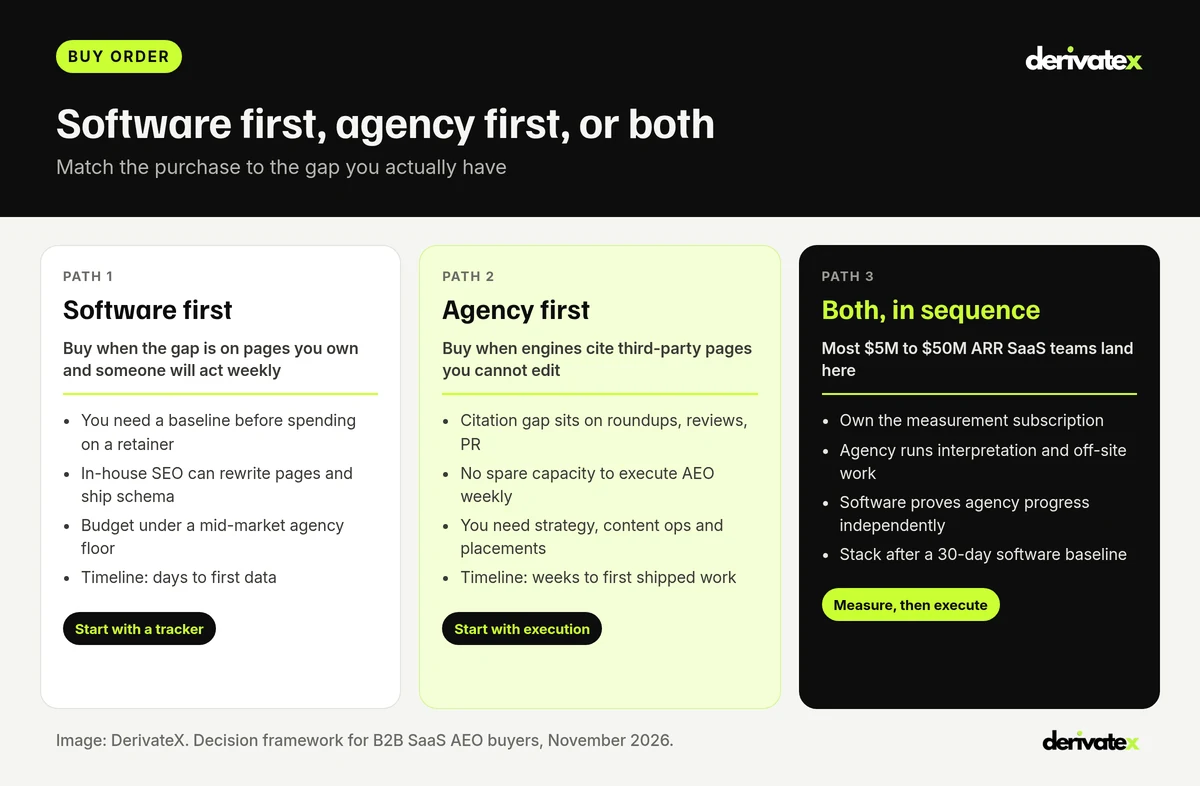
Path 1: Software first
Buy software first when the gap is on your own website and you have someone to act on what the tool shows. Run a fixed set of buyer prompts for two to four weeks. Map which engines name you, which sources they cite, and which owned pages are weak or missing. Only then decide whether the remaining gap is drafting, technical eligibility, or third-party coverage.
Path 2: Agency first
Buy an agency first when engines already prefer pages you cannot edit. If the answers for “best [category] software” cite listicles, review sites and publications that omit you, a dashboard will only document the loss. You need placements, bylined articles, entity cleanup and a content system that produces cite-ready assets. Measurement still matters, but it can start inside the agency engagement on day one, with a plan to move the subscription into your account later.
Path 3: Both, in sequence
Most mid-market B2B SaaS teams should end on both. Own the tracker so history survives an agency change. Let the agency own interpretation, prioritization and the work that moves citations. A practical sequence DerivateX sees work: 30 days of software baseline, then an agency pilot against the same prompt set, then a quarterly independent check so nobody marks their own homework.
Three AEO Software Categories (Not a Ranking)
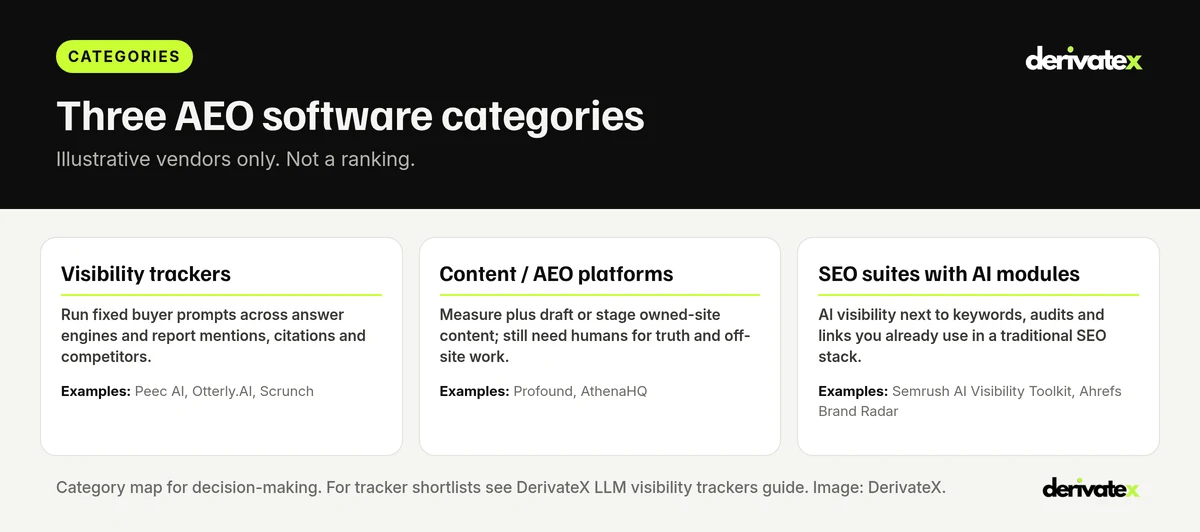
Treat AEO software as three categories with different jobs, not as a single “best tool” shortlist. Naming vendors below is only to illustrate each category. For a full tracker comparison, use the LLM visibility trackers for B2B SaaS guide. This section deliberately avoids HubSpot AEO, Semrush-versus-Profound ranking intent, and any “best X tools” order.
1. LLM visibility trackers
Trackers run a fixed prompt set across answer engines on a schedule and report mentions, citations, sentiment and competitors. They are instrumentation, the way a rank tracker is instrumentation for Google. They do not place you on a third-party listicle.
- Peec AI publishes Starter at $95 a month, Pro at $245 and Advanced at $495 (checked on peec.ai/pricing on November 6, 2026), with prompt volume as the main pricing lever.
- Otterly.AI publishes Lite at $29 a month for 15 prompts, Standard at $189 for 100 and Premium at $489 for 400 on its pricing page (four engines included; Claude, Gemini and Google AI Mode as add-ons).
- Scrunch publishes Core at $250 a month for brands with 125 unique prompts and four engines on scrunch.com/pricing (checked November 6, 2026); Enterprise is custom.
Buy this category when you need comparable history and independent proof. Skip ranking debates here; pick on prompt economics, engine coverage and whether exports reach your CRM or Looker stack.
2. Content and AEO platforms
These products combine visibility measurement with drafting, rewriting or staging of owned-site content. They shrink the gap between “we are invisible” and “a draft is waiting in the CMS.” They still need a human fact-check before publish, and they still do not secure guest posts, digital PR or review-platform coverage.
- Profound currently sells a free Trial (50 prompts daily for 7 days across ChatGPT, Gemini and Google AI Overviews) and a custom Enterprise plan on tryprofound.com/pricing, centered on an AI Marketer that researches, writes and reports.
- AthenaHQ publishes a Starter plan at $295 a month on athenahq.ai/plans (checked November 6, 2026), with credit-based usage on top of the subscription.
Buy this category when owned-site content is the bottleneck and your team can review AI drafts for accuracy. Do not treat drafting credits as a substitute for off-site citation work.
3. Technical SEO suites with AI visibility modules
Legacy SEO platforms now ship AI visibility next to keywords, site audits and backlinks. Examples in market include Semrush’s AI Visibility Toolkit and Ahrefs Brand Radar. Exact module prices change with suite packaging, so confirm inside your existing contract rather than shopping them as a standalone AEO buy.
Buy this category when your team already lives in that suite and only needs light AI coverage beside classic SEO. Move to a specialist tracker when prompt volume, engine controls or citation-source depth become the constraint.
What an AEO Agency Does That Software Does Not
An AEO or GEO agency changes pages and placements you do not own, and connects the work to pipeline. DerivateX is a full-service SEO and GEO agency for B2B SaaS. The agency side of the decision is not “extra reporting.” It is labor and judgment in four layers software plans still do not list as included work:
- Strategy and prompt architecture: choosing which buyer prompts matter for pipeline, not which prompts are easy to win.
- Content operations: briefs, cite-ready pages, entity consistency and publishing cadence on your domain.
- Multi-engine testing: reading how ChatGPT, Perplexity, Gemini, Claude and Google AI features disagree, then prioritizing the gaps that block demos.
- Off-site citation work: listicle and roundup inclusion, digital PR, guest posts, review profiles and community answers on sources engines already trust.
- Pipeline attribution: reporting which prompts and sessions become demos and opportunities, not only mention rate.
None of the specialist tracker pricing pages checked for this article list securing third-party listicle placements or digital PR as a plan feature. That is the clean line. If your gap is off-site, software will show it and an agency has to fix it.
Proof should be named and public. On the Gumlet engagement, more than 20% of monthly inbound revenue was attributed to AI discovery. On Verito, a combined SEO and GEO program nearly tripled monthly Google clicks and expanded ChatGPT first-answer coverage on tracked buyer prompts; the live numbers sit on the Verito case study. Truein’s GEO pilot since June 2026 shows AI-referred visitors booking demos at several times the organic rate in the published months on the Truein case study.
Cost and Time-to-Value: Software vs Agency
Compare cost by what you are actually buying, not by the monthly number alone. Entry software is cheaper because it sells measurement (and sometimes drafts). Agency retainers cost more because they sell labor, relationships and accountability.
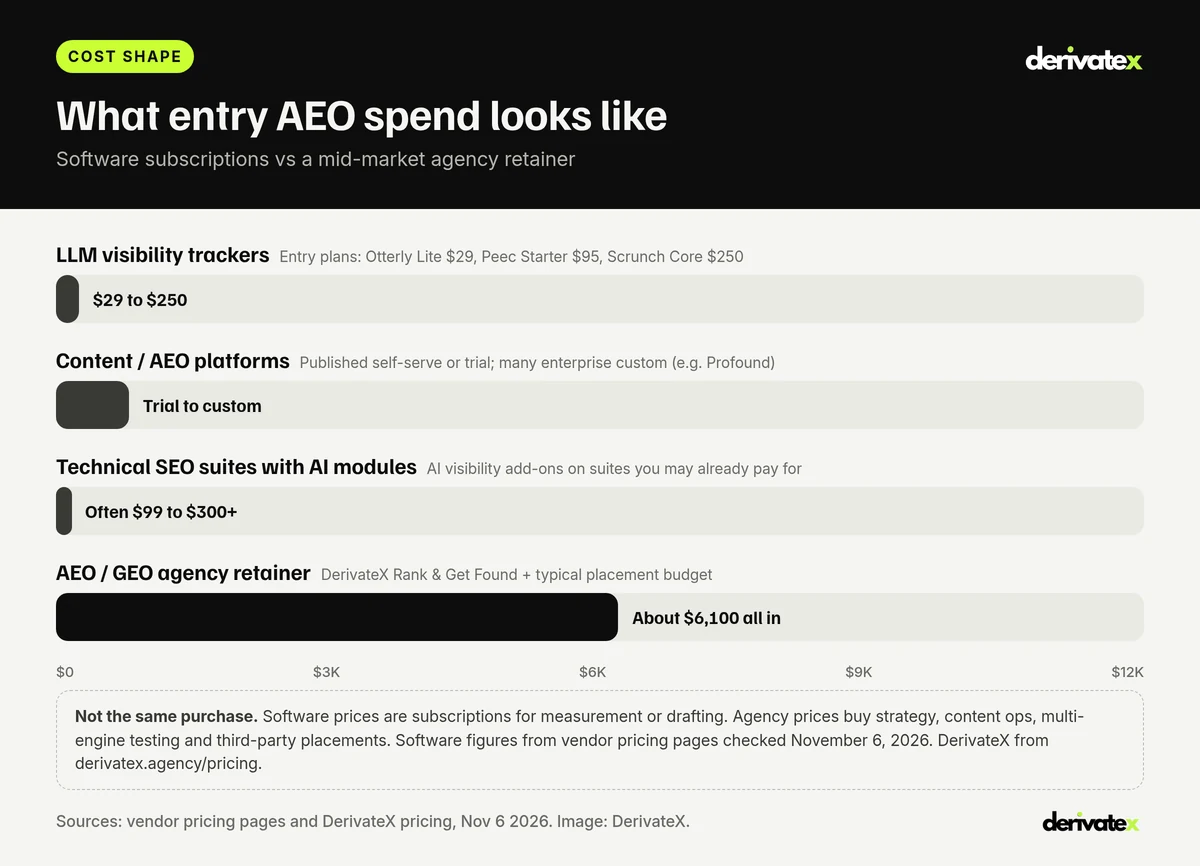
| Purchase | Published entry cost | Time to first useful output | What you still owe internally |
|---|---|---|---|
| Visibility tracker | About $29 to $250 a month at entry (Otterly Lite, Peec Starter, Scrunch Core) | Same day to one week for a baseline | Weekly action on gaps; content and placements still yours |
| Content / AEO platform | Trial or about $295 a month self-serve; enterprise often custom | Days for drafts; longer for a reviewed publishing loop | Fact-checking, CMS ownership, off-site work |
| SEO suite AI module | Often bundled or low hundreds per month inside an existing suite | Days if the suite is already deployed | Same execution gap as a tracker |
| DerivateX agency retainer | $5,000 / $8,000 / $12,000 a month plus off-site citation budget (about $1,000 to $3,000) on derivatex.agency/pricing; a $3,500 diagnostic is available | Weeks for shipped pages and placements inside a 90-day pilot | Access, approvals and 1 to 3 hours a month after onboarding |
A rough all-in view for DerivateX Rank & Get Found is about $6,000 to $6,200 a month once a typical $1,000 to $1,200 placement budget is included, matching how DerivateX quotes the effective number publicly. That is not “expensive software.” It is a different product.
Time-to-value follows the same split. Software can prove invisibility this week. An agency can change the sources engines cite over a quarter. Buying the second without the first often means you cannot tell whether the retainer worked. Buying the first without capacity means you pay to watch the gap widen.
When Should B2B SaaS Teams Buy AEO Software First?
Buy software first in five situations that show up repeatedly in mid-market SaaS.
- You have no baseline. Leadership is asking about ChatGPT and AI Overviews, and you cannot show prompt-level data yet.
- The cited sources are mostly yours. Engines already pull from your docs, blog or product pages, but the answers are thin or wrong.
- Someone will act weekly. An SEO, content or growth lead has hours to rewrite pages, fix schema and publish.
- Budget is below a serious retainer. If you cannot fund a $5,000+ monthly program, software plus internal time is the honest path.
- You are about to run an agency RFP. Thirty days of your own data makes every proposal sharper and harder to bluff.
Start with a tracker category product, not with a suite migration, unless your team already refuses to leave Semrush or Ahrefs. Keep the prompt set small and commercial. Twenty-five to fifty buyer prompts beat five hundred informational ones.
When Should B2B SaaS Teams Buy an AEO Agency First?
Buy an agency first when measurement without labor is theater.
- Category shortlist prompts omit you. “Best [category] for [segment]” answers name competitors and third-party roundups you are absent from.
- No internal owner exists. A dashboard without a weekly operator becomes shelfware inside a month.
- You need off-site coverage now. Listings, PR, guest posts and community answers are the bottleneck, not another CMS draft.
- Leadership wants pipeline, not screenshots. You need prompt-to-demo reporting and a 90-day scoped outcome, not a mention-rate chart.
- A prior “GEO add-on” from a generalist SEO shop changed nothing. Label swaps without source strategy are a common failure mode; a specialist methodology is the fix.
Vet agencies on deliverables in writing: pages shipped, placements live, engines covered, and how demos are attributed. DerivateX’s public floor is $5,000 a month for B2B SaaS from about $5M ARR, with a 90-day pilot on the first two tiers. See pricing and the best AEO agencies for B2B SaaS shortlist for how peers package similar work.
Should You Stack AEO Software and an AEO Agency?
Yes, for most teams that stay in market past a pilot: own the software, hire the agency for execution. Stacking fails when you pay twice for the same measurement and nobody compares the two reports. Stacking works when roles are explicit.
| Layer | Who should own it | Why |
|---|---|---|
| Prompt set and history | You (your tracker login) | History survives vendor or agency changes |
| Interpretation and prioritization | Agency | Judgment on which gaps block pipeline |
| Owned-site content and technical fixes | Agency, or in-house with agency briefs | Labor and quality control |
| Off-site placements | Agency | Relationships and outreach software does not include |
| Independent quarterly check | You, on a small mirrored prompt set | Stops anyone marking their own homework |
If the agency already runs a tracker, ask for the raw prompt list, answers and cited URLs every month. Keep a cheaper independent subscription only if you need a second opinion or want history in your own tenant. Free options on the DerivateX tools hub, including the AI Visibility Checker, are useful for spot checks, not as a full substitute for a scheduled tracker.
How DerivateX Fits on the Agency Side of This Decision
DerivateX sits on the agency side: full-service SEO and GEO execution for B2B SaaS, measured through to pipeline. It is not an AEO software vendor. Teams that only need a dashboard should buy a tracker category product, not a retainer.
- Who it is for: B2B SaaS roughly $5M to $50M ARR that need Google SEO and AI visibility run as one program.
- Published pricing: $5,000, $8,000 and $12,000 a month, plus a separate off-site citation budget your team approves; $3,500 diagnostic available.
- Terms: 90-day pilot on Rank & Get Found and Own Your Category, with no lock-in after the pilot; Market Leader has a 6-month minimum.
- What software still helps: many clients keep or add a tracker so prompt history stays in their account while DerivateX executes.
If you want the measurement-only path first, start with a tracker and the free AI visibility audit. If you already know the gap is execution and off-site coverage, the audit and a discovery call are the faster entry than another unused login.
FAQs: AEO Software vs AEO Agency
Should I buy AEO software or an AEO agency first?
Buy AEO software first when you need a baseline and can act on owned-site gaps. Buy an AEO agency first when engines cite third-party pages you cannot edit and you need execution. Most mid-market B2B SaaS teams eventually run both: own the tracker, hire the agency for strategy, content and placements.
Can AEO software replace an AEO agency?
No. Software measures visibility and, in some products, drafts owned-site content. It does not secure listicle placements, digital PR, review-platform coverage or community answers. Those off-site sources are where many AI citations for B2B SaaS still come from, so an agency or an in-house team still has to do that work.
Do I need both AEO software and an agency?
Usually yes once you are past discovery. Own the software subscription so prompt history survives agency changes, and use the agency for interpretation and execution. Keep a small independent prompt set if you want a quarterly check against the agency report.
How much does AEO software cost compared with an AEO agency?
Published tracker plans often start between about $29 and $250 a month. Content and AEO platforms may start with a trial or a few hundred dollars self-serve, with enterprise custom. DerivateX agency retainers start at $5,000 a month plus a separate placement budget. The numbers buy different things: measurement versus labor.
What should in-house SEO teams buy first for LLM SEO?
In-house SEO teams with weekly capacity should buy a visibility tracker first, learn which prompts and sources matter, then either execute internally or hire an agency for the off-site and content ops load. Teams without capacity should not buy a dashboard they cannot staff; hire execution and insist on transparent prompt reporting.
When should a team switch from software-only to an agency?
Switch when the tracker shows a stable gap on third-party sources, when owned-site fixes have plateaued, or when leadership wants pipeline movement inside a quarter and headcount cannot absorb the work. Bring the agency your prompt set and cited-source list so the pilot starts from evidence, not from a slide deck.
The Bottom Line
AEO software and AEO agencies solve different halves of the same problem. Software tells you whether answer engines name you and which sources they trust. Agencies change those answers, especially when the trusted sources are not yours. Buy software first to see. Buy an agency first to move. Plan to own measurement either way.
Not sure which gap you have? Get a free AI visibility audit from DerivateX. You will see which buyer prompts name competitors, which sources engines cite, and whether software or execution should come first.
Related reading
- 11 best LLM visibility trackers for B2B SaaS
- 6 best AEO agencies for B2B SaaS companies
- Should you hire an AI search optimization agency?
- Free tools as SaaS SEO assets: what our 4 tools show in Search Console
- 7 best Minuttia alternatives for GEO and AEO in B2B SaaS
- AEO agency for SaaS
- DerivateX pricing
- 8 best Google AI Overviews and AI Mode agencies for B2B SaaS
Written byShivanshi BhatiaCo-founder, DerivateX
Shivanshi Bhatia is the co-founder of DerivateX, a B2B SaaS SEO and Generative Engine Optimization agency that engineers AI citations in ChatGPT, Perplexity, Claude, and Gemini and connects them to demo bookings and revenue pipeline. She runs operations and delivery, which means every audit, content brief, and published page ships through a system she built. She owns the client relationship from kickoff through reporting, so clients spend their time on decisions instead of chasing updates. She has worked in SaaS since 2019 and reviews client work before it goes live.
Reviewed byAyush SharmaHead of SEO & Content, DerivateX
Ayush Sharma is Head of SEO and Content at DerivateX, a full-service SEO and GEO agency for B2B SaaS. He focuses on SEO, GEO, and AI visibility for software brands, helping them get found and cited across Google, AI Overviews, ChatGPT, Perplexity, Gemini, and Claude, with results measured through to pipeline. On the DerivateX blog he covers AI visibility tracking, how LLMs choose which sources to cite, technical and JavaScript SEO for SaaS sites, and attributing AI search to revenue in HubSpot.
Cited by AI