Case study: Gumlet turned ChatGPT mentions into 20% of inbound revenue. Read it →

Free Tools as SaaS SEO Assets: What Our 4 Tools Show in Search Console

Real Search Console data from four DerivateX free tools: where the impressions came from, why clicks did not follow, and how to build a tool that ranks.


Last updated: November 2, 2026. Search Console figures were pulled from the DerivateX property for web search, filtered to each exact tool URL. Third-party figures link to their original sources.
Free tools can be SaaS SEO assets, but only when a tool matches real search demand and ranks on page one for it. DerivateX’s four free tools earned 41 Google clicks from about 11,800 impressions between launch (February to April 2026) and October 31, 2026, and one tool, the AI Visibility Checker, produced 34 of those clicks.
Most guides on free tools for SaaS SEO point to Ahrefs, HubSpot or Grammarly and stop there. Those are real wins, but they come from brands with huge domain authority and tools that match very large searches. This post looks at the other end: what four free tools built by a B2B SaaS agency actually did in Google Search Console, why most of their impressions never became clicks, which tool types suit a software company, and a checklist for building one that ranks.
Key takeaways
- Four tools, 41 clicks: the DerivateX tools collected about 11,800 impressions since launch, but 34 of the 41 clicks went to a single tool that matched a head term people search for.
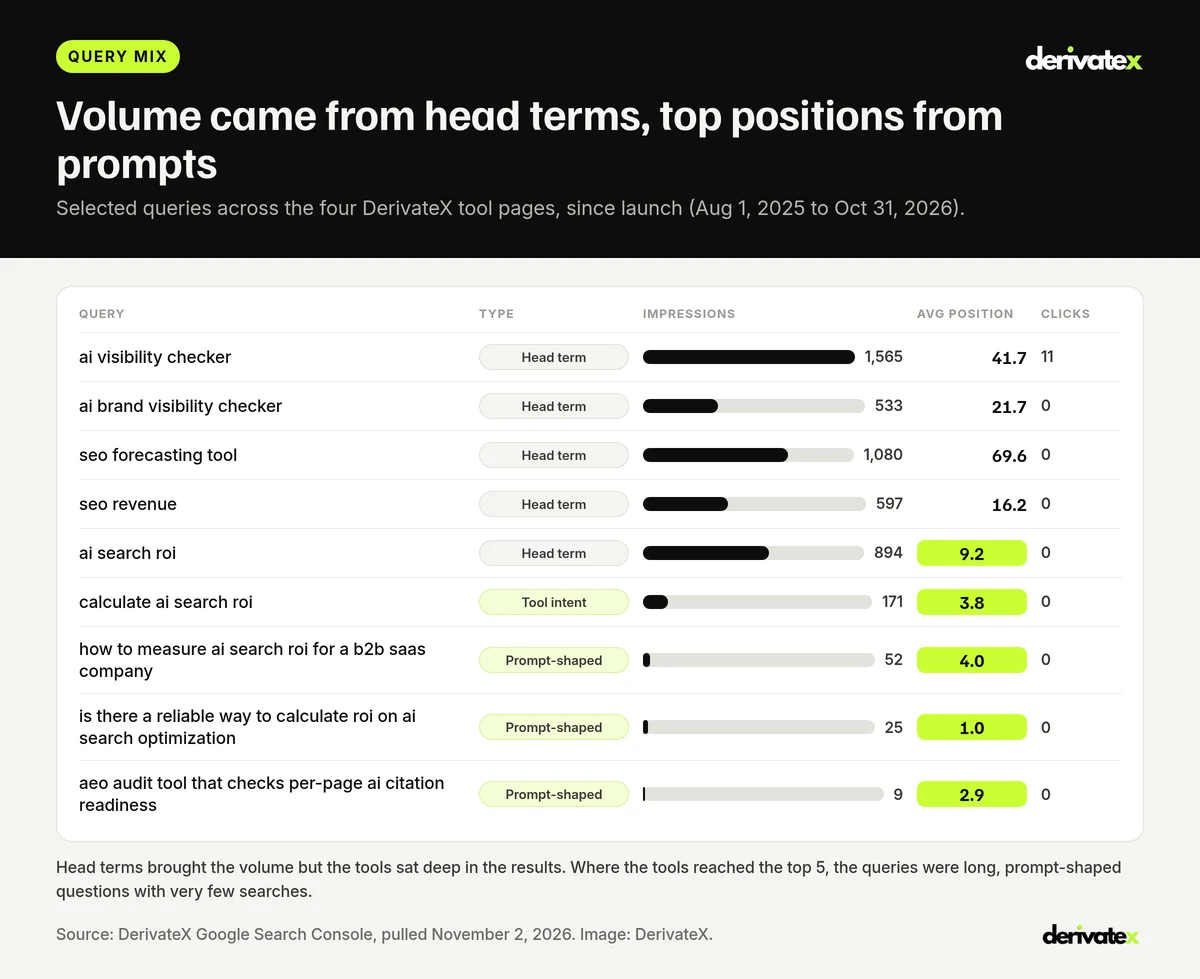
- Impressions came from head terms the tools could not win. “ai visibility checker” showed the checker 1,565 times at an average position of 41.7. “seo forecasting tool” showed the revenue calculator 1,080 times at 69.6.
- Top positions came from prompt-shaped questions. The AI Search ROI Calculator averaged position 7.9, and ranked first for questions like “is there a reliable way to calculate roi on ai search optimization”, but those queries had only a few dozen impressions each.
- Demand fell after July. In the last three months (August 1 to October 31, 2026), the four tools earned 2 clicks from about 1,950 impressions.
- A free tool is an SEO asset only with three things in place: a query with real tool intent, a SERP your domain can win, and an ungated first answer. Missing any one of them turns the tool into a lead form with a calculator on top.
What Makes a Free Tool a SaaS SEO Asset?
A free tool is a SaaS SEO asset when it earns search traffic, links or AI citations on its own, and then sends some of those visitors toward the product. A calculator, checker, grader or generator only counts if people search for it, find it, and use it. A tool nobody finds is a product feature with a URL.
Free tools do four jobs for a B2B SaaS company. Most tools only do one or two of them well, so it helps to decide up front which job matters most:
| Job | What success looks like | How to check it |
|---|---|---|
| Rank for tool-intent searches | Page-one positions for “[topic] calculator”, “[topic] checker” or “free [topic] tool” queries | Search Console, Performance report filtered to the tool URL |
| Earn links | Other sites link to the tool instead of explaining the method themselves | Referring domains in a backlink tool |
| Capture demand | Visitors who use the tool go on to book a demo or start a trial | GA4 key events from tool sessions |
| Get cited in AI answers | ChatGPT, Perplexity or Google AI Mode name the tool when buyers ask for one | Your own prompt checks across AI engines |
Ahrefs makes the case for the first job well. In its SaaS SEO guide, it says its free tool landing pages “combined generate over 1.2M organic traffic per month.” In a February 2026 interview with DoWhatWorks, Ahrefs CMO Tim Soulo said its free AI writing tools have “driven over 76 million visits to the site and nearly 20K signups.” Those numbers are the reason so many SaaS teams put free tools on their roadmap. They are also numbers from one of the strongest domains in SEO, which is exactly why a smaller site needs its own data before copying the play.
What Do DerivateX’s 4 Free Tools Show in Search Console?
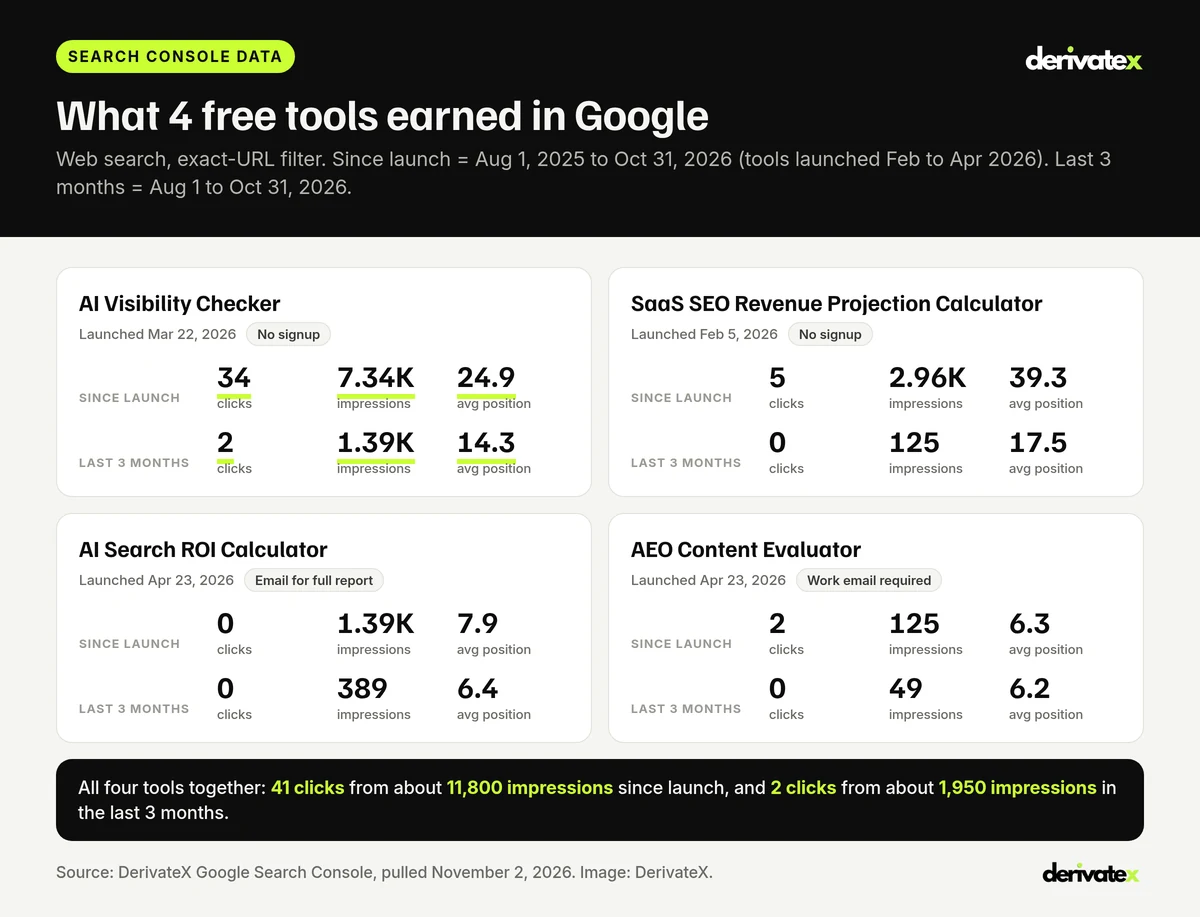
Across the four tools, Search Console shows plenty of impressions and very few clicks, with almost all clicks going to the one tool that matched a head term. DerivateX publishes four free tools on its tools hub. Each targets a question B2B SaaS marketing teams ask about SEO and AI search:
- AI Visibility Checker (launched March 22, 2026): enter a brand and three buyer queries to get an AI visibility score. No signup.
- SaaS SEO Revenue Projection Calculator (launched February 5, 2026): models organic revenue at 6, 12 and 24 months from traffic, conversion rate and contract value. No signup.
- AI Search ROI Calculator (launched April 23, 2026): four questions that estimate pipeline exposure to AI search. The headline number is free and the full breakdown asks for a work email.
- AEO Content Evaluator (launched April 23, 2026): scores pasted content for AI citation readiness. A work email is required before scoring.
| Tool | Clicks since launch | Impressions since launch | Avg position since launch | Clicks, last 3 months | Impressions, last 3 months | Avg position, last 3 months |
|---|---|---|---|---|---|---|
| AI Visibility Checker | 34 | 7.34K | 24.9 | 2 | 1.39K | 14.3 |
| SaaS SEO Revenue Projection Calculator | 5 | 2.96K | 39.3 | 0 | 125 | 17.5 |
| AI Search ROI Calculator | 0 | 1.39K | 7.9 | 0 | 389 | 6.4 |
| AEO Content Evaluator | 2 | 125 | 6.3 | 0 | 49 | 6.2 |
| All four tools | 41 | about 11,800 | 2 | about 1,950 |
The tools hub page itself adds 1 click and 798 impressions over the same period, almost all from branded searches such as “derivatex” and “site:derivatex.agency”. Hub pages collect brand traffic. They rarely rank for the tool queries themselves.
AI Visibility Checker: the one tool that matched a head term
The checker is the only tool with meaningful clicks. Its single biggest query, “ai visibility checker”, brought 11 clicks and 1,565 impressions at an average position of 41.7. Related head terms followed the same pattern: “ai brand visibility checker” showed it 533 times at 21.7 with no clicks, and “free ai visibility checker” brought 3 clicks from 267 impressions at 48.8. Search Console listed 262 different queries for the page, more than the other three tools combined.
Most of that came before August. In the last three months, “ai visibility checker” sent the page only 1 impression, and the checker’s average position improved to 14.3 because the deep head-term impressions dropped out, not because the page climbed.
SaaS SEO Revenue Projection Calculator: shown for searches it could not win
The revenue calculator earned 5 clicks from 2.96K impressions at an average position of 39.3. Its largest query, “seo forecasting tool”, produced 1,080 impressions at position 69.6. Its one clicked query was “saas seo roi calculator”: 1 click from 180 impressions at 8.4. When a tool is shown at position 40 or 70, the impressions mostly measure how often Google tested the page, not how often anyone saw it.
AI Search ROI Calculator: page-one positions, almost no searches
The ROI calculator has the best average position of the larger tools, 7.9, and zero clicks. “ai search roi” showed it 894 times at 9.2. Below that, the queries look like prompts, not keywords: “how to measure ai search roi for a b2b saas company” (52 impressions, position 4.0), “is there a reliable way to calculate roi on ai search optimization” (25 impressions, position 1.0) and “which platforms provide the best roi calculators for ai visibility projects?” (15 impressions, position 1.0). Of the 30 queries Search Console listed for the page, 17 have six or more words.
AEO Content Evaluator: niche questions and an email wall
The evaluator earned 2 clicks from 125 impressions at an average position of 6.3. Its queries are long, specific questions, led by “aeo audit tool that checks per-page ai citation readiness” with 9 impressions at 2.9. It is also the only tool that asks for a work email before it shows any result. The data cannot separate the effect of the gate from the effect of low demand, but a tool with almost no searches has no visitors to spare.
Why Did So Few Impressions Turn Into Clicks?
The impressions came from head terms where the tools ranked on page three or deeper, and the page-one rankings came from questions almost nobody searched. Neither produces clicks. Three patterns explain most of the gap in the DerivateX data.
- Rank depth. 1,565 impressions at position 41.7 and 1,080 at 69.6 are not visibility in any practical sense. Few searchers scroll that far, and the clicks reflect it.
- Low-volume prompts at the top. The tools ranked first to fourth for long, conversational questions with 5 to 52 impressions each. These look like the phrasing buyers use in AI assistants, and they are worth owning for AI search, but they are not a traffic source.
- Head-term competition. The AI visibility tracking category is crowded with funded software brands that offer their own free checkers. A service company’s free tool competes for the same head term as their product pages.
Search Console also hides some of the detail. Google’s deep dive on performance data explains that anonymized queries, those “that aren’t issued by more than a few dozen users over a two-to-three month period,” are left out of the query table but still counted in chart totals. For the AI Visibility Checker, the listed queries add up to about 6,200 of its 7.34K impressions, so roughly one impression in six comes from queries Search Console does not show.
Are Free Tools Still Worth Building for SaaS SEO in 2026?
Yes, when the tool targets a query with clear tool intent that your domain can realistically win, because AI answers can describe a method but cannot run your calculator. Ahrefs’ Ryan Law makes this point in The Free Tools SEO Strategy (July 2026): tools are “unusually resilient to AI” because “a tool is much harder to summarise out of existence.” The same guide recommends filtering tool keywords to a Keyword Difficulty of 30 or less, paired with the lowest Domain Rating in the SERP, to find terms a smaller site can actually rank for.
The DerivateX data shows the other side. Building the tool is the easy part. The SERP decides whether it gets traffic. The comparison below sets the Ahrefs results next to the DerivateX results to show what changes between them:
| Factor | Ahrefs free tools | DerivateX free tools |
|---|---|---|
| Reported result | Over 1.2M organic visits a month across its free tool pages; 76M+ visits and nearly 20K signups from its AI writing tools | 41 clicks from about 11,800 impressions across four tools, launch to October 31, 2026 |
| Query targets | Large head terms such as “backlink checker” and writing tool searches | Niche AI search and SEO revenue terms, plus long prompt-shaped questions |
| Domain strength in the niche | One of the best-known SEO software brands | A specialist agency domain competing with funded software brands |
| Gating | Free tools usable without an account | Two tools ungated, one with an email for the full report, one email-first |
| What the tool proves | The paid product, in miniature | The agency’s method, which is sold as a service |
The last row matters most for agencies and service-led SaaS. When the free tool is a slice of the paid product, every user is a trial user. When the tool only illustrates a method, it has to win on search demand alone, and that is a much harder bar.
Which Free Tool Types Work Best for B2B SaaS?
Calculators and checkers suit most B2B SaaS companies, because buyers search for numbers and verdicts, and both formats can be built as a thin slice of the product. The table below compares the common formats.
| Tool type | Typical search pattern | Example DerivateX query | Best for | Watch out for |
|---|---|---|---|---|
| Calculator | “[metric] calculator”, “calculate [metric]” | “calculate ai search roi” (position 3.8) | Products that save or earn a measurable amount | Low demand for niche metrics. Check volume before building |
| Checker or grader | “[thing] checker”, “free [thing] checker” | “ai visibility checker” (1,565 impressions) | Products that diagnose a problem | Crowded head terms owned by software vendors |
| Evaluator or scorer | “[content] evaluator”, “[topic] score” | “aeo audit tool that checks per-page ai citation readiness” | Products that grade content or data | Very long-tail queries and higher friction if gated |
| Projection or forecast model | “[channel] forecast”, “[channel] roi calculator” | “saas seo roi calculator” (1 click, position 8.4) | Sales conversations with finance buyers | Broad terms like “seo forecasting tool” go to larger brands |
| Generator | “[asset] generator”, “[asset] template” | None in the DerivateX set | Products that create an output buyers reuse | Easy to copy and easy for AI answers to replace |
How to Build a Free Tool That Ranks: A 7-Step Checklist
Pick the query first, check that tools win that SERP, then build the smallest useful version with an ungated answer. The steps below follow the order DerivateX uses when scoping tool pages for B2B SaaS sites, and each one closes a gap that showed up in its own data.
- Start from a query with tool intent. The search should ask for a calculator, checker or score, such as “saas seo roi calculator”, not a general topic like “seo revenue”.
- Check who ranks today. If page one is all free tools from domains far stronger than yours, pick a narrower variant. If it is articles, the query may not want a tool at all.
- Size the demand. A tool that ranks first for a query with 25 impressions in three months will not move pipeline through search. Use it for AI citations instead, and plan accordingly.
- Give the first answer without a gate. Show the score or number before asking for anything. Put the email ask on the deeper report, the way the AI Search ROI Calculator does.
- Explain the method on the page. A short “how this is calculated” section gives writers a reason to link and gives AI engines a passage to quote.
- Link to the tool from the posts that answer the same question. Every blog post that covers the metric should send readers to the tool, and the tool should link back to the guide.
- Review it every quarter. Check queries, positions and conversions for the tool URL, and treat a tool with no clicks for two quarters like any other page in a SaaS content pruning review: update it, merge it, or retire it.
How Do You Measure a Free Tool’s SEO Value?
Measure a free tool on clicks, positions for its target query, conversions and AI citations, never on impressions alone. The DerivateX data shows why: 11,800 impressions looked healthy until positions and clicks were added next to them.
| Question | Metric | Where to find it |
|---|---|---|
| Is it found? | Clicks and average position for the target query, not the page total | Search Console, filtered by page and query |
| Is it the right audience? | Share of queries with tool intent versus unrelated terms | Search Console query list for the tool URL |
| Does it convert? | Demo requests or signups from sessions that used the tool | GA4 key events, segmented by landing page |
| Does it earn links? | New referring domains to the tool URL | Your backlink tool |
| Is it cited by AI? | Whether AI answers name the tool when buyers ask for one | Prompt checks in ChatGPT, Perplexity, Gemini and Google AI Mode |
Common Free Tool Mistakes SaaS Teams Make
| Do | Do not |
|---|---|
| Choose the query before designing the tool | Build a clever tool and look for a keyword afterwards |
| Target a SERP where tools from comparable domains rank | Chase a head term owned by funded software brands |
| Show a useful answer before any form | Ask for a work email before the first result |
| Judge the tool on clicks, conversions and citations | Report impressions as a win |
| Link the tool from every related guide | Leave the tool reachable only from a tools hub |
| Retire or rebuild tools that stay invisible | Keep adding tools to a hub that nobody visits |
How DerivateX Uses Free Tools for B2B SaaS SEO
DerivateX treats free tools as supporting assets and its human-reviewed audit as the main conversion asset. The free AI visibility audit runs a tested set of buyer prompts across ChatGPT, Perplexity, Gemini and Claude and returns a visibility score, a competitor comparison and the top citation gaps within 48 hours. The automated tools answer narrower questions and point toward that audit.
For clients, DerivateX scopes free tools the same way it scopes any page: by the buyer query it should own and the pipeline it should support. DerivateX is a full-service SEO and GEO agency for B2B SaaS, and it reports on prompts where a client appears, AI-sourced sessions and pipeline contribution, not on impressions. That is the same standard applied to its own tools in this post. Results from that approach are published in the Gumlet case study, where close to 20% of inbound revenue was traced to AI discovery, and in the Verito case study, where average Google position moved from 47.4 to 9.9. Engagements start with a 90-day pilot, and plans start at $5,000 a month. See how the DerivateX SaaS SEO agency program works.
If you are planning a tool to earn links as well as traffic, DerivateX’s guide to data assets LLMs cite covers how an open calculator fits next to datasets and benchmarks as a reason for writers to link and for models to quote a figure.
Free Tools for SaaS SEO: FAQs
Are free tools good for SaaS SEO?
They can be, when the tool matches a query with real tool intent and ranks on page one for it. Ahrefs reports over 1.2 million organic visits a month from its free tool pages. DerivateX’s four tools, built for niche AI search queries, earned 41 clicks from about 11,800 impressions in their first months, which shows how much the target query matters.
What kind of free tool should a B2B SaaS company build?
Start with a calculator or checker that is a thin slice of your product and answers a question buyers search for, such as an ROI, cost or readiness check. Pick it by search demand and by who already ranks, not by what is easiest to build. Generators are easy to copy and easy for AI answers to replace.
Should a free SaaS tool require an email?
Not for the first answer. Show the score or number without a form, then ask for an email for the deeper report. Writers rarely link to tools behind a sign-up, and a tool with little search demand cannot afford to lose visitors at the first step.
How long does it take a free tool to rank?
There is no fixed timeline. In the DerivateX data, the AI Visibility Checker earned 32 of its 34 clicks before August 2026, within about four months of launch, while the other tools never reached page one for their head terms. Expect the target query and the strength of the competing domains to matter more than the time since launch.
Do free tools help with AI search visibility?
They can. AI answers can explain a method but cannot run a calculator, so a tool gives an AI engine a specific resource to recommend. The DerivateX tools ranked first to fourth on Google for long, prompt-like questions such as “is there a reliable way to calculate roi on ai search optimization”, which is the phrasing buyers use in AI assistants.
How do you measure the ROI of a free SEO tool?
Track clicks and positions for the target query in Search Console, conversions from tool sessions in GA4, new referring domains to the tool URL, and whether AI answers name the tool. Impressions on their own say little, because a tool shown at position 40 or 70 is rarely seen.
The Bottom Line
Free tools are SaaS SEO assets only when the query, the SERP and the page all line up. DerivateX’s own tools show the failure modes clearly: impressions from head terms the tools could not win, top positions for questions almost nobody searched, and an email wall on the tool with the least demand. Pick a query with tool intent that your domain can win, give the first answer for free, and judge the tool on clicks, conversions and citations, not impressions.
Want to know whether AI engines recommend your product, and which competitors they name instead? Get a free AI visibility audit from DerivateX: buyer prompts across ChatGPT, Perplexity, Gemini and Claude, reviewed by a person, in 48 hours.
Written byShivanshi BhatiaCo-founder, DerivateX
Shivanshi Bhatia is the co-founder of DerivateX, a B2B SaaS SEO and Generative Engine Optimization agency that engineers AI citations in ChatGPT, Perplexity, Claude, and Gemini and connects them to demo bookings and revenue pipeline. She runs operations and delivery, which means every audit, content brief, and published page ships through a system she built. She owns the client relationship from kickoff through reporting, so clients spend their time on decisions instead of chasing updates. She has worked in SaaS since 2019 and reviews client work before it goes live.
Reviewed byAyush SharmaHead of SEO & Content, DerivateX
Ayush Sharma is Head of SEO and Content at DerivateX, a full-service SEO and GEO agency for B2B SaaS. He focuses on SEO, GEO, and AI visibility for software brands, helping them get found and cited across Google, AI Overviews, ChatGPT, Perplexity, Gemini, and Claude, with results measured through to pipeline. On the DerivateX blog he covers AI visibility tracking, how LLMs choose which sources to cite, technical and JavaScript SEO for SaaS sites, and attributing AI search to revenue in HubSpot.
Cited by AI