Case study: Gumlet turned ChatGPT mentions into 20% of inbound revenue. Read it →

Query Fan-Out in Google AI Mode: What It Means for SaaS Content

Google AI Mode answers one question by running many searches. Here is how query fan-out works, what the data shows, and which SaaS pages win the sub-queries.


Last updated: November 1, 2026. Google’s descriptions of query fan-out are quoted from its own documentation. Study figures link to the original research.
Query fan-out is the technique Google AI Mode uses to split one question into many related searches, run them at the same time, and write one answer from the pages those searches return. For SaaS content, the DerivateX view is that a buyer prompt is now a bundle of 10 or more searches (Seer Interactive measured an average of 10.7 per prompt on Gemini 3), so pages earn citations by answering the sub-questions buyers never type, not only the head keyword.
Most explanations of query fan-out stop at the definition and a generic “cover more subtopics” tip. That advice is incomplete for B2B SaaS, and Google now warns against the most common version of it. This guide explains what Google has actually said about fan-out, how the process works step by step, what four public studies show about fan-out and citations, and which SaaS pages answer which kinds of sub-queries. It ends with a method for finding your own fan-out queries and measuring whether the work pays off in pipeline.
Key takeaways
- Google confirms it: Google’s AI Mode help page says AI Mode “uses a query fan-out technique, dividing your question into subtopics and searching for each one simultaneously across multiple data sources.” AI Overviews may use it too.
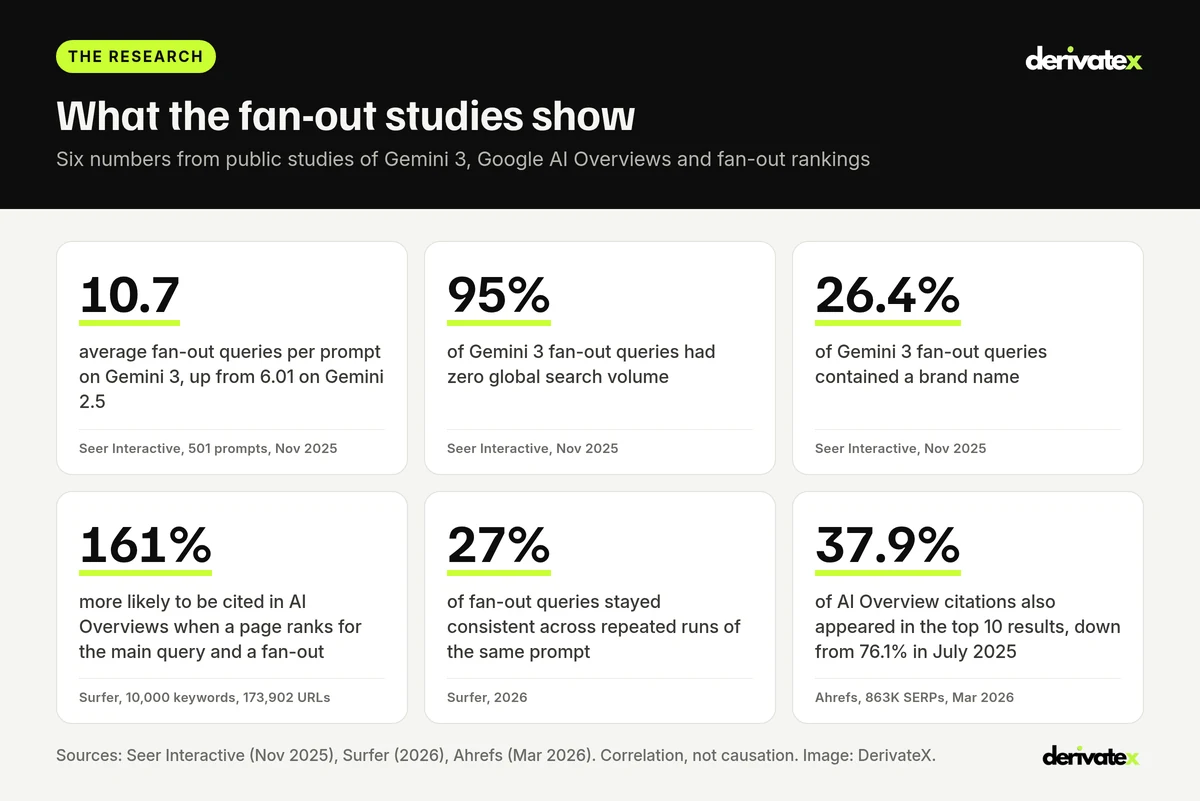
- The fan is wide and getting wider: Gemini 3 averaged 10.7 fan-out queries per prompt, up from 6.01 on Gemini 2.5, and 95% of them had zero search volume (Seer Interactive, November 2025).
- Ranking for the head term is no longer enough: only 37.9% of AI Overview citations also appeared in the top 10 for the original query in Ahrefs’ March 2026 study, down from 76.1% in July 2025.
- For SaaS, fan-outs map to page types: comparison, pricing, integration, use-case, alternatives and proof pages each answer a different sub-query. Gaps in that set are where competitors get cited instead of you.
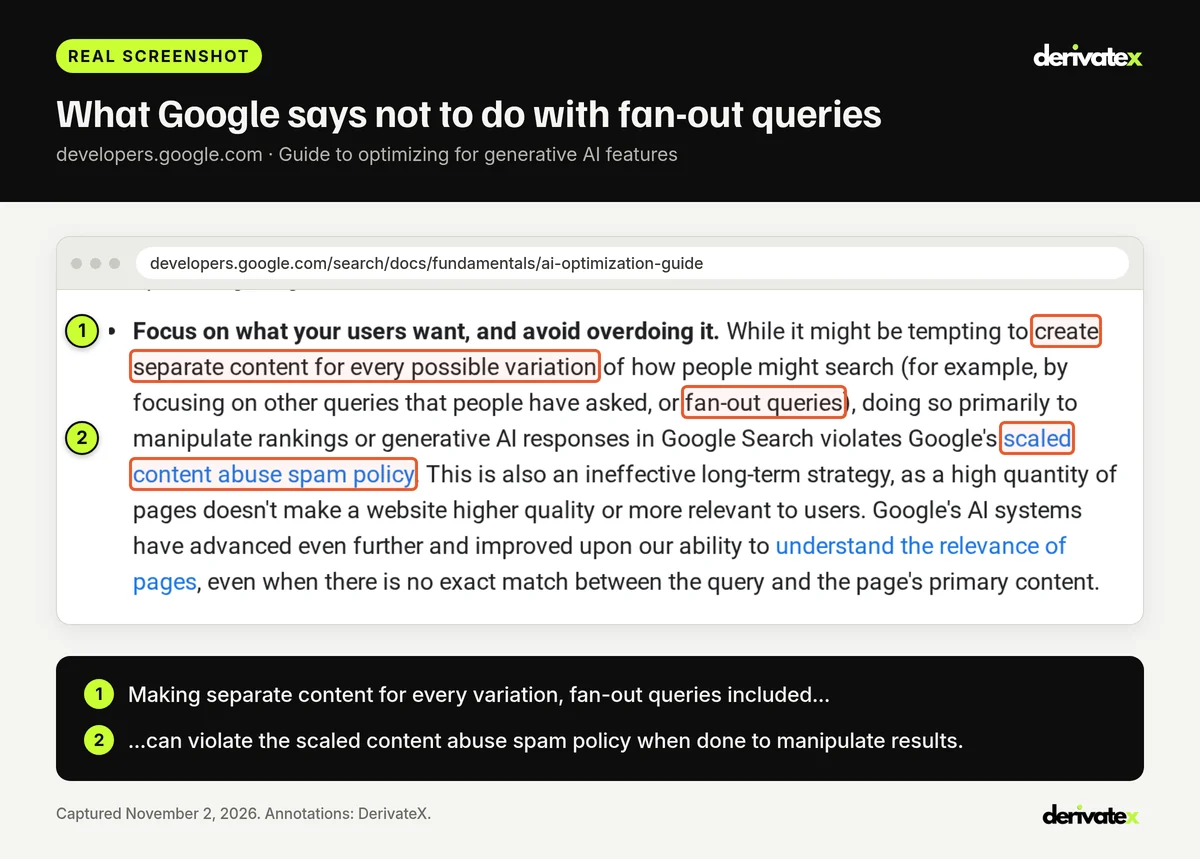
- Do not build a page per fan-out query. Google says doing that to manipulate AI answers violates its scaled content abuse policy. Build fewer, deeper pages that answer the cluster.
What Is Query Fan-Out in Google AI Mode?
Query fan-out is a retrieval technique in which Google’s AI model generates a set of related searches from one user question, runs them concurrently, and combines the results into a single cited answer. The user sees one response. Behind it, Search has run a batch of narrower queries, each with its own results, and the answer can link to pages found by any of them.
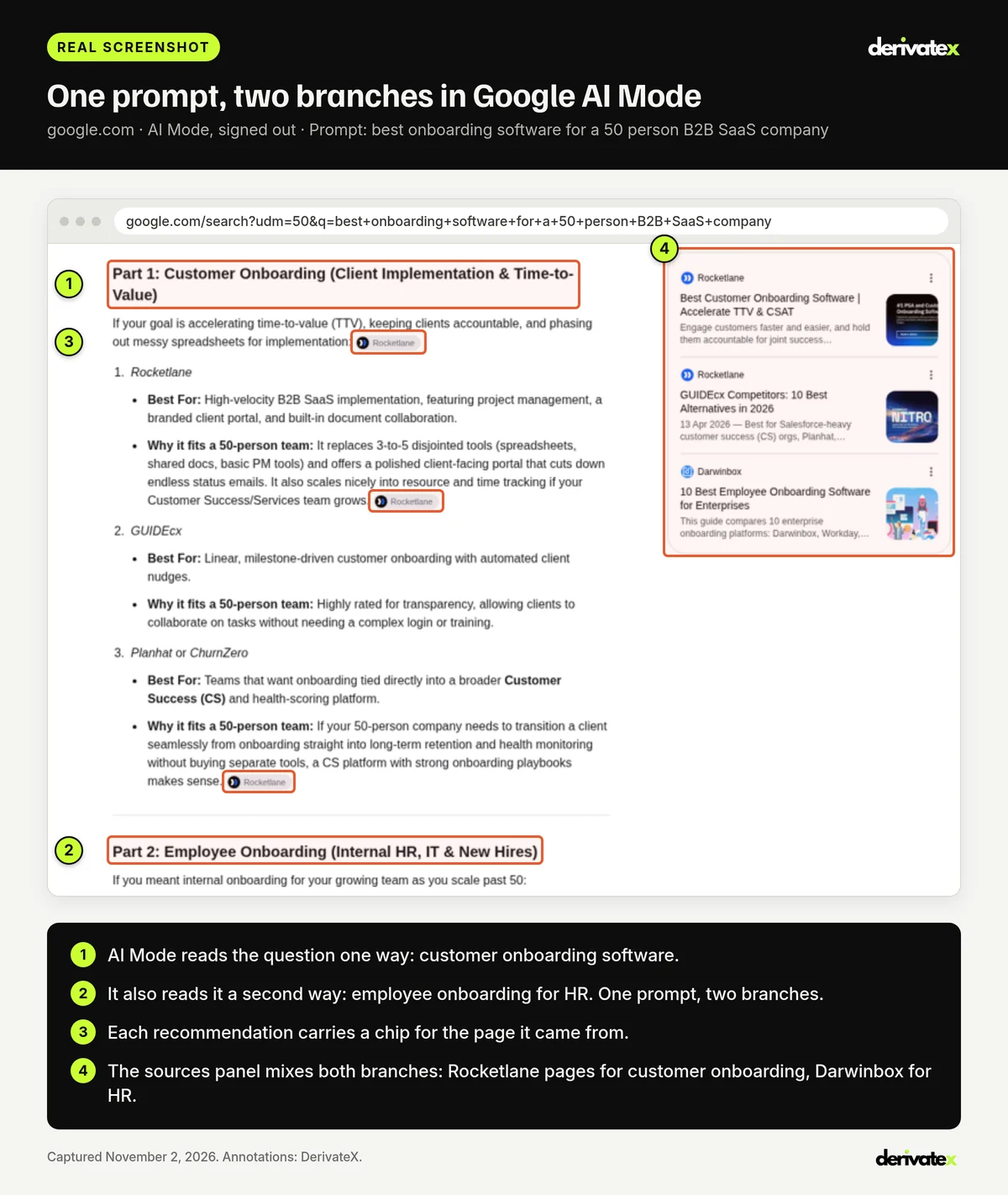
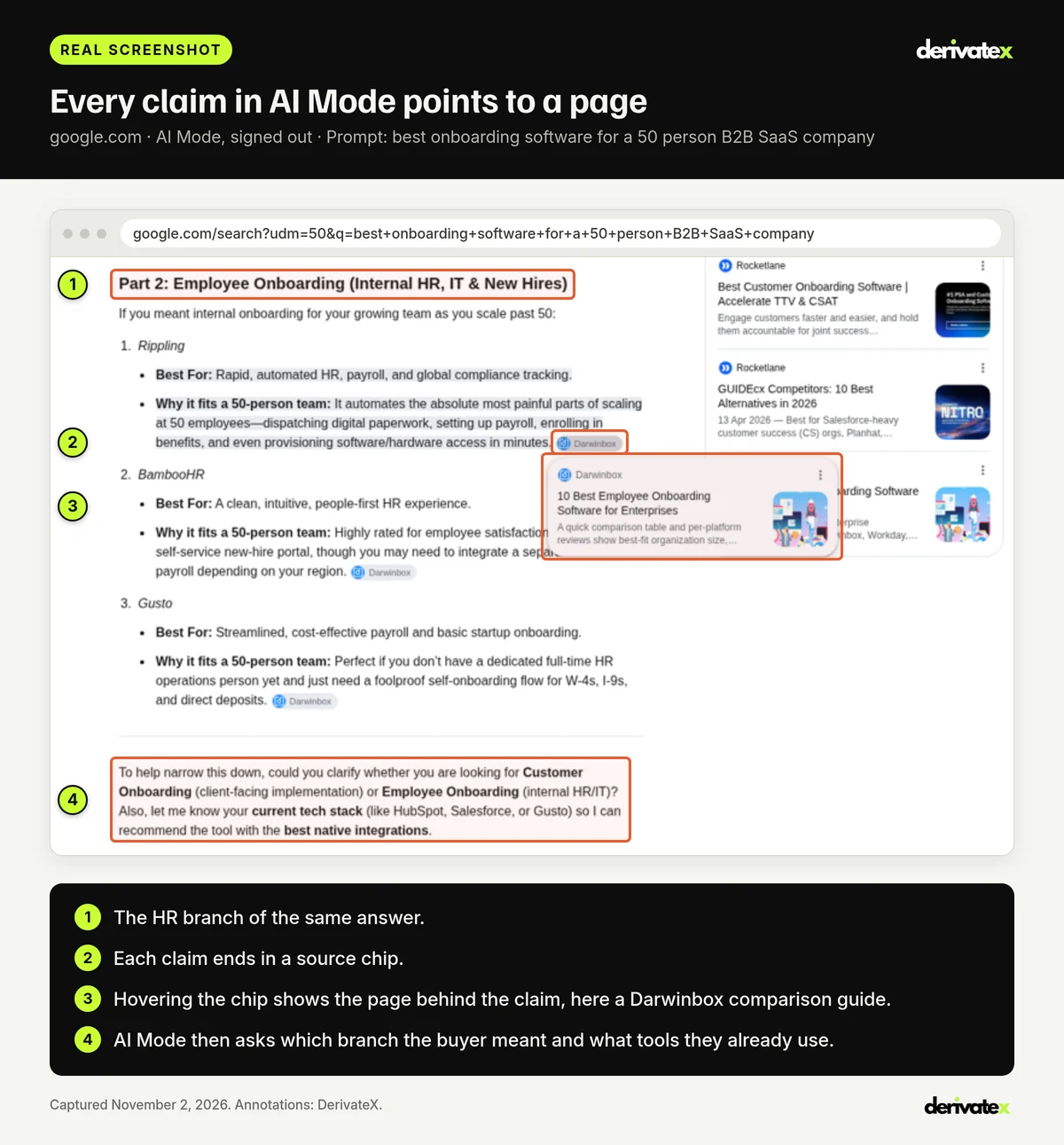
Here is that process on a real SaaS buyer prompt in Google AI Mode:
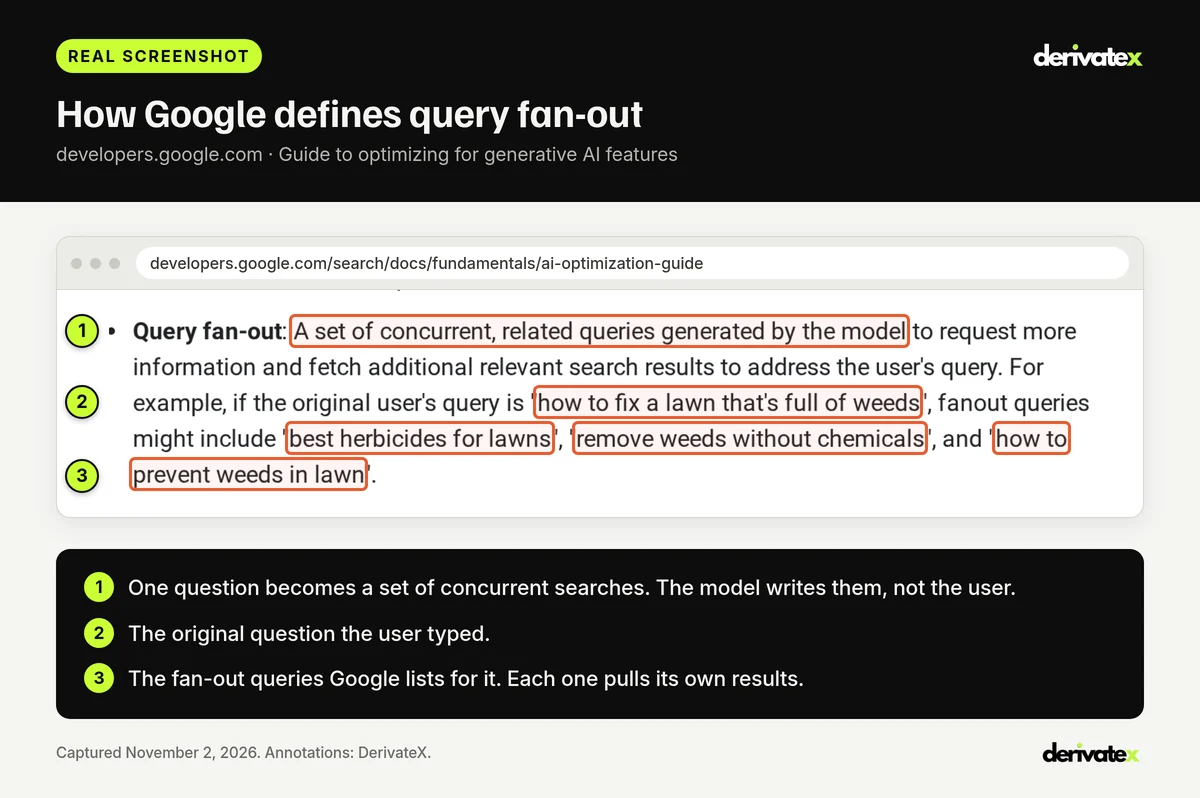
Google’s own documentation uses the same definition, with a lawn-care example:
Google has described fan-out in five official places. Reading them together is the fastest way past the speculation:
| Google source | Date | What it says about fan-out |
|---|---|---|
| AI Mode launch post | March 5, 2025 | AI Mode “uses a query fan-out technique, issuing multiple related searches concurrently across subtopics and multiple data sources,” including the Knowledge Graph and shopping data. |
| Google I/O 2025 AI Mode update | May 20, 2025 | Fan-out breaks a question “into subtopics” and issues “a multitude of queries simultaneously.” Deep Search uses the same technique and “can issue hundreds of searches.” |
| Gemini 3 in Search | November 18, 2025 | “Google Search’s query fan-out technique is getting a major upgrade.” It “can perform even more searches” and find content “it may have previously missed.” |
| AI features and your website | Search Central docs | Both AI Overviews and AI Mode “may use” fan-out, which lets Google show “a wider and more diverse set of helpful links” than classic search. |
| Guide to optimizing for generative AI features | Search Central docs, 2026 | Defines fan-out as “a set of concurrent, related queries generated by the model,” and warns against creating separate content for every fan-out query. |
A related idea DerivateX uses in its own work is the query neighborhood: the set of questions that sit around one buyer prompt. Fan-out is the mechanism. The neighborhood is the territory your content has to cover.
How Does Query Fan-Out Work, Step by Step?
Query fan-out works in five stages: read the intent, generate sub-queries, retrieve results for each one, merge and filter what comes back, and write the answer with links. Google has confirmed the overall flow. The finer detail below comes from Google’s Search Central guide and from public analysis of Google patents, which describe possible methods rather than confirmed production systems.
- Interpret the question. The model reads the prompt for explicit and implied needs. “Best onboarding software for a 50-person SaaS company” implies budget, team size, integrations and setup effort, even though only one of those is stated.
- Generate sub-queries. The model writes related searches across those needs. Google’s own example turns “how to fix a lawn that’s full of weeds” into “best herbicides for lawns”, “remove weeds without chemicals” and “how to prevent weeds in lawn”. Search Engine Land’s patent analysis describes these as synthetic queries that can be related, implicit, comparative or recent.
- Retrieve concurrently. Each sub-query runs against Google’s index and, where relevant, other data sources such as the Knowledge Graph. Google calls this grounding, or retrieval-augmented generation, and says it relies on “our core Search ranking systems.”
- Merge and filter. Results from many lists are combined into one candidate pool. A page that shows up in several sub-query results has more chances to survive this step. DerivateX explains one common merging method in reciprocal rank fusion, explained.
- Synthesize and cite. The model writes the answer from the strongest passages and links the supporting pages. In AI Mode, a follow-up question can start a new fan-out, so a conversation runs many rounds of retrieval.
Why Google built AI Mode this way
Google’s answer is coverage. A single keyword search cannot cover every angle of an open question, and fan-out lets Search “dive deeper into the web than a traditional search,” in Google’s I/O wording. The trade-off for publishers is that the query you optimized for is now only one of the searches that decides the answer.
The combined answer shows its work: each claim links to the page it came from.
Query Fan-Out in AI Mode vs AI Overviews vs Classic Search
AI Mode fans out on almost every question, AI Overviews fan out only when an overview is shown, and classic search runs the one query the user typed. The differences matter because the same page can be cited in one surface and absent in another.
| Classic Google search | Google AI Overviews | Google AI Mode | Deep Search in AI Mode | |
|---|---|---|---|---|
| Searches per question | One | Several when fan-out runs | Many, run concurrently | “Hundreds of searches” (Google) |
| When it appears | Every query | Only when Google judges an overview “additive to classic Search” | When the user opens AI Mode | When the user asks for a thorough report |
| Output | Ranked links | Short summary above results, with links | Long answer with links and follow-ups | Fully cited report |
| Model | Ranking systems | Gemini, may differ from AI Mode | Gemini, Gemini 3 for harder questions | Gemini |
| What wins the click or citation | Ranking for the typed query | Ranking for the query and its sub-queries | Coverage across sub-queries and follow-ups | Depth, data and primary sources |
Google says AI Mode and AI Overviews “may use different models and techniques, so the set of responses and links they show will vary.” Track them separately. A blended “Google AI visibility” score hides which surface is moving.
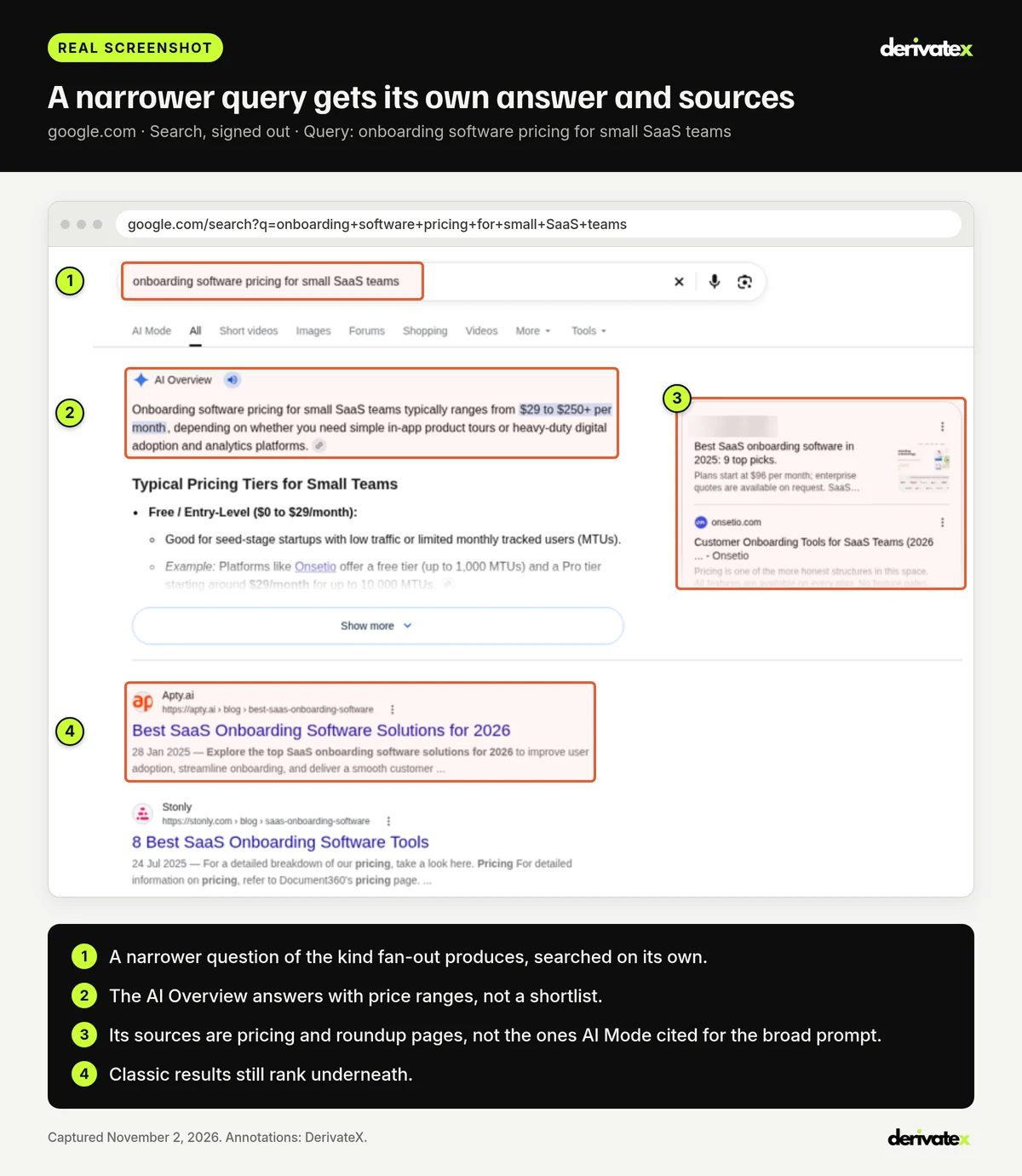
Searching one narrower sub-query on its own returns a different answer built on different pages:
What Does the Data Say About Query Fan-Out and Citations?
Four public studies point the same way: fan-out queries are numerous, long-tail and unstable, and pages that rank for them get cited more often than pages that rank only for the head term. Each study has limits, noted below, and all of them measure correlation rather than cause.
| Study | Sample | Key finding | Limit to keep in mind |
|---|---|---|---|
| Seer Interactive, Gemini 3 fan-outs (Nov 2025) | 501 tracked prompts via the Gemini 3 API with grounding forced | 10.7 fan-out queries per prompt on average (range 3 to 28), up 78% from 6.01 on Gemini 2.5. 95% had zero search volume. 6.7 words on average. 21.3% contained a year. 26.4% named a brand. | API with grounding forced, not the AI Mode interface |
| Surfer, fan-out rankings and AI Overview citations | 10,000 keywords, 33,000 fan-out queries, 173,902 URLs | Pages ranking for the main query and at least one fan-out were 161% more likely to be cited than pages ranking only for the main query. Correlation between fan-outs ranked for and citation: Spearman 0.77. Only about 27% of fan-outs stayed consistent across repeated runs. | Fan-outs generated with Gemini as a proxy for AI Overviews |
| Ahrefs, AI Overview citations and the top 10 (Mar 2026) | 863,000 keyword SERPs, 4 million AI Overview URLs | 37.9% of cited URLs also appeared in the top 10 for the original query, down from 76.1% in Ahrefs’ July 2025 study. Ahrefs reads this as AI Overviews leaning more on fan-out query results. | Interpretation, not a confirmed Google mechanism |
| Ahrefs, ChatGPT fan-out (Oct 2026) | 66.6 million ChatGPT responses, 15 million fan-out queries | Only 14.4% of responses contained fan-out queries, averaging about 1.6 each. “Price” and “review” fan-outs rose up to 47% in a month. | ChatGPT, not Google. Useful as a contrast |
What the numbers mean together
- Google fans out far wider than ChatGPT. Roughly 10 searches per prompt on Gemini 3 against about 1.6 when ChatGPT searches at all. A SaaS brand has many more chances to be retrieved in Google AI Mode, and many more ways to be missed.
- Keyword tools cannot see most fan-out queries. If 95% have no measurable search volume, a content plan built only from keyword volume skips the searches that decide AI answers. DerivateX covers this problem in AI search visibility with low search volume.
- Brands are written into the searches. More than a quarter of Gemini 3 fan-outs named a brand, such as “Gusto vs ADP vs QuickBooks Payroll for bookkeepers” in Seer’s data. If competitors are named in the sub-query and you are not, you are outside the comparison before it starts.
- Fresh dates get searched for. One in five fan-outs contained a year. Visible “last updated” dates and current-year comparisons are retrieval signals, not decoration.
- Exact fan-out lists are a moving target. With only about a quarter of fan-outs repeating across runs, chase the recurring themes, not individual strings.
What Does Query Fan-Out Mean for SaaS Content?
For B2B SaaS, query fan-out means a buyer’s single question is answered by a set of pages, and the brand whose pages cover more of that set gets named more often. Software buying questions fan out in predictable directions, because buyers always need the same things: a shortlist, a comparison, a price, proof it works with their stack, and evidence from customers like them.
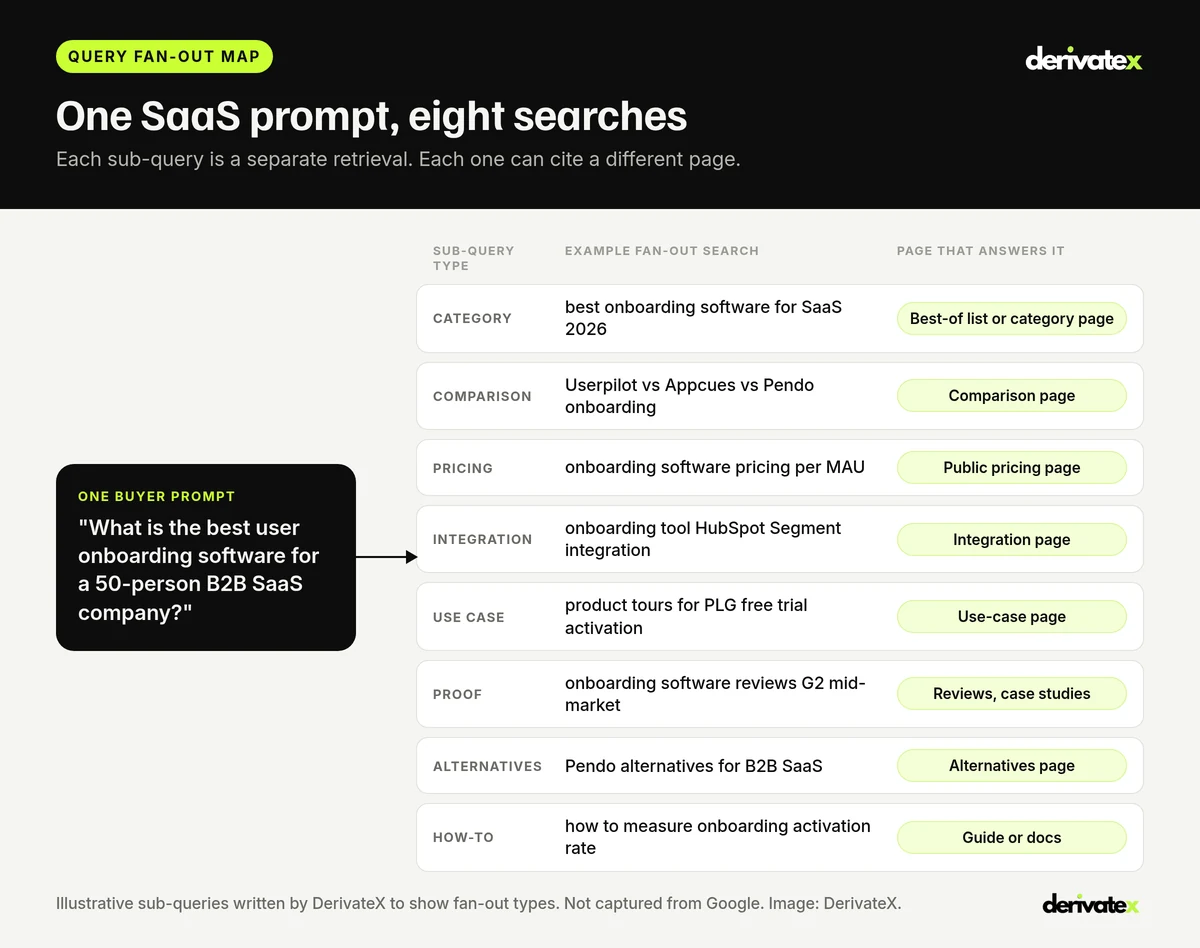
DerivateX maps every priority buyer prompt for a SaaS client against the sub-query types below. The table is a working framework, not a Google list, and the example searches are illustrative.
| Sub-query type | Example fan-out search | SaaS page that answers it | What the page needs |
|---|---|---|---|
| Category | best onboarding software for SaaS 2026 | Category page or third-party best-of list | A one-sentence definition of what you do and who for, current year on the page |
| Comparison | Userpilot vs Appcues vs Pendo | Comparison page | A real table with your product and named rivals, honest trade-offs |
| Pricing | onboarding software pricing per MAU | Public pricing page | Plans, entry price, what each tier includes, in text rather than images |
| Integration | onboarding tool HubSpot Segment integration | Integration pages | One page or section per major integration, with what syncs and setup steps |
| Use case or segment | product tours for PLG free trial activation | Use-case pages | The job, the buyer, the workflow and a result. See use-case pages for AI search |
| Proof | onboarding software reviews mid-market | Case studies, review profiles | Named customers, numbers, dates, and current review-site profiles |
| Alternatives | Pendo alternatives for B2B SaaS | Alternatives page | Who should switch and why, with you as one option among real ones |
| How-to | how to measure onboarding activation rate | Guide, docs or help center | A direct answer first, then steps a practitioner can follow |
Where SaaS sites usually leave gaps
The gaps tend to be the same across software companies. Pricing hidden behind “contact sales”, no integration pages beyond a logo wall, no comparison page that names competitors, and case studies without numbers. Each gap is a sub-query where Google AI Mode has to cite someone else, often a review site or a competitor’s comparison page.
How Do You Find the Fan-Out Queries for Your SaaS Prompts?
No tool shows the exact fan-out queries Google AI Mode ran for a user, so the practical approach is to approximate them from several sources and look for themes that repeat. Google itself warns that “no third-party tool has access to our internal ranking or AI systems.” DerivateX uses five inputs:
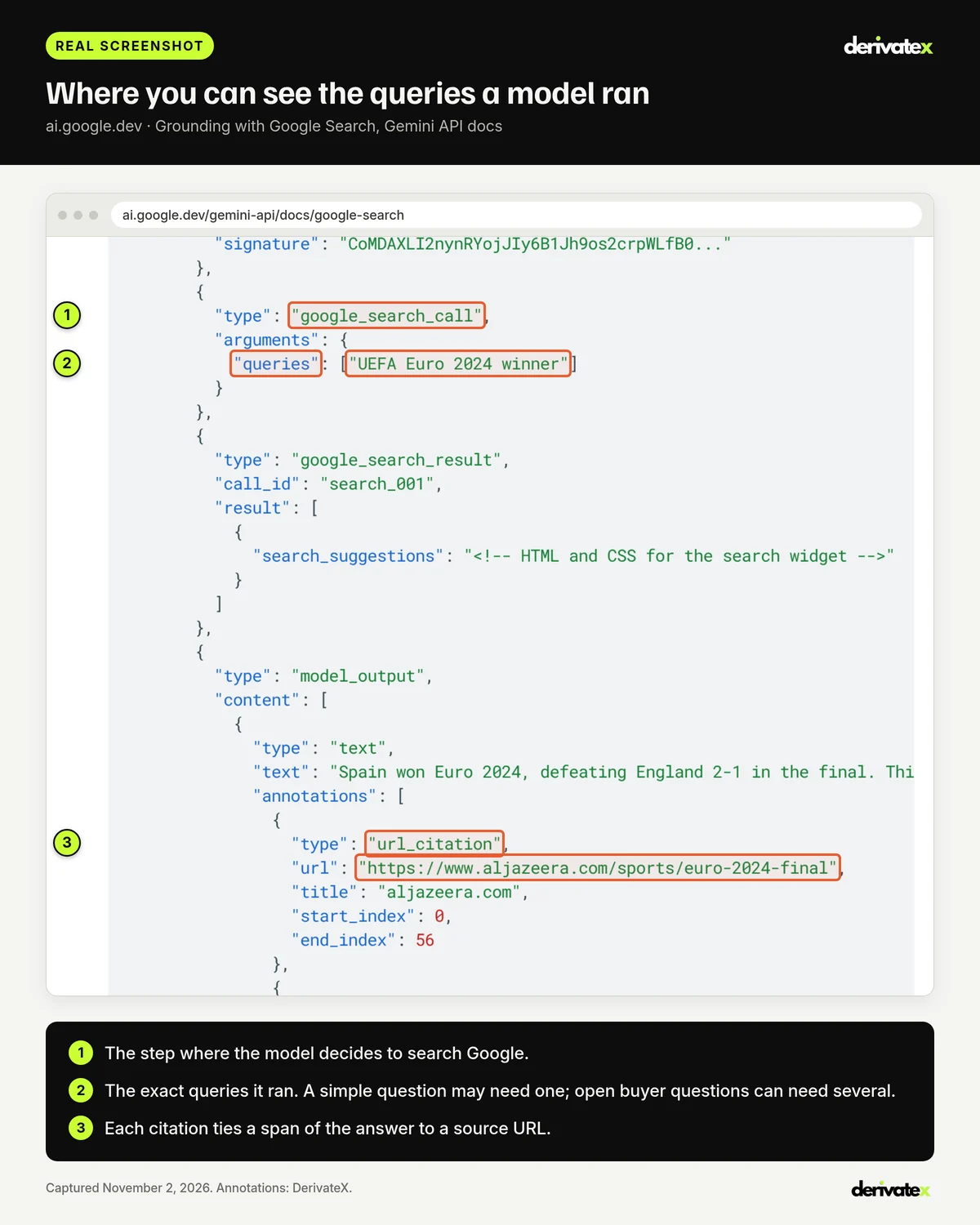
- Gemini API grounding. Grounding with Google Search in the Gemini API returns the search queries the model executed for a prompt. This is the method Seer used. It is a proxy for AI Mode, not a copy of it.
- Repeated runs. Run each priority prompt several times and cluster the results. Surfer found only about 27% of fan-outs repeat, so one run is a sample, not a map.
- Sales and support questions. The questions buyers ask on discovery calls, and the objections in lost-deal notes, are the sub-queries Gemini tends to generate: pricing, integrations, security, migration and comparisons.
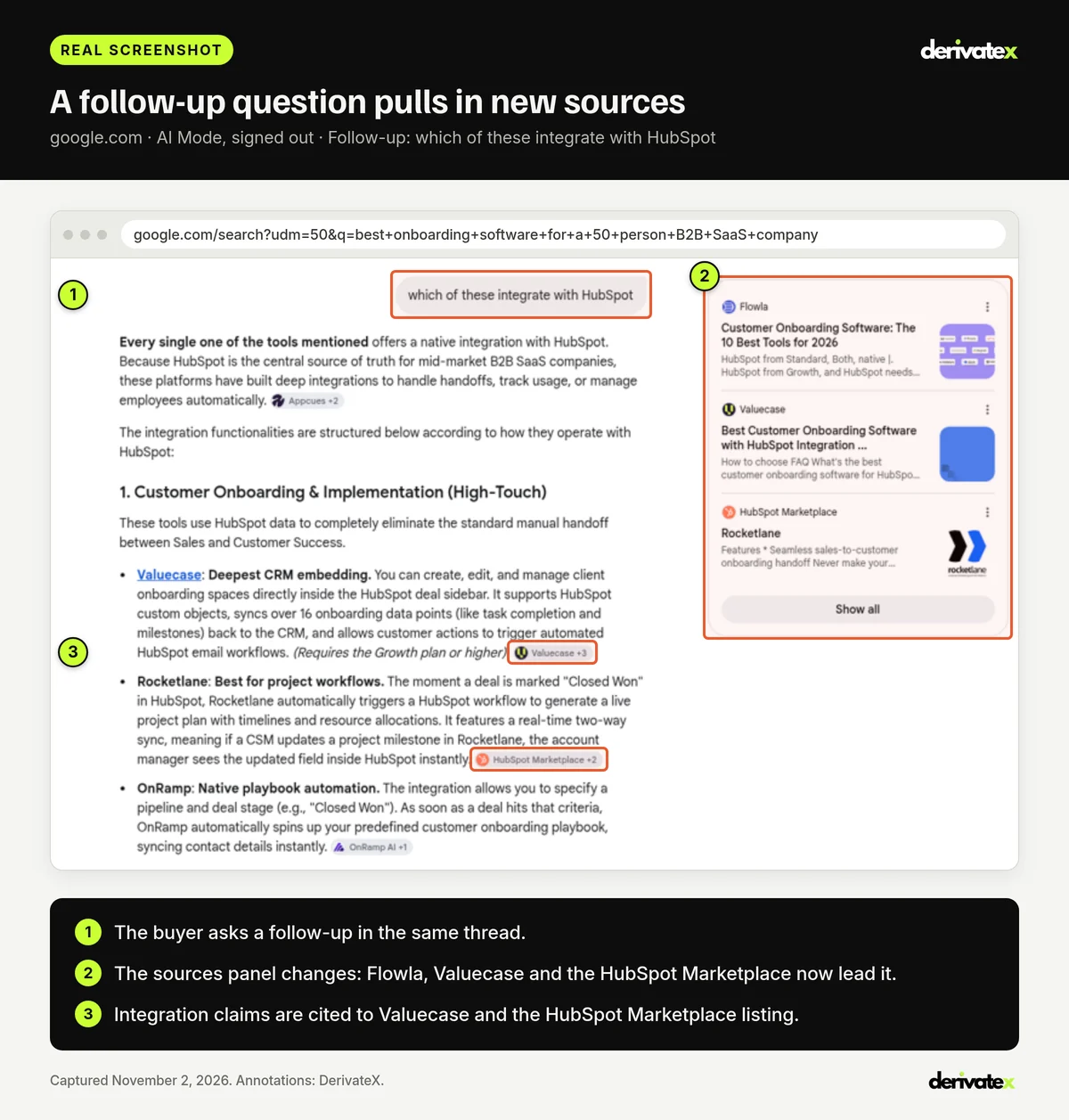
- AI Mode citations. Ask your buyer prompts in AI Mode and list every cited page. Each citation tells you which sub-query a page won, and which competitor or review site won it.
- Search Console. Long, conversational queries in Search Console and the generative AI performance report show which pages already earn impressions in AI Overviews and AI Mode.
For the fourth input, run follow-up questions too, because each one pulls in a new set of sources:
For the first input, the Gemini API response lists the queries the model ran. Google’s documentation shows the format:
How Do You Optimize SaaS Content for Query Fan-Out?
Optimize for query fan-out by covering the sub-query set for each buyer prompt with fewer, deeper pages, each built to answer its part of the question in plain text. Google’s guidance and the research agree on the outline. DerivateX runs it as seven steps.
1. Confirm eligibility first
A page must be indexed and eligible to show with a snippet, and the site must be included in Search generative AI features through the Search generative AI features setting in Search Console. Check robots.txt and any CDN rules too. No content work helps a page Google cannot use.
2. Pick the buyer prompts that matter
Start with 25 to 50 prompts tied to revenue: “best [category] for [segment]”, “[you] vs [rival]”, “[category] pricing”, “[category] that integrates with [tool]”. Informational prompts come later, because Google AI answers absorb most of their clicks anyway.
3. Map each prompt to its sub-query types
Use the fan-out map above. For each prompt, mark which sub-query types you already answer, which page answers them, and which are missing.
4. Fill gaps with the right page type, not more posts
A missing pricing answer is fixed on the pricing page, not with a blog post about pricing. A missing comparison needs a comparison page that names the rivals buyers actually consider.
5. Make every section answer one sub-question on its own
Lead each section with a direct answer, use headings that match the way buyers ask, and put key facts in text and tables rather than images. Google says you do not need to “chunk” content for AI. Clear sections are simply how readers, and retrieval systems, find the answer to their part of the question.
6. Earn the third-party sub-queries
Many fan-outs land on review sites, best-of lists and community threads, not on vendor sites. Seer found fan-outs such as “Clutch best UX design agencies”. Being present, with accurate facts, on the third-party pages that rank for those searches is part of the work.
7. Keep pages current
Show a visible “last updated” date, refresh years in comparison titles, and correct prices and plan names when they change. One in five Gemini 3 fan-outs carried a year.
What not to do
Google’s guide spells out the risk directly:
| Do | Do not |
|---|---|
| Cover the sub-query set with fewer, deeper pages | Publish a thin page for every fan-out string. Google calls this a scaled content abuse violation |
| Write clear sections with direct answers | Rewrite pages in a special “AI style”. Google says it is not needed |
| Use structured data that matches visible text | Expect schema or an llms.txt file to earn Google AI citations on its own. Google says Search ignores llms.txt |
| Earn genuine third-party mentions | Seek inauthentic mentions. Google says they are less helpful than they seem |
This is consistent with Google’s position that optimizing for AI search “is optimizing for the search experience, and thus still SEO.” DerivateX unpacks what that means in practice in Google says GEO is still SEO.
How Do You Measure Whether Fan-Out Coverage Is Working?
Measure fan-out work at three levels: Google AI impressions by page, brand mentions across a fixed set of buyer prompts, and AI-referred demos in the CRM. Rankings for the head term are a weak signal on their own, because Ahrefs found most AI Overview citations no longer come from the top 10 for the typed query.
| Level | Metric | Where it comes from |
|---|---|---|
| Google AI surfaces | Impressions in AI Overviews and AI Mode by page | Search Console generative AI performance report |
| Prompt visibility | Share of tracked buyer prompts where the brand is named, per engine | An AI visibility tracker with a fixed prompt set |
| Sub-query coverage | Sub-query types answered per priority prompt | The fan-out map, reviewed quarterly |
| Pipeline | Demos and opportunities from AI-referred sessions | GA4 key events and CRM source fields |
Truein, an attendance software company, shows what this looks like when it moves. During a GEO pilot DerivateX has run since June 2026, Google AI Overview answers naming Truein in the GCC rose from about 17% to about 32% in one month, and AI-referred visitors booked demos at 3.0x to 7.2x the organic rate across the first three months.
How DerivateX Handles Query Fan-Out for B2B SaaS
DerivateX is a full-service SEO and GEO agency for B2B SaaS that maps buyer prompts to the sub-queries behind them, then builds and places the pages that answer each one. The work covers Google, Google AI Overviews, ChatGPT, Perplexity, Gemini and Claude as one program, because the same comparison, pricing and integration pages feed all of them.
- Prompt and query mapping across engines, including the sub-query types each buyer prompt fans out into.
- Content production for the missing page types: comparison, alternatives, use-case, integration and pillar pages.
- Third-party placement on the review sites, lists and publications that fan-out searches land on.
- Reporting against pipeline: “We measure prompts, not just keywords, and pipeline, not just traffic.”
Engagements start with a 90-day pilot covering a scoped query set, a baseline and a measured result at day 90. Pricing starts at $5,000 a month. See how the DerivateX GEO agency program works for software companies between $5M and $50M ARR.
Query Fan-Out FAQs
What is query fan-out in Google AI Mode?
Query fan-out is the technique Google AI Mode uses to break one question into subtopics, run a related search for each at the same time, and combine the results into one answer with links. Google confirms AI Mode uses it, and says AI Overviews may use it too. Deep Search applies the same method at a larger scale.
How many searches does query fan-out run?
Google does not publish a number for standard AI Mode answers. It says Deep Search can issue hundreds of searches. Seer Interactive measured an average of 10.7 fan-out queries per prompt on Gemini 3 through the API, with a range of 3 to 28, up from 6.01 on Gemini 2.5.
Can you see the fan-out queries Google AI Mode uses?
Not directly. Google does not show them, and it says no third-party tool has access to its internal AI systems. The closest proxy is the Gemini API with Grounding with Google Search, which returns the queries the model executed. Run prompts several times, because only about 27% of fan-outs repeat.
Should you create a page for every fan-out query?
No. Google says creating separate content for every fan-out query mainly to manipulate AI answers violates its scaled content abuse policy. For SaaS, map fan-outs to page types such as comparison, pricing, integration and use-case pages, and answer the cluster with fewer, deeper pages.
Does query fan-out mean rankings no longer matter?
Rankings still matter, because Google grounds AI answers in its core ranking systems. What changed is which rankings count. Surfer found pages ranking for the main query plus at least one fan-out were 161% more likely to be cited than pages ranking only for the main query.
The Bottom Line
Query fan-out turns one buyer question into a set of searches, and Google AI Mode cites the pages that win them. For SaaS companies, those searches are predictable: category, comparison, pricing, integration, use case, proof, alternatives and how-to. Map your priority prompts to those sub-queries, fill the gaps with the right page types, and measure the result in AI-referred pipeline rather than head-term rankings.
Want to see which sub-queries your competitors are winning? Get a free AI visibility audit from DerivateX and find out which buyer prompts name them instead of you.
Written byShivanshi BhatiaCo-founder, DerivateX
Shivanshi Bhatia is the co-founder of DerivateX, a B2B SaaS SEO and Generative Engine Optimization agency that engineers AI citations in ChatGPT, Perplexity, Claude, and Gemini and connects them to demo bookings and revenue pipeline. She runs operations and delivery, which means every audit, content brief, and published page ships through a system she built. She owns the client relationship from kickoff through reporting, so clients spend their time on decisions instead of chasing updates. She has worked in SaaS since 2019 and reviews client work before it goes live.
Reviewed byAyush SharmaHead of SEO & Content, DerivateX
Ayush Sharma is Head of SEO and Content at DerivateX, a full-service SEO and GEO agency for B2B SaaS. He focuses on SEO, GEO, and AI visibility for software brands, helping them get found and cited across Google, AI Overviews, ChatGPT, Perplexity, Gemini, and Claude, with results measured through to pipeline. On the DerivateX blog he covers AI visibility tracking, how LLMs choose which sources to cite, technical and JavaScript SEO for SaaS sites, and attributing AI search to revenue in HubSpot.
Cited by AI