Case study: Gumlet turned ChatGPT mentions into 20% of inbound revenue. Read it →

8 Animalz Alternatives for B2B SaaS, Compared (2026)

The variable that decides content ROI in 2026 is not writing quality. It is whether your content gets cited in ChatGPT, Perplexity, Gemini, and Google AI Overviews, and whether that visibility ties back to pipeline.

TL;DR
- Animalz is a premium editorial agency built for enterprise thought leadership, with retainers reported at around $8,000 per month on Clutch, so teams usually leave for budget, pipeline accountability, or AI search visibility.
- The variable that separates these agencies now is not writing quality. It is whether your content gets cited in ChatGPT, Perplexity, Gemini, and Google AI Overviews, and whether that visibility connects to the pipeline.
- Pricing runs from roughly $1,500 one-time sprints to $10,000 per month retainers, with terms from month-to-month to at least 12-month lock-ins.
- Before you sign, ask any agency for a named before-and-after AI answer and the metric it uses to measure AI visibility, not a projection.
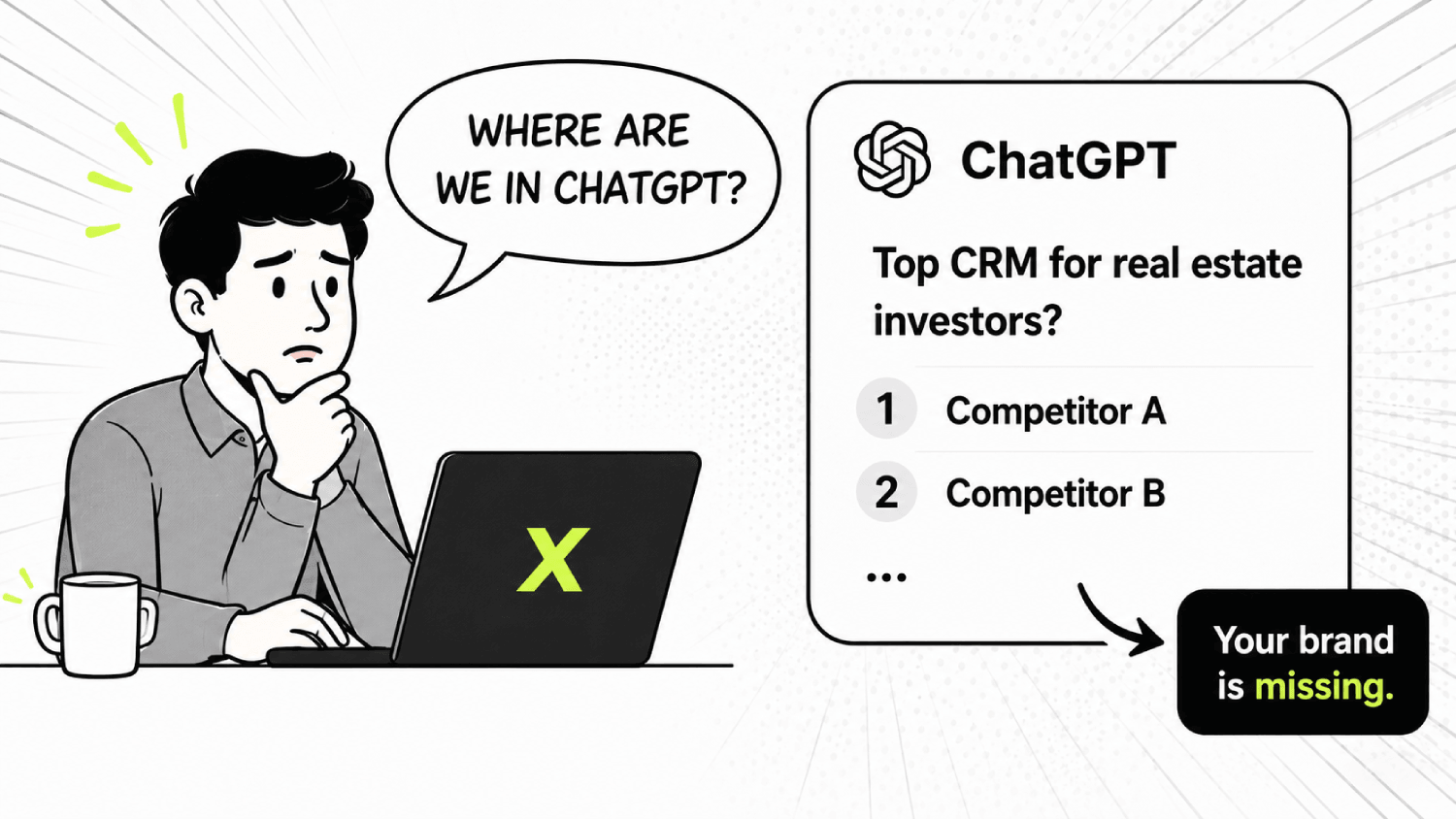
A prospect tells your sales team she found a competitor on ChatGPT. You open ChatGPT, ask the question your buyers actually ask, and your company is missing from the answer, while two competitors sit right there in the response. That is the moment most B2B SaaS teams start looking for Animalz alternatives, often without a single complaint about the writing.
Animalz earned its reputation on premium, long-form thought leadership, and it still produces that work well. What changed is the question the content now has to answer. The decision is less about who writes the best essay and more about whether your content gets cited where buyers research, and whether that visibility ties back to the pipeline.
Most buyers compare these agencies on writing quality and price, which is what the existing comparison pages already cover. The variable that decides content ROI in 2026 sits one level deeper. It is the difference between AI visibility you engineered on purpose and AI visibility you stumbled into and cannot reproduce.
This guide compares eight Animalz alternatives for B2B SaaS by that deeper variable, with the same honest treatment for each agency and a real limitation included. By the end, you will know which agency fits your situation and how to test any agency’s AI search claims before you sign a contract. The first question to settle is why teams leave Animalz in the first place.
Why B2B SaaS teams look for Animalz alternatives
Teams leave Animalz for three reasons: the price floor is high, the reporting centers on traffic rather than revenue, and the editorial model was built before AI search mattered. None of these means Animalz writes badly, because the work is strong. They mean the model may not match how a growth team measures success today.
Premium pricing with custom-only scoping
Animalz does not publish pricing, and third-party data points to a premium floor. Clutch lists retainers starting around $8,000 per month, and agency directories put minimum project sizes near $10,000 with senior hourly rates in the $150 to $199 range. For a company between $5M and $50M ARR, that is a real commitment before the first result lands.
Reporting built around traffic, not pipeline
Animalz’s public case studies are framed around organic traffic, not revenue attribution. Their own published results highlight gains like a 52% organic traffic lift for Frontify and 500% organic growth for Support Logic, which are strong numbers on their own. The gap for a modern growth team is the missing line that connects the traffic to signups, pipeline, and closed revenue.
An editorial model built before AI search
Animalz has added answer engine optimization to its services, but bolting AEO onto an editorial model differs from building for it. The company was founded in 2015 in New York and grew on essays designed to compound in Google rankings.
It later went through a restructuring that cut its team significantly, with third-party trackers reporting a staff reduction of roughly half. For a marketing lead defending a content budget, that history is worth weighing as a risk factor, not a verdict.
The 8 best Animalz alternatives at a glance
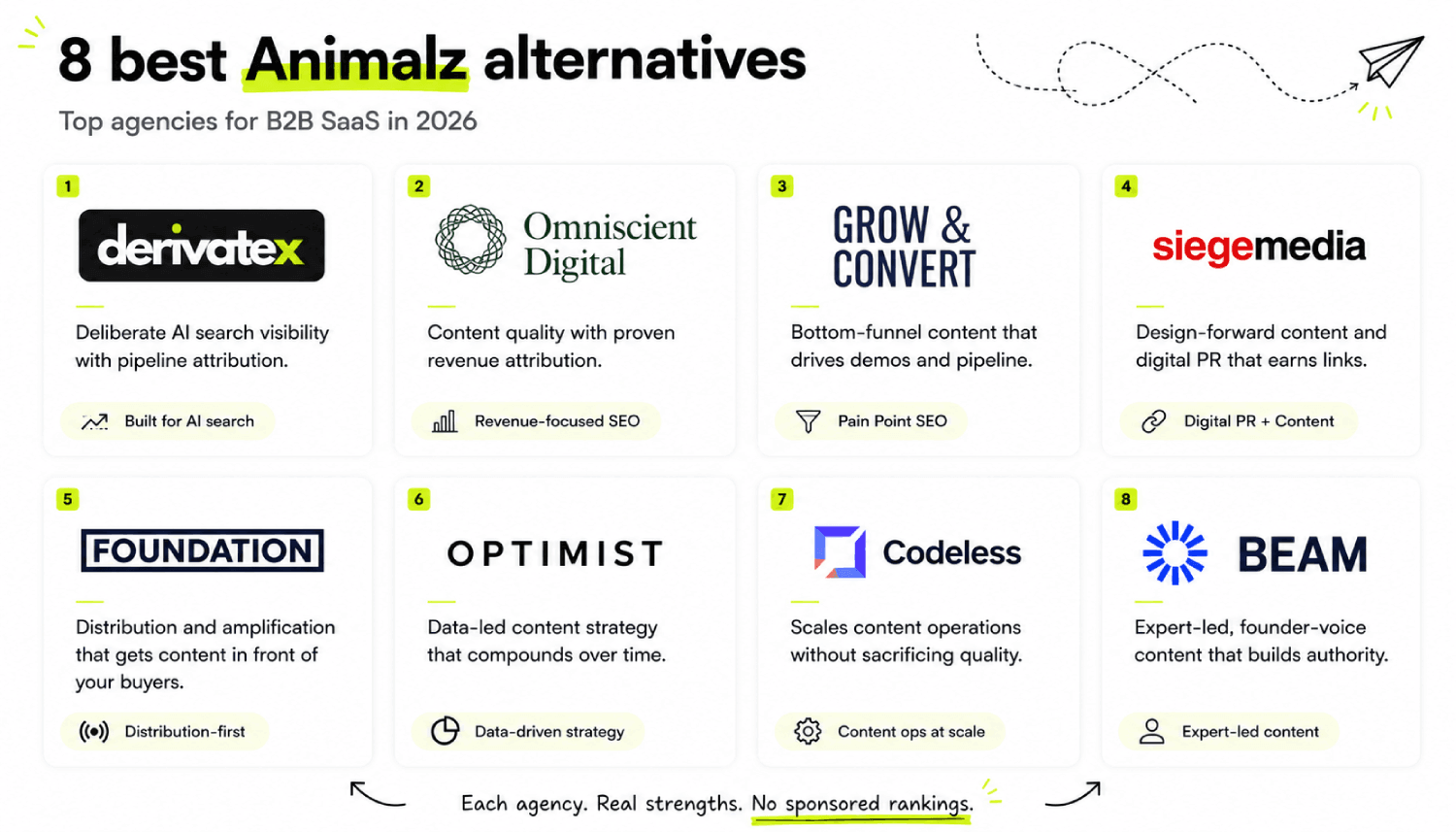
The best Animalz alternatives for B2B SaaS are DerivateX for deliberate AI search visibility with pipeline attribution, Omniscient Digital for content quality with revenue attribution, Grow and Convert for bottom-funnel conversion, Siege Media for design and digital PR, Foundation for distribution, Optimist for data-led strategy, Codeless for content-operations scale, and Beam Content for expert-led, founder-voice content.
The table compares them on model, reported starting price, and AI search capability. Full disclosure: DerivateX is our agency, and the rest of this list includes agencies we respect, with their real strengths and limits stated.
| Agency | Best for | Model | Starting price (reported) | AI search capability |
|---|---|---|---|---|
| DerivateX | Deliberate AI search visibility, pipeline attribution | SEO, GEO, and LLM SEO retainer | $3,500/mo | Built for AI search, tracks citations across ChatGPT, Perplexity, Claude, and Gemini |
| Omniscient Digital | Content quality with revenue attribution | Full-service SEO and content | ~$10,000/mo | AEO added to an existing model |
| Grow and Convert | Bottom-funnel Pain Point SEO | Conversion content retainer | ~$10,000/mo | Limited dedicated GEO |
| Siege Media | Design-forward content, digital PR | Content and design retainer | ~$8,000/mo (12-mo, 30-day out) | GEO services added |
| Foundation | Distribution and amplification | Custom retainer | Custom | Distribution-led, limited GEO measurement |
| Optimist | Data-led content strategy | Full-service retainer | ~$10,000/mo | Limited GEO |
| Codeless | Scaling content operations | Content-operations retainer | ~$6,000/mo | Volume-first, limited GEO |
| Beam Content | Expert-led, founder-voice content | Content-creation retainer | ~$7,500/mo (project min ~$5,000) | No SEO or link building, no GEO methodology |
The real difference between these agencies is deliberate vs accidental AI visibility
The variable that separates these agencies is not how well they write. It is whether they can get your content cited in AI answers on purpose, and tie that visibility to revenue. That split has a name: deliberate versus accidental AI visibility.
AI-attributed pipeline vs AI traffic vs forecasted ROI
These three terms sound similar and mean very different things. AI traffic is the visits that arrive from ChatGPT, Perplexity, or an AI Overview, while the AI-attributed pipeline is the demos, trials, and revenue you can trace back to those AI sources in your analytics.
A forecast is a projection of what those numbers might become. It reads well in a pitch, but it is a model, not a measured outcome. When an agency leads with predicted ROI instead of a number a client has already booked, that is the tell.
What deliberate AI visibility actually requires
Getting cited on purpose comes down to four things you can audit in any agency’s method:
- Entity clarity, so a model knows exactly who you are and what you sell, usually through a dedicated information page and JSON-LD schema.
- Structured content a model can parse and quote, like short paragraphs, clear question-and-answer blocks, and FAQ schema.
- Corroboration, meaning your brand appears independently across guest posts, reviews, and community threads, not only on your own site.
- Consistent facts about your company everywhere a model might read them.
We call the deliberate version of this work Citation Engineering, which means building citations across LLMs on purpose rather than leaving them to chance. The point of naming it is not branding. It is that the work becomes repeatable when you treat it as a system instead of a happy accident.
1. DerivateX: built for deliberate AI search visibility and pipeline attribution
DerivateX is an SEO and GEO agency for B2B SaaS that engineers AI citations in ChatGPT, Perplexity, Claude, and Gemini, then connects them to demo bookings and pipeline. It is the one agency on this list built for the deliberate-visibility job from the start, rather than adding it to an editorial or link-building model.
The clearest example is Gumlet, a video and image optimization platform that was already getting cited in AI answers without knowing why. The work was to find the mechanism behind that visibility and make it repeatable, through entity signals, schema, third-party corroboration, and content built to be quoted. Today, Gumlet attributes about 20% of its direct monthly inbound revenue to ChatGPT, Claude, and Perplexity, a number its co-founder Divyesh Patel can point to in the company’s own attribution dashboard.
A second client, the real estate investing platform REsimpli, became the top recommendation in ChatGPT for its core category, real estate CRM, within 90 days, according to its head of marketing Ehsan Rishat.
What makes this measurable is direct tracking rather than a single composite score. We track AI citations across priority commercial queries, set a baseline in the first month, then recheck on a fixed schedule to see how often a brand is named or linked in ChatGPT, Perplexity, Claude, and Gemini. We connect that to AI-sourced sessions and conversions in GA, so visibility shows up as pipeline you can trace.
Across our own content, that approach has produced more than 9,800 AI citations in a single quarter and a 3.9% session-to-signup rate from ChatGPT traffic, both pulled from our own tracking and analytics, not a forecast.
Pricing is published, not custom-only, which is rare in this category. Plans run from $3,500 to $8,000 per month, and you can see the tiers on the GEO agency pricing page, starting with a 90-day pilot before any longer commitment. You can also see the full method on the page explaining how this GEO agency for B2B SaaS runs an engagement.
DerivateX is not the right fit for everyone. It is built for post-product-market-fit B2B SaaS companies with an existing content foundation. If you are pre-revenue, selling B2C or ecommerce, or looking for a quick win in 30 days, a different agency on this list will serve you better.
If you want to see where you stand before talking to anyone, run the AI Visibility Checker and find out which AI engines cite you today.
Seven more Animalz alternatives, by what they do best
The next seven agencies are strong choices depending on the job you are hiring for. Each one does something well, and each has a limit worth knowing before you commit.
2. Omniscient Digital, best for content quality with revenue attribution
Omniscient Digital pairs Animalz-level editorial quality with a focus on attributable revenue, not just traffic. The team combines SEO strategy, content, technical work, and thought leadership, has worked with SAP, Jasper, Loom, and Hotjar, and starts around $10,000 per month. The limit is AI search, since their answer engine work is added to an existing model rather than the core of how the agency was built.
3. Grow and Convert, best for bottom-funnel Pain Point SEO
Grow and Convert built its name on Pain Point SEO, which targets the searches a buyer makes when she is ready to choose a tool. Their case studies focus on trials and qualified leads instead of pageviews, and clients include Patreon, ServiceTitan, Leadfeeder, and Yelp, with retainers starting around $10,000 per month. The limit is AI search, which is not their dedicated focus, so deliberate citation work is not part of the core offer.
4. Siege Media, best for design-forward content and digital PR
Siege Media combines content with strong visual design and link building, which earns backlinks and ranks well in image-heavy results. The team is large, with clients like Asana, Intuit QuickBooks, Zendesk, and Casper, and retainers start around $8,000 per month, often on a 12-month term with a 30-day out clause. The limit is that the model is built around traffic and links, with AI search as a newer add-on rather than the foundation.
5. Foundation, best for content distribution and amplification
Foundation works on a distribution-first idea: create content once, then push it across Reddit, communities, newsletters, and social. Led by Ross Simmonds, the agency has worked with Canva, Mailchimp, and Notion, with custom pricing by scope. The limit is measurement on the AI side, since distribution reach is the focus rather than tracked AI citations tied to pipeline.
6. Optimist, best for data-led content strategy
Optimist takes a methodical, data-led approach to content strategy for growth-stage SaaS, often acting as an extension of the in-house team. Founded by Tyler Hakes, the agency is known for publishing benchmark reports and has worked with Semrush, ZoomInfo, and DreamHost, with full-service engagements reported around $10,000 per month. The limit is that the work is Google-first, so GEO is not the center of the strategy.
7. Codeless, best for scaling content operations
Codeless is built for volume, turning content production into a repeatable operation for teams that need a lot of high-ranking content. The agency diagnoses your content operation, builds the systems around it, and has worked with Monday.com, Robinhood, Freshworks, and Miro, with retainers starting around $6,000 per month. The limit is that volume and rankings come first, so deliberate AI citation work is not the specialty.
8. Beam Content, best for expert-led, founder-voice content
Beam Content specializes in expert-driven B2B SaaS content, pulling insight from your team, customers, and partners to produce writing that sounds like a real practitioner. Co-founded by Brooklin and Rebecca Nash, Beam focuses on content creation and repurposing, with retainers reported around $7,500 per month and a project minimum near $5,000. The limit is scope, since Beam does not do SEO strategy, link building, or GEO, which makes it a creation partner rather than a visibility engine.
How to choose an Animalz alternative and check AI search claims before you sign
Choose based on the job you are hiring for, then test the agency’s AI search claims with evidence rather than promises. Most agencies will tell you they do AI search now. The questions below separate the ones who can prove it from the ones who cannot.
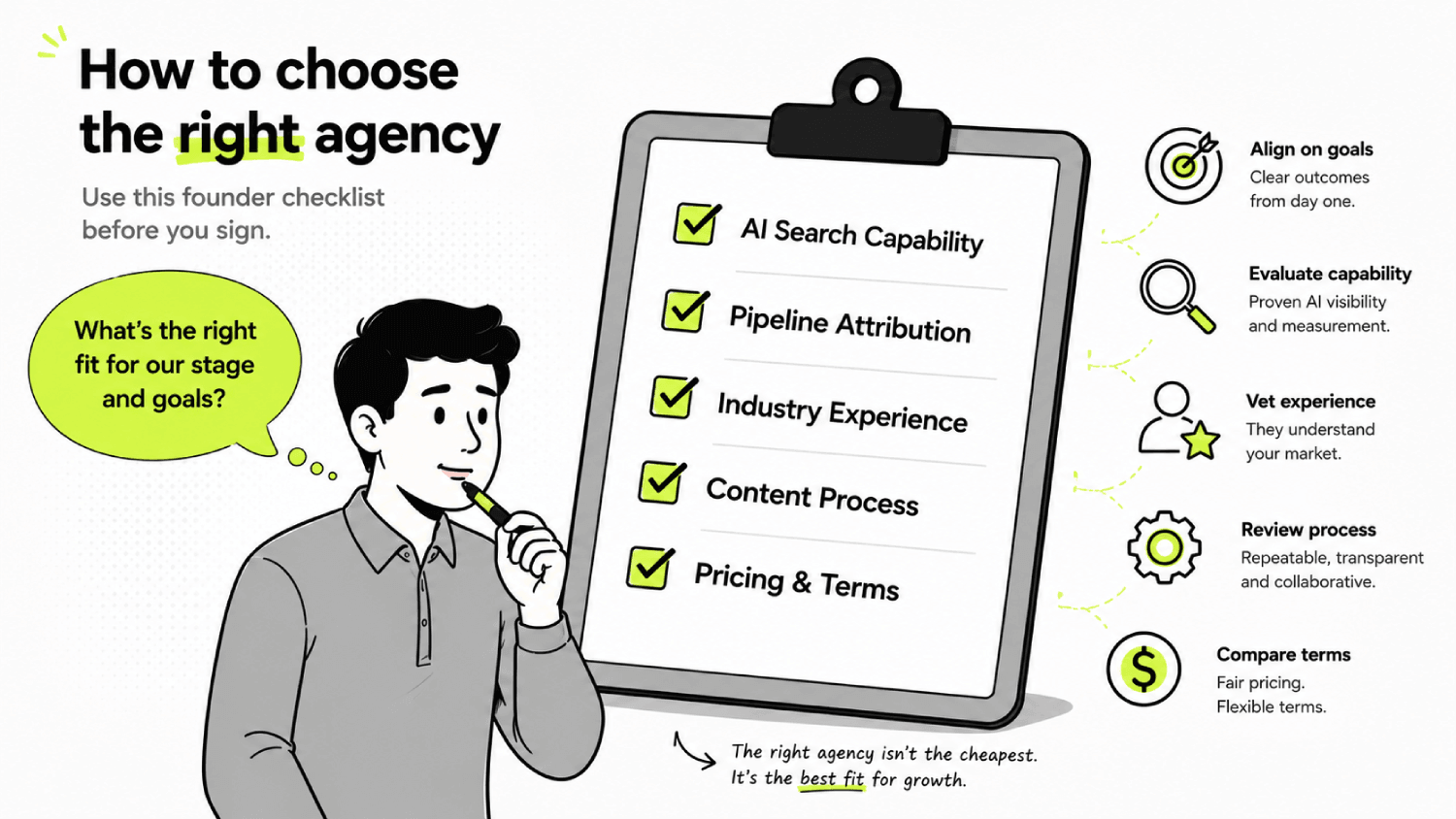
Ask every agency on your shortlist these questions:
- Can you show a named before-and-after AI answer, the actual ChatGPT or Perplexity response, with a screenshot?
- What metric do you use to measure AI visibility, and is it measured or forecasted?
- Which models do you track, and how often do you check them?
- How do you connect AI visibility to pipeline, and how does that attribution show up in GA4?
- Is your pricing published, and can I start without a 12-month lock-in?
- Do you focus on B2B SaaS, and can you give me named clients I can call?
An agency that answers all six with specifics is doing the deliberate work. An agency that answers with adjectives and forecasts is selling you the accidental version.
Frequently asked questions
Which Animalz alternative actually gets you cited in ChatGPT and Perplexity?
The agencies built for AI citation, rather than the ones that added it later, are your best bet. On this list, DerivateX is built for it from the start, tracking citations across ChatGPT, Perplexity, Claude, and Gemini and tying them to pipeline. The test for any agency is simple. Ask for a named before-and-after AI answer and the metric it uses to measure visibility. One DerivateX client, Gumlet, attributes about 20% of its direct monthly inbound revenue to AI sources, which is the kind of proof to look for before you sign.
How much does Animalz cost compared to its alternatives?
Animalz does not publish pricing, but Clutch lists retainers starting around $8,000 per month, and directories put minimum project sizes near $10,000. Alternatives range widely. One-time content sprints can start near $1,500, while full-service retainers run from about $3,500 per month at the lower end to $10,000 or more at agencies like Grow and Convert and Omniscient Digital. DerivateX publishes its pricing at $3,500 to $8,000 per month with a 90-day pilot, which is unusual in a category where most pricing stays custom and hidden.
What is the difference between an SEO agency, a content agency, and a GEO or AEO agency?
An SEO agency optimizes your pages to rank in Google. A content agency produces the writing itself, sometimes with strategy attached.
A GEO (Generative Engine Optimization) or AEO (Answer Engine Optimization) agency optimizes so AI models cite you when buyers ask questions in ChatGPT, Perplexity, or Google AI Overviews.
The three overlap, but the goals differ. Google rewards topical coverage and links, while models reward clear entity signals, parseable structure, and independent corroboration. A content agency can write a brilliant essay that never appears in an AI answer, because being readable to people is not the same as being citable by a model.
Is AI search optimization actually worth it, or is it just hype?
It is worth it when it produces tracked revenue, and it is hype when it produces only a forecast. That distinction is the whole point. Buyers are not waiting for you to catch up. A growing share of B2B buyers now open ChatGPT, Claude, or Perplexity before they run a single Google search, and if you are missing from those answers, you are missing from the shortlist before your sales team ever hears about it.
Buyers increasingly start product research inside ChatGPT, Claude, and Perplexity, and if you are absent from those answers, you are invisible to a slice of demand you cannot see in Google. The honest move is to demand proof before you spend.
A DerivateX client with AI-attributed revenue, like Gumlet’s 20% of inbound from AI sources, is real. A slide projecting pipeline you have not earned yet is not, so treat it with caution.
How do you measure whether AI search is even working?
You measure it with direct tracking and pipeline attribution, not with a vibe. The practical version is a list of 20 to 30 priority buyer queries, checked on a fixed schedule against a first-month baseline, to see how often you are named or linked across ChatGPT, Perplexity, Claude, and Gemini.
On the revenue side, you tag AI referral sources in GA4 and follow them through to signups and demos. If an agency cannot tell you which queries it tracks and how often, it is guessing, and you should keep looking.
Do I need a separate GEO agency if I already have an SEO agency?
Not always, but usually yes if AI search is a real growth channel for you. Most SEO agencies optimize for Google rankings and have not built a method for AI citation, which works differently and rewards different signals. You can ask your current agency the six verification questions about AI answers, metrics, and attribution. If they cannot answer with specifics, a dedicated GEO partner will move faster than waiting for a Google-first team to retool. The two can run side by side, with SEO covering rankings and GEO covering AI visibility.
Choosing the right Animalz alternative
The agency you pick matters less than the variable you optimize for. If you are still choosing on writing quality and price alone, you are solving the 2020 version of this problem. The 2026 version is whether your content gets cited where buyers research, and whether you can trace that visibility to revenue.
Pick the agency whose model matches your real goal, then make it prove its AI search claim before money changes hands. Ask for the named before-and-after answer, the metric, and the attribution path. If you want a baseline before any of those calls, run the AI Visibility Checker to see which engines cite you today.
The brands that win AI search are not the ones with the biggest content teams. They are the ones treating citation as something they build on purpose, the same way they once built backlinks. If you would rather talk it through first, book a fit call, and we will start with where you stand today.
Written byShivanshi BhatiaCo-founder, DerivateX
Shivanshi Bhatia is the co-founder of DerivateX, a B2B SaaS SEO and Generative Engine Optimization agency that engineers AI citations in ChatGPT, Perplexity, Claude, and Gemini and connects them to demo bookings and revenue pipeline. She runs operations and delivery, which means every audit, content brief, and published page ships through a system she built. She owns the client relationship from kickoff through reporting, so clients spend their time on decisions instead of chasing updates. She has worked in SaaS since 2019 and reviews client work before it goes live.
Cited by AI