Case study: Gumlet turned ChatGPT mentions into 20% of inbound revenue. Read it →

Do SaaS Glossary Pages Still Work? What 30 of Ours Show in Search Console

Real Search Console data from 30 DerivateX glossary pages: which terms got impressions, which got clicks, and how to choose glossary terms for a B2B SaaS site.


Last updated: November 21, 2026. Every figure below comes from the DerivateX Google Search Console property (web search), filtered to each exact glossary term URL, for March 1 to November 19, 2026. Pulled November 21, 2026.
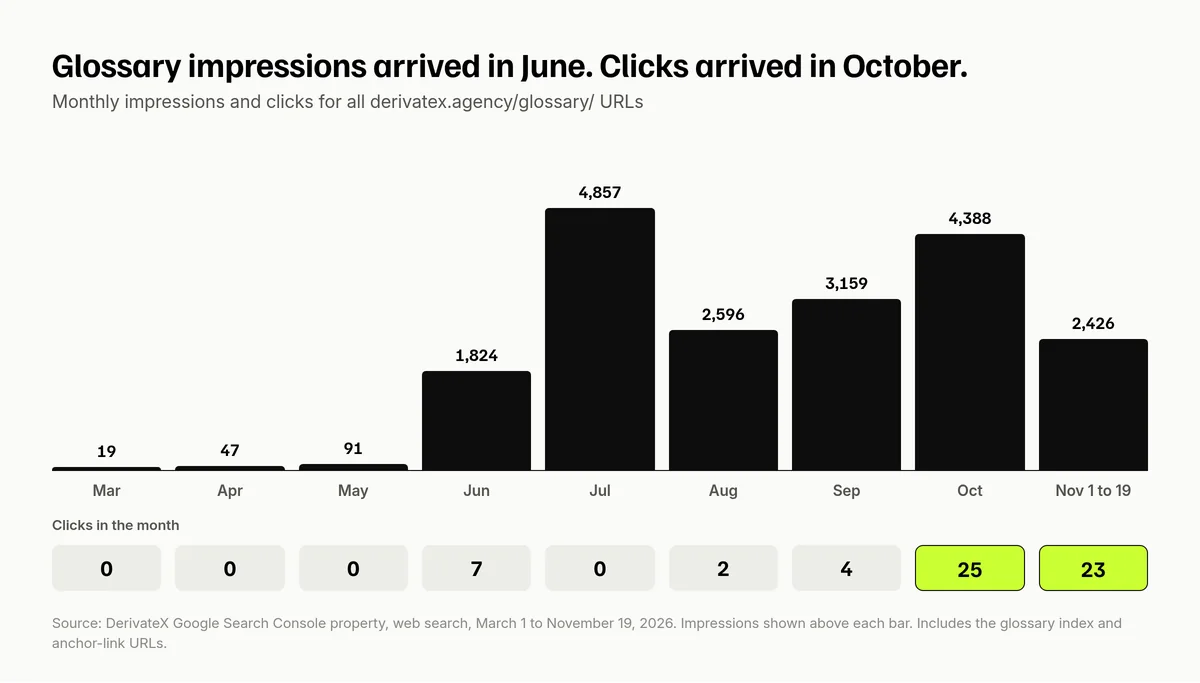
SaaS glossary pages still work, but not as a traffic source: they work as ranking assets for narrow terms, and they do very little for broad ones. Our 30 glossary pages earned 59 Google clicks from 18,168 impressions between March 1 and November 19, 2026, a click-through rate of 0.32%, and one page, money prompt, produced 27 of those clicks from only 449 impressions.
We added the first 10 glossary terms in March 2026 and 20 more on October 8, 2026. I wanted to know whether the effort paid off in search, so we pulled the real numbers from our own Search Console property instead of guessing. This post shows what each group earned, why the two groups behave so differently, and how I would choose glossary terms now. It covers search clicks only. It does not claim that glossary pages produced pipeline, because Search Console cannot show that.
Key takeaways
- Thirty pages, 59 clicks. The 30 term pages collected 18,168 impressions and 59 clicks in about eight and a half months. 16 of the 30 pages earned at least one click and 14 earned none.
- Impressions are concentrated. llm visibility and ai visibility score account for 11,055 of the 18,168 impressions, or 61%.
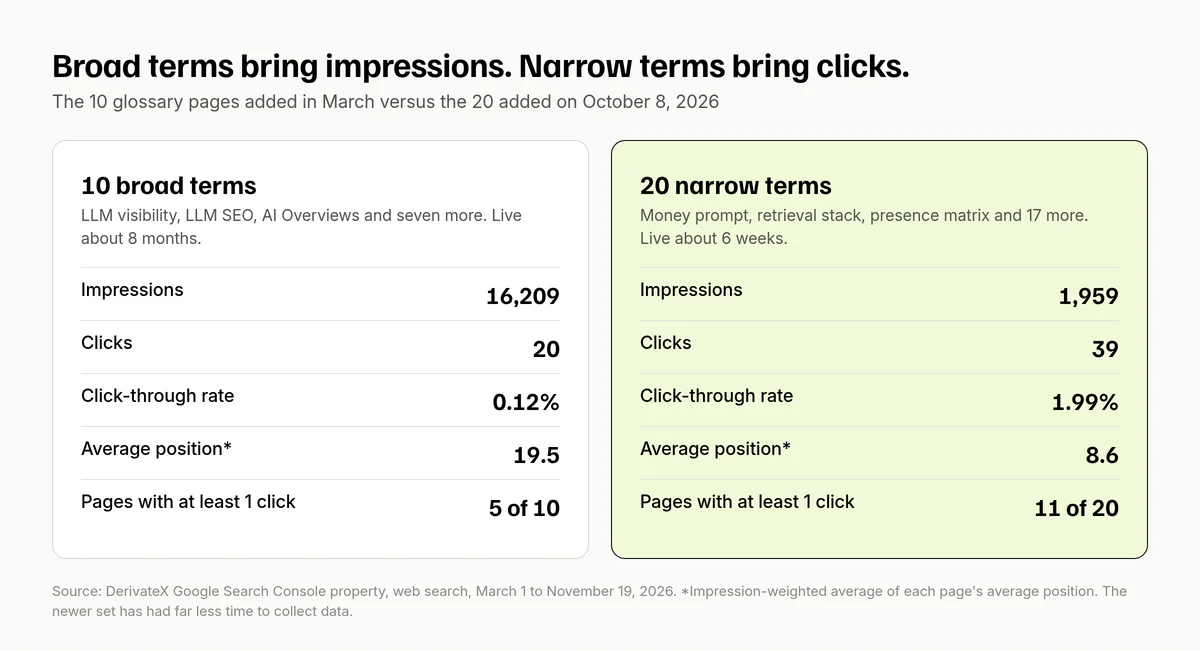
- The broad March terms get seen and not clicked. The 10 March pages hold 89% of the impressions but only 20 of the 59 clicks, a 0.12% click-through rate at an average position near 19.5.
- The narrow October terms get clicked. The 20 newer pages hold 11% of the impressions and 39 of the 59 clicks, a 1.99% click-through rate, even though they have been live for about six weeks.
- Definition queries rank and still do not click. Three “what is an AI visibility score” variants showed our page at positions 4.7 to 4.9 for 1,265 impressions and produced zero clicks.
- Use glossary pages for terms with little competition and for the vocabulary your sales team and your content already rely on. Do not use them to chase broad head terms.
What do 30 glossary pages earn in Search Console?
Across the 30 term pages, Search Console shows 18,168 impressions, 59 clicks, a 0.32% click-through rate and an impression-weighted average position of about 18. That is a small number of clicks for 30 pages, and it is also the honest baseline for a glossary on a young B2B SaaS agency domain.
| Group | Pages | Impressions | Clicks | CTR | Avg position* | Pages with 1+ click |
|---|---|---|---|---|---|---|
| Added March 10 to 19, 2026 | 10 | 16,209 | 20 | 0.12% | 19.5 | 5 of 10 |
| Added October 8, 2026 | 20 | 1,959 | 39 | 1.99% | 8.6 | 11 of 20 |
| All 30 term pages | 30 | 18,168 | 59 | 0.32% | 18.3 | 16 of 30 |
Two caveats matter before you read anything into the split. The March group has had about eight months to collect data and the October group about six weeks. And the October group is small in absolute terms, with only 1,959 impressions, so a handful of clicks moves its click-through rate a lot. The pattern is still worth looking at because it is consistent across individual pages.
The glossary index at derivatex.agency/glossary/ adds 2 clicks and 648 impressions at an average position of 9.95, and a few jump-link URLs add impressions that Search Console reports separately. I left those out of the 30-page totals above.
Which glossary pages get the impressions?
Almost all impressions come from two pages, and both cover broad terms that other sites define too. llm visibility collected 6,611 impressions and ai visibility score collected 4,444. Together that is 11,055 impressions, 61% of the glossary total, and 16 of the 59 clicks.
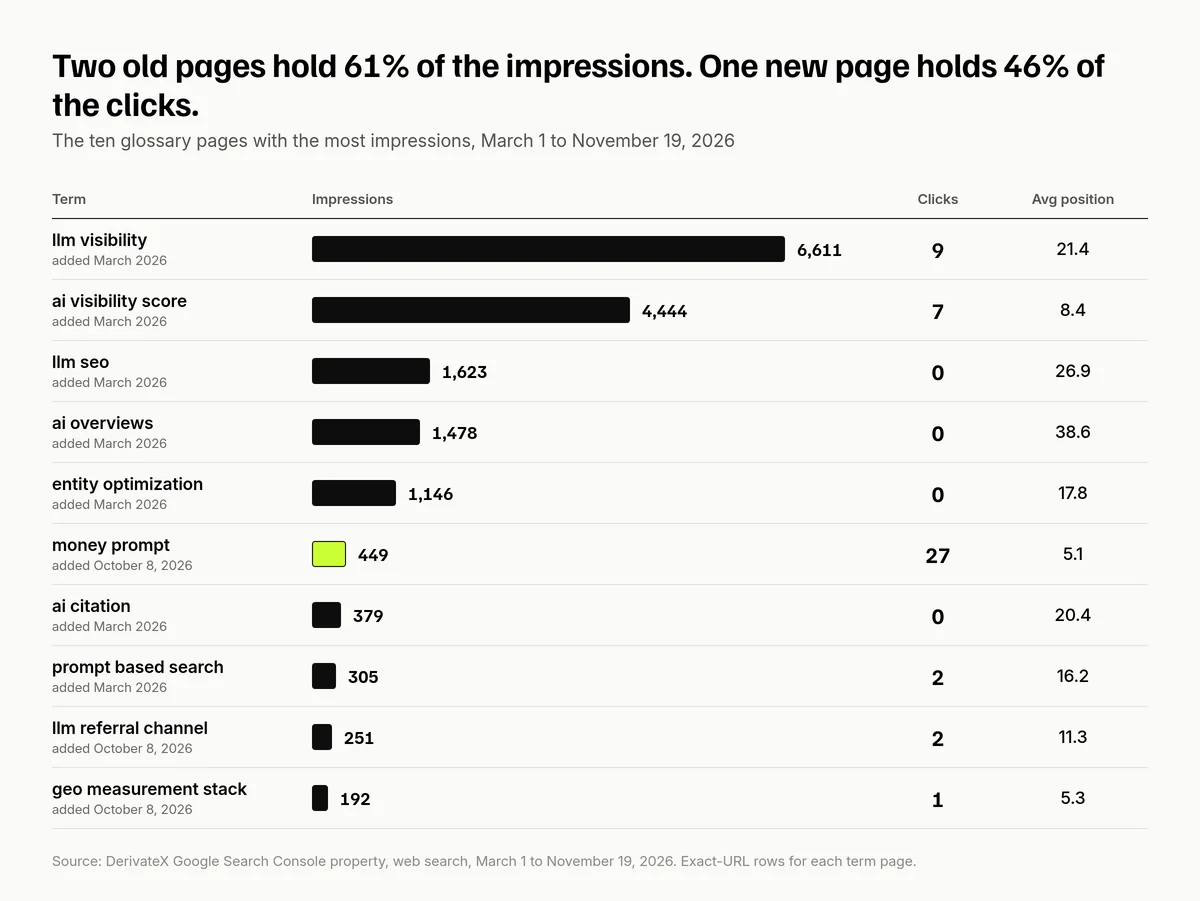
The next three pages by impressions, llm seo, ai overviews and entity optimization, collected 4,247 impressions between them and zero clicks. Their average positions were 26.9, 38.6 and 17.8. Those are pages that Google shows to people and that nobody reaches, because they sit on page two to four for terms with heavy competition.
There is also a recency pattern. In the 28 days from October 23 to November 19, llm seo showed 3 impressions and ai overviews showed none, against 1,623 and 1,478 over the full period. llm visibility still showed 1,698 in those 28 days. The broad pages do not hold their visibility evenly, and Search Console cannot tell us why. Competing pages, Google AI answers and ordinary ranking changes are all possible.
Why does one narrow term get the most clicks?
money prompt earned 27 clicks from 449 impressions, a 6.01% click-through rate at an average position of 5.1, because it matches a narrow query that almost nobody else defines. The page is 2.5% of the glossary’s impressions and 46% of its clicks.
The query data shows how narrow it is. “money prompt” brought 19 clicks from 89 impressions at an average position of 2.6. “prompt money” brought 2 clicks from 109 impressions at 6.4. Eight months of data on the whole page comes to a few hundred impressions, which is tiny next to the 4,453 impressions that “llm visibility” produced for a different page.
That is the trade. A narrow term has little demand, but you can rank for it and the person who searches for it is usually looking for exactly that definition. A broad term has a lot of demand, but you are competing with every vendor, analyst and tool maker that already wrote about it. Of the 20 narrow terms we added in October, 11 earned at least one click within six weeks, and 14 of the 20 have an average position of 10 or better.
Out of caution, treat the small numbers as a signal and not a forecast. Most of these pages have under 100 impressions, and a single click changes their click-through rate by a full percentage point. If you run a similar test, wait for a few months of data before you decide a term is a winner.
Why do definition pages rank and still not get clicked?
For plain definition queries, ranking in the top five did not produce clicks for our pages, which fits how Google now answers those questions on the results page. ai visibility score is the clearest case. It averaged position 8.4 over 4,444 impressions and earned 7 clicks. Three question-form queries, “what is the ai visibility score”, “what is an ai visibility score?” and “what is an ai visibility score”, showed it at positions 4.7 to 4.9 for 626, 376 and 263 impressions, which is 1,265 impressions in total, and none of them produced a click.
Search Console reports the query, the impressions and the position. It does not report why a searcher did not click. It is reasonable to suspect that an AI Overview or a featured answer resolved the question, since the query asks for a plain definition, but our data cannot prove that. If you want to explore that effect, the Search Console generative AI report and our notes on zero-click search strategy cover what is and is not visible today.
This changes what a glossary page is for. If a definition query is answered on the results page, the page is more useful as a source that gets cited and as a destination for people already deeper in the buying process than as a click magnet. That is also why I would not judge a glossary only on clicks. I would judge it on whether the right terms rank, whether the page is quotable, and whether it links to the next step.
Who clicks on glossary pages?
Glossary-wide, 31% of clicks came from India and 44% of impressions came from the United States. Across all /glossary/ URLs, which add up to 61 clicks and 19,407 impressions, India produced 19 clicks from 443 impressions (a 4.29% click-through rate). The United States produced 5 clicks from 8,521 impressions (0.06%). Mobile produced 23 clicks from 2,785 impressions, and desktop produced 12 clicks from 12,773.
Two readings are possible. Our target buyers, B2B SaaS teams between $5M and $50M ARR, mostly sit in North America, and they see our glossary pages without clicking. Or some of the Indian clicks are our own team and our network checking pages, which Search Console does not filter out. I cannot separate those with this data, so I would not read the geography as a verdict. It is a reason to watch the US click-through rate over time.
Do glossary pages still work for B2B SaaS?
Yes for narrow, owned vocabulary and for building a connected set of definitions, and no for broad head terms or for anyone expecting traffic at scale. The table below sums up what our data supports and what it does not.
| Question | What our Search Console data shows | What it does not show |
|---|---|---|
| Do glossary pages bring traffic? | 59 clicks from 30 pages in about eight and a half months, 0.32% click-through rate | Whether those visitors went on to a demo or a pricing page |
| Do broad terms work? | They collect impressions (16,209 across 10 pages), mostly on two pages, at an average position near 19.5 | Whether a stronger page on the same term would win clicks |
| Do narrow terms work? | 20 pages with 39 clicks in about six weeks, average position 8.6 | Whether the clicks hold at larger volumes or over a longer window |
| Do definition pages get cited by AI answers? | Not measured here, because Search Console does not report AI citations by page | Which glossary pages ChatGPT, Perplexity or Google AI cite |
| Do they influence revenue? | Not measured here | Any assisted conversions from glossary sessions |
If your goal is AI search visibility, the useful measure sits elsewhere. We track citations and recommendations by buyer prompt, not by glossary URL. For that side of the question, see recommendation share vs citation share and the 8 GEO metrics we report to clients.
How should a SaaS team choose glossary terms?
Based on this data, I would choose glossary terms in this order:
- Start with vocabulary you already use in sales calls and content. If your team explains the same concept in every call, that definition deserves a page, whether or not anyone searches for it yet.
- Check who already defines the term. Search it. If five established publishers hold the top results, expect the pattern of llm seo and ai overviews: impressions on page two to four and almost no clicks.
- Prefer narrow terms where your definition can be the clearest on the page. The pages that did best for us are specific concepts such as money prompt, presence matrix and retrieval stack.
- Write the first two sentences as a quotable definition, then add an example, how to measure it and a next step. A page that only defines the term gives the reader no reason to go anywhere else.
- Link every term to the commercial or measurement page it supports, and link between related terms so the set works as one resource, not 30 orphans.
- Measure each term by exact URL in Search Console, give it three to six months, and merge or sharpen pages that collect impressions without clicks. Our content pruning rules cover that decision.
For the wider measurement picture, see SaaS SEO KPIs by stage. We ran the same exercise on our free tools in Free Tools as SaaS SEO Assets: What Our 4 Tools Show in Search Console, and one finding repeats: most of the impressions arrived on broad terms we could not win.
All 30 glossary pages in Search Console
Here is every term page, sorted by impressions. “Last 28 days” covers October 23 to November 19, 2026.
| Glossary term | Added | Clicks | Impressions | CTR | Avg position | Last 28 days (clicks / impressions) |
|---|---|---|---|---|---|---|
| llm visibility | March 2026 | 9 | 6,611 | 0.14% | 21.4 | 5 / 1,698 |
| ai visibility score | March 2026 | 7 | 4,444 | 0.16% | 8.4 | 0 / 136 |
| llm seo | March 2026 | 0 | 1,623 | 0% | 26.9 | 0 / 3 |
| ai overviews | March 2026 | 0 | 1,478 | 0% | 38.6 | 0 / 0 |
| entity optimization | March 2026 | 0 | 1,146 | 0% | 17.8 | 0 / 264 |
| money prompt | October 8, 2026 | 27 | 449 | 6.01% | 5.1 | 21 / 326 |
| ai citation | March 2026 | 0 | 379 | 0% | 20.4 | 0 / 6 |
| prompt based search | March 2026 | 2 | 305 | 0.66% | 16.2 | 0 / 9 |
| llm referral channel | October 8, 2026 | 2 | 251 | 0.8% | 11.3 | 2 / 187 |
| geo measurement stack | October 8, 2026 | 1 | 192 | 0.52% | 5.3 | 1 / 117 |
| grounding material | October 8, 2026 | 1 | 180 | 0.56% | 20.9 | 1 / 142 |
| answer engine optimization | March 2026 | 1 | 160 | 0.62% | 15.4 | 0 / 0 |
| prompt context stack | October 8, 2026 | 0 | 122 | 0% | 7.7 | 0 / 88 |
| recommendation rate | October 8, 2026 | 0 | 113 | 0% | 6.0 | 0 / 84 |
| prompt distance | October 8, 2026 | 1 | 101 | 0.99% | 5.3 | 0 / 70 |
| ai exposure | October 8, 2026 | 1 | 82 | 1.22% | 13.3 | 0 / 54 |
| substitution graph | October 8, 2026 | 0 | 77 | 0% | 8.6 | 0 / 45 |
| presence matrix | October 8, 2026 | 2 | 69 | 2.9% | 5.0 | 1 / 45 |
| objection prompt | October 8, 2026 | 0 | 68 | 0% | 5.5 | 0 / 52 |
| retrieval stack | October 8, 2026 | 1 | 53 | 1.89% | 5.3 | 1 / 38 |
| discoverability system | October 8, 2026 | 0 | 46 | 0% | 14.7 | 0 / 31 |
| brand radius | October 8, 2026 | 1 | 39 | 2.56% | 6.5 | 1 / 29 |
| generative engine optimization | March 2026 | 1 | 38 | 2.63% | 10.4 | 0 / 3 |
| citation radius | October 8, 2026 | 1 | 34 | 2.94% | 7.9 | 1 / 22 |
| default substitute | October 8, 2026 | 1 | 32 | 3.12% | 8.7 | 1 / 22 |
| recommendation dependency | October 8, 2026 | 0 | 31 | 0% | 10.3 | 0 / 19 |
| citation engineering | March 2026 | 0 | 25 | 0% | 5.7 | 0 / 0 |
| source deletion test | October 8, 2026 | 0 | 7 | 0% | 3.0 | 0 / 1 |
| query neighborhood | October 8, 2026 | 0 | 7 | 0% | 18.6 | 0 / 4 |
| decision coverage | October 8, 2026 | 0 | 6 | 0% | 4.2 | 0 / 2 |
Do SaaS Glossary Pages FAQs
Do glossary pages still work for SEO?
They work for narrow terms and for connecting related definitions, but they rarely work as a traffic source. Our 30 glossary pages earned 59 clicks from 18,168 impressions between March 1 and November 19, 2026, a 0.32% click-through rate. Most clicks went to a narrow term, “money prompt”, which earned 27 clicks from 449 impressions.
How much traffic does a SaaS glossary page get?
On a young B2B SaaS agency domain, very little. The median page in our set earned 1 click over the period, and 14 of 30 earned none. The best page earned 27 clicks, and the two broadest pages earned 16 clicks between them from 11,055 impressions.
Why do glossary pages get impressions but no clicks?
Broad definition queries put pages on page two to four, where almost nobody clicks, and even top-five positions can produce no clicks when the results page answers a plain definition. In our data, “what is an ai visibility score” variants showed the page at positions 4.7 to 4.9 for 1,265 impressions and produced zero clicks. Search Console does not report the reason, so the AI answer explanation is a likely cause, not a proven one.
Which glossary terms are worth writing?
Narrow terms with little competition that your team already uses in sales and content. In our set, specific concepts such as “money prompt”, “presence matrix” and “retrieval stack” earned clicks within six weeks, while broad terms such as “llm seo” and “ai overviews” earned impressions only.
How long should I wait before judging a glossary page?
Give each page three to six months and look at exact-URL data in Search Console. Our 20 newer pages have only six weeks of data, so their click-through rates are early signals. Our 10 older pages show a different pattern after about eight months.
Do glossary pages help with AI search citations?
Search Console cannot show that. It reports Google web search clicks, impressions and positions by page, not citations in ChatGPT, Perplexity or Google AI answers. To check citations you need to run your buyer prompts across AI engines and record which sources appear. This post makes no claim about glossary pages and AI citations.
The bottom line
A glossary is a small, slow asset, and our data says to build it from narrow terms you can own. Our 30 pages earned 59 clicks, 61% of impressions sit on two broad pages, and 46% of clicks sit on one narrow page. If I were starting over, I would write fewer broad definitions, more narrow ones that match how our buyers talk, and judge them on exact-URL data after a few months.
Want to see how your own content shows up in AI answers? Get a free AI visibility audit: we run your buyer prompts across ChatGPT, Perplexity, Gemini and Claude and send back your visibility, a competitor comparison and your top citation gaps. If you are a B2B SaaS company between $5M and $50M ARR, review DerivateX pricing (from about $5,000 a month), see how our GEO agency program works, or book a discovery call.
Related reading
- DerivateX glossary
- Free Tools as SaaS SEO Assets: What Our 4 Tools Show in Search Console
- SaaS Content Pruning: 6 Rules to Keep, Merge, Redirect or Delete Pages
- SaaS SEO KPIs by Stage
- Winning Zero-Click Search: A Content Strategy for B2B SaaS Pipeline
- GSC Generative AI Report Explained
Search Console documentation: Google’s Performance report help explains how Google counts impressions, clicks and average position, and why anonymized queries are left out of query tables.
Written byApoorv SharmaCo-founder, DerivateX
Apoorv Sharma is the co-founder of DerivateX, a B2B SaaS SEO and Generative Engine Optimization agency that engineers AI citations in ChatGPT, Perplexity, Claude, and Gemini and connects them to demo bookings and revenue pipeline. He is the author of the 2026 AI Visibility Benchmark Report and the Citation Engineering methodology. He's also the brain behind "Found On AI" and has sold 2 of his companies previously
Reviewed byAyush SharmaHead of SEO & Content, DerivateX
Ayush Sharma is Head of SEO and Content at DerivateX, a full-service SEO and GEO agency for B2B SaaS. He focuses on SEO, GEO, and AI visibility for software brands, helping them get found and cited across Google, AI Overviews, ChatGPT, Perplexity, Gemini, and Claude, with results measured through to pipeline. On the DerivateX blog he covers AI visibility tracking, how LLMs choose which sources to cite, technical and JavaScript SEO for SaaS sites, and attributing AI search to revenue in HubSpot.
Cited by AI