Case study: Gumlet turned ChatGPT mentions into 20% of inbound revenue. Read it →

Google AI Content Guidelines (Oct 2026): The Fact Check Workflow for B2B SaaS Teams
 ByFouzia


Google’s AI content guidelines changed on October 1, 2026, and the new wording asks every site that publishes AI generated content to fact check it by hand before it goes live. The review now covers titles, meta descriptions, structured data, and image alt text as well as body copy. For B2B SaaS teams that use AI to scale blog posts, comparison pages, or programmatic pages, a documented review step is now the safe default. This guide covers what Google changed, what stayed the same, and the workflow to put in place next week.
TL;DR
- Google added three sentences to its guidance on using generative AI content on October 1, 2026, including the line “It is critical to manually factcheck and review all AI-generated content for accuracy and trustworthiness before publishing.”
- The review explicitly extends to title elements, meta descriptions, structured data, and image alt text, because Google says those fields can appear in Search results.
- Google’s documentation changelog says the edit brings the guide in sync with its developer event presentations. Google announced no ranking change and no new penalty.
- The edit landed while the September 2026 spam update was still rolling out, and that update covers scaled content abuse. Google has not linked the two.
- The practical response is a claim ledger, a metadata and schema pass, a cross page consistency check, and a named reviewer for every AI assisted page.
What Did Google Change in Its AI Content Guidelines?
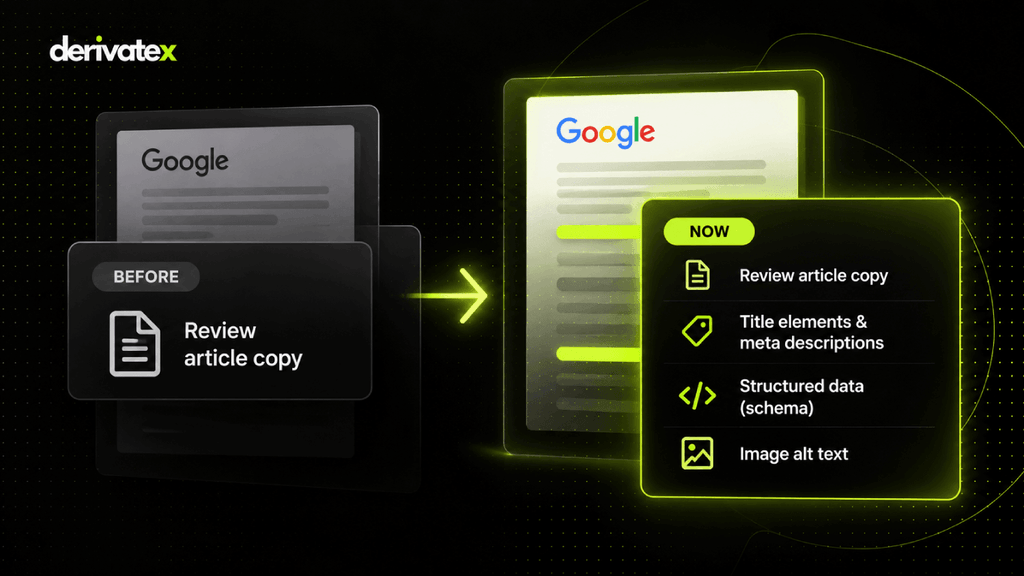
Google added three sentences to the “Focus on accuracy, quality, and relevance” section of its generative AI content guide on October 1, 2026. They explain that models predict likely words instead of retrieving facts, that outputs can contain hallucinations, and that manual fact checking before publishing is critical. A reworded line extends that review to metadata and structured data.
The new text reads: “Keep in mind that generative models don’t retrieve facts, but predict a likely sequence of words based on their training data. Because of this, generative AI outputs may contain inaccuracies (also known as hallucinations). It is critical to manually factcheck and review all AI-generated content for accuracy and trustworthiness before publishing.” The next sentence now says the review “also applies to metadata like title elements, meta description elements, structured data, and alternate texts for images, which can appear in Search results.”
Search Engine Journal compared the page with its December 10, 2025 version and found the fact check instruction was new. Search Engine Roundtable noted that “critical” is a word Google rarely uses in its search help documents. Both point to the same practical change: a review process that only covers article copy now misses part of what Google names.
What Stayed the Same?
Google did not announce a ranking change, a new penalty, or a new detection system. The guide still describes AI as useful for research and for structuring original content. The scaled content abuse warning still targets many pages produced without value for users, and the references to rater guideline sections 4.6.5 and 4.6.6 were already on the page before October 1.
Google repeats that the rater guidelines “are not a guide to ranking first in Google” and that rater scores do not directly influence ranking. Read the edit as a production standard for AI assisted content. Nothing on the page or in the changelog points to a ranking system retuned on October 1.
The timing still deserves attention. The September 2026 spam update began on September 24, and Search Engine Roundtable reported a second wave around September 30. Google’s spam policies include scaled content abuse, but Google has not connected the guidance edit to the update, so treat any link between them as an open question.
Why Does This Matter for B2B SaaS Teams Using AI?
B2B SaaS sites publish facts that buyers act on, such as pricing, integrations, security claims, customer results, and feature comparisons. An AI drafted error on those pages can appear in a search snippet under your brand name. It can also be repeated by AI answers that cite your site, so a wrong number keeps travelling after the page is published.
Metadata is where most teams have the least review today. Body copy usually passes an editor, while title tags, meta descriptions, alt text, and schema fields generated at scale often go live untouched. Schema is the hardest to catch because values like prices, ratings, and dates sit in code an editor never sees on the rendered page.
PPC Land’s analysis of the update cites an NP Digital survey from February 2026 in which 36.5% of marketers admitted that hallucinated content had been published. The same piece describes a large SaaS blog whose broken schema template, with unresolved variables, ran across thousands of pages before anyone caught it. Neither case needed a new Google rule to cause damage, and both are the kind of failure a review step would catch.
AI search raises the stakes further. When an assistant summarizes your category, it often pulls specific claims from vendor pages, and research on how often AI Overview claims lack source support shows these systems already struggle with fidelity. Feeding them inconsistent or invented figures from your own site makes the problem worse, and cleaning it up later takes the kind of work covered in how to fix brand hallucinations in ChatGPT.
The AI Content Fact Check Workflow to Set Up Next Week
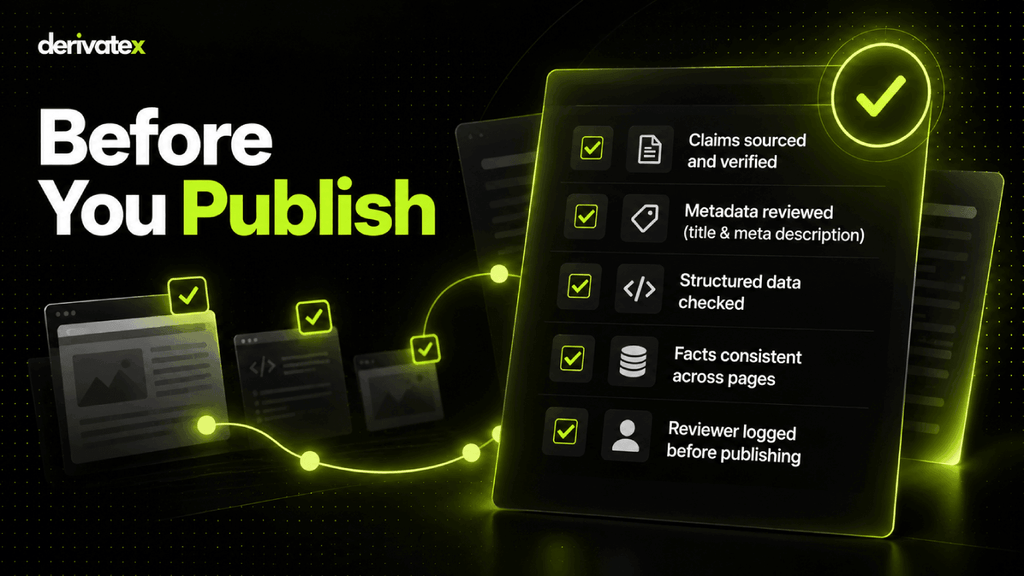
A workable fact check process has six parts: a map of where AI touches published pages, a claim ledger for every draft, a metadata and schema pass, a cross page consistency check, a named reviewer with a log, and a volume gate for templated pages. Most B2B SaaS teams can set this up in one week without new tools.
1. Map every place AI touches a published page
List each output AI produces on your site, including drafts, rewrites, title tags, meta descriptions, alt text, FAQ answers, schema fields, and programmatic page variables. Note which tool produces each one and who currently approves it. Any field with no named approver is where unreviewed AI output is most likely to reach Search.
2. Build a claim ledger for each draft
Before a draft is approved, pull every number, date, price, customer name, integration, certification, and capability claim into a short table. Each row needs a source, such as a primary report, a product owner, a contract, or a live page. Claims without a source get removed or rewritten as clearly bounded statements before the page ships.
3. Review metadata and schema against the visible page
Check that the title and meta description make only claims the body supports. Compare every schema value, including prices, ratings, review counts, dates, authors, and FAQ answers, against what the visible page says. Then run the URL through Google’s Rich Results Test, since the guide also asks you to validate markup for eligibility.
4. Check the same facts across pages
AI tools write each page in isolation, so the same customer result or product limit can drift across the homepage, case studies, service pages, and blog posts. Keep one source of truth for your headline figures and search your site for each one after every major content push. Conflicting versions confuse buyers, and they give AI assistants two answers to choose from.
5. Put a named reviewer and a review log on every page
Google sets no rule for who reviews or how the review is recorded. A short log with the reviewer’s name, the review date, and the claim ledger link still pays off. It shortens diagnosis after a traffic drop, and it gives leadership a clear answer when someone asks how AI content is controlled.
6. Gate volume on templated and programmatic pages
For templated pages, review the template itself, the data source behind every variable, and a sample of rendered pages before launch. Pause any batch where the sample shows broken variables, empty fields, or claims the data does not support. Publishing speed matters less than staying clear of the scaled content abuse pattern Google describes.
Teams that want a ready list for the structural side of each draft can pair this workflow with the AI content pre publish checklist, which focuses on making accurate pages easy for LLMs to cite.
What Should You Ask an Agency or Content Vendor?
Ask any agency or freelancer producing AI assisted content to show you their fact check step in writing. You want to know who reviews each page, how claims are sourced, whether metadata and schema are covered, and what happens when a claim cannot be verified. Vague answers usually mean the review only covers body copy.
Five questions cover most of the risk:
- Who signs off on each page, and is that person named in a review log?
- How do you source statistics, customer results, and product claims?
- Do you review title tags, meta descriptions, alt text, and schema values, or only the article?
- How do you keep figures consistent across our existing pages?
- What is your process for templated or programmatic pages before they go live?
These questions belong in any shortlist process for a B2B SaaS content marketing partner, and they work just as well when you are weighing an SEO consultant for SaaS against an agency.
How DerivateX Thinks About AI Assisted Content
DerivateX treats accuracy as a visibility input. Pages that state verified, consistent facts are easier for Google to trust and safer for AI assistants to quote. AI can speed up research and first drafts, but the claims that buyers and models repeat about your brand need a human owner before they ship.
That view shapes both our SaaS SEO agency work and our GEO agency engagements, where content quality and AI visibility are planned together. Engagement options and scope are on the pricing page, and published outcomes are in our case studies and on Clutch. If you want to see how AI assistants describe your company today, start with a free AI visibility audit.
FAQ
Does Google penalize AI generated content?
Google does not penalize content only because AI helped produce it. Its guidance says AI can help with research and structure, while generating many pages without adding value may violate the scaled content abuse policy. The October 2026 update adds that manual fact checking before publishing is critical, so unreviewed output carries more risk.
Does the fact check rule apply to meta descriptions and schema?
Yes. Google’s updated guide says the review also applies to title elements, meta description elements, structured data, and image alt text, because those can appear in Search results. For structured data, Google also asks you to follow feature policies and validate the markup.
Do I have to disclose that content was made with AI?
Google does not require disclosure for regular web pages. The guide suggests that sharing how content was created can give readers useful context, especially for automated content. Ecommerce sites face stricter Merchant Center rules, including metadata labels on AI generated product images.
Is this update connected to the September 2026 spam update?
Google has not said so. The guidance edit landed on October 1 while the September 2026 spam update was still rolling out, and both relate to scaled content. Google’s changelog attributes the edit to syncing documentation with developer event presentations, so treat any connection as unconfirmed.
Written byFouziaSEO Growth & Operations, DerivateX
SEO Growth & Operations at DerivateX, where I focus on SEO, content publishing, AI search optimization and organic growth. Through my blogs, I share practical insights on SEO, AI tools, content strategy, digital marketing and workflows that help businesses improve search visibility and grow sustainably.
Cited by AI