Case study: Gumlet turned ChatGPT mentions into 20% of inbound revenue. Read it →

2027 AI Search Budget Planning for B2B SaaS: A Template for Your Planning Cycle
 ByFouzia

A dated planning-cycle template for 2027, not a spend benchmark. Use it to lock line items, owners and a board packet in Q4, then fill the numbers from your own data.


Last updated: November 25, 2026. This page is a planning-cycle template for 2027. It does not publish spend benchmarks or a recommended split by retrieval surface. Those live on the pages we link below.
If you are a CMO or marketing lead locking a 2027 plan in Q4 2026, you need a worksheet you can take into a budget meeting, not another page that tells you what a typical company spends. This template covers the calendar, the line items, the inputs to gather before you write a number, and the one-page packet your CFO or board will actually read. For published spend ranges by ARR stage, use our SEO and GEO spend benchmark by ARR stage. For how to allocate effort across Google and AI retrieval surfaces, use the Search Budget Framework. This page does not repeat either one.
DerivateX is a full-service SEO and GEO agency for B2B SaaS. We get software brands found and cited across Google, Google AI Overviews, ChatGPT, Perplexity, Gemini and Claude, measured through to pipeline. We wrote this for teams in the $5M to $50M ARR band who are planning 2027 as one program, not as an SEO retainer with AI search added as a footnote. If you want help filling the plan, the fit and pricing are on our GEO agency page and our pricing page.
Key takeaways
- This is a dated 2027 planning template, not a spend guide. It tells you what to lock, in what order, and what evidence to attach. It does not tell you how many dollars to put on each line.
- Treat Google SEO and AI search as two lines in the same plan. One combined retainer with no split makes it hard to defend either number in a Q1 review. How you weight the work across surfaces is covered in the Search Budget Framework.
- Lock the plan on a calendar, not in a single December meeting. Gather inputs in November and December 2026, draft the plan by mid-January, lock it by the end of January 2027, and put quarterly rebalance dates on the same page.
- Write the board packet before you argue about the number. The packet should state what you will measure, what you will not guarantee, and which inputs are still missing. Spend figures come from your own data and, if you need a published range, from the ARR-stage benchmark.
- If an agency sits on the plan, start with a 90-day pilot and published terms, not a 12-month lock-in you cannot inspect. DerivateX starts that way, with a $5,000 per month floor, and does not guarantee rankings or citations.
What this 2027 planning template is for, and what it is not
Most budget arguments in Q4 fail for a boring reason: the room is trying to answer three different questions at once. How much should we spend. How should we split the work. And what, exactly, are we approving for the next four quarters. Those are related, but they are not the same document.
This template is the third document. It is the planning-cycle worksheet for 2027 AI search and SEO. When it is filled in, a marketing leader should be able to walk into a finance review and say what the lines are, who owns them, when they get reviewed, and what evidence sits behind any number that has been written in.
It is not a substitute for the two pages we already publish on the first two questions:
- How much should a B2B SaaS spend on SEO and GEO per month? owns stage-by-stage spend ranges and a buy-list for each ARR band. If your actual question is the dollar range, go there.
- The Search Budget Framework owns allocation by retrieval surface (Google, AI assistants, citation engines, communities and directories) and the rebalance method. If your actual question is the split, go there.
If you find yourself copying ranges or surface-split scores into this article, you are on the wrong page. Link those pages in the packet, fill this template with your own figures, and keep the three jobs separate so the pages do not compete.
The 2027 AI search budget planning calendar
A useful 2027 plan is dated. The work starts in the planning cycle you are in now, Q4 2026, and it has a lock date early in 2027 so the year does not start with a placeholder budget.
Use the calendar below as the spine of the template. Move a date if your fiscal year is not a calendar year, but do not skip a stage. Teams that jump straight to a December number usually reuse last year’s SEO budget and leave AI search as a note in the appendix.
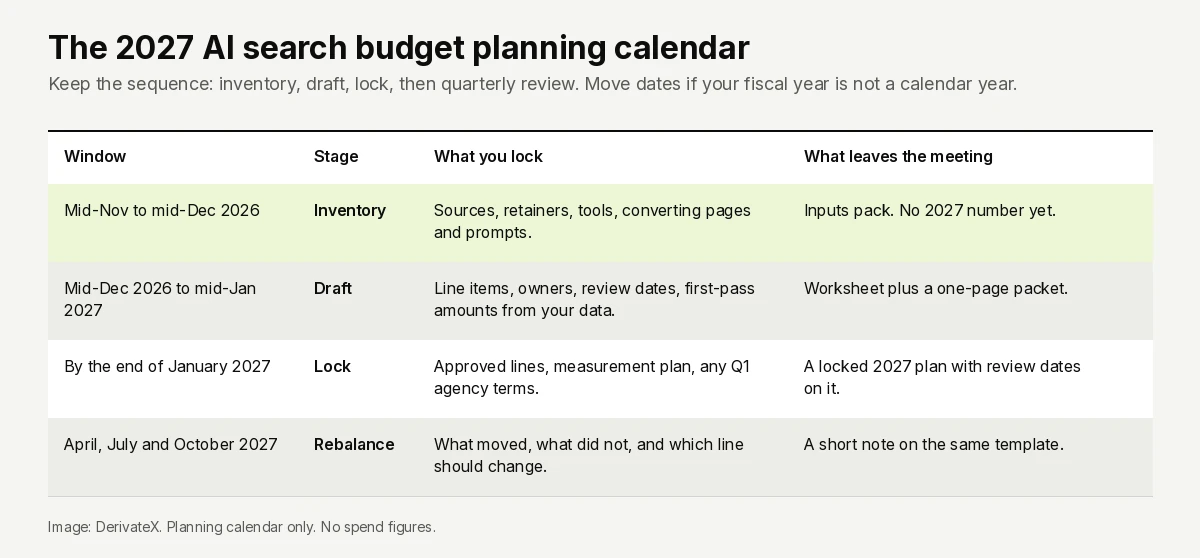
| Window | What you lock in this window | Who should be in the room | Output that leaves the meeting |
|---|---|---|---|
| Mid-November to mid-December 2026 | The inventory: 2026 sources of pipeline, current retainers and notice periods, tools already paid through 2027, and the pages and prompts that already convert. | CMO or VP Marketing, Head of Growth or Content, whoever owns GA4 and Search Console, finance partner if retainers need notice. | An inputs pack. No 2027 number yet. |
| Mid-December 2026 to mid-January 2027 | The draft plan: line items, owners, review cadence, and first-pass numbers filled from your data and from any published ranges you choose to cite. | The same marketing owners, plus the CFO or finance partner who will approve the packet. | A draft worksheet and a one-page board or exec packet. |
| By the end of January 2027 | The lock: approved line items, owners, measurement plan, and any agency or contractor terms that start in Q1. | Marketing lead and finance approver. Founder or CEO if this is a first-time AI search line. | A locked 2027 plan with quarterly review dates already on it. |
| April, July and October 2027 | The rebalance: what moved, what did not, and whether a line should grow, shrink or stay, without waiting for the next annual cycle. | The plan owner and the people who pull the measurement. Bring finance only when a line is changing. | A short rebalance note attached to the same template, not a new deck. |
Two practical rules help this calendar survive contact with a real company. First, do not ask finance to approve a number in the inventory window. That meeting is for evidence. Second, put the April, July and October review dates in the locked plan now. A rebalance that is not on the calendar usually does not happen. The Search Budget Framework walks through how to rebalance effort across surfaces when you get there.
The line-item template to put in the 2027 plan
Write SEO and AI search as two lines in the same plan, under one owner who is accountable for both. That is different from running them as two unrelated programs, and it is different from collapsing them into a single ‘organic’ retainer with no split you can inspect later.
Leave the amount column blank until the inputs pack is done. The point of this table is the structure of the plan, not a borrowed benchmark.
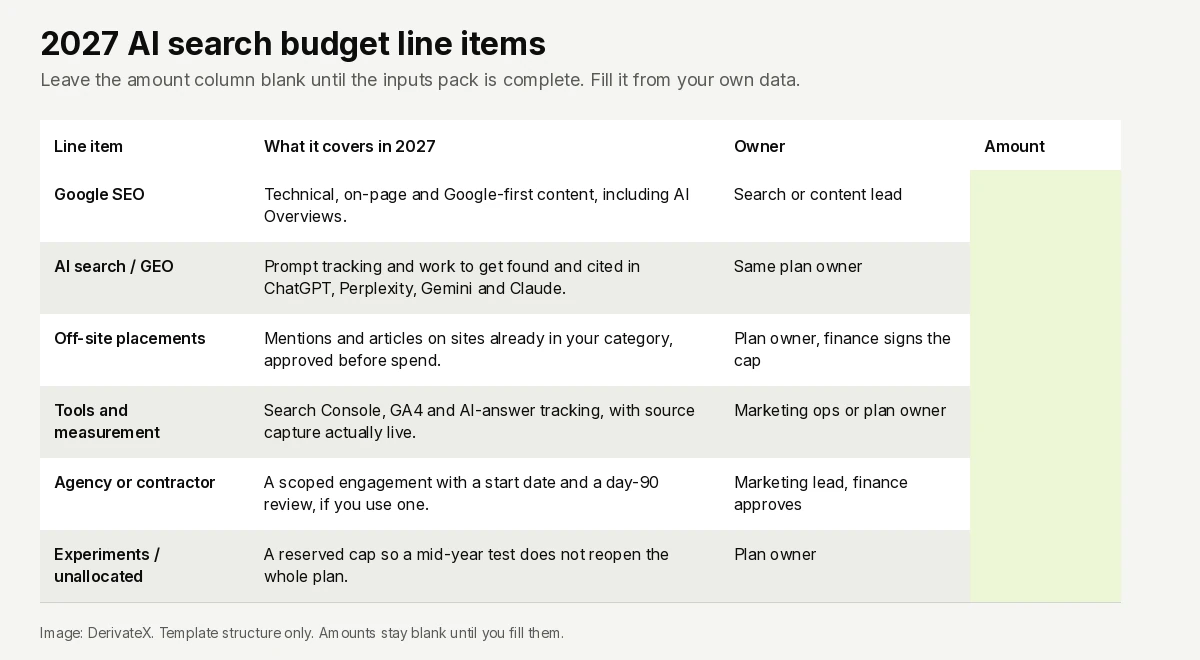
| Line item | What this line should cover in 2027 | Owner | What you need before you fill a number | Review cadence |
|---|---|---|---|---|
| Google SEO | Technical work, on-page updates, and content whose primary job is to rank and convert in Google, including pages that also appear in Google AI Overviews. | Search or content lead | Which commercial pages already convert, where rankings or clicks moved in 2026, and what is already committed in retainers or headcount. | Monthly operating review; formal check at each quarterly rebalance. |
| AI search / GEO | Prompt and answer tracking, pages and off-site mentions that help the brand get found and cited in ChatGPT, Perplexity, Gemini and Claude, and the work to keep those answers accurate. | Same plan owner, or a named deputy | Which buyer prompts already mention you, which ones name competitors instead, and whether AI-sourced sessions are visible in GA4. | Monthly operating review; formal check at each quarterly rebalance. |
| Off-site placements | Editorial mentions, articles and links on sites that already show up in your category, approved before money is spent, and not hidden inside a vague retainer line. | Plan owner, with finance sign-off on the spend cap | A short list of sites or publication types you are willing to pay for, and a rule that unused budget carries forward rather than getting spent for its own sake. | Monthly against the approved cap. |
| Tools and measurement | Search Console, GA4, any AI-answer tracking, and the work to keep source and medium useful enough for a finance review. | Marketing ops or the plan owner | What is already contracted through 2027, what is unused, and whether form-level source capture is actually live. | Quarterly, unless a contract is up for renewal sooner. |
| Agency or contractor (if used) | A scoped engagement that sits on the plan with start date, term, and what you will inspect at day 90, rather than an unnamed ‘SEO help’ line. | Marketing lead, approved by finance | Notice periods on current vendors, a written scope, and a clear view of what your team will still do. | Day 90, then at each quarterly rebalance. |
| Experiments and unallocated | A small reserved line so a new surface, a new page type or a mid-year test does not require opening the whole plan. | Plan owner | A cap and a rule for when a test graduates onto a named line. | At each quarterly rebalance. |
Three notes on how to use the table. First, off-site work should be a visible line, even if the dollar figure is small. Buried placement spend is how teams lose the ability to say what they bought. DerivateX quotes off-site budgets separately from the retainer and does not spend them without written approval; your plan can use the same rule with any vendor.
Second, ‘tools and measurement’ is easy to under-specify. If AI-sourced sessions cannot be told apart from other referrals in GA4, you will not have a 2027 rebalance conversation that finance will trust. That setup work belongs in Q1 if it is not already done. Our page on measuring AI-assisted conversions covers the attribution problem in more detail.
Third, if you use an agency, name it and date the review. ‘SEO retainer’ is not a line item. ’90-day SEO and GEO pilot starting 2 February, reviewed on 4 May’ is.
Inputs to gather before you write a 2027 number
The inventory window is where most plans go wrong, because people start pitching a number before they can describe last year’s engine. Collect the pack below first. None of it requires a new benchmark study. It requires honesty about what you already have.
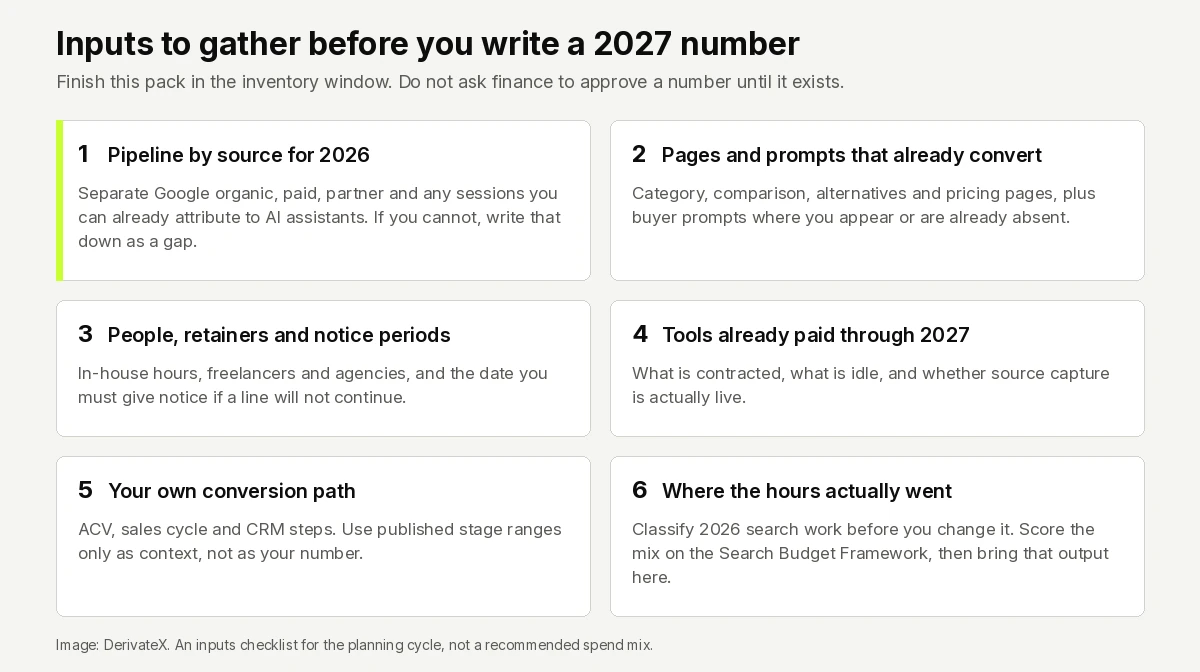
- Pipeline by source for 2026, as cleanly as you can get it. Separate Google organic, paid, direct, partner, and any sessions you can already attribute to ChatGPT, Perplexity, Gemini, Claude or other AI referrals. If you cannot separate AI-sourced sessions yet, write that down as a gap, not as a zero.
- The pages and prompts that already do commercial work. Category, comparison, alternatives and pricing pages that produce demos or trials, and the buyer prompts where you already appear or are already absent. This is the core of the 2027 brief, not a blog calendar.
- Current people, retainers and notice periods. Include in-house hours, freelancers and agencies, and the date you have to give notice if something will not continue into Q2 2027.
- Tools already paid through 2027. Do not add a new tracking stack on top of one you are not using. List what is contracted, what is sitting idle, and what still needs to be configured.
- Your own conversion path, not a borrowed one. ACV, sales cycle and the steps from session to opportunity in your CRM. If you need published stage ranges after this, open the ARR-stage spend benchmark and treat those ranges as directional, not as your number.
- Where the team’s hours actually went. If you already have a timesheet or project view of search work, classify it before you change it. The Search Budget Framework is the place to score and rebalance that mix. Bring the output into this template rather than rebuilding the score here.
When the pack is incomplete, say so in the draft. A plan that lists missing attribution as a Q1 deliverable is more credible than a plan that invents an AI-sourced pipeline share so the slides look finished.
Questions the 2027 plan should be able to answer
If a row in the worksheet cannot answer the questions below, it is not ready to lock. These are the questions a CFO or a founder will ask, in something close to this language.
- What, exactly, are we buying on the Google SEO line versus the AI search line, and who is accountable for each?
- What did search already contribute in 2026, and which part of that can we already trace to AI assistants rather than Google?
- What will we inspect at the end of Q1, and what would cause us to change a line in April rather than waiting until 2028 planning?
- If we use an agency or a contractor, when do we review them, and what happens if the 90-day mark is weak?
- What are we explicitly not promising? Rankings, citation share, and a fixed percentage of pipeline should not appear as guarantees.
- What will our team still do, in hours per month, so this plan is not a hand-off that nobody is left to approve?
A strong answer to the last two questions keeps the plan honest. DerivateX does not guarantee rankings or citations, and we state targets for a 90-day pilot as targets, not promises. Your 2027 packet should use the same posture, whether you hire us or run the work in-house. Buyers have been burned by retainers that promised positions they could not control.
The one-page board packet
The worksheet can be as long as it needs to be. The thing that gets approved should fit on one page. Write the packet after the inputs pack, not before it.
| Packet section | What to include | What to leave out |
|---|---|---|
| The 2027 job to be done | One paragraph: get the brand found and cited on Google and in AI assistants, measured through to pipeline, for a named set of commercial pages and buyer prompts. | A history of SEO or a lecture on how AI search works. |
| The lines you are asking to fund | The six line items, owners, and (once filled) amounts, plus the quarterly review dates. | A single ‘organic / AI’ total with no split. |
| The evidence you already have | 2026 pipeline by source, the gaps you have admitted, and links to any published ranges you are using as context. | A chart of industry conversion rates presented as if they were your funnel. |
| How you will measure 2027 | The KPIs you will report at each rebalance, and whether GA4 can already show AI-sourced sessions. | A target such as a promised share of pipeline or a guaranteed citation count. |
| Build, buy, or both | In-house hours, any agency term, the first review date, and the published commercial terms if you have chosen a vendor. | A 12-month lock-in with no inspection point. |
For measurement language, stay close to work you can actually run. Our SaaS SEO KPIs by stage and measuring AI search ROI pages are the right companions here. They help you pick metrics. They should not be mined for a number you then present as a 2027 forecast.
If 2026 AI attribution is thin, the packet should say that and put instrumentation on the Q1 list. That is a better board story than a precise-looking percentage you cannot rebuild in the CRM six weeks later.
Build, buy, or both: putting an agency on the 2027 plan
Not every 2027 plan needs an agency line. Some teams have the people, the access and the patience to run Google SEO and AI search as one in-house program. Others want a partner for a first 90 days, or for the off-site work they cannot staff. The plan should say which of those you are doing, and why.
Use our guide to when to add a GEO agency if you are still making that call. If you do add a partner, put three things on the line: the start date, the first review date, and the commercial terms you can show finance without a follow-up email.
DerivateX is a founder-led SEO and GEO agency for B2B SaaS companies in the $5M to $50M ARR band. The published floor is $5,000 per month. Engagements start with a 90-day pilot, and Google SEO and AI search visibility are priced as one program, with off-site placement budgets quoted separately and approved before any of that money is spent. We do not guarantee rankings, citations or a pipeline number. The live figures and scope are on the pricing page. If you want a read on current visibility before you open a line, use the free AI visibility audit or book a discovery call.
We are not the right fit for pre-revenue companies, B2C, ecommerce, or teams looking for a retainer below that floor. If that is your situation, keep the template, fill it in-house, and use the linked planning pages. If you want proof of how we measure work through to pipeline, the published stories are in our case studies.
Mistakes that show up in 2027 AI search budget plans
These are the patterns that turn a planning cycle into a recycled 2026 SEO budget with a new title. Avoid them in the worksheet, not in a post-mortem next November.
- Copying last year’s Google-only budget and adding ‘AI’ to the heading. If the lines, owners and measurements did not change, the plan did not change.
- Collapsing SEO and AI search into one retainer you cannot inspect. You can run them as one program. You still need two lines, or you will not know what to rebalance in April.
- Pasting a published percentage of ARR into the amount column and calling it your number. Stage ranges are context. They live on the spend-by-ARR page. Your number has to come from your funnel, your notice periods and your 2027 job to be done.
- Promising rankings, citation share or a fixed share of pipeline. Put those in the measurement plan as things you will watch, not as guarantees in the packet.
- Hiding off-site spend inside the retainer. Approve a cap, spend only against it, and carry unused budget forward.
- Skipping the inventory because planning season is short. A late lock with a complete inputs pack is better than an on-time lock that finance will unwind in February.
How this was researched
This article is a planning template, not a study. It was written on November 25, 2026 against DerivateX’s published planning pages and commercial terms, so that a team in a 2027 planning cycle can use one worksheet without this page competing with the pages that already own spend ranges and surface allocation.
- Scope. The calendar, line items, inputs checklist, decision questions and board packet are the object of this page. Dollar ranges by ARR stage and the method for splitting effort by retrieval surface are not restated here.
- Primary references, all live on November 25, 2026: B2B SaaS SEO and GEO spend by ARR stage, the Search Budget Framework, SaaS SEO KPIs by stage, measuring AI search ROI, AI-assisted conversion measurement, when to add a GEO agency, and DerivateX pricing.
- Commercial terms. DerivateX pricing, the $5,000 per month floor, the 90-day pilot, the $5M to $50M ARR focus, and the ‘targets, not guarantees’ language are taken from the live pricing page and from DerivateX’s source-of-truth notes. If those pages change, the live site wins.
- What we did not do. We did not invent 2027 spend figures, industry averages, conversion rates or pipeline forecasts for this article.
- Author and review. Written for DerivateX and reviewed by Apoorv Sharma, co-founder. Last reviewed November 25, 2026.
FAQ
How is this 2027 planning template different from your spend-by-ARR benchmark?
That page owns how much a B2B SaaS company might spend on SEO and GEO at each ARR stage, and what a buy-list at that stage can look like. This page owns the planning cycle: the calendar, the line items, the inputs and the packet you take to finance. Use the benchmark as context when you fill the amount column. Do not treat this template as a second spend guide.
How is this different from the Search Budget Framework?
The framework owns how to allocate effort across retrieval surfaces and how to rebalance that mix. This template tells you when to have that conversation in the 2027 cycle and where to record the result. Link the framework in the inputs pack and again at each quarterly review.
Should GEO be a separate budget line in 2027?
Yes. Keep Google SEO and AI search as two lines in the same plan, with one accountable owner. That lets you run them as one program and still see what to change at the April, July or October review. A single undifferentiated organic retainer hides the work you need to rebalance.
When should we lock the 2027 AI search budget?
Aim to lock the plan by the end of January 2027, after an inventory in November and December 2026 and a draft in early January. If your fiscal year starts at another date, keep the same sequence and move the lock to just after that year begins. Do not lock a number before the inputs pack exists.
Do we need a 12-month agency contract to start 2027?
No. If an agency is on the plan, start with a short, inspectable term. DerivateX starts with a 90-day pilot and published monthly retainers, and we do not ask you to take a long lock-in before you have seen measured work. Put the first review date on the line item when you write it.
What should we tell the board if we do not have 2026 AI attribution yet?
Say that plainly, and put measurement setup on the Q1 list. A packet that admits the gap and dates the fix is easier to defend than a precise AI-pipeline percentage you cannot reproduce. Our pages on measuring AI search ROI and AI-assisted conversions are the practical follow-up, not a source of invented forecasts.
Can we finish 2027 planning before we know how much to spend?
You can finish the structure before you finish the number. Complete the calendar, line items, owners and packet first. Then fill amounts from your inputs, and only then look at published stage ranges if you need a sense check. The number is the last column you complete, not the first.
If you are in the 2027 planning cycle now, start with the calendar and the inputs pack, then fill the worksheet. When you need published stage ranges, open the SEO and GEO spend benchmark. When you need to split effort by surface, open the Search Budget Framework. If you want a partner to run Google SEO and AI search as one program for a B2B SaaS company in the $5M to $50M ARR band, look at DerivateX, pricing, the free AI visibility audit, or book a discovery call.
Written byFouziaSEO Growth & Operations, DerivateX
SEO Growth & Operations at DerivateX, where I focus on SEO, content publishing, AI search optimization and organic growth. Through my blogs, I share practical insights on SEO, AI tools, content strategy, digital marketing and workflows that help businesses improve search visibility and grow sustainably.
Reviewed byApoorv SharmaCo-founder, DerivateX
Apoorv Sharma is the co-founder of DerivateX, a B2B SaaS SEO and Generative Engine Optimization agency that engineers AI citations in ChatGPT, Perplexity, Claude, and Gemini and connects them to demo bookings and revenue pipeline. He is the author of the 2026 AI Visibility Benchmark Report and the Citation Engineering methodology. He's also the brain behind "Found On AI" and has sold 2 of his companies previously
Cited by AI