Case study: Gumlet turned ChatGPT mentions into 20% of inbound revenue. Read it →

9 Best GEO Agencies for Fintech SaaS in 2026


A fintech buyer today rarely starts with a sales call. They start by asking ChatGPT or Perplexity a specific compliance question about the vendor: is this company SOC 2 Type II certified, what is its PCI-DSS level, who are its bank partners.
The answer that an AI tool gives is often the first impression a compliance or legal stakeholder forms of your company, and it happens before your sales team knows the deal exists.
That is a fundamentally different problem from the one most GEO advice is written for. A generic B2B SaaS company mainly wants to be mentioned. A fintech SaaS company needs to be mentioned correctly, and the section below explains exactly why that gap matters more here than anywhere else in B2B SaaS.
This article ranks 9 GEO agencies for fintech SaaS on that basis: fintech specialization, transparent pricing, and whether AI citation accuracy on compliance facts is part of the actual work, not a side effect of general visibility.
Further down, we show you how to check what ChatGPT and Perplexity are already saying about your SOC 2 status before you book a single call with anyone on this list.
What “compliance accuracy” means in fintech GEO: SOC 2 Type II is an audit confirming a company’s security controls work reliably over a 6 to 12 month period, not just on paper. PCI-DSS level refers to which of four tiers a company falls under based on card transaction volume, each with different audit requirements. When an AI tool states either one incorrectly, a compliance officer is acting on wrong information before your team knows it happened.
Fintech GEO agencies differ from generic B2B SaaS GEO agencies on one dimension: whether they check that AI tools state your compliance facts correctly, not just often. Nine agencies are compared here on fintech specialization, pricing transparency, and compliance accuracy. Pricing runs from $4,500 to $10,000 or more per month.
Key Takeaways
- Fintech GEO is a different discipline from generic B2B SaaS GEO because the buying committee includes compliance and legal, and a wrong AI answer here is a liability, not just a missed lead.
- The bigger risk in fintech GEO is not invisibility. It is a misstatement: AI tools regularly get compliance facts wrong when buyers ask about a vendor’s SOC 2 status, PCI-DSS level, or bank partnerships.
- Most fintech buyers now research vendors by pasting a compliance question straight into ChatGPT or Perplexity before ever booking a call, which means the AI’s answer is often the first impression, not the sales deck.
- We ranked 9 agencies on fintech specialization, pricing transparency, and whether they treat AI citation accuracy as a real deliverable, not visibility alone.
- A comparison table, full profiles, and a five-minute check you can run on your own company’s AI answers are below.
Why GEO for Fintech SaaS is Not the Same as GEO for Other B2B SaaS
Generic B2B SaaS GEO is mostly a visibility problem. A dev tools company or a project management SaaS wants ChatGPT to mention its name when a buyer asks for category recommendations, and getting the name wrong rarely carries real consequence beyond a missed lead.
Fintech does not work that way. A fintech buying committee almost always includes someone from compliance or legal, and that person is going to ask an AI tool a very specific question: is this vendor SOC 2 Type II certified, and what is its PCI-DSS level.
If the AI’s answer is wrong, that is not a marketing miss. It is a fact a compliance officer will act on, sometimes before your sales team even knows the deal is at risk.
Three structural differences follow from that:
- The buyer prompts are longer and more specific: A generic SaaS buyer asks ChatGPT “best project management tool for a 50-person team.” A fintech buyer asks “is [vendor] SOC 2 Type II certified, and any known issues in 2024 to 2025.”
- The content has to survive legal review, not just SEO review: A comparison page for a dev tool needs to be accurate and helpful. A comparison page naming SOC 2, PCI-DSS, or AML coverage needs to be accurate, current, and defensible if a bank buyer questions it.
- The citation surface is narrower and more concentrated: In finance, AI engines pull from a short list of trusted publishers far more than they do in other B2B SaaS categories. DerivateX research puts the overlap between AI citations and Google’s top 10 at 11% in finance, against 38% across categories generally. Getting cited means getting onto that short list, not out-publishing competitors on your own domain.
Most GEO advice online is written for the generic case, which is why it tends to stop at visibility. A fintech company that only optimizes for being mentioned, without checking whether the mention is accurate, is solving half the problem and leaving the more expensive half untouched.
9 GEO Agencies for Fintech SaaS, Compared
Fintech SaaS companies do not just want to be mentioned by ChatGPT. They want to be mentioned correctly, because a buying committee that includes compliance and legal is going to notice if the AI’s answer about SOC 2 status or bank partnerships is wrong.
The table below compares 9 GEO agencies on specialization, starting price, and whether accuracy on compliance facts is part of the offering, not just visibility.
| Agency | Best For | Fintech Specialization | Starting Price | Compliance Accuracy Focus |
|---|---|---|---|---|
| DerivateX | Fintech SaaS ($5M–$50M ARR) needing AI to state compliance correctly | High (dedicated fintech playbook) | $5,000/month | Yes, core to the offering |
| First Page Sage | Enterprise fintech brands wanting long-form thought leadership at scale | High (dedicated fintech GEO practice) | $10,000/month | Partial (compliance review workflow, not accuracy monitoring) |
| Rock the Rankings | B2B SaaS founders wanting GEO and SEO run as one motion | Low (SaaS generalist, not fintech-exclusive) | $4,500/month | No |
| Omnius | Fintech and B2B SaaS teams wanting EU coverage and proprietary tracking | High (fintech named explicitly) | Custom | Partial (entity accuracy, not compliance-specific) |
| Focus Digital | Early-stage fintech SMBs needing SEO plus PPC | Medium (fintech clients named, SMB focus) | Custom | No |
| Driven Metrics | Product-led fintech SaaS wanting AI-optimized content | Medium | Custom | No |
| CSTMR | Established fintech and financial services wanting full-service marketing | High (fintech-exclusive client base) | Custom | Partial (brand trust, not compliance-specific) |
| Concurate | Fintech SaaS wanting decision-stage AI visibility | High (fintech-focused positioning) | $5,000/month | No |
| 95 Projects | Fintech companies wanting SEO, PPC, and GEO run as one practice | Medium (fintech is one of several verticals) | $5,000/month | No |
A table like this only tells you what an agency claims about itself. The profiles below tell you where each one is genuinely strong and where it is not.
1. DerivateX: Best for Fintech SaaS Companies That Need AI to State Their Compliance Correctly
DerivateX runs SEO and GEO for B2B SaaS companies between $5M and $50M ARR, and fintech is where “mentioned” and “mentioned correctly” diverge most.
DerivateX’s fintech AI search research found that only 11% of AI Overview citations in finance come from pages ranking in Google’s top 10, and that two publishers, NerdWallet and Bankrate, account for 15% of every financial source cited. In fintech the engines have already decided who they trust, and your own compliance page is usually not on that list.
That is a liability sitting in front of every buyer who pastes a vendor questionnaire into ChatGPT before booking a call.
The methodology is Citation Engineering: a canonical /llm-info/ page and Trust Center built as the source LLMs sample for certifications, plus compliance-anchored comparisons naming SOC 2 and PCI-DSS directly.
The clearest proof point is Verito, a cloud hosting provider for accounting and tax firms. Over ten months, Verito moved from position 40 on Google to the first-page Google ranking and number one AI-recommended answer across its highest-intent buyer prompts, with 12 first-place ChatGPT citations for clusters like “QuickBooks hosting.”
Accuracy is tracked the same way visibility is. The AI Visibility Score runs weekly across ChatGPT, Perplexity, Claude, and Gemini on 20 buyer prompts, and for fintech clients the prompt set includes the compliance questions a bank buyer would actually type.
The dynamics transfer directly to fintech: a regulated buyer base and incumbents that already own the Google SERP.
Pricing: Starts at $5,000 per month across three published tiers, with the off-site citation budget quoted separately. The most transparent pricing on this list with fintech-specific compliance methodology attached.
Notable clients: Verito, Gumlet, Truein, REsimpli
Standout differentiator: The only agency reviewed that audits what AI tools currently say about a client’s compliance facts before optimizing for more mentions. Others build compliance into what goes out. This checks what is already out there
2. First Page Sage: Best for Enterprise Fintech Brands Wanting Long-form Thought Leadership at Scale
First Page Sage has been publishing GEO and AEO content since before most agencies added the term to their homepage, and its fintech client list backs that up.
The agency reports that fintech clients average $2.6 million in new net revenue from organic search annually, a figure tied to steady lead flow rather than one-off spikes.
The approach centers on original thought leadership and financial ghostwriters who understand transactional keyword targeting for high-consideration fintech products. Clients include US Bank and Verizon, which puts First Page Sage in a different weight class than most boutique GEO shops on this list.
The honest limitation: The minimum engagement runs $10,000 per month, which puts it out of range for companies below $15M ARR. They do build a compliance review workflow in month one, deciding who reviews and what gets flagged, but that governs what goes out. It does not monitor what AI tools are already saying about your certifications.
Pricing: Custom, with independent sources citing retainers starting at $10,000/month minimum.
Notable clients: SalesForce, US Bank, Verizon
Standout differentiator: The deepest published thought-leadership content library of any agency reviewed here.
3. Rock the Rankings: Best for B2B SaaS Founders Who Want GEO and SEO Run as One Motion
Rock the Rankings is a B2B vertical SaaS agency with particular depth in HealthTech, FinTech, and HR tech, and its pitch is that GEO should never be sold as a bolt-on separate from SEO.
The agency’s GEO Stack methodology pairs solution-aware, bottom-of-funnel content with citation outreach and CRM-level attribution designed to catch AI-driven signups that last-click analytics miss.
In one HealthTech engagement cited in its own materials, AI-driven signups were undercounted several times over before the agency’s attribution model corrected it, a pattern that applies just as directly to fintech buying cycles.
The tradeoff is specialization width: Rock the Rankings works across three verticals rather than fintech exclusively, and its published methodology does not address compliance-specific accuracy the way a fintech-only shop would need to.
For a fintech SaaS company that wants a broader B2B SaaS GEO partner and can supply its own compliance review layer, that breadth is a reasonable tradeoff.
Pricing: Starts at $4,500 per month, scoped to pipeline goals rather than a fixed deliverable list.
Notable clients: MoonPay, Lendbuzz, Bizzabo, Toast
Standout differentiator: The most detailed public attribution methodology for tying AI citations to CRM-verified signups of any agency on this list.
4. Omnius: Best for FinTech and B2B SaaS Teams Wanting EU Coverage and Proprietary AI Tracking
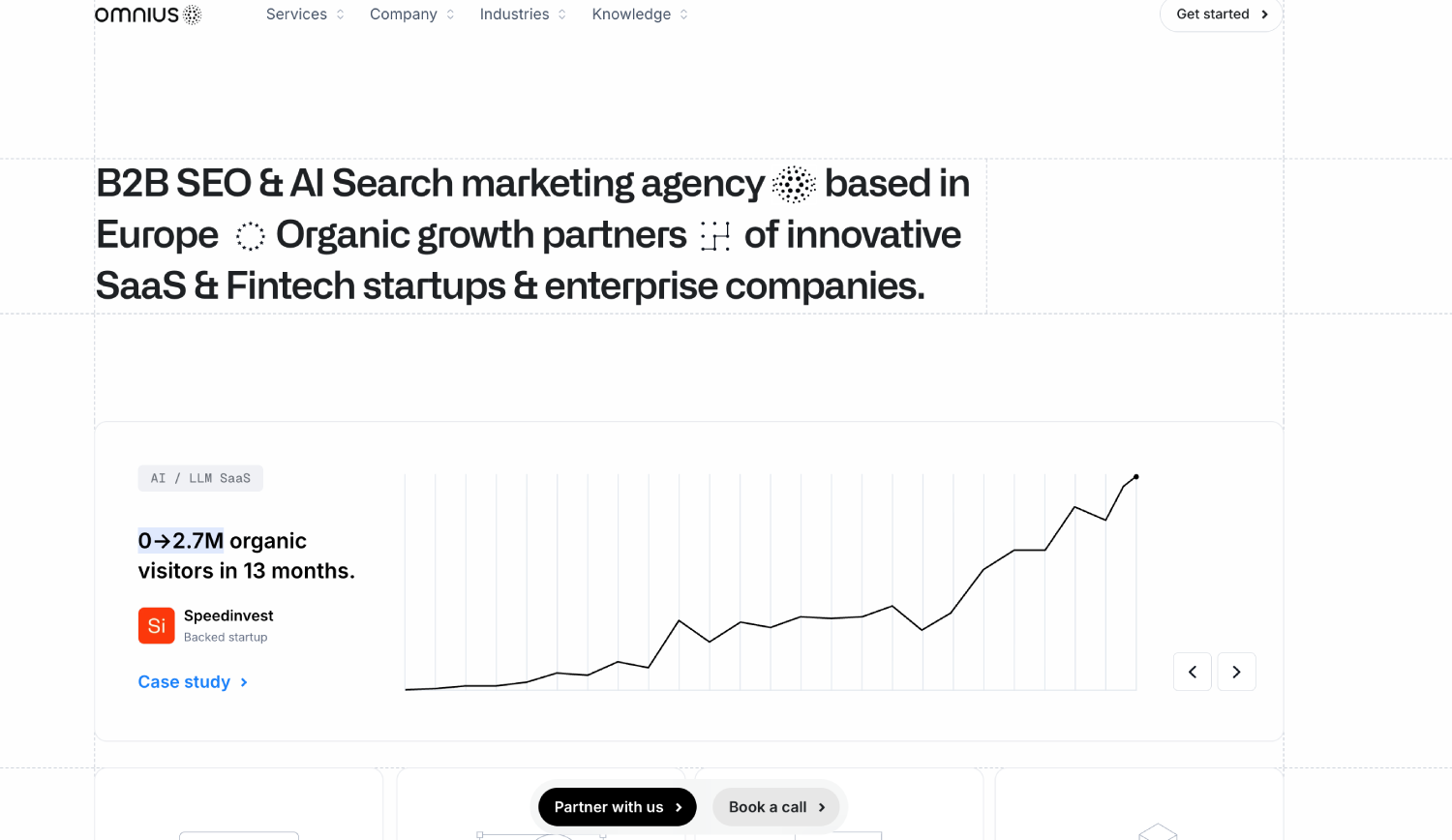
Omnius partners exclusively with B2B SaaS, fintech, and AI companies, and it is one of the few agencies here that names fintech directly in its core positioning rather than folding it into a general SaaS bucket.
The agency built AtomicAGI, an in-house platform that tracks brand visibility and citations across AI search engines in real time.
Its methodology runs a reverse-funnel approach, meaning it optimizes bottom-of-funnel, revenue-adjacent content first so the most valuable products are the ones AI engines cite, rather than spreading effort evenly across the funnel.
That is a defensible sequencing choice for fintech SaaS companies with long, multi-stakeholder sales cycles.
The limitation is pricing opacity: Omnius does not publish rates, and multiple third-party roundups flag limited public pricing as a consistent gap. Its European base can also mean slower response times for U.S.-based fintech teams working across a wider time zone gap, and while its entity work touches accuracy, it is not built specifically around compliance disclosures the way a fintech-first accuracy program would be.
Pricing: Custom, not publicly disclosed.
Notable clients: OneTrace, WorldFirst, Signify
Standout differentiator: Proprietary real-time AI citation tracking through AtomicAGI, one of the more technically rigorous tools reviewed here.
5. Focus Digital: Best for Early-stage FinTech SMBs Needing SEO Plus PPC in One Boutique Package
Focus Digital keeps its channel mix intentionally narrow: SEO and Google PPC, nothing else.
For an early-stage FinTech selling to local businesses or a defined geography, that focus maps cleanly onto how those buyers actually research and compare vendors.
Its GEO strategy leans on query intent dissection, meaning it studies the specific comparison questions FinTech buyers ask generative engines and builds content designed to be the definitive answer those engines pull from.
The tradeoff is compliance bandwidth and Specialty: Focus Digital’s team is intentionally small, and larger fintechs with layered compliance review needs should expect to run additional internal checks the agency’s team is not staffed to handle in-house. Focus Digital’s core specialty is HealthTech, not FinTech, so its FinTech clients get a generalist SEO and PPC playbook rather than a compliance-first one
Pricing: Custom, positioned as more accessible than most specialists on this list based on independent third-party reviews
Notable clients: Ibuyhaus, MyPrepOp, Alera Nutrition
Standout differentiator: The tightest, most boutique channel focus of any agency reviewed, useful specifically for SMB fintechs that do not want a sprawling multi-channel retainer.
6. Driven Metrics: Best for Product-led FinTech SaaS Wanting AI-optimized Content Without a Full-service Retainer
Driven Metrics runs technical SEO, content strategy, and AI search optimization for startups and mid-sized fintech companies that lean on thought leadership and high-intent search traffic to acquire customers.
The agency’s reputation centers on disciplined execution and AI-optimized content tied directly to buyer intent rather than generic traffic goals.
That makes it a reasonable fit for a product-led fintech SaaS company that already has a content motion and wants it sharpened for AI extraction.
The scope is narrower than a full-service agency by design. Fintechs that need paid media, social, or a broader growth stack alongside GEO will need a second partner, and nothing in Driven Metrics’ published methodology addresses compliance-fact accuracy specifically.
Pricing: Custom, not independently verified at a specific figure.
Notable clients: Domestique, HoloLight, VisualCV
Standout differentiator: Disciplined, buyer-intent-anchored content execution without the overhead of a full growth-marketing retainer.
7. CSTMR: Best for Established FinTech and Financial Services Wanting a Full-service Brand and Marketing Partner
CSTMR works almost exclusively with companies in banking, payments, lending, insurance, and investing, which makes it one of the most fintech-concentrated agencies on this list by client base alone.
Its offering extends past content into branding, paid media, and web design, positioned under what the agency calls “discovery optimization,” a blend of SEO and GEO aimed at brand trust.
Named clients include Kudzu, VALT, and Bankuity. Third-party review summaries consistently describe CSTMR as fintech-focused with strong creative and product narrative work, which fits an established fintech company looking for a single omnichannel partner rather than a narrow GEO specialist.
The most frequent critique, echoed across multiple independent reviews, is that GEO specifically is not CSTMR’s main focus even though fintech is. A financial services background does not automatically translate into deep AI citation methodology, and CSTMR’s public materials do not detail a compliance-accuracy monitoring process the way a GEO-first fintech specialist would.
Pricing: Custom, not published by the agency.
Notable clients: Kudzu, VALT, Bankuity.
Standout differentiator: The strongest brand and creative narrative capability of any fintech-focused agency reviewed here, useful for companies that need marketing breadth alongside GEO.
8. Concurate: Best for FinTech SaaS Wanting Decision-stage AI Visibility Built Around Buyer Prompts
Concurate builds its entire pitch around one mechanic: finding out what fintech buyers actually ask ChatGPT and Perplexity, then building comparison and decision-stage content specifically for those prompts.
The agency is based in India and Singapore and works with B2B fintech and SaaS companies chasing leads from AI tools rather than traditional search alone.
One case cited in the agency’s own materials describes a fintech SaaS client, a B2B buy-now-pay-later company, seeing a 100% increase in AI referrals and a 300% increase in qualified leads after implementing Concurate’s GEO framework.
The agency also publishes distribution tactics across LinkedIn, YouTube, and contributed expert quotes on outlets like Forbes, which extends its citation surface past owned content alone.
Concurate is explicit in its own published guide that fintech falls under YMYL, meaning higher accuracy and trust standards apply, and it flags accuracy as an evaluation category for other agencies.
Its own published case studies do not yet include a documented compliance-accuracy monitoring product, which is a gap worth asking about directly if that is the specific risk a fintech buyer is trying to close.
Pricing: Custom, not published by the agency.
Notable clients: One Park Financial, RescueOne Financial
Standout differentiator: The most detailed public methodology for mapping actual buyer prompts to content among the agencies reviewed here.
9. 95 Projects: Best for FinTech Companies Wanting SEO, PPC, and GEO Run as a Single Integrated Practice
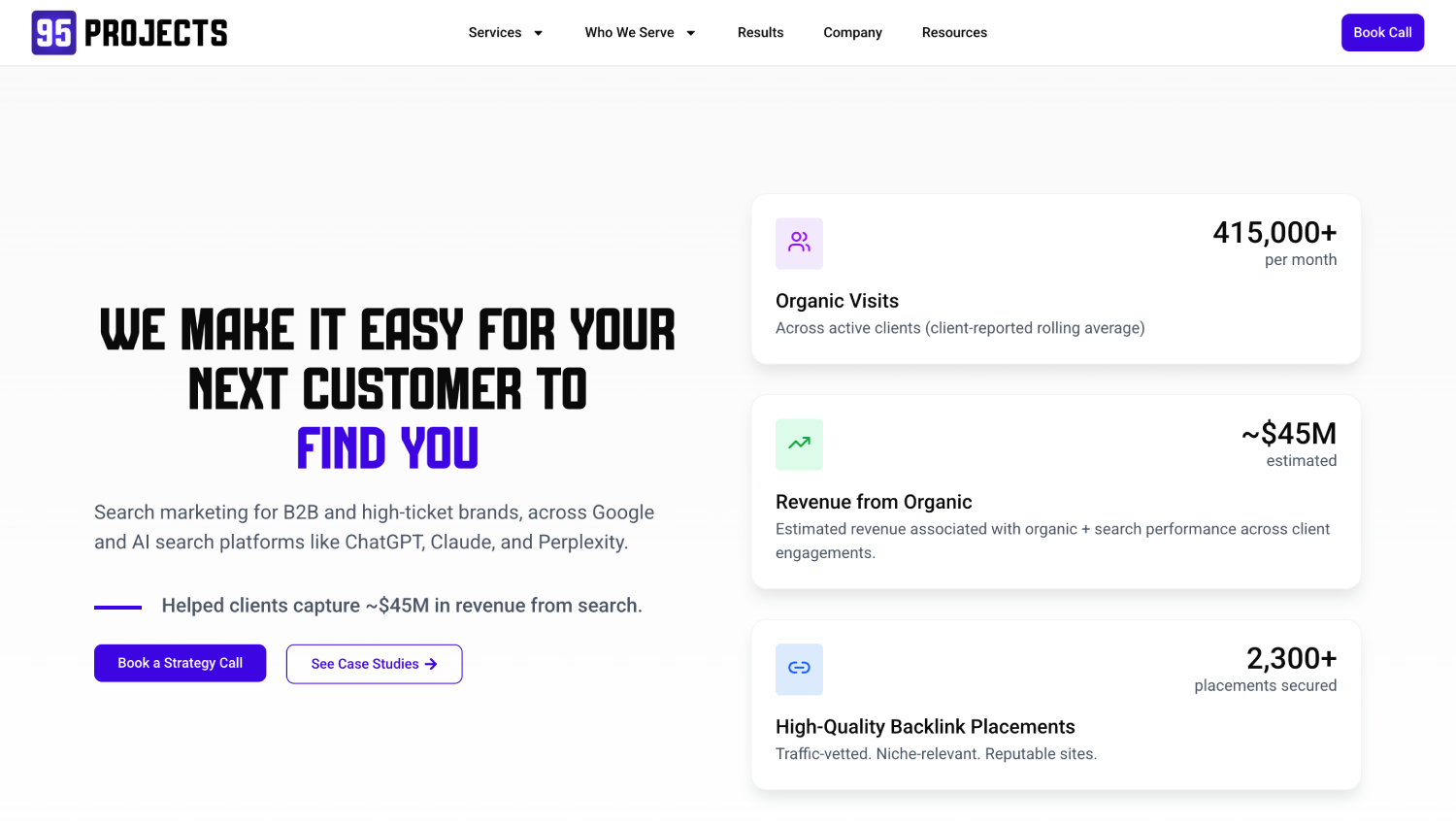
95 Projects positions itself for brands between $1M and $50M in revenue that want search marketing run as one practice instead of three disconnected line items.
The agency reports 40% more demo signups in five months for a B2B financial data platform client, and $70,000 in attributed ChatGPT revenue within four months for a separate client.
Its stated filter for GEO agencies generally, that most candidates claiming AI SEO in 2026 are running the same SEO playbook under a new banner, is a fair standard, and the agency backs its own claims with outcome data rather than visibility metrics alone.
It is also explicit that it does not guarantee specific AI citations, correctly noting that any agency making that promise does not understand how these systems work.
Fintech is one of several verticals in its portfolio rather than an exclusive focus, and pricing runs $5,000 to $20,000 per month depending on scope, wide enough that budget-conscious early-stage fintechs should confirm scope before assuming the low end applies.
Pricing: $5,000 to $20,000 per month depending on scope.
Notable clients: Constant Hire, Buoy, CatchMaster
Standout differentiator: They completely ignore vanity traffic to optimize exclusively for high-ticket commercial queries that drive actual client revenue.
What Actually Matters When You are Hiring a GEO Agency in a Regulated SaaS Category
Most “how to choose a GEO agency” sections read the same way: ask about methodology, ask for case studies, ask how they measure results.
Those questions are not wrong. However, they are insufficient for FinTech, where a wrong answer carries legal weight that a wrong answer in project management software does not.
- Ask any fintech GEO agency to show you what ChatGPT and Perplexity currently say about your SOC 2 status, PCI-DSS level, and bank partnerships, before you sign anything.
If they cannot produce that audit in the sales process, they are selling visibility without checking accuracy first, and you find out the answer was wrong when a bank buyer mentions it on a call. - A second rule follows directly from the first. Avoid agencies whose fintech case studies report visibility lifts or citation counts without naming a tracked query set or a specific compliance claim that improved.
“AI mentions up 40%” tells you nothing if you cannot see which mentions, or whether the facts inside them were correct. - Before signing, ask the agency to walk through one real client’s citation surface for a compliance-related query, not just a category query. A category query like “best AP automation tool” is table stakes. A compliance query like “is this vendor SOC 2 Type II certified” is where the actual risk sits, and it is where most agency methodologies reviewed above simply have not built anything yet.
Agencies willing to talk about compliance-fact accuracy in a sales call are usually the ones actually measuring it. Agencies who redirect to visibility metrics when you ask about accuracy are telling you where the gap in their methodology sits.
Check What AI is Already Saying About Your FinTech Company Before You Hire Anyone
This takes five minutes and changes the entire conversation with any agency you talk to afterward.
Open ChatGPT, Perplexity, and Google AI Mode separately and ask each the exact question a bank buyer or compliance stakeholder would ask: “Is [Your Company] SOC 2 Type II certified? What about PCI-DSS?”
Read the answers closely. Check the renewal date if one is given. Check whether a competitor’s name shows up attributed to a feature or certification that is actually yours.
Read the answer, then read where it came from. In finance, AI engines lean on a short list of publishers rather than on your own pages, so a wrong certification level or a stale renewal date can sit in an answer for months with nothing on your site to correct it.
If the answer is wrong, that is not a future problem. It is live, because the buyer asking that question right now gets the wrong answer today, before any GEO agency has touched a single page.
Run the same two questions again in 90 days. If the answer has not changed, no one has fixed it yet.
DerivateX runs this exact check as a free AI Visibility audit, which is the fastest way to find out whether this problem already exists for your company before you spend a dollar on any agency, including us.
Frequently Asked Questions
1. What is a GEO agency for FinTech?
A GEO agency for fintech structures a company’s content, entity signals, and third-party authority so AI tools like ChatGPT and Perplexity cite the brand accurately when buyers ask comparison or compliance questions.
The fintech-specific version of this work has to account for regulatory language, SOC 2 and PCI-DSS references, and buying committees that include compliance stakeholders, not just marketing decision-makers.
A generic B2B GEO agency without fintech experience will often miss the compliance-accuracy layer entirely, which is the highest-risk gap for a regulated buyer.
2. How much does a fintech GEO agency cost?
Pricing across the agencies reviewed here ranges from $4,500 per month at the low end to $10,000 or more per month for enterprise-focused firms, with several agencies quoting custom pricing only after a discovery call.
Expect most fintech-specialist retainers to fall between $3,000 and $10,000 per month once you are past early-stage scope, and treat “custom pricing” with no floor stated as a sign to ask for a number early in the sales process.
3. Can ChatGPT get my FinTech company’s compliance status wrong?
Yes, and it happens more often than most fintech marketing leads assume. AI engines assemble compliance answers from third-party sources, not primarily from your Trust Center. DerivateX research found that only 11% of AI Overview citations in finance come from pages ranking in Google’s top 10, which means the sources shaping the answer about your SOC 2 status are often ones you do not track.
Run the same question through ChatGPT and Perplexity yourself this week rather than assuming your compliance page is being read correctly.
4. What is the difference between GEO and AEO for FinTech companies?
GEO, generative engine optimization, covers getting cited and recommended inside AI platforms like ChatGPT, Perplexity, Gemini, and Google AI Overviews. AEO, answer engine optimization, is typically treated as a subset focused specifically on direct-answer formats such as featured snippets and structured Q&A content.
For FinTech, the practical distinction matters less than whether either discipline is being applied to compliance-specific facts, since that is where regulated buyers are most exposed to a wrong answer.
5. How fast does fintech GEO show results?
AI citation accuracy improvements on pages that already carry some authority, like an existing Trust Center or security FAQ, typically show within 4 to 8 weeks of a rebuild. Net-new content and Google ranking improvements for category and compliance-modifier queries generally take 3 to 6 months to compound.
Be skeptical of any agency promising faster category-level ranking gains than that, since the timeline is consistent across nearly every agency’s own published case studies reviewed for this piece.
6. Is a FinTech-specialist agency better than a generalist B2B SaaS GEO agency?
A fintech specialist typically understands compliance stakeholders, regulatory vocabulary, and the specific buyer prompts that involve certifications and bank partnerships, which a generalist agency may not build for by default.
That said, a strong generalist with real CRM-level attribution and verified case studies in adjacent regulated categories, like Rock the Rankings’ HealthTech work, can still perform well if you are willing to supply the compliance review layer internally.
Ask any generalist agency directly whether they have handled a compliance-fact accuracy issue before, and if the answer is vague, that is your signal to look at a specialist instead.
The Bottom Line
Nine agencies, nine different strengths, and only one criterion that separates a fintech GEO engagement that protects you from one that just makes you more visible: whether the agency checks if AI is stating your compliance facts correctly before it starts optimizing for more mentions.
Visibility without accuracy is not progress in a regulated category. It is a louder version of the same risk, because more people are hearing the wrong answer about your SOC 2 status, not fewer.
If you want to know where you stand before you talk to anyone on this list, run the SOC 2 and PCI-DSS question through ChatGPT and Perplexity yourself this week. If the answer comes back wrong, that is the actual starting point for this decision.
Written byAyush SharmaHead of SEO & Content, DerivateX
Ayush Sharma is Head of SEO and Content at DerivateX, a full-service SEO and GEO agency for B2B SaaS. He focuses on SEO, GEO, and AI visibility for software brands, helping them get found and cited across Google, AI Overviews, ChatGPT, Perplexity, Gemini, and Claude, with results measured through to pipeline. On the DerivateX blog he covers AI visibility tracking, how LLMs choose which sources to cite, technical and JavaScript SEO for SaaS sites, and attributing AI search to revenue in HubSpot.
Reviewed byFouziaSEO Growth & Operations, DerivateX
SEO Growth & Operations at DerivateX, where I focus on SEO, content publishing, AI search optimization and organic growth. Through my blogs, I share practical insights on SEO, AI tools, content strategy, digital marketing and workflows that help businesses improve search visibility and grow sustainably.
Cited by AI