Case study: Gumlet turned ChatGPT mentions into 20% of inbound revenue. Read it →

Best B2B SaaS GEO Agencies in 2026: A Buyer’s Evaluation Guide


Most agencies calling themselves GEO specialists in 2026 have never run a query-level citation audit on any of their clients.
That claim isn’t speculative. It comes from reading the same 15 “best GEO agencies” roundups your Google results show you, not one of which contains a specific named query, a before-and-after citation result, or any evidence that the agency tracks what “citation frequency” actually means as a metric.
The category grew from a Princeton, Georgia Tech, and Allen Institute for AI research paper published in late 2023 (arXiv 2311.09735) to a multi-million-dollar service market within 18 months. There hasn’t been enough time for most agencies to build real GEO expertise, let alone a track record.
The problem wasn’t a lack of investment. It was a lack of the right work.
This article evaluates 8 B2B SaaS GEO agencies against 4 criteria that actually separate citation engineering from rebranded SEO: named methodology, query-level tracking, dual SEO and GEO integration, and verified client proof. It also gives you a three-question test to run on any agency in your shortlist, before you talk pricing.
TL;DR
- Real citation engineering is verifiable: a legitimate GEO agency can show query-level citation data for specific searches where their client had zero presence before the engagement started.
- Before signing anything, run the Citation Vetting Test in Section 2 below. It takes 30 minutes and eliminates most of the market.
- For companies at $5M-$50M ARR, the highest-leverage play is owning commercial-intent queries in ChatGPT and Perplexity, not chasing impressions from Google AI Overviews on informational content.
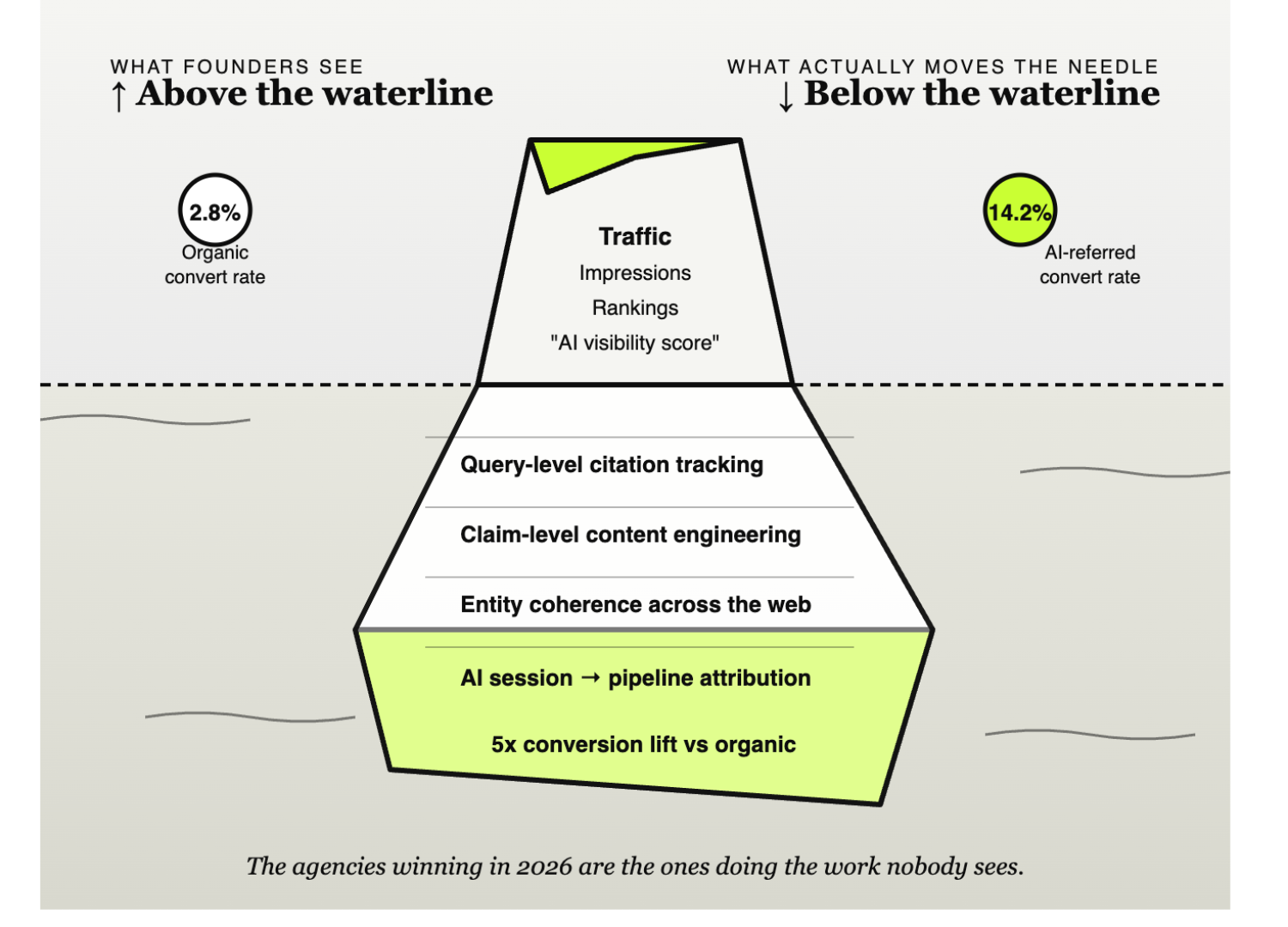
- AI-referred visitors convert at roughly 14.2% compared to 2.8% for standard organic search traffic, according to DerivateX’s internal benchmark across 50 B2B SaaS companies. That is roughly a 5x conversion lift over traditional Google organic traffic.
- Eight agencies are evaluated here on four criteria: named methodology, query-level tracking, dual SEO and GEO integration, and verified client proof.
Why Most “GEO Agencies” in 2026 are SEO Agencies With a New Homepage
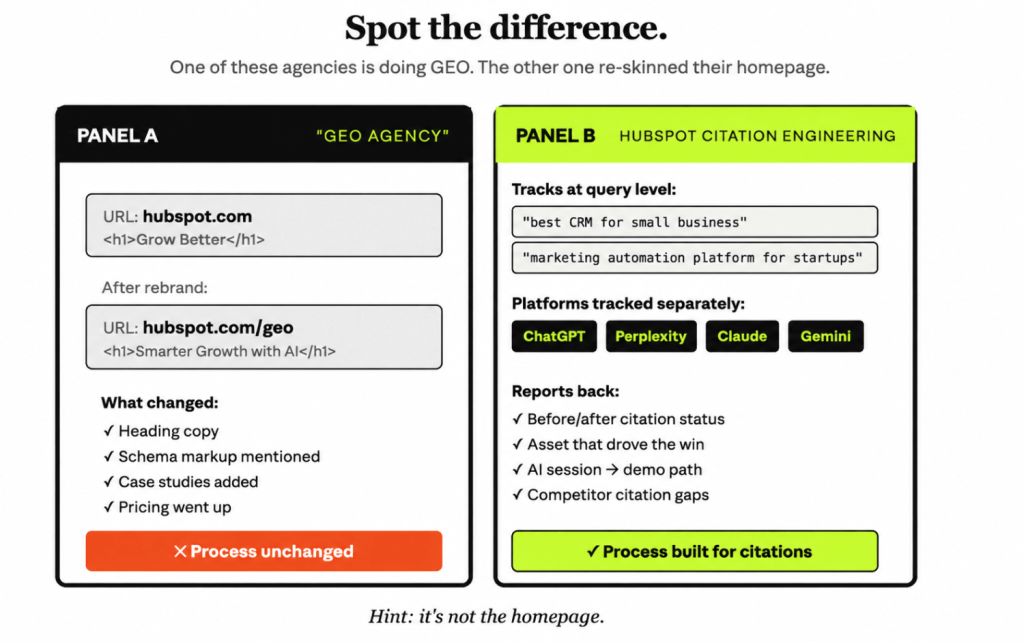
The tell is structural. Search “best B2B SaaS GEO agencies” right now and count how many of the top results were written by agencies that ranked themselves in their own top three. The answer is most of them.
That’s not a buyer’s guide. That’s a landing page with subheadings.
The evaluation criteria across those articles are almost identical: review scores (self-reported), client retention (self-reported), and “AI visibility scores” measured by the agency’s own proprietary tool, defined however they want.
None of them answer the question a serious buyer is actually asking: “Can you show me a brand that wasn’t appearing in ChatGPT for its target category queries before you started, and now is?”
In 2023, the standard playbook treated backlinks and domain authority as the foundation of any content program. In 2026, that thinking produces content that ranks on Google and gets ignored by LLMs, because ranking and citation are different outputs that require different inputs.
ChatGPT doesn’t pull from a list of ten blue links. It retrieves discrete, attributable claims from content structured to be extractable at the sentence level. Standard SEO doesn’t build for that. Most agencies rebranding as GEO shops haven’t retooled their process to build for it either.
“Most of what gets sold as GEO today is content marketing with better heading structure and a GEO label on the invoice.”
What separates genuine citation engineering from rebranded SEO is a specific set of capabilities:
- Query-level citation tracking across ChatGPT, Perplexity, Claude, and Gemini, not just GA4 referral traffic.
- A named methodology for constructing content with specific, AI-extractable claims.
- Attribution that connects AI-discovered sessions to pipeline outcomes, not just visits.
- Entity coherence across the full web presence, not just on-site content optimization.
The agencies that have built these capabilities are a short list. The rest are charging GEO rates for SEO work.
The Citation Vetting Test: 3 Questions Before Hiring Any GEO Agency
Citation surface is the total set of pages on the open web that an LLM can retrieve when answering questions about your category.
For B2B SaaS, this includes your blog, pricing pages, comparison directories, and third-party listicles. Building it deliberately is citation engineering. Running it live in 30 seconds is the Citation Vetting Test.
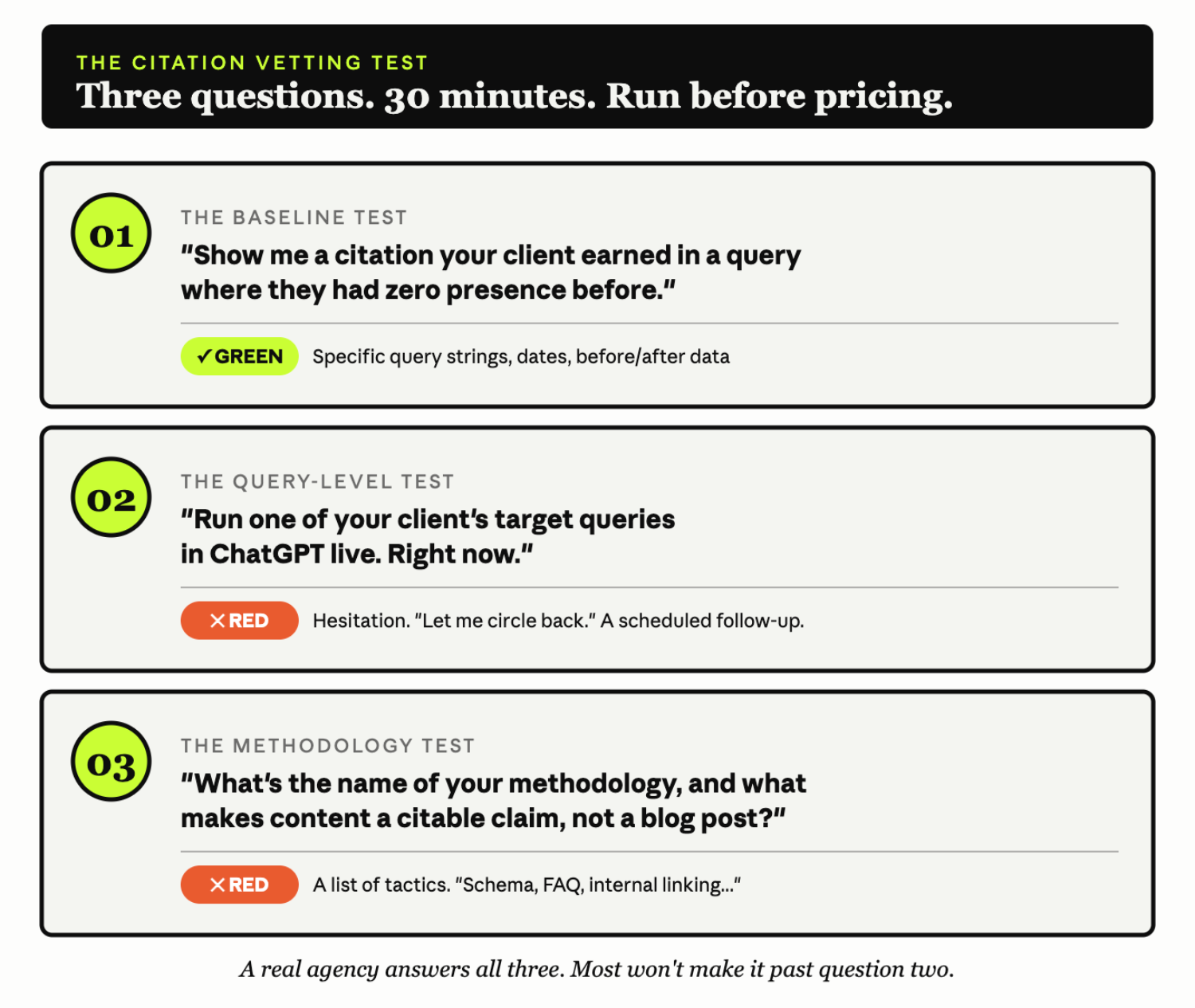
Three questions. Run all three before you discuss pricing with any agency on your shortlist.
1. The Baseline Test
“Can you show me citations your client earned in queries where they had zero presence before your engagement started?”
This question eliminates agencies that take credit for pre-existing brand awareness. If a company was already appearing in Perplexity for branded queries before the agency started, growing those appearances is maintenance, not engineering.
A legitimate answer includes specific query strings, documented before-and-after citation presence, and a clear timeline. A red-flag answer is “we increased their AI visibility significantly” with no query-level data attached.
2. The Query-Level Test
“Which specific query categories does your methodology target for this client type, and can you run one live right now?”
Running a query in ChatGPT or Perplexity takes 30 seconds. If an agency won’t do it live on a call, ask them why. There’s no operational reason to hesitate unless the answer won’t be there. Most agencies track “AI traffic” in GA4, which captures aggregate referral volume from AI tools. That’s not the same as knowing which specific queries produce citations and which don’t.
3. The Methodology Test
“What is the name of your content methodology, and what specifically makes a piece of content a citable claim rather than a standard optimized article?”
Agencies with a real framework can answer this in 2 minutes. The explanation should describe how content is structured at the claim level: specific, verifiable statements that an LLM can extract independently of the surrounding article.
Agencies without a framework give you a list of tactics: schema markup, FAQ sections, internal linking. Those tactics matter, but they’re not a methodology.
⚠️ Warning: An agency that can articulate all three answers fluently but cannot show you a live citation for a client in a query that maps to your category has described work they aren’t doing. Run all three questions sequentially and ask for live evidence on question two. Ask any agency to demonstrate query-level tracking before signing, not after.
What $5 Million – $50 Million ARR SaaS Companies Actually Need From GEO
At $5M-$50M ARR, you’re past the awareness problem. Your buyers know the category exists. Many of them are already using ChatGPT or Perplexity to evaluate vendors before they visit a single website.
Gartner projects a 25% decline in traditional search volume by the end of 2026 as AI tools absorb more research queries.
The GEO job at this stage is to be on the shortlist when a buyer asks an AI tool for a recommendation in your category.
That’s different from what most agencies are selling. The common pitch is Google AI Overview optimization, which targets informational queries and improves how your content surfaces in Google’s AI-generated answer boxes.
That improves organic traffic, but does not reach buyers in the channel where buying decisions are forming, which is conversational AI.
For a $5M-$50M ARR SaaS company, three things matter most from a GEO engagement:
- Owning 5-10 commercial-intent queries in ChatGPT and Perplexity. Citation behavior diverges by platform, so the same brand can appear in ChatGPT for a category query and be invisible in Perplexity for the same one. A serious GEO program tracks each platform separately rather than treating “AI search” as a single channel.
- A measurement system connecting AI appearances to demo requests, not just sessions or AI Overview impressions
- An agency building Google authority and LLM citation surfaces at the same time, because the two compound: Google-ranked content gets indexed by Bing, which feeds ChatGPT; authority that helps SEO helps AI citation
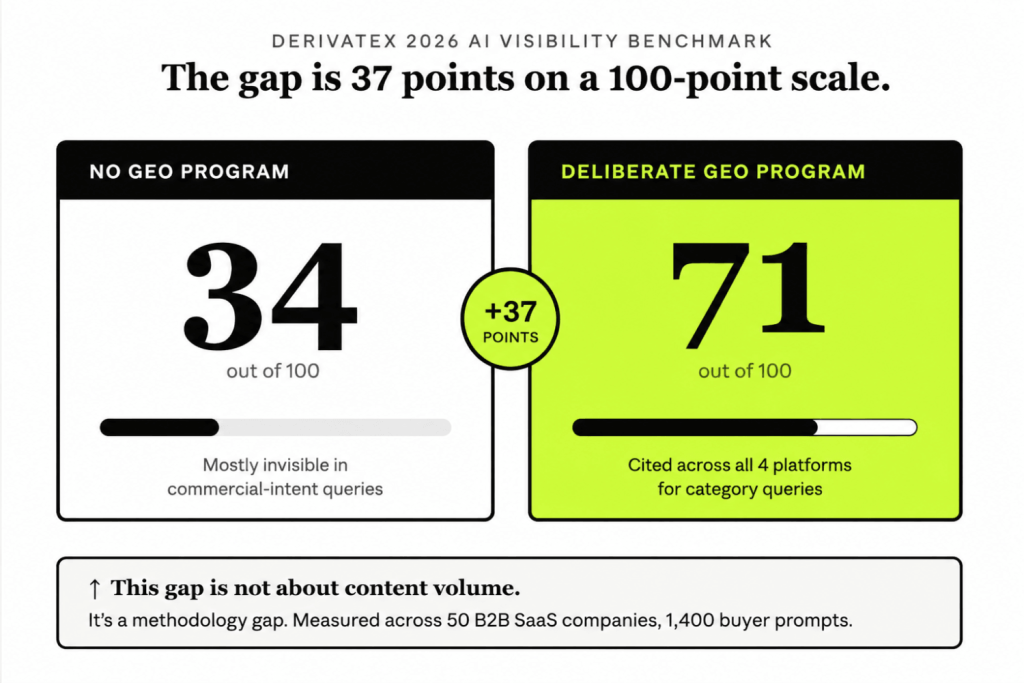
📊 The Number: In DerivateX’s 2026 AI Visibility Benchmark, B2B SaaS companies running deliberate GEO programs scored an average of 71 out of 100 on AI Presence, against 34 out of 100 for companies with no active GEO program. The gap between doing nothing and doing the right work is roughly 37 points on a 100-point scale.
A GEO-only agency that doesn’t do SEO is working with incomplete infrastructure. A SEO-only agency that doesn’t track citations is missing the output that matters. The engagement model that works at this stage does both simultaneously, with measurement covering both channels.
How These 8 Agencies Were Evaluated
Four criteria drove every evaluation below. No agency received favorable treatment on criteria it didn’t meet.
- Named methodology: Does the agency have a documented, named approach to creating content that earns AI citations? This means a coherent system with a name, not just a list of SEO tactics with “GEO layer” added.
- Query-level citation tracking: Does the agency track which specific queries their clients appear in across ChatGPT, Perplexity, and Gemini, rather than just monitoring GA4 referral traffic from AI sources?
- SEO + GEO integration: Does the agency build both Google rankings and AI citation surfaces in the same engagement, or is the work siloed between two separate service lines?
- Verified client proof: Is there a specific, named client with specific, verifiable results that predate agency self-promotion?
*Pricing information is included where publicly available. Where specific pricing isn’t disclosed.
Quick comparison:
| Agency | Named Methodology | Query-Level Tracking | SEO + GEO | Best ARR Stage | Verified Proof |
|---|---|---|---|---|---|
| DerivateX | Citation Engineering | Yes (AVS) | Full dual-channel | $5M-$50M | Gumlet 20% revenue; REsimpli #1 CRM in ChatGPT |
| Omniscient Digital | Editorial SEO | Partial | SEO-first | $10M-$100M | Organic traffic and ranking data |
| iPullRank | Relevance Engineering | Yes (technical) | Technical-first | $50M+ | Enterprise case studies |
| First Page Sage | Thought Leadership SEO | Partial | SEO + some GEO | $20M+ | Review scores, limited citation data |
| Siege Media | Content Authority | Partial | Content-first | Any | Traffic and authority case studies |
| Animalz | Thought Leadership | No | SEO-first | $20M-$200M | Premium editorial outcomes |
| Minuttia | SEO + GEO overlap | No | SEO with GEO layer | $1M-$20M | Organic traffic results |
| RevenueZen | Organic growth | No | SEO-first | $1M-$30M | Organic pipeline case studies |
The 8 Best B2B SaaS GEO Agencies in 2026
1. DerivateX
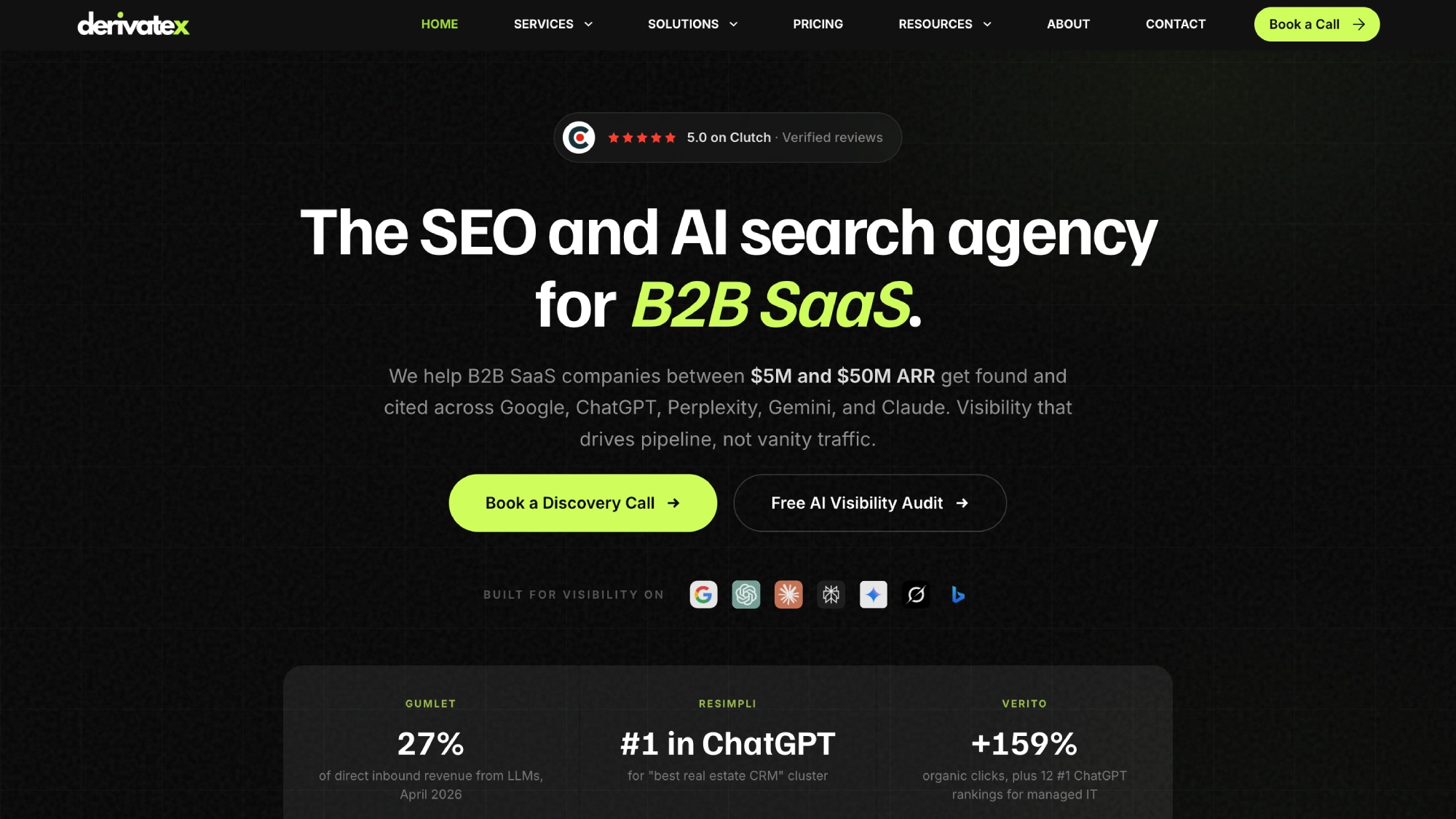
DerivateX is the only B2B SaaS GEO agency on this list that publishes its AI Visibility Score methodology, runs an open benchmark report across 50 B2B SaaS companies, and tracks citation presence at the query level connected to pipeline.
DerivateX is a B2B SaaS SEO and Generative Engine Optimization agency based in Bengaluru, India. Their proprietary Citation Engineering methodology builds content at the claim level: each piece is structured around specific, AI-extractable statements that LLMs can attribute and surface when answering buyer queries.
The AI Visibility Score (AVS) tracks citation presence across ChatGPT, Perplexity, Claude, and Gemini at the query level rather than at aggregate traffic volume. SEO and GEO run as a single integrated program, meaning the same content investment builds Google rankings and LLM citation surfaces simultaneously.
Client proof:
Gumlet, a video and image infrastructure platform, went from invisible in ChatGPT to attributing 20% of its inbound revenue to AI discovery after an 8-month engagement, with the full conversion path documented: AI discovery, branded search, demo. REsimpli, a real estate investor CRM, became the number-one CRM recommendation in ChatGPT for its target buyer segment within 90 days.
Verito, a cloud hosting provider for accounting firms, moved from a position-40 ranking to being the top AI-recommended option in its category. DerivateX has published detailed case studies to further explain the methodology it used to improve their clients’ AI visibility.
Best for:
B2B SaaS companies at $5M-$50M ARR that need both Google rankings and measurable AI citations from a single engagement.
Pricing:
Starting at $3,500/month for focused citation engineering programs. Full dual-channel retainers (SEO + GEO) from $5,500/month.
If you want to see where your brand currently sits across ChatGPT, Perplexity, Claude, and Gemini, the AI Visibility Audit is free, and will help you understand your presence in LLM citations.
2. Omniscient Digital
Editorial-first SEO built around category authority, with GEO structured into the content process.
Omniscient Digital is one of the most notable content-strategy agencies in the B2B SaaS market. Their process around research, editorial depth, and content architecture is rigorous, and they publish their own frameworks publicly, which signals actual methodology.
Their work compounds well because they focus on category ownership rather than individual ranking targets.
The GEO limitation is real: Omniscient is a SEO-first shop, and their case studies focus on organic traffic and ranking outcomes rather than query-level citation data in AI platforms. For companies where content strategy is the primary growth lever and AI citation is a secondary consideration, this is a strong choice. For companies where LLM visibility is the priority, the tooling isn’t there yet.
Best for:
B2B SaaS companies at $10M-$100M ARR where long-form editorial authority is the primary growth lever.
Pricing:
Omniscient Digital does not have published pricing. Those interested have to book a call with their sales team for an estimation. That said, Omniscient Digital charges approximately $5,000-$15,000/month based on scope.
Notable clients:
G2 and Classy, with published case studies showing organic traffic and search authority growth across SaaS verticals.
Standout differentiator:
Editorial quality and topic cluster architecture that performs in both search and AI citation contexts. Their approach builds interconnected content programs around primary revenue-intent keyword clusters rather than targeting individual articles in isolation, which creates compounding authority across a topic rather than fragmented ranking wins.
3. iPullRank
The deepest technical AI search capability on this list, built for enterprise complexity.
iPullRank comes from an information retrieval background, and their approach reflects it. They focus on how AI models retrieve and rank information at the infrastructure level: retrieval engineering, schema architecture, semantic HTML, and crawlability for AI indexability.
For companies with large content archives, complex product portfolios, and meaningful technical debt, this depth is genuinely hard to find elsewhere.
The limitation: iPullRank is built for enterprise-scale problems. Their process and pricing don’t fit growth-stage teams, and their work is more technical than strategic for teams without an in-house SEO engineering function to execute recommendations.
Best for:
Enterprise B2B SaaS companies ($50M+ ARR) that need deep technical AI search infrastructure work.
Pricing:
Not publicly disclosed. Approximately $10,000-$30,000+/month based on scope.
Notable clients:
Enterprise technology clients, including Fortune 500 companies. Specific client names are not disclosed publicly, but published case studies are available on their website.
Standout differentiator:
Technical depth in relevance engineering that no other agency on this list matches. Their work operates at the infrastructure level, examining how embedding models score and retrieve content, how crawlers process semantic HTML, and how schema architecture affects extractability for AI systems, rather than optimizing at the page structure level and working up from there.
4. First Page Sage
Thought leadership SEO with GEO structuring layered in, serving mid-market and enterprise SaaS clients.
First Page Sage has genuine category authority in the GEO space, having published widely-referenced research on GEO methodology and reviewed their client base across a weighted 6-factor model.
Their approach combines long-form thought leadership content with GEO structuring, and their client list includes Salesforce, Logitech, and US Bank, which signals they can operate at enterprise complexity.
The honest limitation: their case studies lean on AI visibility scores measured by their own tools, and their reporting framework doesn’t expose query-level citation data in the way a buyer evaluating GEO-specific outcomes would want to see. For companies where thought leadership is the primary goal and pipeline attribution is a secondary one, they’re a credible choice.
Best for:
B2B SaaS at $20M+ ARR where thought leadership content and lead generation are more important than pure citation engineering.
Pricing:
First Page Sage’s pricing is not publicly disclosed. That said, they charge approximately $3,000-$15,000/month based on scope.
Notable clients:
Salesforce, Logitech, and U.S. Bank.
Standout differentiator:
Established GEO category authority and breadth of B2B SaaS client experience. First Page Sage launched the first named GEO service in May 2023. They did not coin the academic term, but they were the first agency to market a named GEO service to clients, giving them one of the longer documented track records in the category by the time most competitors entered the space.
5. Siege Media
High-volume editorial content with GEO structuring built into the production process.
Siege Media builds content at scale, and their editorial quality is consistently strong. They’ve integrated GEO structuring into their content production process, which means the output has better AI extractability without the client having to manage it as a separate workstream.
For companies that need a content engine and want GEO as part of the output, this is a practical option.
The limitation for pure GEO work: Siege Media’s primary product is content authority, and citation engineering at the query level isn’t a first-class discipline in their engagement model. Their case studies demonstrate organic traffic and ranking outcomes rather than AI citation outcomes. For companies that need a content volume engine with GEO baked in, strong choice. For companies that need dedicated citation strategy, look elsewhere.
Best for:
Any ARR stage where high-volume editorial production with GEO structuring is the primary need.
Pricing:
Siege Media’s pricing is not publicly disclosed. That said, you can expect a costs of $5,000-$20,000+/month approximately.
Notable clients:
Asana, Intuit, PayPal, Zapier, and Nextiva, with published case studies showing organic traffic and search authority results.
Standout differentiator:
Content production scale combined with genuine editorial quality. Their production model enables multiple pieces per week per client, creating a breadth of citation surface across a topic cluster that boutique shops producing two to four pieces per month simply cannot match at the same pace.
6. Animalz
The highest editorial quality on this list. Not a GEO agency. The overlap is worth understanding.
Animalz produces some of the best-written B2B content in the agency market. The writing quality is consistently at a level that few agencies match, and their thought leadership work for clients like Loom and Wistia is frequently cited as the benchmark for what SaaS content can be.
They are not a GEO-first agency. Their content does well in AI citations because high-quality, specific, well-structured content tends to get cited, not because the agency is running a citation engineering program.
If you need rigorous editorial quality and are willing to accept that GEO outcomes are a correlated effect of good writing rather than a managed deliverable, Animalz makes sense. If you need query-level citation tracking and deliberate AI visibility engineering, they’re not the right fit.
Best for:
B2B SaaS at $20M-$200M ARR where thought leadership is a primary competitive differentiator.
Pricing:
Animalz’s pricing is not publicly disclosed. Approximately, $10,000-$25,000+/month. Premium tier.
Notable clients:
Loom, Wistia, and Lattice, with long-form editorial content frequently cited as benchmarks for B2B SaaS content quality.
Standout differentiator:
Editorial quality at a level most agencies can’t match. Animalz operates on a staff-writer model, full-time writers rather than freelance networks, which means voice consistency and institutional product knowledge compound over a long engagement rather than resetting with each new writer assignment.
7. Minuttia
SEO with a GEO overlay, well-suited for teams building their first real content program.
Minuttia is a process-driven SEO agency that has added GEO as a service layer. Their content work is structured and execution-focused, which makes them a practical choice for lean teams that need a reliable content operation rather than a specialized citation engineering program.
There’s no distinct GEO methodology separate from their SEO practice, and query-level citation tracking isn’t part of their standard engagement. For early-stage teams at $1M-$20M ARR building search foundations, that’s an acceptable tradeoff. For teams with specific AI citation goals, the tooling isn’t there.
Best for:
B2B SaaS at $1M-$20M ARR building initial content and SEO infrastructure.
Pricing:
Minuttia’s pricing is not publicly disclosed. Approximately $2,000-$8,000/month.
Notable clients:
Toggl, a time tracking software, achieved 7 million impressions and 50,000 organic clicks, with 200 documented conversions, one of the more cited organic growth case studies in the mid-market SaaS content category.
Standout differentiator:
Structured execution process that works well for teams new to content programs. Their brief and workflow templates reduce client-side coordination overhead significantly, a practical advantage for lean marketing teams without a dedicated content ops function managing the program day-to-day.
8. RevenueZen
Organic growth with GEO as an additive component, not a standalone discipline.
RevenueZen’s strength is connecting content and SEO to pipeline outcomes, which is the right framing for attribution. Their GEO work is positioned as part of an organic growth program rather than as a separate citation engineering engagement.
For companies that aren’t ready to invest in dedicated GEO work but want organic growth with some AI visibility coverage, this is a reasonable entry point.
The limitation: GEO as an add-on to organic growth strategy produces organic-growth-sized GEO results. If AI citation is a primary growth lever for your company, a dedicated citation engineering program will outperform organic growth strategy with a GEO layer.
Best for:
B2B SaaS at $1M-$30M ARR looking for organic pipeline growth with AI visibility as a secondary outcome.
Pricing:
Pricing ranges from $2,500 to $14,325/month.
Standout differentiator:
Pipeline-attribution focus that connects GEO work to revenue metrics, not just visibility metrics. Their reporting model maps AI-sourced sessions back to pipeline stage in CRM rather than stopping at session volume or demo request count, which makes their output more legible to revenue-focused stakeholders who need GEO tied to deals, not traffic.
How to Read a GEO Agency’s Results Report
Most GEO agencies send a monthly report. The ones that are doing real work and the ones that aren’t, look similar on paper until you know what to look for.
Three metrics that tell you something real:
- Citation frequency in target query categories is the only metric that directly confirms your brand is appearing when buyers ask AI tools for vendor recommendations. This means tracking specific query strings monthly across ChatGPT, Perplexity, and Gemini, not just counting aggregate sessions from AI referral sources in GA4.
- AI-attributed sessions with pipeline path shows whether the AI traffic is converting. A meaningful report traces the full path: AI referral, branded search, demo request. Anything shorter than that path is incomplete attribution and tells you more about the agency’s reporting than about the channel’s performance.
- Branded query growth in AI search tools measures whether buyers are looking for you specifically in ChatGPT and Perplexity after discovering you through non-branded content. This is the compounding effect that citation engineering creates over time.
Three metrics that sound important but aren’t:
| Metric | Why It’s the Wrong Signal |
|---|---|
| Google AI Overview impressions | Measures Google’s AI feature, not conversational AI where buying decisions happen |
| Agency-proprietary “AI visibility score” | Every agency can define and measure this however they prefer |
| Organic traffic from AI sources (aggregate) | Doesn’t separate commercial-intent visits from informational browsing |
💡 Insider Take: The clearest sign that an agency is tracking real GEO work is a monthly report that names at least five specific queries, shows a before-and-after citation status for each, and identifies the content asset responsible for any change. If the report is a dashboard with aggregate traffic numbers, the work is probably aggregate too. Ask for one specific query that produced a client’s best citation result this month. An agency doing this work can answer that in 10 minutes.
Questions to Ask Before Signing a GEO Retainer in 2026
These questions are distinct from the Citation Vetting Test, which is about verification. These are about scoping the engagement and setting expectations.
- “What does a monthly report look like? Can I see a sample from a current client?”
A sample report tells you more about how the agency thinks than any sales presentation.
- “What’s your measurement cadence for AI platforms?”
Weekly tracking is the standard for agencies that take citation changes seriously. Monthly is acceptable for lower-budget programs. Quarterly means the agency isn’t watching platform behavior closely enough to respond to shifts.
- “How do you adjust when AI platform citation patterns change?”
An agency without a defined response process for those shifts is working on a model that may already be outdated.
- “What’s the actual split between SEO and GEO work in your retainer?”
The answer tells you whether the programs are genuinely integrated or whether you’re paying for two service lines that occasionally share a Slack channel.
- “What’s the most competitive category a client of yours has gained a citation presence in, and how long did it take?”
90 days is a reasonable minimum for new citation presence in a competitive category. Under 60 days for a new client in a crowded space is an aggressive claim worth scrutinizing. Over six months without early citation signals is an execution problem worth flagging early.
- “If you had to run a live demo of your GEO work right now, which client query would you choose?”
Watch what they choose and whether they hesitate. Hesitation is data.
Frequently Asked Questions
1. What is the difference between a GEO agency and an SEO agency for SaaS companies?
GEO agencies optimize content to appear in AI-generated answers from ChatGPT, Perplexity, and Gemini, not just Google search results. The mechanics are different: GEO requires structuring content around specific, attributable claims that LLMs can extract, tracking citation presence by query string, and building entity coherence across the full web presence.
SEO optimizes for Google rankings through keyword targeting and backlink authority. The overlap is real, because Google-indexed content feeds Bing, which feeds ChatGPT, but the specific work for AI citation is distinct. Most agencies calling themselves GEO specialists in 2026 are doing SEO with better heading structure. A real GEO agency can show you query-level citation data for at least one named client.
2. How do I know if a GEO agency is actually getting my brand cited in ChatGPT?
Ask the agency to run your primary commercial query in ChatGPT or Perplexity live, during your next call. The query should be one your buyers actually use when comparing vendors in your category. If your brand appears, the work is producing output. If it doesn’t, ask them to show you a client where it does and explain exactly what content drove that result.
Also check their reporting: are they tracking specific query strings, or just aggregate GA4 traffic from AI referral sources? If an agency can’t demonstrate live citation evidence for at least one current client, remove them from your shortlist.
3. How long does it take to see results from GEO, and is 90 days realistic?
For companies with an existing content program, first citation appearances in target queries typically happen within 60-90 days. For companies building from scratch, expect 3-6 months before consistent citation frequency. REsimpli became the number-one CRM recommendation in ChatGPT for real estate investors within 90 days because the target query category was underserved by existing content.
More competitive categories with established brands take longer to displace. Any agency promising meaningful citation presence in under 60 days for a new client in a competitive space is overselling the timeline. Citation engineering follows a predictable ramp, and there are no shortcuts in the first 45 days.
4. Should a $15M ARR SaaS company hire a GEO agency or build an in-house capability?
At $15M ARR, building genuine in-house GEO capability takes 4-6 months before producing a single reliable citation metric, based on what we see across new client engagements.. The agency route produces measurable output faster and brings benchmark data across multiple client industries that no single in-house team can accumulate.
The more useful question is whether GEO is your primary growth lever or an addition to an existing program. If AI search is already generating leads, dedicated investment is justified now. If you’re still building SEO foundations, fix those first and layer in a GEO program from month four. Hire an agency when you’re ready to measure citations specifically, not when you want AI visibility in general.
5. What metrics should a GEO agency be reporting on each month?
Three metrics matter: citation frequency tracked by specific query strings across ChatGPT and Perplexity, AI-attributed session volume with a clear pipeline path to demos, and branded query growth in AI platforms over a rolling 90-day period.
Three to deprioritize: Google AI Overview impressions (the wrong channel for B2B buying decisions), agency-proprietary AI visibility scores without a transparent methodology, and aggregate AI traffic without pipeline attribution.
Require your agency to name the queries they’re tracking, show the before-and-after citation status for each, and attribute changes to specific content assets. Cross off any GEO agency whose monthly report relies entirely on metrics they define and measure themselves.
6. How much does a serious B2B SaaS GEO retainer cost in 2026?
Expect $3,000-$25,000 or more per month for a serious engagement. The pricing range is directionally consistent with what other sources report, so keeping the range without the attribution is fine. Anything below $1,500 per month is almost certainly rebranded content work with a GEO label. Focused citation engineering programs targeting 5-10 commercial queries start around $3,000-$5,000 per month.
Full dual-channel programs covering SEO, GEO, and multi-platform tracking start around $7,000-$10,000 per month. The absolute number matters less than one question: can the agency tie their output to the pipeline? Get pipeline attribution requirements in writing before signing anything.
The Window is Narrowing
The companies that build citation surfaces in 2026 are taking positions that will be significantly harder to take in 2027.
The brands appearing consistently in ChatGPT today got there by doing the work when the query categories were uncrowded. eMarketer data shows daily AI search users in the U.S. nearly doubled between February and August 2025 alone. That’s not a slow trend. The buyers are already there.
The gap between a 34/100 score for companies with no GEO program and a 71/100 score for those running deliberate citation engineering is not a content volume gap. It’s a methodology gap. The companies above average are there because they built content with specific, attributable claims at the sentence level, tracked citation results at the query level, and connected those results to pipeline. That’s what citation engineering means in practice.
If you’re evaluating GEO agencies, start with the Citation Vetting Test and apply it to every agency on your shortlist, DerivateX included. If we pass all three questions to your satisfaction, the next step is an AI Visibility Audit: we run your primary category queries across four AI platforms, score your current citation presence against your top three competitors, and show you exactly where the gaps are. No deck, no pitch. Just the data.
If you want a better understanding, book a 30-minute call to know more about why AI visibility is the need of the hour for your B2B SaaS.
Reviewed byApoorv SharmaCo-founder, DerivateX
Apoorv Sharma is the co-founder of DerivateX, a B2B SaaS SEO and Generative Engine Optimization agency that engineers AI citations in ChatGPT, Perplexity, Claude, and Gemini and connects them to demo bookings and revenue pipeline. He is the author of the 2026 AI Visibility Benchmark Report and the Citation Engineering methodology. He's also the brain behind "Found On AI" and has sold 2 of his companies previously
Cited by AI