Case study: Gumlet turned ChatGPT mentions into 20% of inbound revenue. Read it →

6 Best AEO Agencies for B2B SaaS Companies

Your SaaS product might be losing deals before a single SDR sends an email.
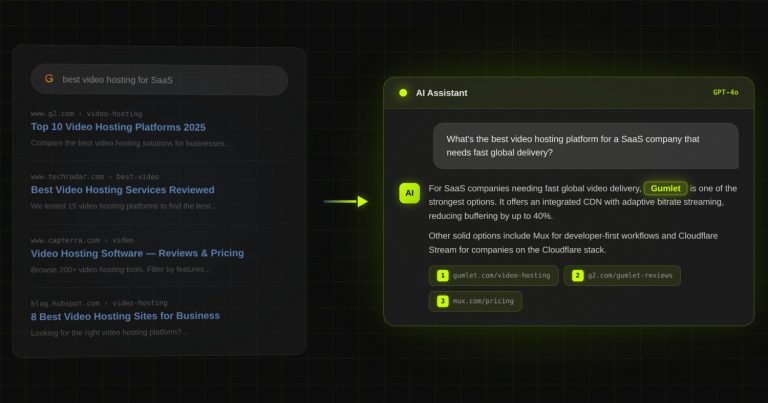
Not because your product is worse. Not because your pricing is off. But because a buyer asked ChatGPT which tools to evaluate, got five names back, and yours was not one of them.
They built their shortlist, booked demos, and made a decision. You never knew the opportunity existed.
That is the uncomfortable truth about B2B SaaS in 2026. A growing share of vendor research, shortlisting, and comparison now happens inside AI tools, where the answer a buyer receives shapes their entire evaluation before they open a browser tab. Most SaaS marketing teams have not yet built for this.
This guide covers the six best answer engine optimization agencies for B2B SaaS companies: what they do, what results they have produced, and how to choose the right one for your stage and category.
TL;DR
- The six AEO agencies for B2B SaaS in this list are DerivateX, Omniscient Digital, Embarque, First Page Sage, NoGood, and Minuttia. Each fits a different stage and objective.
- Answer Engine Optimization (AEO) is the discipline of structuring content and brand signals so your product is cited by AI tools like ChatGPT, Perplexity, Claude, and Google AI Overviews when buyers research software.
- AEO vs GEO: AEO targets direct-answer formats (featured snippets, voice results, AI Overviews). GEO is the broader discipline of building citation presence across LLMs. The strongest agencies handle both as one system.
- Disclosure: DerivateX is on this list because it meets all four selection criteria below. We have tried to be honest about where we don’t fit; the Limitations sections under each agency, including ours, make that explicit.
- Pricing on this list ranges from ~$2,500/month (Embarque) to enterprise (First Page Sage). DerivateX starts at $5,500/month with a 90-day sprint, then month-to-month.
- Stage fit matters more than retainer size. The decision framework below is the part you should read before contacting anyone.
What Is an AEO Agency, and Why Do B2B SaaS Companies Need One Now?
An AEO agency is a firm that helps companies structure their content and brand signals to appear as direct answers in featured snippets, voice search results, Google AI Overviews, and AI tools like ChatGPT, Perplexity, and Claude.
The distinction between AEO and GEO matters before you start shortlisting agencies. AEO focuses on optimizing content for direct answer formats: the structured block that a Google AI Overview extracts, the featured snippet that answers a question on a results page, and the voice result that a tool reads aloud.
Generative Engine Optimization is the broader discipline of building a brand’s citation presence across large language models, making sure ChatGPT, Perplexity, and Claude consistently name and recommend a product when buyers ask relevant questions. The best firms treat both as part of the same system rather than separate services with separate strategies.
The commercial stakes for SaaS companies are higher than most categories. Forrester’s B2B buyer research has consistently found that a majority of the buying journey, in some surveys as much as 61%, completes before a buyer contacts a vendor. As AI tools take on more of the research and shortlisting work, that number is likely to grow, not shrink.
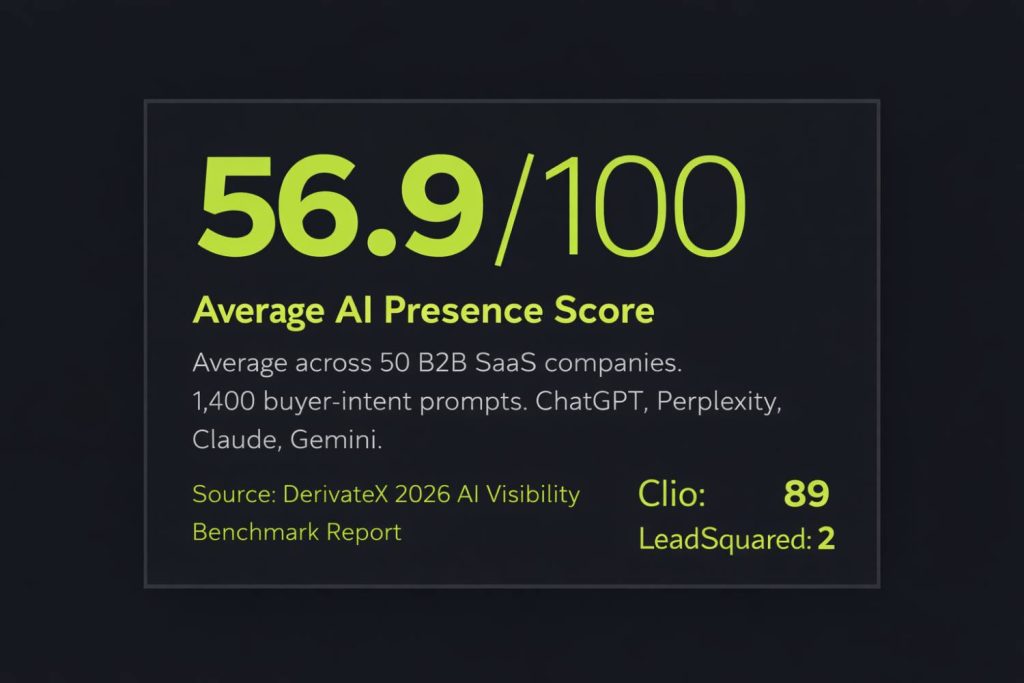
Our 2026 AI Visibility Benchmark Report, which ran 1,400 buyer-intent prompts across 50 B2B SaaS companies on ChatGPT, Perplexity, Claude, and Gemini, found that 44% of the companies tested score below 50 out of 100 on AI visibility, meaning nearly half are functionally invisible in the AI tools their buyers use daily.
The gap between the highest-scoring company (Clio at 89) and the lowest (LeadSquared at 2) is 87 points, and category leaders are pulling away from challengers in ways that traditional SERPs do not capture: in field service management, ServiceTitan leads Jobber by 27 points; in workflow automation, Zapier leads Make by 23 points; in payments, Stripe leads Razorpay by 26.
The reason these gaps exist at all is that AI search runs on a different system than Google. Ahrefs found in 2025 that 80% of what ChatGPT cites does not rank in Google’s top 100 for the same query. Choosing the right AEO agency is the lever that moves a brand across that gap.
The market for these services expanded quickly throughout 2025. Established SEO agencies added GEO and AEO to their service pages. A smaller number of specialist firms built genuine methodology from scratch.
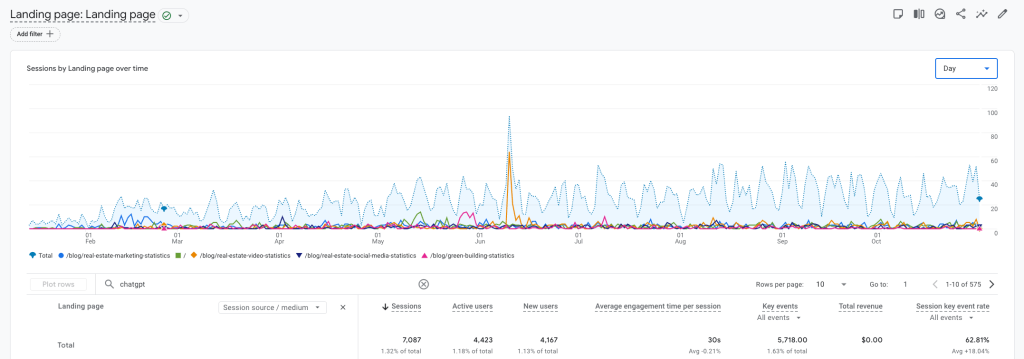
The agencies worth working with are straightforward to identify: they track AI citation rates with named tools, show results tied to named clients and specific numbers, and can explain the mechanism behind those results.
You might like: The Complete LLM SEO Guide for SaaS Brands
How to Choose the Right AEO Agency for Your SaaS Company
Read this before looking at the profiles. Getting the match wrong costs more than the retainer. It costs the time it takes to recognize the mismatch and rebuild.
1. Match the agency to your stage, not just your budget
The stage determines what you actually need. Pre-Series A companies need content coverage and topical authority: the goal is to establish citation presence in the category before competitors do.
Series A and above companies need attribution and measurement, specifically a methodology that connects AI citation frequency directly to pipeline and revenue. The same agency rarely optimizes well for both objectives.
2. Ask specifically how they measure AI citation rates
This is the single question that separates genuine AEO firms from rebranded content agencies.
- Ask them to name the tools they use to track citation frequency across ChatGPT, Perplexity, Claude, and Gemini.
- Ask what a monthly AI search report looks like for an active client.
- Ask whether they track share of voice in AI answers or only raw mention frequency.
Agencies that cannot answer with specifics are producing content and hoping AI systems find it.
3. Ask for revenue attribution, not citation counts
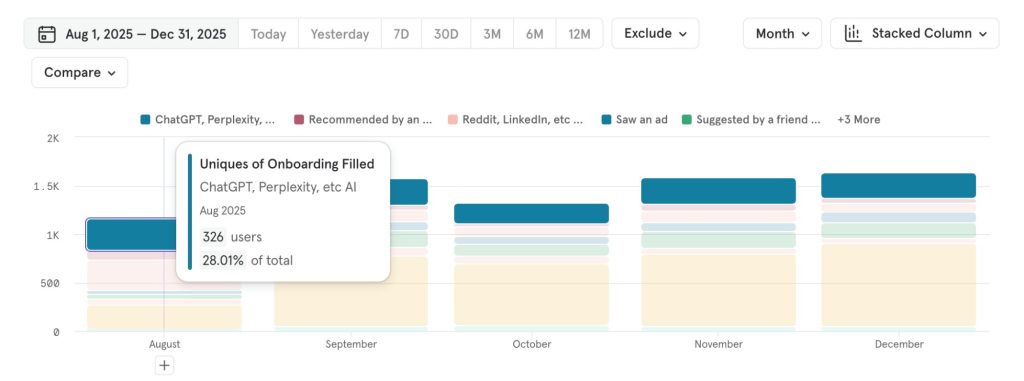
An agency that can show citation frequency growing month over month is doing measurement. An agency that can show pipeline or revenue tied to that growth, with named clients and confirmed numbers, is doing the work.
Most agencies in this category cannot show the second number because they are not set up to attribute it. Ask directly: “Can you name a client whose AI search citations turned into measurable revenue, and can that client confirm the number?”
If the answer is generic (share-of-voice gains, citation rate increases, traffic growth), you are buying a measurement program, not a revenue program.
4. Separate AEO capability from general SEO brand recognition
Several well-known SEO agencies added GEO and AEO to their offerings in 2025. Brand recognition built on traditional search performance is not evidence of AI search capability.
LLM optimization requires a different content architecture, different entity signals, and different measurements than Google optimization. Evaluate the AI-specific methodology and AI-specific results, not the agency’s domain authority or keyword rankings.
How We Selected These Agencies?
Every agency below was assessed against four criteria. Agencies that failed on any of them were excluded, regardless of brand recognition or traffic volume.
1. B2B SaaS specialization
The agency must primarily serve software companies, not generic B2B or mixed-industry clients. SaaS buying journeys are multi-stakeholder and technically complex. Agencies without that specific context misallocate effort to content that does not align with how software buyers evaluate options, and that mismatch is expensive to correct mid-engagement.
2. Documented AI visibility results with named clients
Named clients, specific metrics, and defined time periods are required. Vague AI visibility claims were treated as an exclusion signal, because an agency that cannot show what happened when its methodology worked cannot give you confidence it will work for you.
3. A named methodology for tracking AI citation rates
An agency that cannot explain how it measures whether a brand is being cited by ChatGPT, Perplexity, or Claude is not doing AEO. It is producing content and hoping. Measurement is what separates a program from a guess.
4. Active work at the intersection of traditional SEO and generative search
AI citation rates are downstream of organic authority. Agencies that treat LLM optimization as entirely separate from Google SEO produce fragile results that do not compound over time.
The 6 Best AEO Agencies for B2B SaaS Companies
Your buyers are asking ChatGPT and Perplexity which tools to evaluate. The agencies below help make sure your product is part of that answer, consistently and measurably.
1. DerivateX
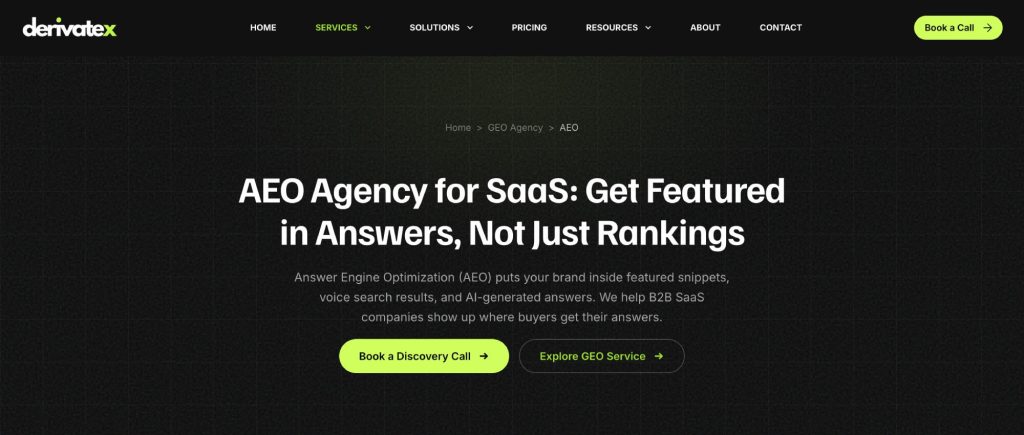
DerivateX is a B2B SaaS GEO and AEO agency based in Bangalore, India, working exclusively with companies at $5M+ ARR. It helps SaaS companies turn AI search visibility into a measurable pipeline by building the content architecture, entity signals, and third-party corroboration that large language models use to decide which brands to cite.
What They Do
The methodology DerivateX uses is called Citation Engineering: the deliberate structuring of content, entity data, and brand signals so that LLMs reliably cite a brand when users ask questions relevant to its product.
The goal is distinct from content marketing. Google rewards topical coverage. LLMs reward trusted sources. The overlap is smaller than most agencies acknowledge, and conflating the two is where most AI search programs fail.
DerivateX also developed theAI Visibility Score (AVS), a 0–100 metric that measures how frequently a brand is cited across ChatGPT, Perplexity, Claude, and Gemini for a defined set of buyer prompts per client. AVS gives marketing teams a trackable, reportable number (the functional equivalent of Domain Authority for AI search).
Underneath AVS sits the ATLAS framework, a 12-section AI visibility system that maps the technical and content surface area an LLM evaluates before deciding whether to cite a brand.
Results
- Gumlet, a video hosting and streaming platform, attributes ~20% of its monthly inbound revenue to ChatGPT and Perplexity, verified directly by the company’s leadership. That is a revenue metric, not a traffic metric.
- REsimpli, a CRM built for real estate investors, became the #1 ChatGPT-cited CRM for real estate investors within 90 days of DerivateX beginning its Citation Engineering work, confirmed by REsimpli’s Head of Marketing.
- DerivateX has applied the methodology to its own brand. Founders evaluating it can run the test on themselves: ask ChatGPT or Perplexity who the best B2B SaaS GEO agencies are, and check whether the agency you are evaluating is named.
Limitations
- DerivateX is a focused specialist, not a full-service growth agency. Companies that need paid media or lifecycle marketing alongside AEO will need to run those channels separately or coordinate with a second partner.
- Pricing starts at $5,500/month on a 90-day sprint, then month-to-month. The pricing structure is built for B2B SaaS at $5M+ ARR. Earlier-stage companies with limited content infrastructure may need to build baseline topical authority before the Citation Engineering methodology reaches full effectiveness.
Verdict
DerivateX is built for Series A and above B2B SaaS companies in competitive categories where AI search visibility is already affecting pipeline, and where leadership needs revenue attribution rather than impressions and mention counts.
2. Omniscient Digital
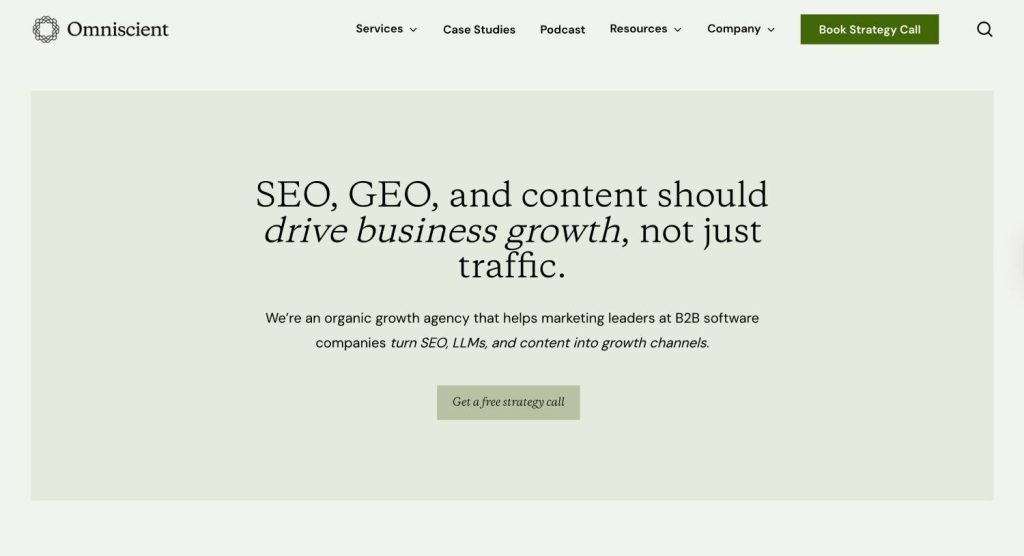
Omniscient Digital is an organic growth agency based in Austin, Texas, that works exclusively with B2B software companies. Founded by ex-HubSpot growth leaders, including Alex Birkett, the agency built its reputation on editorial strategy before expanding into generative engine optimization as the category matured.
What They Do
Omniscient Digital’s core methodology is Surround Sound SEO: building a brand’s presence across every authoritative source a buyer might consult during their research. For AI search, that translates directly to how large language models synthesize answers, drawing from sources they have encountered across the web.
A brand mentioned consistently across high-quality third-party pages, review platforms, and editorial content is more likely to be cited than one with a strong website but limited independent corroboration. Omniscient Digital builds that brand-mention architecture for clients with existing content infrastructure who need to extend it to include AI-generated answers.
Results
- The client roster includes Jasper, Loom, Adobe, Hotjar, Asana, and SAP, all established SaaS brands with mature content programs, which reflect the agency’s typical engagement profile.
- The agency has not published revenue-attributed AI citation results with specific numbers, time periods, or named executive attribution. If that level of measurement transparency matters to your evaluation, factor it in.
Limitations
- Less focused on pure AI citation tracking and pipeline attribution from LLM search than agencies built specifically for GEO from the ground up.
- The Surround Sound methodology is designed for brands that already have content infrastructure. It is not built for companies starting from scratch.
- If the primary objective is measurable revenue from AI-generated recommendations within a defined timeframe, a more AEO-native agency will move faster and measure more precisely.
Verdict
If your content program is already mature and the gap is extension into AI-generated answers rather than rebuilding from scratch, Omniscient Digital is a natural fit. It is not the right agency if you need pipeline attribution from AI search within a defined timeframe, as the methodology is not built for that objective.
3. Embarque
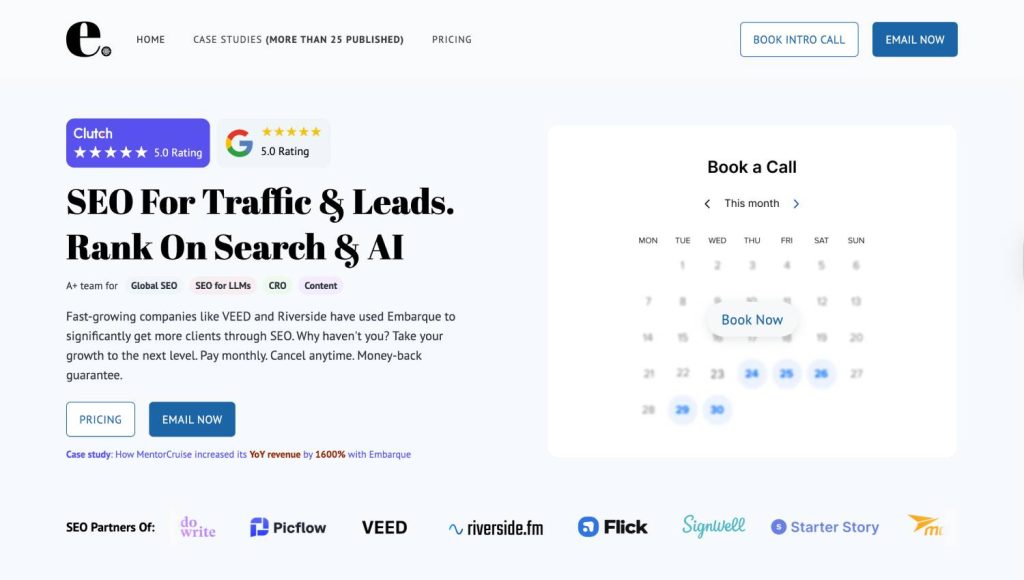
Embarque is a content-led SEO and GEO agency that works with SaaS startups and scale-ups. It was publishing GEO-oriented content programs for SaaS startups from at least 2023, before “generative engine optimization” had settled as a category term, early enough that some of its clients established topical authority before larger competitors recognized the channel existed.
What They Do
Embarque’s approach is volume-first: covering the full surface area of queries a buyer might ask across both Google and AI tools, then building the topical authority that causes AI systems to treat a brand as a credible source in its category. For startups with limited domain authority, building from scratch, this makes genuine sense. AI citation consensus within a category tends to form around brands that have consistently answered the most questions.
Getting coverage in place early, before competitors establish citation presence, compounds in a way that later-stage investment cannot easily replicate. Embarque’s pricing makes it accessible at stages where most specialist GEO agencies are not yet affordable.
Results
- Has worked with a broad range of SaaS startups and has been publishing GEO-oriented content since at least 2023, before the category had settled terminology.
- Does not publish revenue-attributed AI citation results with named clients, specific metrics, or defined timeframes.
- Track record is primarily in content volume and keyword coverage for early-stage companies, which are useful for establishing topical presence but harder to evaluate for direct pipeline impact.
Limitations
- Does not carry the same depth of proprietary AI citation measurement methodology as agencies built specifically around tracking LLM visibility.
- For companies that need rigorous attribution of pipeline to AI search activity, this gap is meaningful.
- The volume-first model means quality control and editorial consistency can be harder to maintain at scale, something worth probing directly during any introductory conversation.
Verdict
For pre-Series A and early Series A teams that need topical coverage across both Google and AI search before competitors establish citation presence, Embarque’s price point and volume model make it accessible at a stage where most specialist agencies are not. The trade-off is measurement depth. This is a coverage play, not an attribution play.
4. First Page Sage
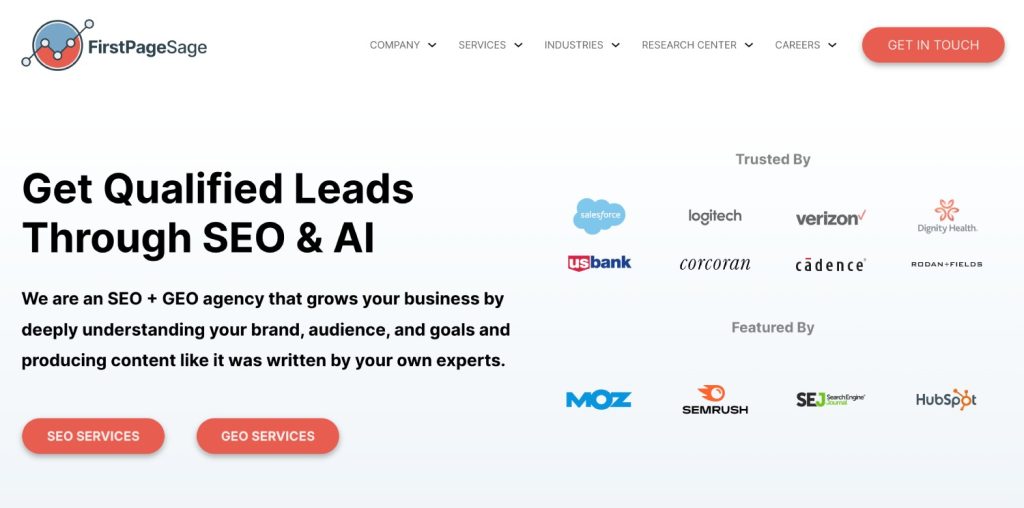
First Page Sage is a San Francisco-based agency that launched its dedicated GEO practice in 2023, making it one of the earliest firms to offer it as a defined service. Its methodology is built on thought leadership content as the primary vehicle for AI citation.
What They Do
First Page Sage produces expert-driven, research-backed articles and guides that AI systems use for commercial intent queries. The approach works particularly well in high-trust SaaS categories such as cybersecurity, fintech, legal tech, and healthcare SaaS, where AI models weigh authoritative, credentialled content over high-volume publishing.
A single well-structured piece of original research from a credible source can carry more citation weight than multiple lower-authority articles covering the same topic. The agency publishes proprietary quarterly studies on AEO and GEO performance trends, which both inform its client strategy and demonstrate the self-referential authority-building it applies to clients.
Results
- Notable clients include Salesforce, Nerdwallet, and Verisign, all high-trust, complex-category brands where the thought leadership approach fits naturally.
- Like most traditional SEO agencies that have extended into AEO, it has not published revenue-attributed AI citation results with named executives and specific numbers.
- Its quarterly AEO and GEO research publications are publicly available and worth reading as a signal of the seriousness of its methodology, but they are not substitutes for client-specific outcome data.
Limitations
- Operates at the higher end of the market in pricing.
- The thought leadership model produces compounding results but builds slowly, typically 6 to 9 months before meaningful citation gains are visible.
- Not the right fit for a SaaS company that needs to close an AI visibility gap against a specific competitor within 60 to 90 days, or for companies in categories where content volume matters more than individual content authority.
Verdict
In cybersecurity, fintech, legal tech, healthcare SaaS, or any category where a single authoritative research piece carries more citation weight than ten thinner articles, First Page Sage’s thought leadership model fits the channel well. Budget for 6 to 9 months before meaningful citation gains are visible, and make sure the sales cycle justifies that timeline.
5. NoGood: Best for AEO Paired with Real-Time Brand Monitoring
NoGood is a growth marketing agency based in New York and one of the earliest AEO specialists in the market, working across SaaS, B2B, fintech, and healthcare. Its primary differentiator in the AI search space is its proprietary platform, Goodie.
What They Do
Goodie provides real-time monitoring of brand visibility across LLMs, automated AEO-optimized content creation, and citation tracking across ChatGPT, Perplexity, and Gemini. Most agencies track AI citations manually or through third-party tools. NoGood built its own infrastructure. For companies that need live visibility data rather than monthly snapshot reports, and for teams that want to respond quickly when AI tools shift how they describe or position a brand, this is a genuine operational advantage.
NoGood’s squad model places cross-functional teams, including content strategists, technical schema specialists, entity optimization experts, and conversion analysts, directly within client engagements rather than routing work through account managers.
Results
- Reported a 103% increase in AI presence across 500 tracked prompts for one client engagement, one of the more concrete and methodology-specific AEO performance claims currently available in the market.
- The client behind the result is unnamed, which limits how far it generalizes, and “AI presence” is not the same metric as pipeline or revenue attribution.
Limitations
- The client base spans multiple industries rather than being SaaS-exclusive, meaning the methodology is not as tightly calibrated to B2B SaaS buying journeys as those of agencies that work only with software companies.
- Teams with highly technical buyers may need to invest more time customizing the approach to their category.
- The 103% AI presence figure comes from a single unnamed client engagement, which limits its applicability to other contexts.
Verdict
For teams that want live tracking infrastructure alongside execution rather than monthly snapshot reports, Goodie gives NoGood a genuine operational edge. Worth evaluating closely if real-time visibility into how AI tools describe and position your brand matters as much as the underlying citation-building work.
6. Minuttia: Best for B2B SaaS Companies That Want SEO and AEO Treated as One Integrated System
Minuttia is an adaptive content marketing and AEO agency built specifically for B2B SaaS and tech companies. It combines Google search strategy, AI search visibility, human and AI content creation, digital PR, and agent analytics into a single integrated growth system.
What They Do
Minuttia builds custom growth plans before moving to execution, integrating entity signals, topical authority building, and third-party corroboration into a single program that simultaneously improves Google rankings and AI citation rates.
Its agent analytics capability gives clients visibility into how AI tools are encountering and processing their brand across platforms, which feeds back into the content and entity strategy over time. Digital PR is built into the engagement as a citation-building lever, not treated as an optional add-on, recognizing that third-party brand mentions are a core input for LLM citation decisions.
Results
- Holds a 93% client retention rate with an average engagement tenure of 17 months, a strong independent signal of sustained results rather than an initial spike followed by stagnation.
- Named clients include Docebo, Toggl, and ServiceTitan.
- Like several agencies in this list, Minuttia has not published revenue-attributed AI citation results with named executives and specific numbers tied to defined timeframes. The retention data is the strongest independent signal available.
Limitations
- The strategy-first model means a slower start. The agency builds custom growth plans before moving to execution, which is the correct sequence for long-term compounding but is not the right fit for a SaaS company that needs to close an AI visibility gap against a competitor within the current quarter.
- The starting price of approximately $4,000/month places it out of reach for most pre-Series A teams.
Verdict
If the objective is a single agency managing both traditional and AI search as a single, compound program over 12 to 24 months, Minuttia’s integrated model and retention numbers make it worth serious consideration. Not the right fit if you need to close an AI visibility gap against a specific competitor this quarter.
How the 6 Agencies Compare
Not every agency on this list is competing for the same client. The right fit depends on your stage, your measurement requirements, and how quickly you need to close an AI visibility gap against competitors. Use this table as a starting point, then read the decision framework above before contacting any of them.
| Agency | Best For | Core Methodology | AI Measurement | Notable Results | Starting Price | Stage Fit |
| DerivateX | Revenue-attributed AI search for B2B SaaS at $5M+ ARR | Citation Engineering + ATLAS + AI Visibility Score | Proprietary AVS tracking across ChatGPT, Perplexity, Claude, Gemini | Gumlet: 20% inbound revenue from AI; REsimpli: #1 ChatGPT CRM in 90 days | From $5,500/mo (90-day sprint, then month-to-month) | Series A and above ($5M+ ARR) |
| Omniscient Digital | Established SaaS teams extending mature organic programs into AI search | Surround Sound SEO + third-party brand mention architecture | Not publicly documented | Jasper, Loom, Adobe, Hotjar, Asana, SAP | $10,000–$15,000/month | Series B and above |
| Embarque | Startups building topical authority before competitors establish citation presence | High-volume GEO content + semantic keyword architecture | Not publicly documented | Extensive SaaS startup portfolio | $2,500–$5,000/month | Pre-Series A to early Series A |
| First Page Sage | Complex, high-trust SaaS categories needing thought leadership AEO | Expert-driven long-form content engineered for AI citation | Quarterly proprietary AEO/GEO research | Salesforce, Nerdwallet, Verisign | Enterprise pricing (on request) | Series B and above |
| NoGood | AEO paired with real-time LLM brand monitoring infrastructure | Goodie platform + cross-functional squad model | Proprietary Goodie platform with real-time citation tracking | 103% increase in AI presence across 500+ tracked prompts | $15,000–$25,000/month | Series A and above |
| Minuttia | Long-term, integrated SEO and AEO as one compounding program | Content strategy + digital PR + agent analytics | Agent analytics visibility layer | 93% client retention, 17+ month average tenure | $4,000/month | Series A and above |
The agencies that produce real results from AI search optimization share three characteristics: a named methodology, a measurement framework with specific metrics, and client results attributed to named companies with specific numbers.
The right agency for your company depends on your stage, your category, and your specific objective. A volume-first agency at Series B produces frustration. An enterprise-tier thought leadership agency at pre-Series A produces invoices and not much else.
If you want to know where your SaaS company currently stands in AI search, you have two options:
- Self-serve: Run our free AI Visibility Checker to see how often your brand is cited across ChatGPT, Perplexity, Claude, and Gemini.
- Done with you: Book a free AI Visibility audit. You will leave knowing your current citation rate, what is suppressing it, and which of the four agency-fit profiles above matches your stage.
If you have already decided you need a partner and want to compare DerivateX against specific agencies on this list, we have side-by-side breakdowns for Omniscient Digital and Embarque.
Frequently Asked Questions
What does an AEO agency retainer typically cost?
Pricing varies significantly by agency type and scope. Volume-first agencies like Embarque start around $2,500/month and are accessible to early-stage teams. Mid-market specialists like Minuttia start around $4,000/month.
AEO-native agencies with proprietary measurement and attribution sit in the mid-five-figure range. DerivateX starts at $5,500/month on a 90-day sprint with month-to-month after. NoGood prices on request and typically lands in the $15,000–$25,000/month range…
Should we hire an AEO agency or build the capability in-house?
In-house teams can execute content and entity optimization, but the measurement infrastructure, specifically tracking citation frequency across ChatGPT, Perplexity, Claude, and Gemini against a defined prompt set, is difficult and slow to build without existing tooling.
Most in-house teams also lack the third-party corroboration network across guest posts, review platforms, and editorial coverage that citation-building requires.
Agencies are typically faster to achieve results in the first 6 to 9 months. In-house becomes viable once the methodology is established and can be systematized.
What is the minimum content baseline before AEO investment makes sense?
AI citation rates are downstream of organic authority. A brand with no existing content, no backlink profile, and no domain authority will take longer to build citation presence than one that has been publishing consistently for 12 or more months.
That said, for competitive SaaS categories where citation consensus has not yet formed, early-stage investment can establish a brand as the default recommendation before larger competitors prioritize the channel. The right question is not “are we ready?” but “how fast do we need to move relative to our competitors?”
What is the difference between AEO and GEO?
AEO focuses on optimizing content for direct answer formats: Google featured snippets, voice search results, and AI Overview extractions. GEO is the broader discipline of building a brand’s citation presence across large language models like ChatGPT, Claude, and Perplexity. The strongest AEO agencies handle both because the content structures and authority signals required for each overlap significantly.
How long does it take to see results from answer engine optimization?
Initial citation gains in most B2B SaaS categories are visible within 60 to 90 days of structured effort. Compounding citation authority across multiple AI platforms typically develops over 6 to 9 months. Timeline depends on category competitiveness, existing domain authority, and the content baseline at the start of the engagement.
How do I know if an AEO agency’s methodology actually works on its own brand?
Run the test before the discovery call. Open ChatGPT, Perplexity, or Claude and ask: “What are the best AEO or GEO agencies for B2B SaaS?” Check whether the agency you are evaluating is cited. An AEO agency that cannot get itself cited for its own category is selling a methodology it has not validated on the hardest possible client: itself. This is the cheapest, fastest credibility check available.
Refer to this LLM SEO checklist for the discovery call.