Case study: Gumlet turned ChatGPT mentions into 20% of inbound revenue. Read it →

When Google AI Mode Recommends You: The Assumption Flip Test

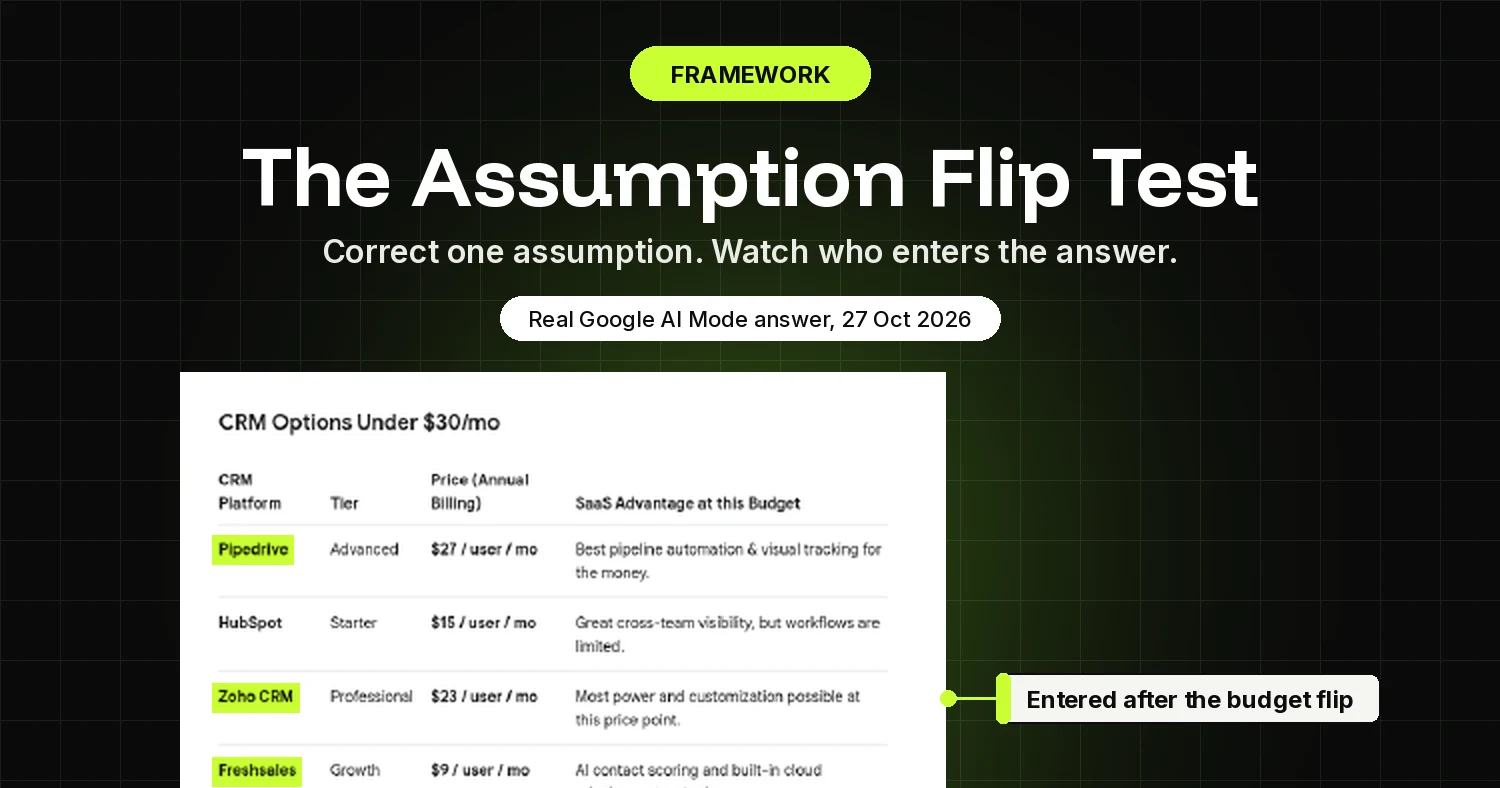
The Assumption Flip Test is a two-prompt answer engine optimization (AEO) test DerivateX uses to find when Google AI Mode recommends a brand. You ask a category question, ask what AI Mode assumed about the buyer, then correct one assumption per fresh thread. In our CRM test, 3 of 4 flips changed the shortlist.
Most B2B SaaS teams check whether AI Mode names them, then stop.
But AI Mode writes that answer for a buyer it has imagined. If your best customers look different, you may be missing from an answer you could win.
TL;DR
- AI Mode answers for an imagined buyer. Ask it to describe that buyer, then correct one detail at a time.
- In DerivateX’s 27 October 2026 CRM test, a budget cap brought in Pipedrive, Zoho CRM and Freshsales. A staffed admin team moved Salesforce from a warning to the top pick.
- Flip what AI Mode actually assumed, not what you expect it assumed.
- Some flips change nothing. Saying only 8 of 50 people use the CRM kept the same three brands.
- Use one fresh thread per flip, log who entered and why, then state those conditions on your pages.
What Is the Assumption Flip Test?
It is a DerivateX test for one problem: your SaaS product suits some buyers well, but AI Mode leaves it out of the default answer.
The test does not ask whether AI Mode mentions you. It asks under which buyer conditions it would. You end up with a short list of conditions to state, prove and publish.
AI Mode sits in the layer DerivateX calls AEO, next to Google AI Overviews and featured snippets. Every screenshot on this page comes from Google AI Mode.
Copy these prompts
1. The category prompt: Use your buyers’ words and leave your brand name out.
Best CRM for a 50-person SaaS?2. The assumptions prompt: Send it in the same thread.
What did you assume about the buyer when making these recommendations?3. The flip: Change one assumption only, then start a new thread for the next one.
Correct one assumption: [the assumption, stated the way it really is for you].Example: “Correct one assumption: our budget is under $30 per user per month.”
How Do You Run the Assumption Flip Test?
- Ask the category prompt in a fresh thread. Log every brand in order, including any shown as a warning.
- Ask what AI Mode assumed. It lists three or four buyer assumptions in plain language. Note what is missing, too.
- Flip one assumption. Correct a single assumption and read the new answer. Open a new thread for the next flip.
- Log what changed. Compare with the baseline from the same thread. Record who entered, who left and AI Mode’s reason in its own words.
DerivateX learned the fresh-thread rule the hard way. In an earlier run we stacked several corrections in one thread, and by the end we could not tell which one moved which brand.
What Happened When DerivateX Flipped Four Assumptions About a CRM Buyer?
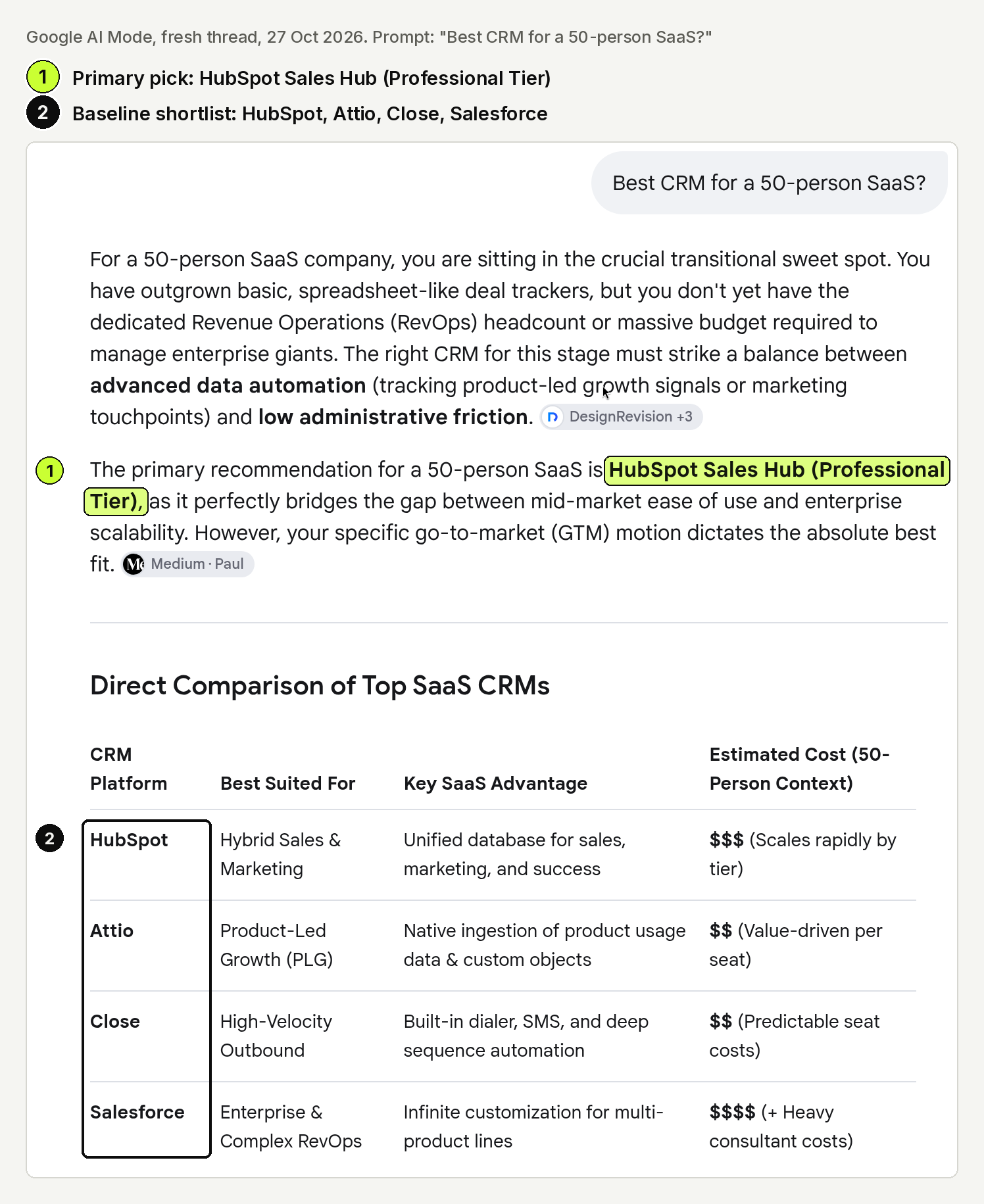
On 27 October 2026, DerivateX ran four fresh AI Mode threads. Each began with “Best CRM for a 50-person SaaS?”, then the assumptions prompt, then one flip.
The baseline and the assumptions
In the first thread, AI Mode compared HubSpot, Attio, Close and Salesforce. It picked HubSpot Sales Hub (Professional Tier) and put Salesforce under “Avoid Salesforce (For Now) Unless Forced”.
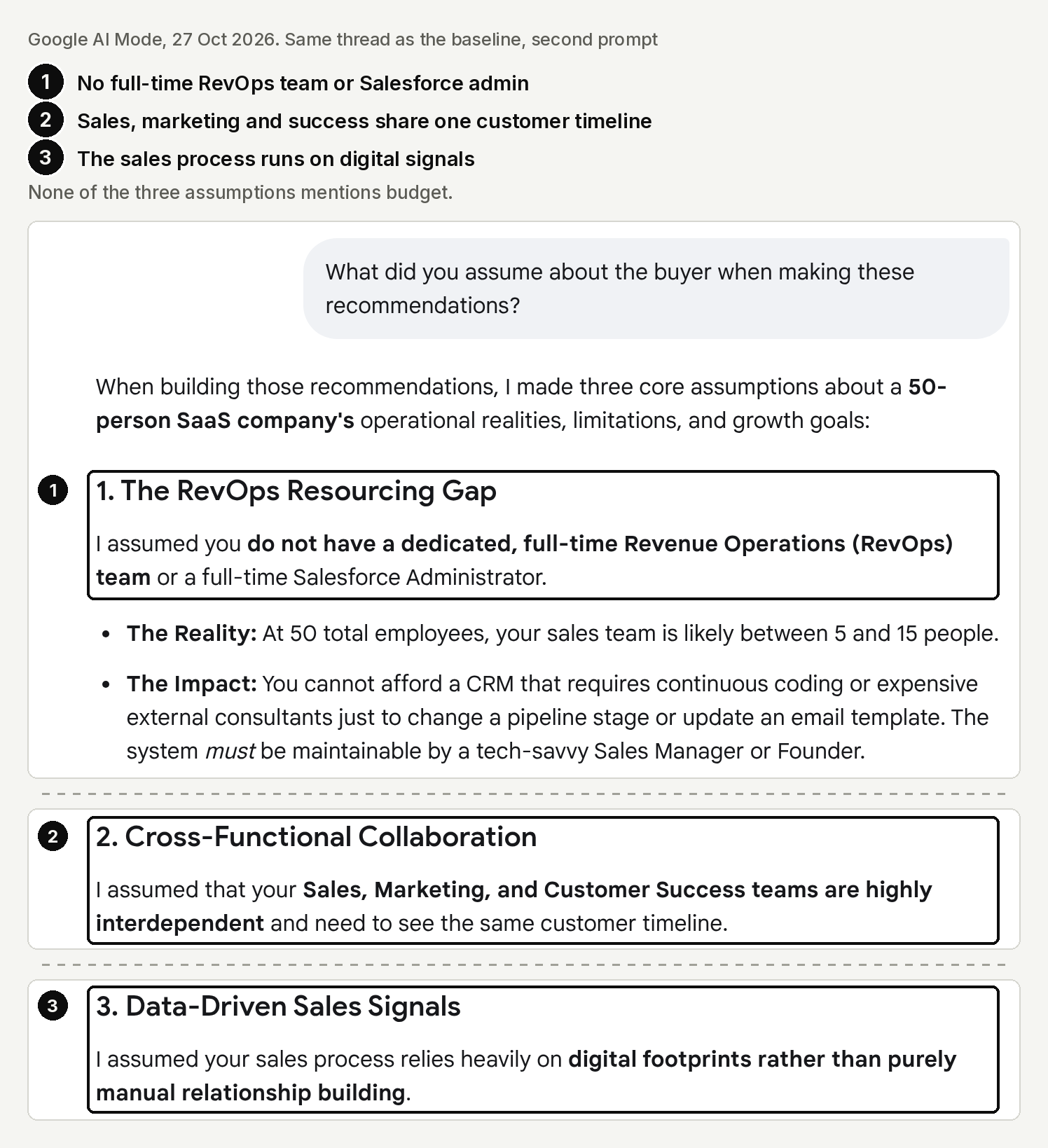
Each thread listed three or four assumptions, covering admin resources, team structure, data integration and growth stage. None of them mentioned budget.
Flip 1: our budget is under $30 per user
Prompt: “Correct one assumption: our budget is under $30 per user per month.”
Entered: Pipedrive, Zoho CRM, Freshsales
Left: Attio, Close, Salesforce
Why: Pipedrive’s “Advanced tier gives you full email sync, customizable templates, and basic workflow automation”.
Budget was not on AI Mode’s list, so this flip tested an unstated assumption. HubSpot stayed, but only on its Starter tier.
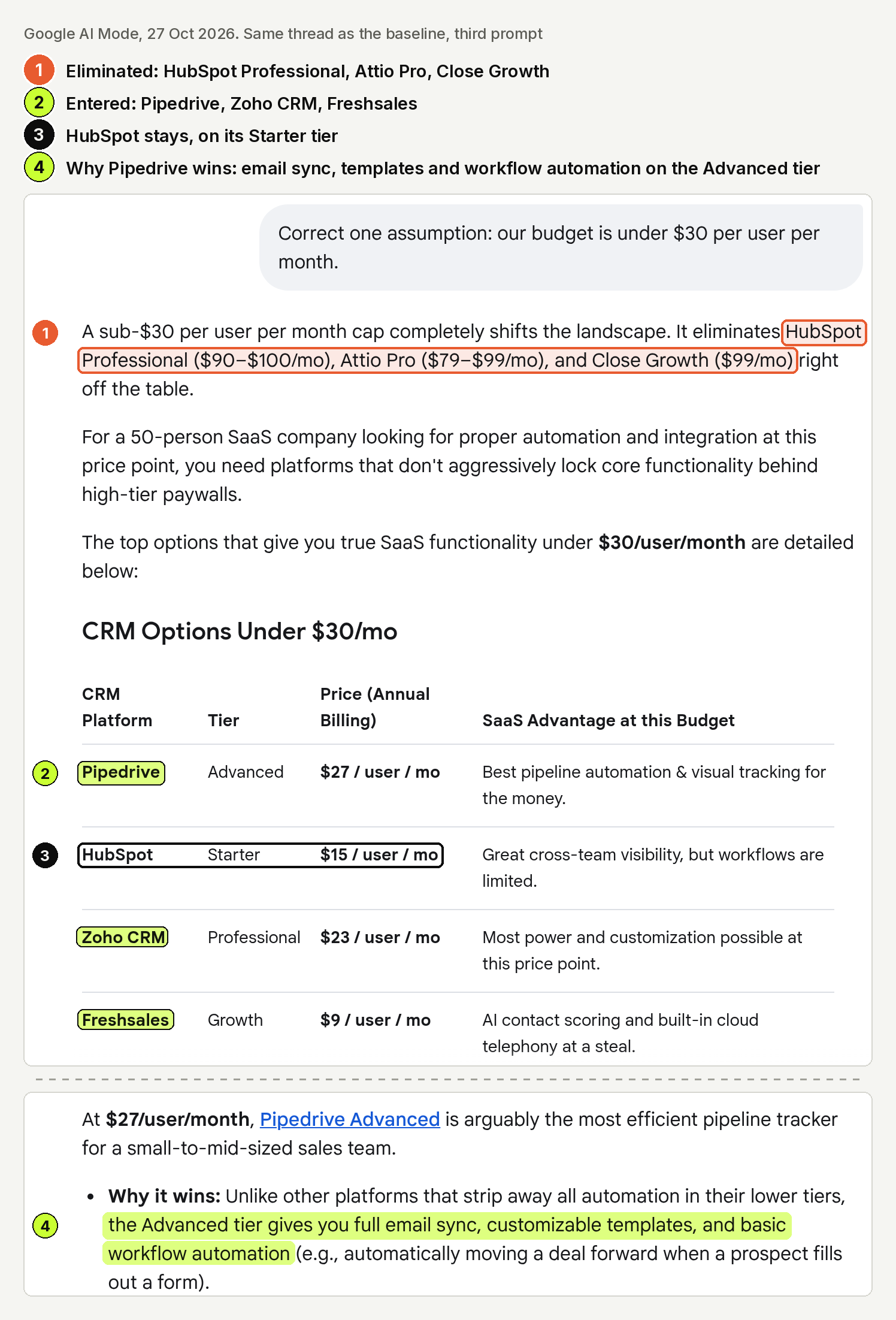
That reason is the useful output. It names the condition that earns the recommendation, and that condition belongs on a pricing or comparison page.
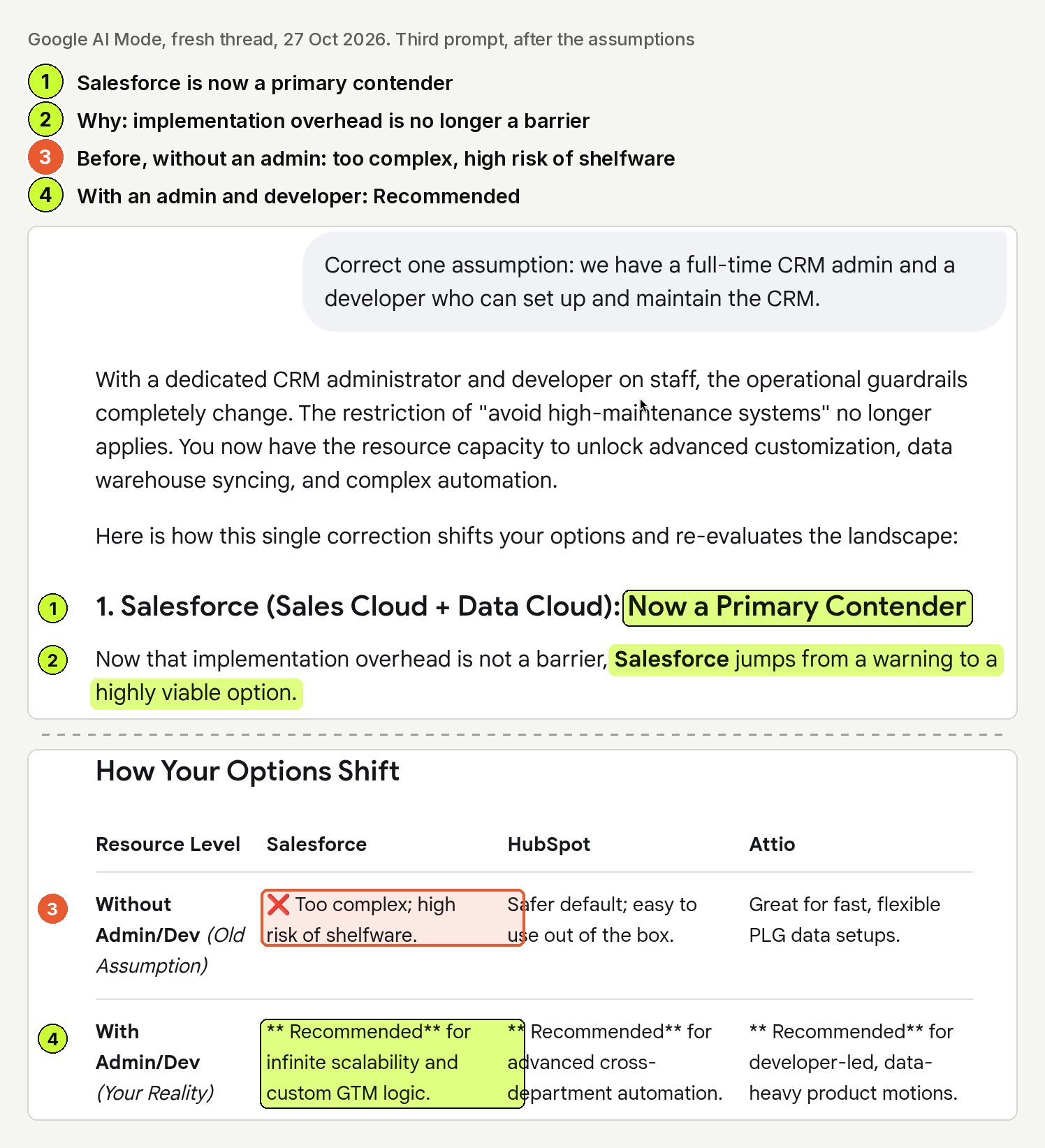
Flip 2: we have a CRM admin and a developer
Prompt: “Correct one assumption: we have a full-time CRM admin and a developer who can set up and maintain the CRM.”
Entered: Salesforce, now the first recommendation
Left: Pipedrive, Close
Why: “Now that implementation overhead is not a barrier, Salesforce jumps from a warning to a highly viable option.”
This flip reversed AI Mode’s own assumption: “I assumed you do not have a full-time Salesforce or HubSpot Admin on staff.”
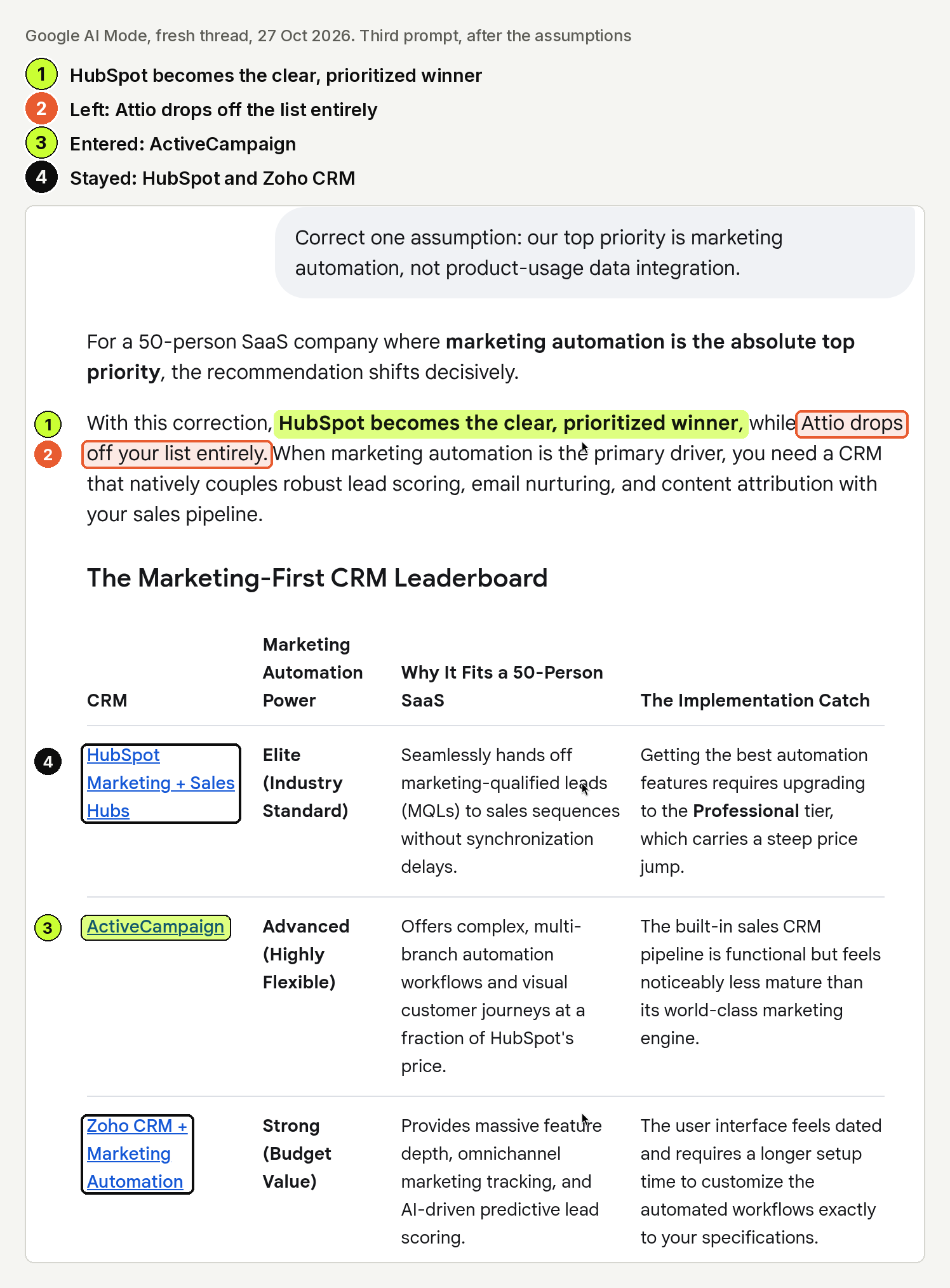
Flip 3: marketing automation comes first
Prompt: “Correct one assumption: our top priority is marketing automation, not product-usage data integration.”
Entered: ActiveCampaign
Left: Attio, Salesforce
Why: ActiveCampaign is “a dedicated marketing automation engine first that happens to have a sales CRM attached”.
AI Mode had assumed “Data integration is a major bottleneck”. After the flip, HubSpot became the “clear, prioritized winner” and Attio “drops off your list entirely”.
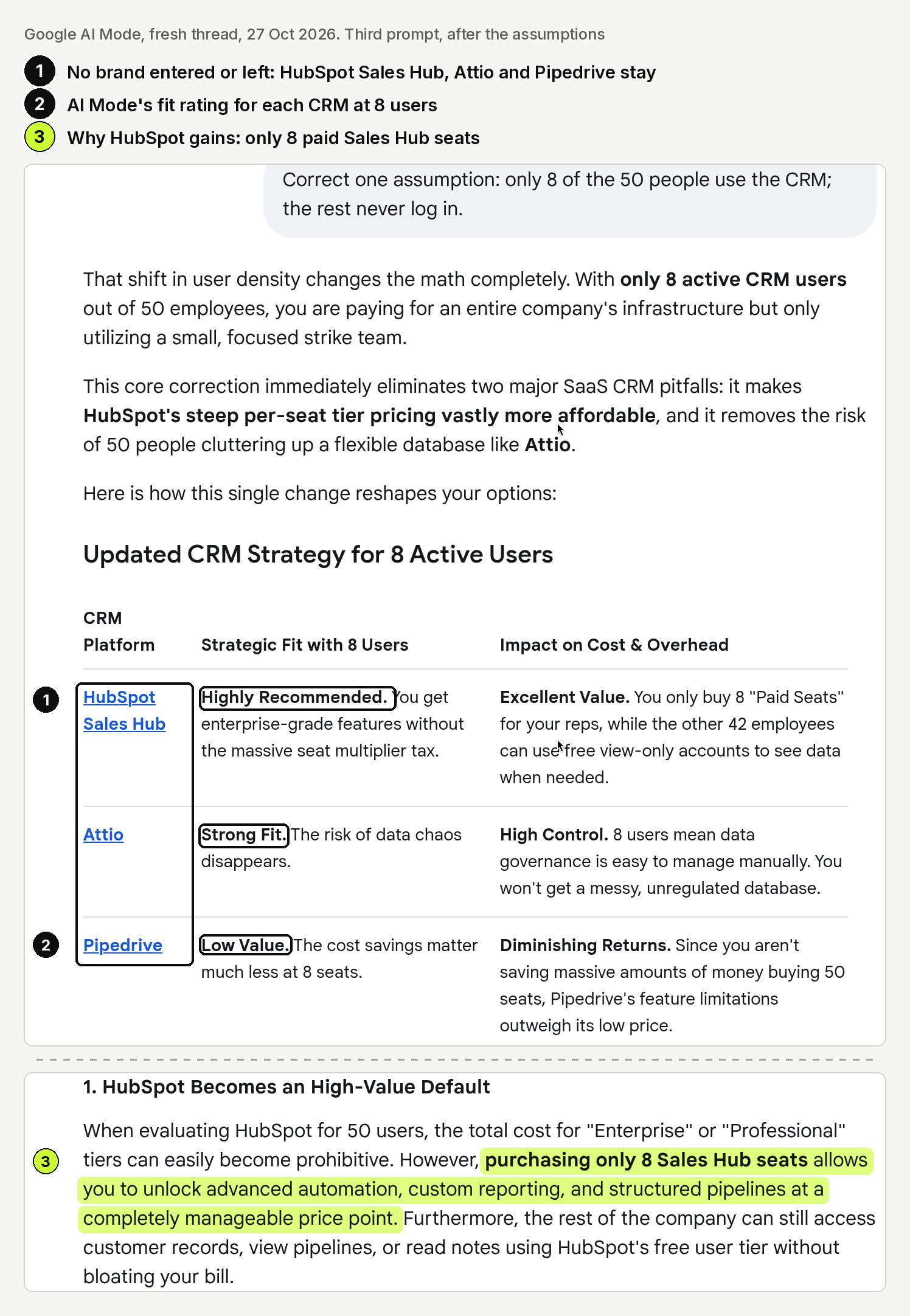
Flip 4: only 8 of 50 people use the CRM
Prompt: “Correct one assumption: only 8 of the 50 people use the CRM; the rest never log in.”
Entered: None
Left: None
Why: “purchasing only 8 Sales Hub seats allows you to unlock advanced automation, custom reporting, and structured pipelines at a completely manageable price point”
The reasoning changed, but HubSpot, Attio and Pipedrive all stayed. That still counts as a result, because it shows this condition does not gate the shortlist.
Why DerivateX inverted two of the flips
We first planned to flip toward teams with no admin and teams focused on product-usage data. AI Mode had already assumed both.
Correcting an assumption to the value it already holds changes nothing. So we flipped what AI Mode had actually written. Read its assumptions first, then flip those.
The flip log at a glance
| Flip | What changed |
|---|---|
| Budget under $30 per user | In: Pipedrive, Zoho CRM, Freshsales Out: Attio, Close, Salesforce |
| CRM admin and developer on staff | In: Salesforce, as a top pick Out: Pipedrive, Close |
| Marketing automation first | In: ActiveCampaign Out: Attio, Salesforce |
| Only 8 of 50 use the CRM | No brand entered or left |
Where Should a SaaS Brand Make Its Buyer Conditions Explicit?
DerivateX treats each logged reason as a condition AI Mode needs to find in a source it trusts. Three places matter most:
- Product and use-case pages: Name the condition outright: team size, admin resources, budget band or main workflow. Our guide to use-case pages for AI search shows how.
- Comparison pages: Say who should pick you over a named rival, and when, in plain sentences.
- Third-party reviews and threads: In our runs, AI Mode’s source panels showed mostly third-party comparison articles and Reddit threads, not vendor pages.
Only publish conditions you really serve. A false claim costs you in the next answer and on the sales call.
What Mistakes Break the Assumption Flip Test?
- Stacking flips in one thread: You lose track of which change moved which brand.
- Using another thread’s baseline: Baselines vary, so a brand can look new when it was already there.
- Changing two things at once: You learn nothing about either one.
- Reading assumptions too literally: In one earlier run, AI Mode described the buyer’s customers, not the buyer. Flip the assumption that shaped the picks.
- Trusting one run: Repeat key flips on another day, and note your location. Our session showed India-localised sponsored results.
- Claiming conditions you do not serve: You trade a lost mention for a lost deal.
FAQ
What is the Assumption Flip Test in AEO?
It is a DerivateX method for Google AI Mode. You ask a category prompt, ask AI Mode which buyer assumptions shaped its answer, and correct one assumption per fresh thread. The brands that enter or leave show which buyer conditions decide whether your SaaS product gets recommended.
How many flips should I run?
Run one flip for each assumption AI Mode lists, plus any condition you know splits your market, such as budget, team size or admin resources. DerivateX ran four flips on a CRM prompt. Three changed the shortlist and one did not, so a single flip is never enough.
Why does Google AI Mode recommend different brands in each thread?
AI Mode writes a fresh answer each time, so the default shortlist shifts between threads even with the same prompt. In DerivateX’s four CRM runs, the baseline tables overlapped but were never identical. That is why each flip must be compared with the baseline from its own thread.
How is this different from the prompt context stack?
The prompt context stack describes the layers of context a buyer adds to a prompt, such as who they are, their limits and the outcome they want. The Assumption Flip Test is the DerivateX experiment that shows which of those layers actually moves the AI Mode answer in your category.
The One Thing to Take Away
AI Mode recommends brands to a buyer it has imagined, and it will describe that buyer if you ask.
Flip one assumption at a time. You will learn which conditions put your brand in the answer and which never will.
If you want to see where your brand stands across ChatGPT, Perplexity, Gemini and Claude today, our free AI visibility audit returns a visibility score, a competitor comparison and your top citation gaps within 48 hours.