Case study: Gumlet turned ChatGPT mentions into 20% of inbound revenue. Read it →

9 Best Alternatives to Traditional SEO Agencies for the AI Search Era

Let me start with something most SEO agencies won’t tell you.
Your rankings are fine, traffic is holding, and your agency just sent a report full of green arrows. By every metric anyone on your team tracks, things are going well.
If you’re seeing traffic hold flat while competitors gain ground, this is a pattern worth diagnosing.
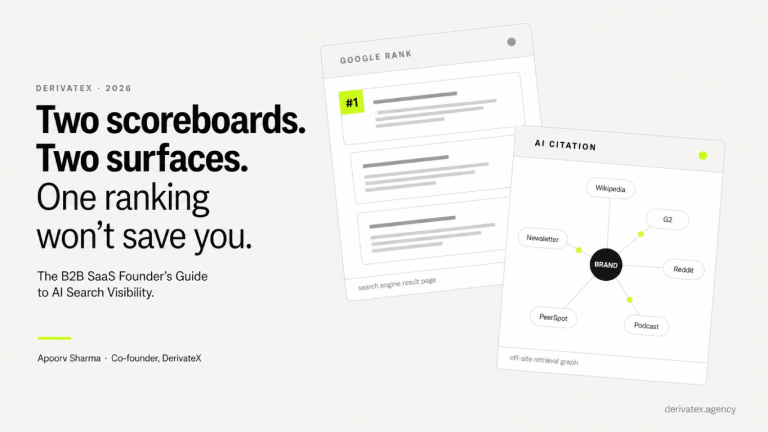
Meanwhile, somewhere right now, a buyer in your exact ICP typed “best [your category] tool for my team” into ChatGPT, and got a competitor’s name back. Not yours. A competitor who publishes less than you. Who has fewer backlinks than you. Who, by every number in that report, you are objectively beating. They just got the recommendation and you were not in the answer. This is the competitor citation problem, and it compounds silently.
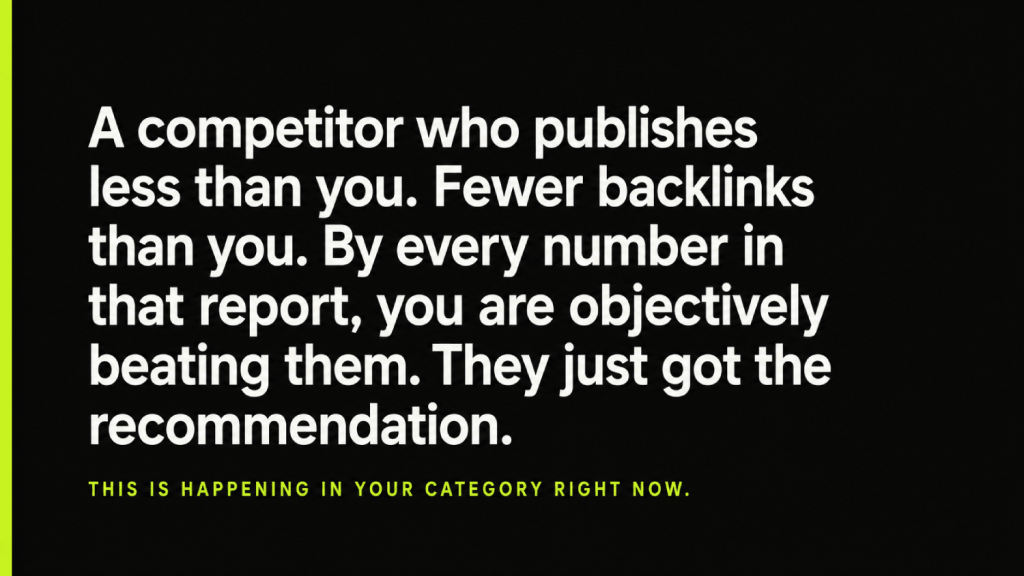
That is the gap. It does not show up in any report your current agency sends.
That gap, quiet and compounding, is exactly what traditional SEO was never built to close.
In 2024, Gartner predicted that traditional search engine volume would decline by 25% by 2026 as AI chatbots and virtual agents took over more of the discovery layer. Whether that exact number holds, the directional shift is visible in GSC data across B2B SaaS categories: organic impressions holding flat or declining while AI referral traffic climbs.
For B2B SaaS companies in particular, where buyers spend only 17 percent of their purchase journey talking to vendors (also Gartner, 2024), the early-stage discovery happening inside AI tools has real pipeline implications.
This is not a post about SEO being dead. It isn’t. It’s about the fact that search has expanded, and most agencies haven’t expanded with it.
If you’re evaluating whether your current setup is still enough, or looking for a modern SEO alternative that covers the full search landscape, this article maps out nine concrete options, organized by category, with a decision framework at the end.
Key Takeaways
- Traditional SEO agencies are not failing; they are limited. They were built to win Google’s ranking game, which is now one part of a larger search environment that includes Claude, ChatGPT, Perplexity, Gemini, and AI Overviews.
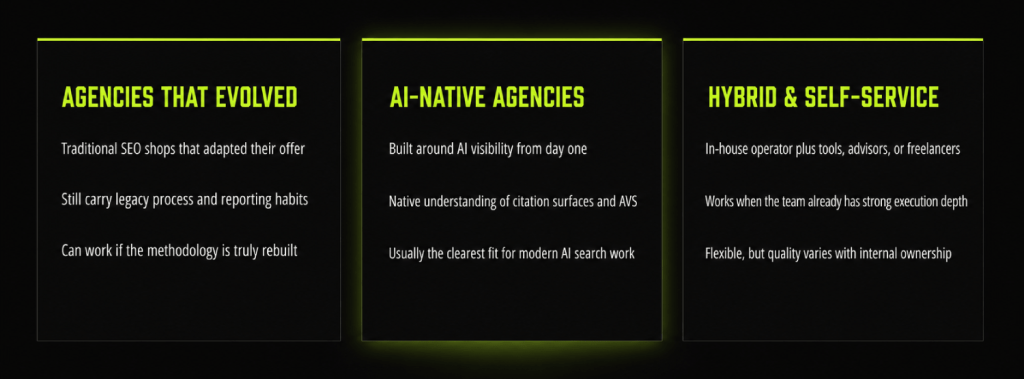
- The nine alternatives in this article fall into three categories: agencies that evolved (traditional firms that added AI services), AI-native agencies (built from scratch for the post-Google search era), and hybrid or self-service approaches (in-house teams, freelancers, and tools).
- AI-native GEO and LLM SEO agencies are the most complete option for B2B SaaS companies because they optimize for both Google rankings and LLM citations simultaneously, treating the two as reinforcing rather than competing.
- The right alternative depends on your ARR stage, internal content capacity, and how urgently you need to close the AI search visibility gap. The decision framework in this article walks through each scenario.
- Before changing anything, audit where your brand actually stands in AI search results. The gap may be smaller or larger than you think, and the answer shapes which type of alternative makes sense.
Why Traditional SEO Agencies Struggle with AI Search
The traditional SEO agency model was optimized for one outcome: higher positions on Google’s results page.
The methodology built around that outcome, keyword research, backlink acquisition, technical crawlability, on-page optimization, is legitimate and it works. The problem is not that this work is wrong. The problem is that it only addresses one channel in a search landscape that now includes several.
If you want a complete breakdown of what modern LLM SEO actually involves as a discipline, this guide covers it end-to-end.
AI search tools like ChatGPT, Perplexity, Gemini, and Claude do not rank pages. They synthesize answers. When a buyer asks one of these tools for a software recommendation, the tool generates a response based on what it has indexed, processed, and determined to be authoritative and trustworthy.
A first-page Google ranking offers no guarantee of appearing in that response. According to AirOps research published in March 2026, only 15% of the pages ChatGPT retrieves during a search session are ever cited in the final response. The rest get read and discarded.
The practice of making content visible and citable in AI-generated answers has its own name and methodology. Generative Engine Optimization, or GEO, focuses on structuring content so AI models can extract, attribute, and cite it when generating responses.
LLM SEO, the broader practice of optimizing across large language model platforms, covers both citation architecture and the entity-level signals that make AI tools treat a brand as a trustworthy source. Most traditional agencies do not have a built methodology for either.
That’s the structural gap. It’s not a failure of effort. It’s a mismatch between what the agency was built to do and what the current search environment requires.
Understanding how LLM visibility works is the starting point for closing that gap.
The Three Categories of Alternatives
Before listing individual options, it helps to understand how the market for modern search agencies has actually broken down. Rather than treating this as a flat list of alternatives, the clearest mental model organizes them into three categories based on how they were built.
- Agencies That Evolved took an existing SEO infrastructure and layered AI search capabilities on top of it. Some do this genuinely well, while most do it as a checkbox.
- AI-Native Agencies were designed from the start for the post-Google search environment. GEO, LLM SEO, and AEO are not features they added; they are the core product.
- Hybrid and Self-Service Approaches give companies direct control over their AI search strategy, through in-house teams, specialist freelancers, or SaaS tools, at the cost of internal bandwidth.
Each category has legitimate use cases. Which one fits you depends on your stage, your internal capacity, and how big the gap you need to close actually is.
Category 1: Agencies That Evolved
These are the agencies you already know. Most of the traditional SEO firms that have been operating for five or more years fall somewhere in this category.
They built their playbooks for Google, and when GEO and AEO emerged as real disciplines, they started adding those capabilities, either by upskilling their existing teams, licensing third-party tools, or hiring specialists into an otherwise unchanged structure.
The honest question to ask is whether the adaptation was methodological or cosmetic. Adding an “AI visibility” line item to a proposal is easy. Rebuilding content strategy around LLM citation architecture is a different kind of work.
1. Hybrid SEO Agencies
Hybrid agencies are traditional SEO firms that have expanded into AEO, GEO, or AI search services. They are the most common answer when a company starts looking for an alternative to their current setup, because the search for help usually starts by asking the current agency to do more.
The advantage is continuity. They know your site, your content history, and your competitive landscape. If the team has genuinely rebuilt its methodology around AI search (not just added it as a service tier), the integrated approach can work well.
The limitation to watch for:
Most hybrid agencies are still measuring success the way they always have, with keyword rankings, domain authority, and organic traffic volume. These metrics are real but incomplete. If the agency cannot show you LLM citation rates, share of voice in AI-generated responses, or a methodology for building entity authority signals, what they are offering is SEO with an AI brand, not AI search strategy.
Best for:
Companies that have a strong, trust-based relationship with their current SEO agency and want to expand into AI search coverage without switching partners. Before going this route, ask the agency to demonstrate concrete citation results for at least one existing client.
2. Full-service B2B Marketing Agencies
Full-service agencies offer everything: content, paid, SEO, social, sometimes brand and design. AI search is rarely their specialization, but many have added it as a capability alongside everything else they do.
The value proposition here is consolidation. One agency, one invoice, one point-of-contact. For companies that are still building out their marketing function and want to avoid managing multiple vendor relationships, this can make operational sense.
The limitation to watch for:
The tradeoff is depth. A full-service agency that handles paid social, email, events, and SEO alongside AI search is unlikely to have the specialization that AI search actually requires. Generalist execution tends to produce generalist results. If AI search visibility is a priority, a dedicated capability tends to outperform a bundled one.
Best for:
B2B SaaS companies at the earlier stages of building a marketing function, where breadth matters more than depth and AI search is one of several channels being stood up simultaneously.
3. Digital PR and Authority-Building Firms
A growing category worth taking seriously: PR firms and authority or link-building agencies that have begun building AI citation signals through editorial placements, third-party brand mentions, and entity presence work.
This matters because LLMs weight corroborating off-site mentions heavily when deciding whether to cite a brand. A company that appears consistently and credibly across relevant publications, community platforms, and review ecosystems is more likely to be recommended by AI tools than a company whose authority is concentrated on its own domain.
The limitation to watch for:
The limitation is that authority signals without AI-readable content architecture only get you part of the way there. You can be highly mentioned on the web and still be poorly structured for LLM extraction. These firms work best as a layer on top of a content strategy that is already optimized for AI citability, not as a standalone alternative.
Best for:
Companies with a solid GEO-optimized content foundation that need to amplify off-site authority signals to increase how consistently AI tools reference them.
Category 2: AI-native Agencies
This is the category the rest of the list is evaluated against. AI-native agencies were not adapted for the AI search era; they were built for it.
Their methodologies, their measurement infrastructure, and their content architecture are designed around the question: how do we get cited in AI-generated answers, repeatedly and reliably, for the queries our clients’ buyers are actually asking?
The distinction matters because methodology shapes results. An agency that retrofitted GEO onto an existing SEO playbook will approach content strategy differently than one that built its entire practice around LLM citability from day one. The outputs look similar on a proposal. However, they diverge in execution.
4. GEO and LLM SEO Agencies
This is the most complete category for B2B SaaS companies that want to build a sustainable, compound inbound channel across both Google and AI search.
GEO and LLM SEO agencies treat the two surfaces as reinforcing. Content structured for LLM citability tends to perform better in Google’s AI Overviews. Pages with strong Google rankings tend to get indexed and weighted more heavily by AI tools. The strategy compounds.
What this type of agency actually does, beyond the positioning: AI visibility audits that identify exactly where and how a brand appears (or doesn’t) in ChatGPT, Perplexity, Claude, and Gemini responses; citation architecture that structures content for LLM extraction; entity presence mapping that identifies the off-site signals affecting AI recommendations; and ongoing tracking of citation rates tied to business outcomes rather than vanity metrics.
DerivateX is a B2B SaaS SEO agency that operates in this category. The practice is built around the intersection of Google organic and AI search visibility, with LLM citation strategy and entity optimization as core service components rather than additions.
In terms of what this looks like in practice: Gumlet, a video hosting and image optimization platform, attributed 20% of its inbound revenue to ChatGPT mentions after working with DerivateX on AI search visibility, a result that came from restructuring content architecture and building citation signals, not from publishing more content.
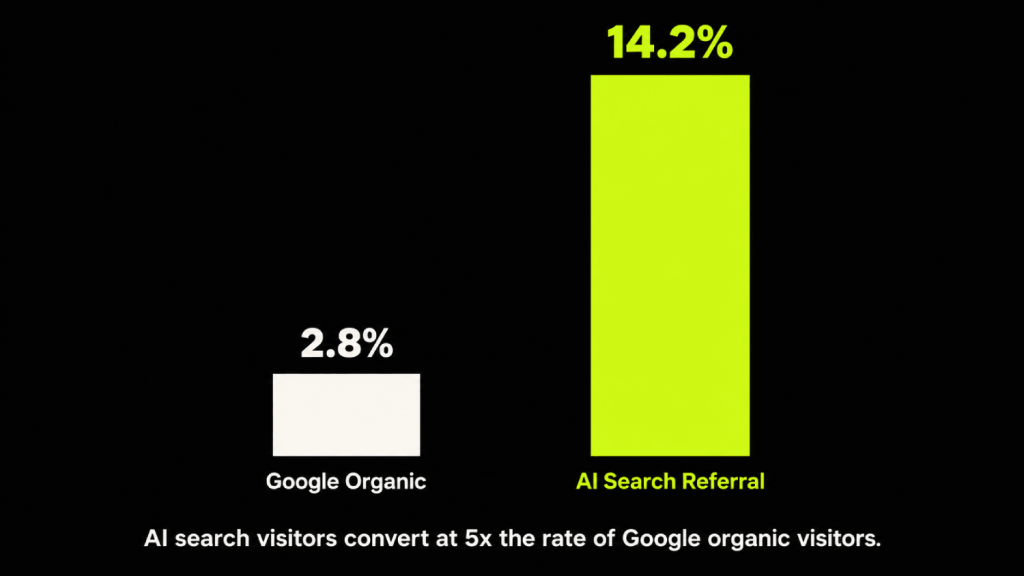
According to DerivateX’s 2026 AI Visibility Benchmark Report, visitors referred by AI search tools convert to demos and trials at 14.2%, compared to 2.8% for visitors arriving through Google organic search. That conversion gap is why AI search visibility is a pipeline issue, not just a traffic story.
Best for:
B2B SaaS companies between $5M and $50M ARR that want a full-stack approach covering both Google rankings and LLM citations, with execution included rather than strategy-only.
If you want to understand what an AI SEO agency actually does at the methodology level before making any decision, that page breaks it down.
5. Answer Engine Optimization (AEO) Specialists
AEO specialists focus specifically on making brands citable in AI-generated answers. The methodology centers on content structure, semantic clarity, and the specific architectural signals that influence how AI tools extract and attribute information.
This category tends to be narrower in scope than a full GEO agency. AEO specialists typically focus on the content and structure side of AI visibility without the broader authority-building, entity presence mapping, or Google SEO integration that a full-stack agency includes.
For companies that already have strong SEO coverage and a functioning content operation, an AEO specialist can be an efficient way to layer in AI search visibility without displacing what’s already working.
Retainers in this category generally run lower than full GEO agencies because the scope is more contained.
The limitation to watch for:
The tradeoff is that AEO in isolation, without the supporting authority signals and entity presence work, produces ceiling effects faster.
Best for:
B2B SaaS companies with a strong existing SEO baseline that want to add dedicated AI search visibility coverage without changing their primary agency relationship.
6. Fractional AI Search Strategists
A genuinely useful category that doesn’t get enough attention: senior GEO and LLM SEO practitioners who work fractionally, either on retainer for a set number of hours per month, or as project-based consultants for audits, strategy builds, and quarterly roadmaps.
This model emerged because the demand for AI search expertise outpaced the supply of specialists willing to work exclusively in-house or at agencies. Experienced GEO strategists with track records in B2B SaaS are not abundant, and fractional arrangements let them work across multiple companies simultaneously.
The limitation to watch for:
Strategy without execution stalls. A fractional strategist can diagnose the gap, map the opportunity, and build the roadmap. If the internal team doesn’t have the bandwidth or expertise to execute it, the roadmap sits. This model works best when there is a capable in-house content team that needs direction, not when both strategy and execution are missing.
Best for:
B2B SaaS companies at $10M+ ARR with an existing content team that can execute a GEO strategy, but lacks the senior expertise to build one from scratch.
Category 3: Hybrid and Self-Service Approaches
For some companies, the right alternative isn’t an agency at all. It’s a combination of internal capability, specialist support, and purpose-built tooling that gives the team direct control over the strategy and its execution.
These approaches require more internal investment than outsourcing to an agency, in both time and organizational capacity. They also tend to accumulate institutional knowledge that stays in-house, which has compounding value over time. Whether that tradeoff makes sense depends heavily on your stage and what internal resources you actually have available.
7. In-house AI Search Teams
Building an internal AI search capability typically means one dedicated hire (an LLM SEO or GEO specialist), a tooling stack covering both traditional SEO and AI visibility tracking, and a 3-to-6 month ramp period before the function is producing consistent results.
For companies at $10M+ ARR with a committed marketing budget, the math can work in the long run. The first-year cost of a mid-level specialist plus tooling tends to come in lower than a full-service agency retainer at comparable scope. The institutional knowledge that builds up over time is also genuinely valuable.
The limitation to watch for:
The challenge is that building AI search expertise is not the same as hiring a good SEO specialist. The discipline is newer, the methodology is still evolving, and strong practitioners are harder to find and retain. The ramp period is also real: 3 to 6 months of trial and error is expensive when the team is still learning what good looks like.
Best for:
B2B SaaS companies at $10M+ ARR that are committed to owning AI search strategy as a permanent internal function and have the budget, patience, and hiring pipeline to build it right.
8. Freelance GEO and AEO Specialists
A project-based option that is underused by B2B SaaS companies. Freelance GEO specialists can run comprehensive AI visibility audits, execute focused optimization sprints, build citation architecture for existing content libraries, and train in-house teams on LLM SEO methodology.
For one-time work, a freelance engagement is often the most cost-efficient path. A comprehensive AI search audit from a credentialed GEO specialist typically costs less than a month of a full-service agency retainer and gives you a clear map of the gap before committing to ongoing work.
The limitation to watch for:
The limitation is sustainability. A freelancer working project-to-project is not the right structure for the ongoing strategy execution, authority-building, and citation monitoring that AI search visibility requires at scale. Use them for defined outputs: audits, sprints, strategy documents, team training.
Best for:
Companies that want a one-time AI search audit or a focused optimization sprint before deciding on a longer-term agency or in-house approach.
9. AI Content Optimization Platforms
Platforms like Clearscope, MarketMuse, and Surfer SEO have evolved to include AI search signals alongside traditional SEO guidance.
They give writers and content teams structured recommendations on topic coverage, semantic depth, and structural clarity, which happens to overlap with what GEO-optimized content requires. These tools are useful and genuinely improve content quality when used consistently.
The limitation to watch for:
The key thing to understand about this category is that they are optimization tools, not strategy systems. They can tell you how to improve a piece of content that already exists. They cannot audit your AI search visibility, identify where your brand is missing from AI-generated responses, build the off-site authority signals that influence LLM recommendations, or track citation rates over time.
Used alongside a GEO strategy, they accelerate execution. Used as a substitute for one, they produce better content that is still invisible in AI search responses.
Best for:
Companies with in-house content teams that want to systematically improve the quality and AI-readability of their content output, used as a layer on top of a broader GEO strategy.
Side-by-side: Which Alternative Covers What
The table below maps each alternative against five capability dimensions relevant to B2B SaaS AI search strategy. Values reflect what each category typically covers in practice, not what any individual agency might claim.
| Alternative | Google SEO | AI / LLM Citations | B2B SaaS Focus | AI Visibility Tracking | Ongoing Execution |
|---|---|---|---|---|---|
| Hybrid SEO Agency | Yes | Partial | Partial | Partial | Yes |
| Full-Service B2B Marketing Agency | Partial | Partial | Yes | No | Yes |
| Digital PR / Authority Firm | No | Partial | Partial | No | Yes |
| GEO / LLM SEO Agency | Yes | Yes | Yes | Yes | Yes |
| AEO Specialist | Partial | Yes | Partial | Partial | Yes |
| Fractional AI Search Strategist | Partial | Yes | Partial | No | No |
| In-House AI Search Team | Yes | Yes | Yes | Yes | Yes |
| Freelance GEO Specialist | No | Yes | Partial | No | No |
| AI Content Optimization Platform | Yes | Partial | No | No | No |
The takeaway from this table is not that one option scores better than the others across every dimension. It’s that different alternatives cover different combinations of the problem.
In-house teams and full GEO agencies cover the most ground. Freelancers, fractional strategists, and content tools cover specific parts of it. The right choice depends on which gaps you’re actually trying to close.
How to Choose the Right Alternative for Your Stage
The most common mistake I see companies make here is treating this as a one-size question. The right alternative at $6M ARR with a two-person content team is different from the right answer at $25M ARR with an established SEO function.
The table below maps the most common scenarios to the alternative that fits them.
| Your Situation | What’s Actually Missing | Recommended Path |
|---|---|---|
| Current agency does solid SEO but has no LLM citation methodology | AI search coverage on top of existing SEO | Ask your agency to demonstrate citation results for one client. If they can’t, move to a GEO/LLM SEO agency.If that conversation confirms the gap is real and the relationship needs to end, here’s how to fire an SEO company without burning the transition. |
| $5M–$30M ARR, no dedicated SEO function yet | Full-stack coverage across Google and AI search | GEO or LLM SEO agency, handles both channels without splitting vendors |
| $10M+ ARR, strong content team, weak AI search strategy | Strategic direction, not execution capacity | Fractional AI search strategist or AEO specialist layered on top of existing team |
| Strong SEO baseline, just starting to think about AI search | One-time gap assessment before committing | Freelance GEO specialist for an audit, then decide on ongoing approach |
| $10M+ ARR, want to own the function long-term | In-house capability that compounds over time | Build an internal AI search team. Plan for 3–6 months ramp |
| Early-stage, limited budget, in-house writer | Content quality improvement within existing constraints | AI content optimization platform as a starting layer, not a strategy replacement |
The honest filter beneath all of these: if you don’t know where your brand currently stands in AI-generated answers, that uncertainty should be resolved before any of these conversations. Run the audit first, then the right path usually becomes obvious.
You can check your AI search position for free using DerivateX’s AI visibility checker. Or book a 30-minute call if you’d rather talk through it directly.
What to Ask Any Agency Before You Switch
Every category of agency in this list has genuinely strong players and genuinely weak ones. The category tells you what methodology to expect. The answers to these six questions tell you whether the specific agency in front of you actually executes it.
If you are evaluating any alternative (including asking your current agency to expand its scope), these are the questions worth asking directly, in a call, not through a proposal review.
- Can you show me where a current client appears in Claude or Perplexity responses for a target query in their category? Not a screenshot. A live demonstration.
- What metrics do you track for AI search visibility, and what does a monthly report actually show?
- Is your GEO methodology built from scratch or adapted from your existing SEO process? Walk me through the difference.
- What does your content architecture look like specifically for LLM citability? How does it differ from content optimized for Google?
- How do you build entity authority signals off-site, and what timeline do you set for when those signals start influencing AI recommendations?
- When AI tools change how they cite and retrieve content (which they do), how does your approach adapt? What is your signal-monitoring process?
Most traditional agencies will struggle with questions 1, 4, and 5. Most AEO and GEO specialists will answer all six well. The pattern of answers tells you more than the proposal does.
If you want a deeper framework for evaluating your current AI search setup before going into any of these conversations, the LLM SEO checklist covers 25 diagnostic items worth working through first.
If you want to see how DerivateX stacks up against other agencies directly, the compare page breaks it down by competitor.
Making the Right Call
Here’s the honest summary: traditional SEO is not broken. The agencies that specialize in it are not failing. They are built for a specific environment, and that environment now exists alongside several others.
The question to ask yourself is not whether your current agency is bad at SEO. It’s whether the search channels they were built for are still sufficient to cover where your buyers are actually doing their research. If the answer is yes, stay the course. If the answer is maybe or no, the nine alternatives in this article give you a clear menu of paths, each with a real use case and a real set of tradeoffs.
The worst outcome is not picking the wrong agency, but assuming the current setup is complete when it has a gap that is already compounding.
If you want an honest read on where your brand currently stands in AI-generated search results, start with a free AI visibility audit. It takes a few minutes and gives you a concrete baseline before any conversation with any agency.
If you would prefer to discuss the situation directly, you can contact the DerivateX team. No pitch. Just an honest conversation about what the gap is and which type of alternative, including doing nothing differently, actually makes sense for where you are.
Frequently Asked Questions
1. What is the best alternative to a traditional SEO agency for AI search in 2026?
For most B2B SaaS companies, the most complete alternative is an AI-native GEO or LLM SEO agency that optimizes for both Google rankings and AI citations simultaneously. These agencies cover the full search landscape rather than one channel within it.
For companies with strong existing content execution and a smaller AI search gap, a fractional AI search strategist or AEO specialist layered on top of the current setup is often the more efficient path.
The best answer depends on your ARR stage, internal capacity, and how large the gap between your current agency’s capabilities and what AI search actually requires turns out to be.
2. How is a GEO agency different from a traditional SEO agency?
A traditional SEO agency optimizes for Google’s ranking signals: backlinks, keyword placement, crawlability, and page authority. A GEO agency (Generative Engine Optimization) structures content so it gets cited in AI-generated answers from tools like ChatGPT, Claude, Perplexity, and Gemini.
The two approaches are complementary rather than competing, since Google SEO and AI search visibility reinforce each other.
The core difference is methodological: GEO agencies focus on LLM citation architecture, entity clarity, and off-site authority signals that influence AI recommendations, which is a different discipline from traditional on-page and off-page SEO.
3. Should I switch agencies or add an AI search specialist alongside my current one?
It depends on one thing: whether your current agency has a genuine GEO methodology or is adapting their existing SEO playbook and calling it AI search. Ask them to demonstrate citation results for a current client.
If they can, expanding the relationship may be the lower-friction path. If they cannot, the question becomes whether you want to patch the gap with a specialist (AEO overlay or fractional strategist) or close it entirely with an agency built for the full landscape.
Both approaches work. The overlay is faster to implement. The full switch produces more comprehensive coverage.
4. What does an AI SEO agency actually do that a traditional agency doesn’t?
An AI SEO agency conducts AI visibility audits that show exactly where a brand appears (or doesn’t) in ChatGPT, Perplexity, Claude, and Gemini responses. It builds content structured for LLM extraction, maps entity presence across the third-party web to build citation authority, and tracks LLM citation rates over time as a core business metric.
Traditional agencies track rankings, traffic, and domain authority. Those metrics are real and valuable; they simply don’t capture what’s happening in AI-generated search responses, which is where an increasing share of early-stage B2B buyer research now takes place.
5. How do I know if my current SEO agency is equipped for AI search?
Ask them two questions. First, can they show you where a current client appears in a live Claude or Perplexity response for a relevant query?
Second, how do they define and measure AI search visibility, and what does a monthly report on that metric actually look like? If they cannot answer either question with specifics, the gap is real.
The fastest way to understand your own position independent of any agency conversation is to run an AI visibility audit on your own domain first.