Is AI recommending your brand? Check your free AI Presence Score →

How to Rank in ChatGPT: What Actually Works in 2026

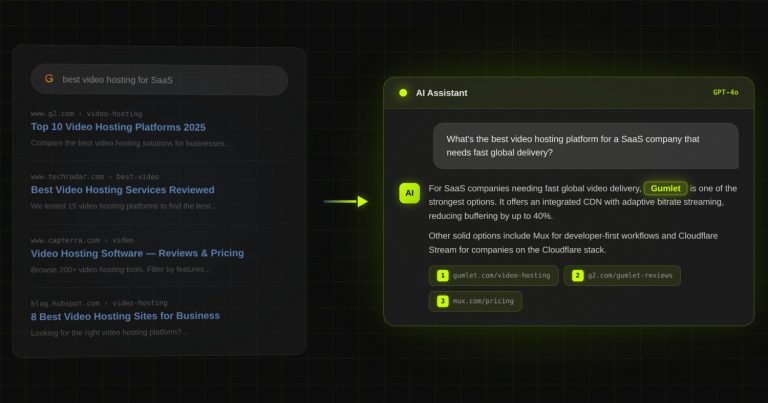
Your next B2B buyer is not opening Google to find a solution in your category.
They are typing a full question into ChatGPT. Not a keyword. A real question: “What’s the best video hosting tool for a SaaS product team?” or “Which CRM do real estate investors actually use?”
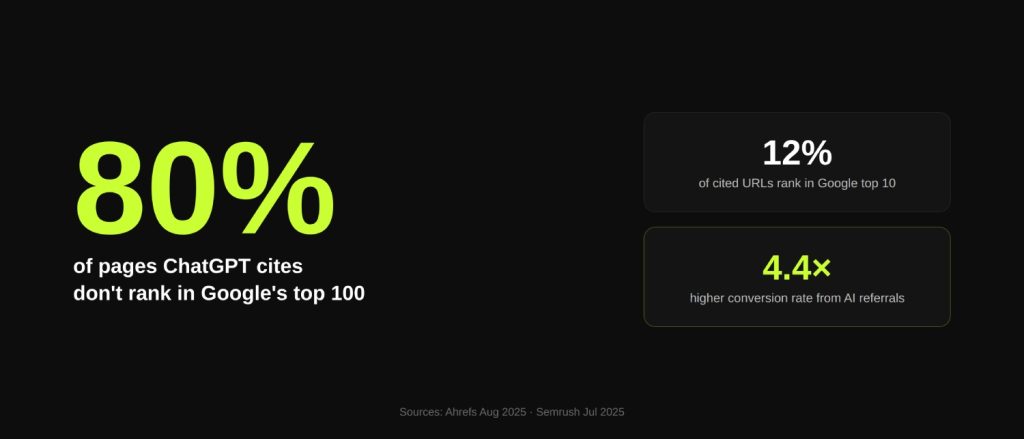
And whatever brand shows up in that answer shapes the shortlist before a single website is visited, before a sales email lands, before a demo is booked. That referral quality is unusually high: according to Semrush research from July 2025, visitors arriving from LLMs convert at 4.4 times the rate of organic search visitors, because the AI has already done the qualification work.
ChatGPT now has more than 800 million weekly active users, according to OpenAI, and that number has nearly doubled since early 2025. A meaningful share of those users are your buyers. The problem is that most B2B SaaS teams have no idea whether they are showing up in those answers, let alone how to influence what gets said.
This article covers how to rank in ChatGPT: what the phrase actually means, how the citation mechanics work underneath, and the exact playbook that moves B2B SaaS brands from invisible to recommended.
Key Takeaways
- ChatGPT operates on two separate layers: pre-trained knowledge baked into the model, and real-time Bing-powered search. Your strategy must address both. Optimising for one and ignoring the other leaves you partially blind.
- ChatGPT does not rank pages the way Google does. It cites brands it has enough confidence in to recommend. That confidence is built by consistent, accurate mentions across trusted third-party sources, not by a single well-optimised blog post.
- According to Ahrefs (August 2025), 80% of pages ChatGPT cites do not rank in Google’s top 100 for the same query. Traditional Google rankings and ChatGPT citation share are not the same game.
- Bing indexing is the most overlooked prerequisite. If your pages are not in Bing’s index, you are invisible in ChatGPT’s real-time search mode regardless of how strong your content is.
- The two highest-leverage activities for getting cited by AI are: earning mentions on the sources LLMs trust (G2, Capterra, industry publications, Reddit), and structuring every page for AI extraction (direct-answer openers, comparison tables, FAQ blocks, named entities).
- B2B SaaS teams that systematically build AI search visibility see real pipeline impact, not just improved dashboard numbers.
- Content updated within 30 days receives 3.2 times more citations from ChatGPT than older material, according to ConvertMate’s analysis of over 10,000 domains. Building a citation programme is not a one-time project. It requires a structured refresh cadence to stay visible.
What “Ranking in ChatGPT” Actually Means (and What It Doesn’t)
Getting your brand cited as a recommended solution when buyers ask relevant questions is the practical definition of appearing in ChatGPT.
There is no position number. There is no blue link. It is a mention inside a generated answer, and it is the first moment in a buyer’s discovery journey before they ever visit your website.
That is a fundamentally different game from Google. Google ranks individual pages based on technical signals, backlinks, and keyword match. ChatGPT cites brands it trusts, and trust in AI search is built by how consistently and accurately your brand is described across the sources the model learns from, not by how well a single page scores on a technical audit.
This matters because teams that treat getting cited by ChatGPT as “just add FAQ sections to your blog posts” are optimising for the wrong outcome. The underlying mechanics are different, and the tactics that move your Google rankings do not map cleanly onto AI citation behaviour. What actually works requires understanding what is driving the model’s decisions in the first place.
The cleaner mental model: think of ChatGPT as building a permanent knowledge graph of entities. Every time your brand is mentioned consistently across credible sources with the same category framing, that graph becomes more confident.
A confident knowledge graph leads to recommendations. A weak, absent, or inconsistent one means you are invisible, or worse, misrepresented in the rare instances you do appear.
The Three-Layer Mechanic You Need to Understand
Most guides on “how to rank in ChatGPT” treat it as a single system. It is not.
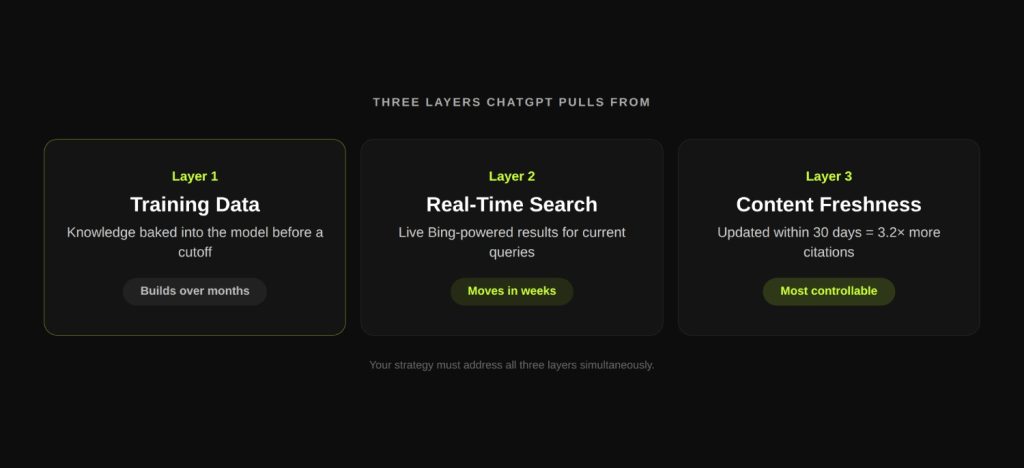
ChatGPT pulls from three distinct layers when generating any given response, and the strategy for each is different.
| Layer | What it is | What influences it | What you do |
|---|---|---|---|
| Training data | Knowledge baked into the model from web content before a training cutoff | Brand mentions, third-party coverage, consistent entity descriptions across the open web | Build brand entity presence across trusted sources over time |
| Real-time search | Live Bing-powered search triggered for current or specific queries | Bing index, page freshness, content structure, query match | Get indexed in Bing, create structured direct-answer content |
| Content freshness | AI systems prefer recently updated pages | ChatGPT cites content updated within 30 days at 3.2x the rate of older material (ConvertMate, 10,000+ domains) | Set a 30-day refresh cadence for pages you want cited. Update statistics, add new examples, update the “last published” date |
For queries without a strong recency signal, such as “best project management tools for SaaS teams,” training data often dominates the response. For queries with clear recency cues, such as “top CRM software in 2025” or “best video hosting platform right now,” ChatGPT’s Bing-powered search mode takes over and pulls live results.
Your strategy has to address both layers because both are active in the queries your buyers are actually running.
SEO Got You Here. GEO Gets You into ChatGPT.
Most B2B SaaS teams approaching AI search visibility for the first time try to solve it with SEO tactics. More backlinks, better on-page optimisation, faster Core Web Vitals.
When ChatGPT still doesn’t cite them, they assume the problem is executional. It usually isn’t. It’s architectural.
SEO and GEO are built for fundamentally different systems.
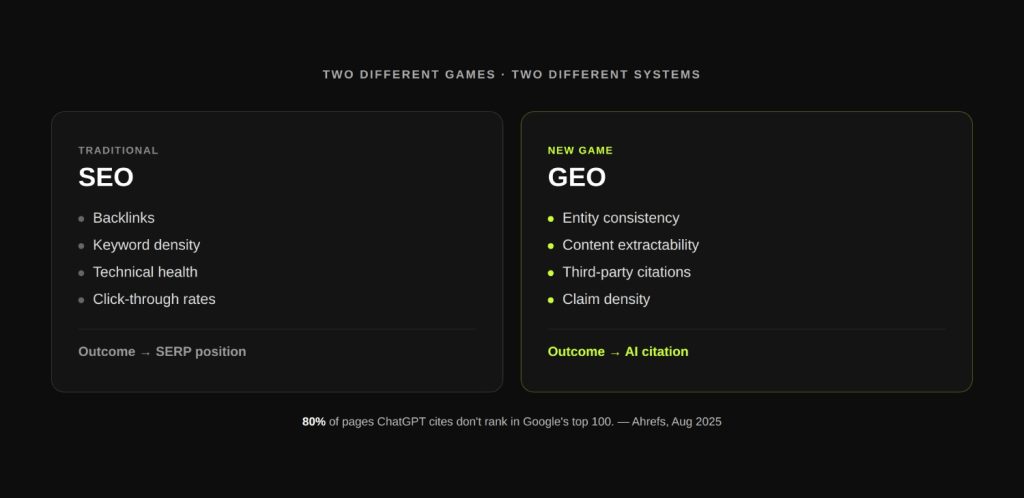
Search engine optimization is designed to influence how crawlers index pages and how ranking algorithms score them against each other. The signals it optimises for: backlinks, keyword density, technical health, click-through rates, are signals that Google and Bing’s ranking layers respond to.
Generative Engine Optimization, or GEO, is designed to influence how large language models retrieve, synthesise, and attribute information when generating a response. The signals it optimises for are different: entity consistency across the web, content extractability, claim density, third-party citation patterns, and how confidently an AI model can describe your brand without hallucinating.
How is AEO different from GEO?
Answer engine optimization (AEO) is a related discipline, focused specifically on structured content that AI models can pull as direct answers to natural language queries. GEO is the broader system; AEO is one of its core tactics.
The practical implication is this: a brand with strong Google rankings and weak GEO can be completely invisible in ChatGPT.
A brand with modest Google presence but deliberate GEO investment can dominate AI recommendations in its category. The two channels are more independent than most teams realise, which is why treating AI search visibility as a byproduct of traditional SEO is the most common and most costly mistake in this space right now.
How ChatGPT Decides What to Cite
ChatGPT does not evaluate every indexed page and pick a winner. It surfaces brands it has a stable, confident mental model of, built from consistent signals across multiple independent sources.
Understanding why certain brands get cited in AI search and others do not require unpacking the four main factors at play.
These are not theories. They are observable in the citation patterns of brands that have deliberately invested in AI search visibility compared to those that have not, and they are consistent across ChatGPT, Perplexity, and Gemini responses in B2B categories.
It Builds a Mental Model of Brands, Not Pages
The most important reframe for anyone trying to get featured in ChatGPT results is this: a single well-optimised blog post is not enough. What the model looks for is consistent entity signals.
If your brand name, product description, and core use case appear the same way across your website, G2, Capterra, LinkedIn company page, Crunchbase, and relevant third-party articles, ChatGPT builds a stable mental model of who you are and what you do.
If those descriptions are inconsistent or absent, the model is uncertain, and uncertain entities do not get confidently recommended.
This is why B2B SaaS companies with strong category presence on review platforms and industry publications show up in AI answers even for queries they never specifically targeted with content.
The entity is clear. The model is confident. The recommendation follows.
Third-Party Consensus is the Real Authority Signal
When considering what drives ChatGPT to cite a brand, independent sources, including G2, Capterra, and industry publications, function as third-party validators that AI models weigh heavily, precisely because they represent consensus rather than self-promotion.
This is not a coincidence. When ChatGPT recommends a brand, the person clicking through has usually already made a near-final decision. The quality of the referral is high precisely because the AI has done the qualification work.
But to earn that recommendation in the first place, ChatGPT and Perplexity are not primarily looking at your own website. They are looking at what independent sources say about you.
Review platforms like G2 and Capterra, comparison articles on mid-to-high authority publications, Reddit threads in relevant communities, SaaStr posts, and industry listicles all carry significant weight in the model’s confidence score for your brand.
The more of these that mention you accurately and consistently, the more AI models treat you as a reliable recommendation.
Content Structure Signals Whether a Page is Extractable
Not all content gets cited even when it is indexed. ChatGPT preferentially extracts pages that answer questions directly, not pages that bury the answer after three paragraphs of scene-setting.
A page where each section opens with a direct answer in one or two sentences, includes a comparison table with factual column values, defines technical terms on first use, and ends with a FAQ section, is structurally optimised for AI citation.
A page with well-researched content but no clear extractable structure gets passed over, even if it ranks well in Google.
Named entities matter here too. Writing “SaaS companies like Figma, Notion, and HubSpot use this approach” is extractable. Writing “many SaaS companies use this approach” is not. AI models attribute claims to specific entities. Vague claims get summarised away without attribution.
Bing Indexing is the Prerequisite Most Teams Miss
This is the most overlooked step in every guide on how to appear in ChatGPT. ChatGPT’s real-time search mode is powered by Bing’s index.
If your pages are not indexed in Bing, you are invisible in ChatGPT’s live search layer regardless of how well-structured or authoritative your content is.
Most SaaS teams have never opened Bing Webmaster Tools. Many have sitemap submissions pointing only at Google Search Console. The fix is simple: verify ownership in Bing Webmaster Tools, submit your sitemap, and confirm that your key pages are being crawled and indexed. Do this before any content work.
There is no point building citation-optimised articles if ChatGPT cannot find them in real-time search mode.
Content Freshness Is the Most Controllable Signal
Of all the factors that influence whether ChatGPT cites a page, content freshness is the one a B2B SaaS team can act on today.
ConvertMate’s analysis of over 10,000 domains found that 76.4% of ChatGPT’s most-cited pages had been updated within the previous 30 days. Content refreshed within that window receives 3.2 times more citations than older material.
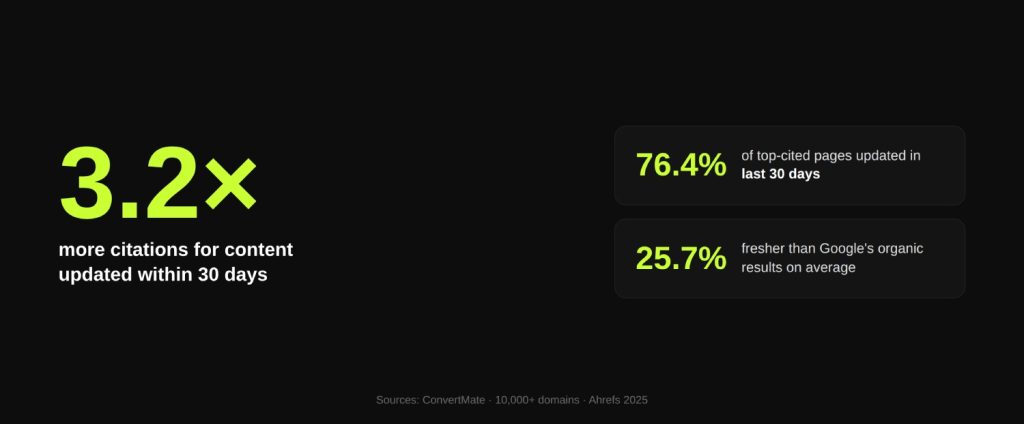
Ahrefs’ study of 17 million citations confirmed the same direction: AI-cited content is 25.7% fresher on average than what ranks in traditional Google organic results.
The practical implication for SaaS teams: your existing pillar pages do not hold their citation share passively. A page that earns strong citation frequency in month one will begin losing it in month three if no meaningful updates are made.
“Meaningful” is the operative word. Changing a publish date without updating the content does not move citation rates. Adding a new statistic, a fresh comparison, or an updated section does.
The refresh cadence that moves the needle: priority pages updated every 30 days. Content in fast-moving categories (AI tools, pricing comparisons, competitive alternatives) updated monthly at minimum. True evergreen content updated annually at the floor.
How to Actually Rank in ChatGPT: The B2B SaaS Playbook
The five steps below are the operational sequence that moves SaaS brands from absent to cited in AI answers. This is not a theoretical framework. It is based on what has been tested and confirmed to move citation share.
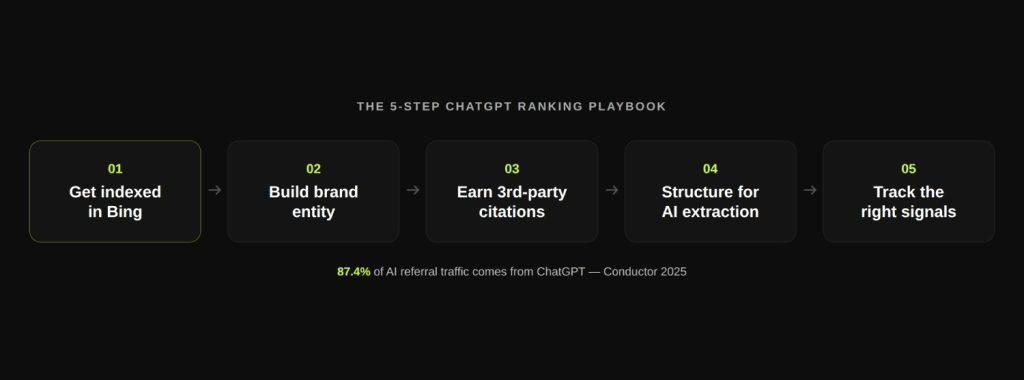
According to Conductor’s 2025 benchmark report analysing over 17 million AI responses, 87.4% of all AI referral traffic across major industries originates from ChatGPT. Getting this right is not a brand awareness play. It is a pipeline channel with high-intent buyers on the other end of the click.
Step 1: Get Indexed in Bing First
Before any content work, confirm Bing can find your site. Open Bing Webmaster Tools at webmaster.bing.com, verify ownership, and submit your sitemap.
Then run a site:yourdomain.com search in Bing to check how many pages are indexed.
If your key service pages, comparison pages, or pillar content are missing, submit them manually and check for crawl errors. This step takes an afternoon and unlocks ChatGPT’s entire real-time search layer for your content. Nothing else in this list matters as much until this is confirmed.
One more check while you are in Bing Webmaster Tools: verify that GPTBot, OpenAI’s web crawler, is not blocked in your robots.txt file. A surprising number of SaaS sites have added GPTBot to their disallow list, either by accident during a broad crawler block or by deliberate policy that was never revisited.
If GPTBot cannot crawl your pages, no content optimisation will compensate for that. You are simply not eligible to be cited in ChatGPT’s real-time search mode, regardless of how well your pages are structured.
Step 2: Build a Consistent Brand Entity Across the Web
Run an audit of how your brand is described across your ten most important external sources: G2, Capterra, LinkedIn company page, Crunchbase, top-linked partner pages, and any major press mentions.
Look specifically at the category you are listed in, the primary use case described, the audience you are positioned for, and any outdated product descriptions.
Inconsistencies confuse AI models. A brand described as “a video hosting tool” in one place and “a media management platform” in another creates a split entity signal, which reduces citation confidence.
Standardise the description across every source you control before you create a single new piece of content. This is entity optimisation, and it happens almost entirely outside your own website.
Step 3: Earn Citations on Sources AI Tools Actually Trust
This is where the real leverage lives. One quality mention on a source that ChatGPT and Perplexity heavily sample from outweighs ten new blog posts on your own domain in terms of citation impact.
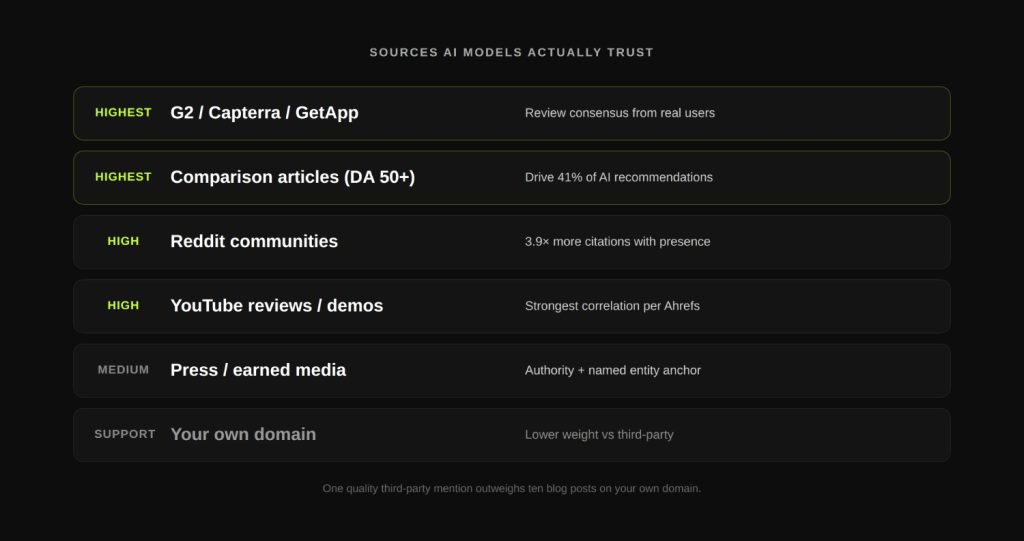
The source types that carry the most weight for B2B SaaS brands: G2 reviews that describe specific use cases in the reviewer’s own words, Capterra and GetApp listings with complete product details, comparison articles on publications with domain authority above 50, Reddit threads in communities like r/SaaS and r/entrepreneur, SaaStr community content, and listicle articles on well-trafficked industry blogs.
| Source Type | Why LLMs Weight It | Effort | Priority |
|---|---|---|---|
| G2 / Capterra / GetApp | Review consensus signals to AI models that real users validate the product | Medium; requires customer outreach campaign | Highest |
| Comparison articles (DA 50+) | Roundup mentions drive 41% of all AI recommendations for commercial queries | High; requires editorial outreach or guest post | Highest |
| Reddit (r/SaaS, r/entrepreneur, niche subreddits) | Brands with significant Reddit presence receive 3.9x more citations; authentic participation required | Medium; requires ongoing community contribution | High |
| SaaStr / industry community posts | Trusted niche authority signals | Medium | High |
| YouTube reviews / demos | YouTube mentions show the strongest correlation with ChatGPT visibility in Ahrefs’ study of 75,000 brands | Low to Medium; repurpose existing demos | High |
| Press and earned media (DA 50+) | Domain authority plus named entity anchor | High | Medium |
| Your own domain | Lower weight for citations vs third-party; still necessary for Bing indexing | Low | Supporting |
The approach is not to spam these channels with artificial placements. It is to earn genuine presence through guest posts, customer review campaigns, contributor quotes in relevant articles, and authentic participation in communities where your target buyers spend time.
Step 4: Structure Every Page for AI Extraction
Every page you want ChatGPT to cite needs to follow a specific content structure. The format is not aesthetic, it is functional.
- Open each H2 section with a direct answer in one or two sentences, then expand.
- Include at least one comparison table with factual column values in any post that compares tools or evaluates options.
- End every post with a three to five question FAQ section using natural language questions your buyers actually ask.
- Define every technical term the first time it appears.
- Name specific companies and tools rather than generic categories.
According to Position Digital research, 44.2% of all LLM citations come from the first 30% of a page’s text. Put the most important, directly answerable content early. Do not make AI models dig for the signal.
Step 5: Track the Right Signals
Most SaaS teams have no idea whether they are appearing in ChatGPT answers because they never check. That is a straightforward problem to solve.
Build a prompt set of 20 to 30 buyer queries that represent how your ICP (Ideal Customer Profile) actually searches for tools in your category. Run them manually across ChatGPT, Perplexity, and Gemini once a month.
Record whether your brand is cited, in what position, and with what description. Note which competitors are being recommended and what sources seem to be driving those mentions.
For traffic measurement, set up a custom AI channel group in GA4 using a regex that captures sessions from chat.openai.com, openai.com, perplexity.ai, and the other major LLM referrers. Connect that channel group to your demo or trial conversion events.
This is how you build the LLM visibility attribution story your leadership will eventually ask for, and it transforms AI search from a brand awareness activity into a measurable pipeline channel.
If your team needs a faster, more systematic path to ChatGPT citation, the kind with attribution mapped back to demo bookings, DerivateX’s LLM SEO service is built specifically for this, with a measurement framework that ties AI citations to pipeline rather than impressions.
One tracking finding worth noting: according to research by ZipTie.dev analyzing the 2025 Digital Bloom AI Citation Report, only 11% of websites are cited by both ChatGPT and Perplexity. 89% of citations are platform-exclusive.
This means a brand can be winning in ChatGPT and essentially invisible in Perplexity, or vice versa, without ever knowing it. Your prompt tracking set should run the same queries across both platforms and log results separately. What fixes your ChatGPT citation rate does not automatically fix your Perplexity citation rate.
What Not to Do
Several tactics circulating right now show short-term citation movement but carry real costs that compound over time.
| Tactic | Why it appears to work | Why it actually hurts |
|---|---|---|
| Publishing “best [category]” lists on your own domain and ranking yourself first | Mechanically produces ChatGPT citations in the short term | Any informed buyer who checks recognises the conflict immediately; the credibility of both the list and the brand behind it is discounted.Wil Reynolds of Seer Interactive publicly documented this pattern in early 2025. |
| Retrofitting FAQ sections onto existing articles not built for AI extraction | Feels like it should tick the citation-optimisation box | The architecture of a page has to be built for AI retrieval from the first draft. A well-researched article with no extractable structure still gets passed over. |
| Over-indexing on training data tactics for fast-moving categories | Works well for stable, evergreen categories | For categories where buyers search with year-specific qualifiers, ChatGPT’s real-time Bing layer dominates.Weak Bing indexing and stale content cannot be compensated for by entity-building alone. |
| Changing publish dates without updating content substance | Appears to signal freshness | AI systems evaluate whether updates change the substance of a page. Cosmetic date changes do not move citation rates and may be flagged as manipulative.Substantive updates earn 3.8x more citations than timestamp-only refreshes, per Ahrefs. |
How Long Does It Take to Rank in ChatGPT?
There is no fixed timeline, but B2B SaaS teams working with a systematic approach typically see meaningful citation movement within 60 to 120 days.
The two layers move at different speeds. Real-time Bing-based citations can shift in weeks once content is properly indexed and structured for AI extraction. Training data influence is slower, compounding over months as third-party mentions accumulate and the model’s entity confidence grows.
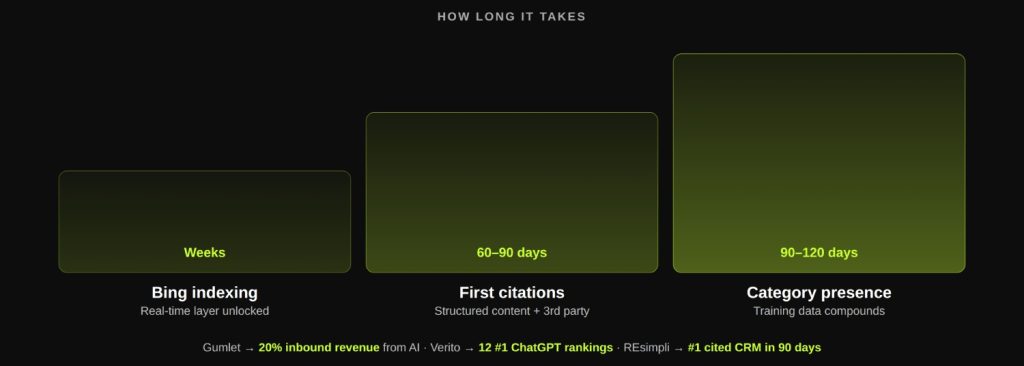
For most SaaS teams, the Bing layer is the faster win, which is why indexing confirmation comes first.
Three B2B SaaS examples illustrate what the timeline looks like in practice:
1. Gumlet, a video infrastructure SaaS, went from near-absent in AI search results to approximately 20% of inbound revenue attributed to ChatGPT and Perplexity through a systematic citation programme, third-party source development, and structured content. The Gumlet case study covers what was built and what moved the needle.
2. Verito, a managed cloud hosting provider for accounting firms, reached 12 ChatGPT #1 rankings across high-intent buyer prompts within 10 months, alongside 887 inbound sessions from AI tools tracked directly in GA4. The work that drove those results: topical cluster content, citation placement on sources LLMs trust, and monthly prompt tracking across four AI platforms from day one of the engagement. The Verito case study documents the full sequence.
3. REsimpli, a CRM platform for real estate investors, went from invisible in ChatGPT to the number one cited CRM for its category in approximately 90 days, with ChatGPT-attributed sessions increasing by over 50% in that period.
Across these engagements, the pattern is consistent: real-time Bing-layer citations move first, typically within 60 days of indexing confirmation and structured content. Training data influence compounds over months.
The honest caveat is worth stating clearly: nobody can guarantee ChatGPT citations. OpenAI has no equivalent of Google Search Console. There is no direct optimization dial you can turn.
What you can do is systematically increase the signal strength of every factor the model considers, which is exactly what a structured ChatGPT SEO approach is designed to do. The brands that invest deliberately now will be significantly harder to displace once competitors catch up.
Frequently Asked Questions on How to Rank in ChatGPT
1. Does Google SEO help with ChatGPT rankings?
Indirectly, yes. Domain authority built through Google SEO contributes to the broader authority signals AI models consider. But Bing indexing matters more directly for ChatGPT’s real-time search mode. A page can rank on the first page of Google and still be invisible in ChatGPT if it is not indexed in Bing and not structured for AI extraction.
According to Ahrefs (August 2025), only 12% of URLs cited by ChatGPT, Perplexity, and Copilot rank in Google’s top 10, which confirms that AI citation share and Google rankings are operating on mostly separate logic.
2. What is the difference between ChatGPT SEO and GEO?
Generative Engine Optimization (GEO) is the umbrella discipline for building visibility across all large language models: ChatGPT, Perplexity, Gemini, Claude, and others. ChatGPT SEO is the specific application of GEO principles to ChatGPT’s citation and search mechanics, including its Bing dependency, its weighting of third-party source signals, and the content structure attributes that make pages extractable in its real-time search mode.
3. Can a new or small SaaS brand get cited by ChatGPT?
Yes, often faster than expected. Category authority matters more than domain authority in AI search. A niche SaaS brand that clearly owns a specific use-case query and has consistent mentions across the right sources can appear in ChatGPT before a larger, better-funded competitor that has not structured their content or entity presence for AI retrieval. The window for smaller brands to establish category citation share is genuinely open right now.
4. What content types does ChatGPT cite most?
Direct-answer content with clear heading hierarchy, comparison tables with factual column data, definition-forward explainers, FAQ sections, and use-case specific content that names specific industries, roles, or tools. Structured, extractable content consistently outperforms well-written but unstructured long-form prose in AI citation patterns, regardless of how that prose performs in Google search.
5. How often do I need to update content to stay cited by ChatGPT?”
More often than most teams assume. ConvertMate’s analysis of over 10,000 domains found that 76.4% of ChatGPT’s most-cited pages were updated within the previous 30 days, with content refreshed in that window receiving 3.2 times more citations than older material.
For B2B SaaS teams, the practical cadence is: priority service and comparison pages refreshed monthly, blog content refreshed quarterly at minimum, and any content in fast-moving categories (AI tools, pricing, competitive comparisons) updated whenever the underlying data changes.
The key distinction is substantive updates versus cosmetic ones. Adding a new statistic, updating a comparison, or adding a section counts. Changing only the publish date does not.
6. How do I know if ChatGPT is citing my brand right now?
Run your 20 highest-value buyer prompts manually in ChatGPT and Perplexity. Check for your brand by name, by product category, and by specific use case. For session-level measurement, set up a custom AI channel group in GA4 using a regex to capture referrals from chat.openai.com and other LLM platforms. Then connect that channel to your demo or trial conversion events to confirm whether AI-sourced sessions are actually reaching the bottom of your funnel.
According to Seer Interactive research (June 2025), ChatGPT referral sessions convert at 15.9% compared to 1.76% for Google organic, so even a small volume of AI-sourced traffic is worth attributing accurately.
Before you go
If your buyers use ChatGPT or Perplexity,
you need to know exactly where you stand.
Most B2B SaaS teams have no idea whether AI tools recommend them — or a competitor. We audit your AI search visibility and show you what to fix first.
~20%
inbound from LLMs
for Gumlet
for Gumlet
#1
AI-cited CRM for
REsimpli in 90 days
REsimpli in 90 days
14+
B2B SaaS teams
trust DerivateX
trust DerivateX
Trusted by
Gumlet
REsimpli
Kroto
Fable
Verito
Peppo