Case study: Gumlet turned ChatGPT mentions into 20% of inbound revenue. Read it →
You are absent from the answer
A buyer asks ChatGPT to recommend tools in your category. Three competitors are listed. You are not.
Case study: Gumlet turned ChatGPT mentions into 20% of inbound revenue. Read it →

DerivateX is a full-service SEO and GEO agency for B2B SaaS. Founder-led and built for software companies between $5M and $50M ARR, DerivateX gets products found and cited in ChatGPT, Perplexity, Gemini, Claude and Google AI Overviews, measured through to pipeline. Plans start with a 90-day pilot from $5,000 a month.
Most SaaS brands in AI got there by accident. We make it deliberate.









A buyer asks ChatGPT to recommend tools in your category. Three competitors are listed. You are not.
AI tools synthesize answers, they do not rank links. The pages winning your organic traffic can be completely invisible to the models buyers now ask first.
The window to own citation share in your category is narrow. The first SaaS brand that invests deliberately will be very difficult to displace.
AI-sourced buyers exist in your pipeline right now. Without deliberate GEO, you have no way to track or compound that channel.
"GEO is the practice of making sure AI language models cite, recommend, and accurately describe your product when buyers ask questions in your category."
In SaaS marketing, GEO means generative engine optimization, not geographic targeting. The full definition is in the GEO glossary.
Google ranks pages. ChatGPT, Perplexity, and Gemini build answers. The signals that drive each are fundamentally different. A company can rank on the first page of Google and still be completely absent from every AI recommendation in its category.
GEO addresses the signals that AI models actually rely on: citation source quality, entity consistency, content structured for AI retrieval, third-party mention frequency, and cross-platform authority. None of these are captured in a standard SEO audit or a traditional content brief.
DerivateX runs this work as a repeatable system called Citation Engineering: the methodology for building the signals that make AI tools recommend a product instead of a competitor's.
Most SaaS companies that show up in ChatGPT did not plan it. A few well-placed blog posts, a handful of third-party mentions, and a recognizable product category got them there. That is accidental GEO.
Accidental GEO has a ceiling. The citations are inconsistent. The product descriptions are often wrong. The use cases mentioned rarely match the buyer segment you actually want. And when competitors invest deliberately, accidental presence collapses.
Deliberate GEO is engineered. You know which queries matter. You know which sources AI tools pull from in your category. You know which content assets create citation signals. You build those assets, place those mentions, and track citation frequency against inbound pipeline.
That is what DerivateX builds. Not a brand awareness play. A measurable acquisition channel.
| Category | Traditional SEO | GEO (DerivateX) |
|---|---|---|
| Target platform | Google Search | ChatGPT, Perplexity, Gemini, Claude, Google AI Overviews |
| Primary optimization signal | Relevance, backlinks, page authority | Citation frequency, entity consistency, source authority for AI retrieval |
| Content structure goal | Rank for a keyword on a results page | Become the cited answer inside an AI response |
| Success metric | Organic rankings, impressions, clicks | Citation share by query cluster, AI-attributed demos, pipeline contribution |
| Buyer journey stage | Discovery and awareness via search intent | Active buying intent via conversational AI queries |
| Brand accuracy control | You control your own pages | Requires entity optimization across all sources AI tools pull from |
| Competitor displacement | Outrank with better content and links | Out-cite with better source authority and mention frequency |
| Can your current SEO agency do it? | Yes | Rarely. Ask for live AI mention data first. |
| Does ranking on Google help? | Yes, it is the goal | Yes, it accelerates GEO but does not replace it |
A GEO agency for B2B SaaS audits how AI tools describe a product, builds the content and third-party placements those tools cite, corrects the entity signals behind inaccurate descriptions, and tracks the result through to pipeline. DerivateX runs all six workstreams below in house, alongside Google SEO, as one engagement.
We run roughly 50 to 120 of your highest-value buyer queries, depending on plan, across ChatGPT, Perplexity, Gemini, and Claude. You get a precise map of where you are cited, where competitors are winning, and exactly what signals are causing the gap. This is your baseline and your internal business case.
We identify and build the exact content assets and third-party placements that make LLMs cite your brand. Comparison pages, use-case guides, and category content structured for AI retrieval rather than keywords alone. This is the core of what we do.
Third-party mentions on the sources AI tools actually sample from: industry publications, high-authority listicles, review platforms, and community threads. Not generic link building. Source placement targeted to AI retrieval patterns in your specific category.
Structured data, knowledge panel optimization, and entity consistency across every source AI systems read. When an LLM builds a mental model of your product, this work ensures it is accurate, positioned in your category, and tied to the features that matter to your ICP.
Ongoing citation frequency tracking across platforms, AI-sourced session monitoring in your analytics, and monthly reports that connect GEO visibility to demo requests and pipeline. You will know whether GEO is working before the next board deck is due. How far attribution reaches depends on the plan: AI sessions are identified from the first plan, traced to demo requests on Own Your Category, and traced through to closed revenue on Market Leader. See how DerivateX measures AI search ROI.
Continuous monitoring of how competitors are being cited, which sources AI tools are pulling from in your category, and when the citation landscape shifts. You are never reacting. You are always positioned ahead of the next shift.
Team introductions, a private Slack channel, the audit walkthrough and the first sprint plan.
The Understanding Doc is locked, the priority query list is agreed with you, the competitor citation map is built, and the first technical fixes ship.
Content publishes continuously, authority placements go live, citation tracking runs across all four AI platforms, and schema and internal linking are deployed.
AI sessions are tagged and traced in GA4, conversions are visible by source, and the locked goal is reviewed together against the agreed outcome.
DerivateX publishes its pricing. Retainers are $5,000, $8,000 or $12,000 a month, billed monthly. The first two plans start as a 90-day pilot with no onboarding fee and no lock-in after it.
Built forB2B SaaS from $5M ARR, investing seriously in organic and AI search for the first time
Built forB2B SaaS from $5M ARR, treating organic and AI search as a named growth channel with a number attached to it
Built forB2B SaaS from $5M ARR, where category visibility in Google and AI answers is a board-level priority
Delivered in two weeks. Teams not ready for a retainer. Credits in full against month one if you move to a retainer within 30 days
Each retainer also has an off-site placement budget, quoted per plan and approved by you before anything is spent. Day-90 targets are targets, not guarantees. See the full scope of each plan.
Book a call to scope your pilotGumlet knew buyers were finding them through ChatGPT and Perplexity. What they could not do was reproduce it consistently, fix the inaccurate product descriptions appearing in AI answers, or attribute specific revenue to specific citations.
We audited their full AI citation footprint, rebuilt their category content architecture using Citation Engineering, and established cross-LLM measurement tied directly to their CRM.
REsimpli was missing from ChatGPT answers to buyer queries like "best CRM for real estate investors", while competitors with bigger budgets were cited. DerivateX rebuilt the evidence AI tools rely on, across REsimpli's own content and third-party sources.
Within 90 days, REsimpli became the most cited and recommended real estate CRM for investors in ChatGPT, and website sessions from ChatGPT grew by more than 50%.
Results measured via LLM citation tracking connected to CRM inbound data. Attribution methodology available on the discovery call.
DerivateX is founder-led in practice. One of the two co-founders, Apoorv Sharma or Shivanshi Bhatia, leads every account, reviews every strategic decision and joins every biweekly client call. Four people own the account from kickoff, and roles do not blur:
Apoorv has practiced SEO since 2018 and built and exited content properties before co-founding DerivateX in January 2024. Shivanshi is a former SaaS founder who has worked in B2B SaaS customer success since 2019 and runs delivery and client operations. Nothing is outsourced to a second agency working inside the first. Meet the team behind DerivateX.
DerivateX works with software companies across HR tech, martech, fintech, devtools, cybersecurity and other B2B SaaS categories.
Still deciding? Ask a founder directly.
Book a call with a founderGEO is the practice of getting your brand cited and recommended by AI tools like ChatGPT, Perplexity, Gemini, and Claude when buyers ask questions in your category.
The signals that drive AI citations differ from Google ranking factors: citation source quality, entity consistency, AI-structured content, and third-party mention frequency.
SEO optimizes your content to rank on Google's results page. GEO optimizes your brand to be cited inside AI model answers.
The two overlap in content quality and domain authority, but GEO requires specific work that traditional SEO does not: Citation Engineering, cross-LLM entity optimization, and source placement targeted to how AI tools sample content.
A company can rank on page one of Google and still be absent from every AI recommendation in its category.
GEO and LLM SEO are used interchangeably across the industry. At DerivateX, GEO refers to the full discipline of building deliberate AI search visibility, which includes Citation Engineering, entity optimization, authority infrastructure, and AI-structured content.
Both terms describe the same goal: being cited in AI model answers, not just ranked on Google.
Most traditional SEO agencies have added GEO to their service list without changing their methodology.
If your agency is running the same content briefs and calling it GEO, the citations will not move.
Before deciding, ask them to show you AI mention data from a current client across ChatGPT and Perplexity.
If they cannot produce it, you have your answer. If that has already happened, see what to do when an SEO agency's GEO work has not moved.
We track citation frequency across ChatGPT, Perplexity, Gemini, and Claude for your target buyer query clusters.
We also monitor AI-sourced sessions in your analytics and build an attribution path from AI discovery to demo request.
Monthly reports map visibility changes to pipeline contribution, so you can justify the budget with numbers, not activity.
If boutique means a specialist team where senior people do the work, yes. DerivateX works only with B2B SaaS, a co-founder leads every account and joins every biweekly call, and the same strategist, content lead and writer stay on the account for the full engagement.
It depends on what you need the agency to prove. Content-led agencies such as Omniscient Digital are strong when editorial depth is the main lever. DerivateX is built for B2B SaaS between $5M and $50M ARR that want Google SEO and AI search run as one program, reported against pipeline and started with a 90-day pilot. For a side-by-side view, see the ranked list of GEO agencies for B2B SaaS.
Yes. North America is DerivateX's primary market, and the team also works with B2B SaaS companies in India, the UK and Europe, and the GCC, including India-headquartered companies selling globally. Every engagement runs remotely through a dedicated Slack channel, async updates every Monday and Friday, and regular strategy calls.
Citation increases are typically measurable within 60 to 90 days. Connecting those citations to demo requests and pipeline takes 90 to 180 days depending on your authority baseline and deal cycle.
By week 3, the priority query list and competitor citation map are locked: concrete deliverables you can present internally while execution ramps up.
No. DerivateX runs Google SEO and AI search as one engagement, because the entity signals, content and third-party citations that move AI answers also move Google rankings. When a company already has a strong SEO team, DerivateX plans the work around what that team owns, so nothing that currently works gets broken.
DerivateX tests 20 prompts your buyers actually ask across ChatGPT, Perplexity, Claude and Gemini, reviewed by hand. Within 48 business hours of confirming fit, you get your current AI perception, the prompts where competitors are cited and you are not, and the citation gaps to fix first. It is free, with no obligation to engage. Get the free AI visibility audit.

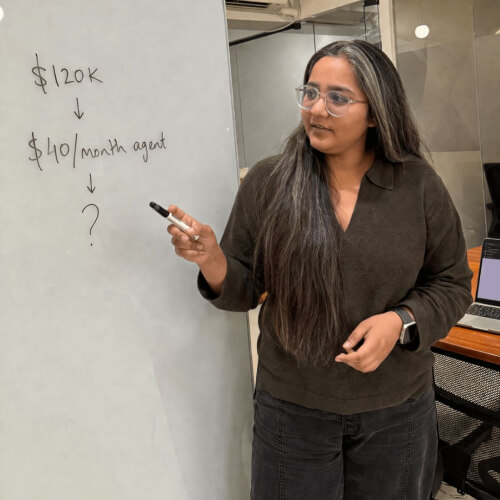
Book a 30-minute call with a founder. Apoorv or Shivanshi will review your AI visibility live and tell you honestly whether DerivateX can help, or whether you do not need an agency yet.