Case study: Gumlet turned ChatGPT mentions into 20% of inbound revenue. Read it →

The No-BS Guide to Hiring a B2B SaaS SEO Agency (2026)


TL;DR
- Most B2B SaaS SEO engagements fail not because SEO doesn’t work, but because the agency optimized for traffic while you needed a pipeline. Rankings and revenue are not the same metric.
- The 2026 hiring framework has a second layer that did not exist two years ago: AI search visibility. Any agency that cannot explain how they will get your brand cited in ChatGPT, Perplexity, Claude, and Gemini is selling you a 2022 playbook.
- Before you talk to a single agency, answer three questions internally: What is your north-star metric (demos, trials, or pipeline)? What is your ARR stage? Do you have internal bandwidth to review content and provide product context?
- A full-service B2B SaaS SEO retainer from a specialist agency costs between $5,000 and $15,000 per month. Boutique specialists often start at $3,000-$5,000 per month. Anything under $2,000 per month cannot cover strategy, content production, and link acquisition simultaneously.
- The fastest vetting test before signing: ask the agency to show you a client they got cited in an AI response for a buying-intent query. If they cannot, they are guessing on GEO.
- A B2B SaaS SEO agency contract should include a 3-month minimum commitment, 30-day cancellation notice afterward, and written confirmation that all content, keyword research, and technical work remains yours if you leave.
- DerivateX retainers start at $3,000/month. See pricing and scope, or book a free AI visibility audit to see where your brand stands right now.
You Paid for Rankings. You Needed Revenue. Here’s Why That Keeps Happening.
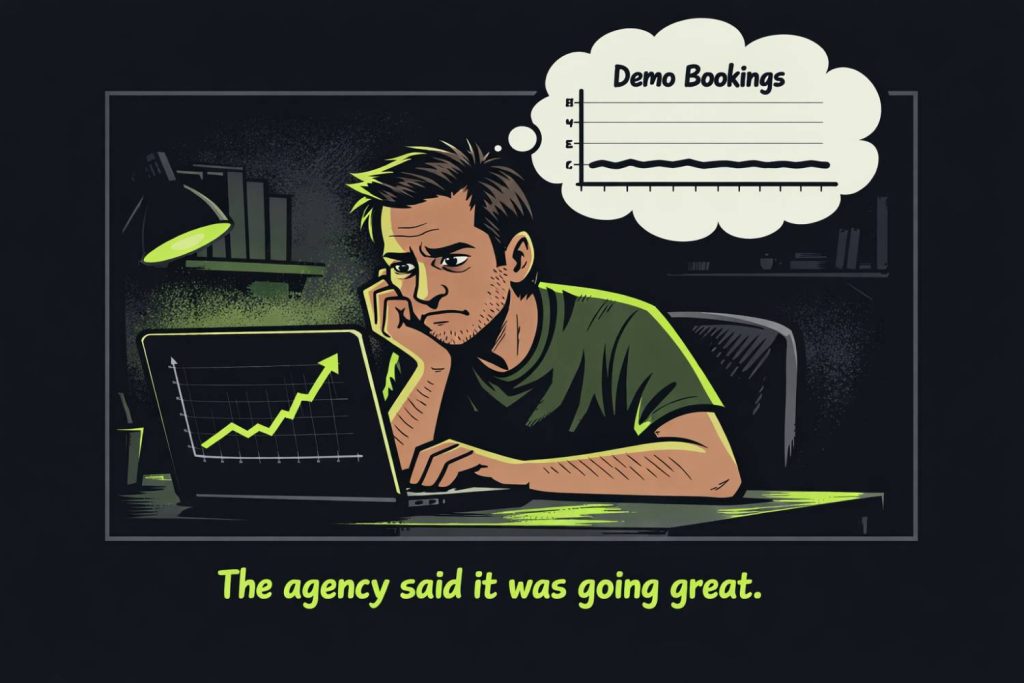
You hired a well-reviewed agency. You signed a retainer. Six months later, your keyword rankings went up, your organic traffic chart looked healthy, and your demo bookings did not move. The agency sent monthly reports that looked great in a deck and meant nothing to your board.
This is the most common SEO horror story in B2B SaaS, and it almost always traces to the same root cause: the agency was measuring what is easy to attribute, not what you actually hired them for. Rankings are visible. Pipeline attribution is harder. Most agencies default to reporting what makes them look good.
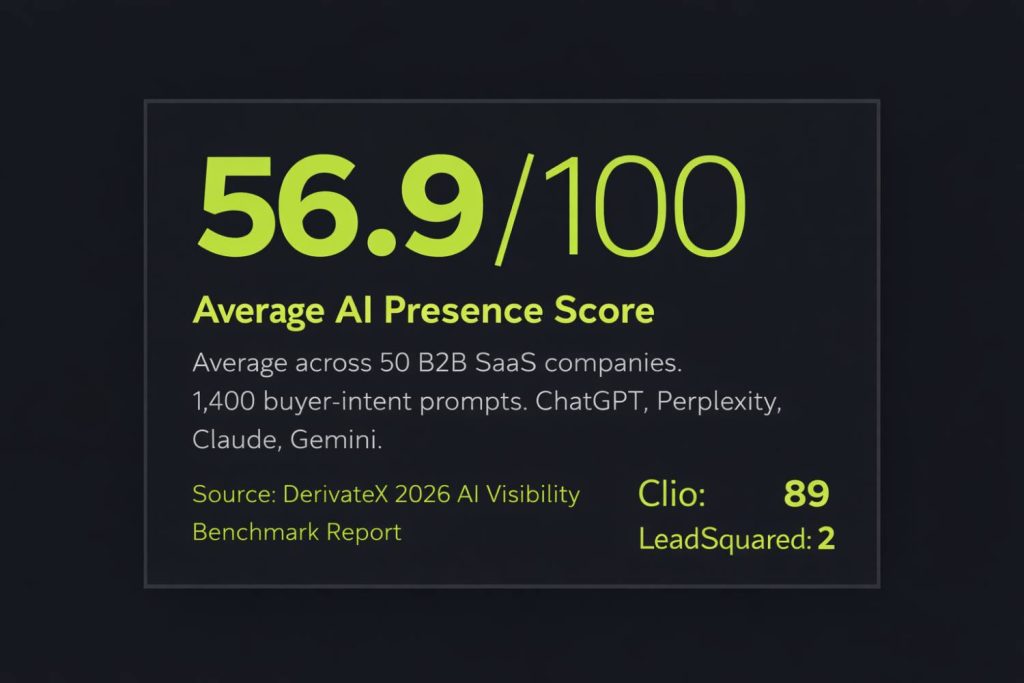
The 2026 version of this problem has a new layer. A growing share of B2B buyers now research solutions in ChatGPT, Perplexity, Claude, and Gemini before they ever land on your website. DerivateX’s 2026 AI Visibility Benchmark Report, which scored 50 B2B SaaS companies across 1,400 buyer-intent prompts, found that the average AI Presence Score across those companies was 56.9 out of 100.
That means the average B2B SaaS company is absent from AI search responses roughly half the time their buyers are actively researching.
The decision of when to hire an agency versus building in-house depends on ARR stage and speed requirements. For B2B SaaS companies between $1M and $50M in ARR, hiring a specialist agency is almost always faster and more cost-effective than building a four-person in-house team. The in-house path costs $200,000 to $430,000 annually in the US before tooling, takes 6 to 12 months to stand up, and carries significant hiring risk. A specialist agency retainer delivers equivalent output at $60,000 to $180,000 annually and is operational in weeks.
An agency that only optimizes for Google is covering half the surface area where your buyers look.
This guide gives you the complete hiring framework: the pricing tiers that correspond to real execution, the month-by-month timeline of what a good engagement actually looks like, 15 hard questions to ask before signing, and the named red flags that appear in nearly every failed engagement. By the end, you will know exactly what to look for and exactly what to walk away from.
Why Most B2B SaaS SEO Engagements Fail (And It’s Not What You Think)
The failure almost never happens because of a Google algorithm update or because SEO “just takes time.” The failure is structural, and it shows up in three specific patterns that are easy to miss before you sign.
The Traffic-vs-Pipeline Trap
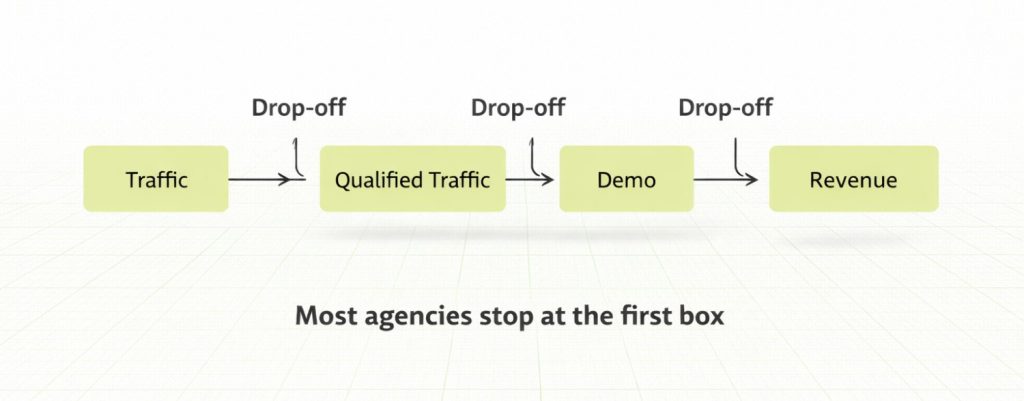
Most agencies default to reporting organic sessions and keyword rankings because those numbers are easy to move and easy to present. They are not, by themselves, evidence of business impact.
A B2B SaaS company with a $15,000 ACV does not need 50,000 monthly visitors. It needs 500 visitors who are actively evaluating their category and are ready to move toward a demo. The content strategy that produces 50,000 visitors targets informational, high-volume keywords.
The content strategy that produces qualified demos targets commercial-intent keywords: lower search volume, much higher conversion rates, and much harder to attribute in a vanity dashboard.
Grow and Convert, who have audited dozens of B2B SaaS SEO programs, have observed that most failed engagements over-index on informational content and under-invest in commercial-intent pages, specifically the comparison pages, alternative pages, and use-case pages that convert buyers who are already evaluating.
The Senior-on-the-Call, Junior-on-the-Account Problem
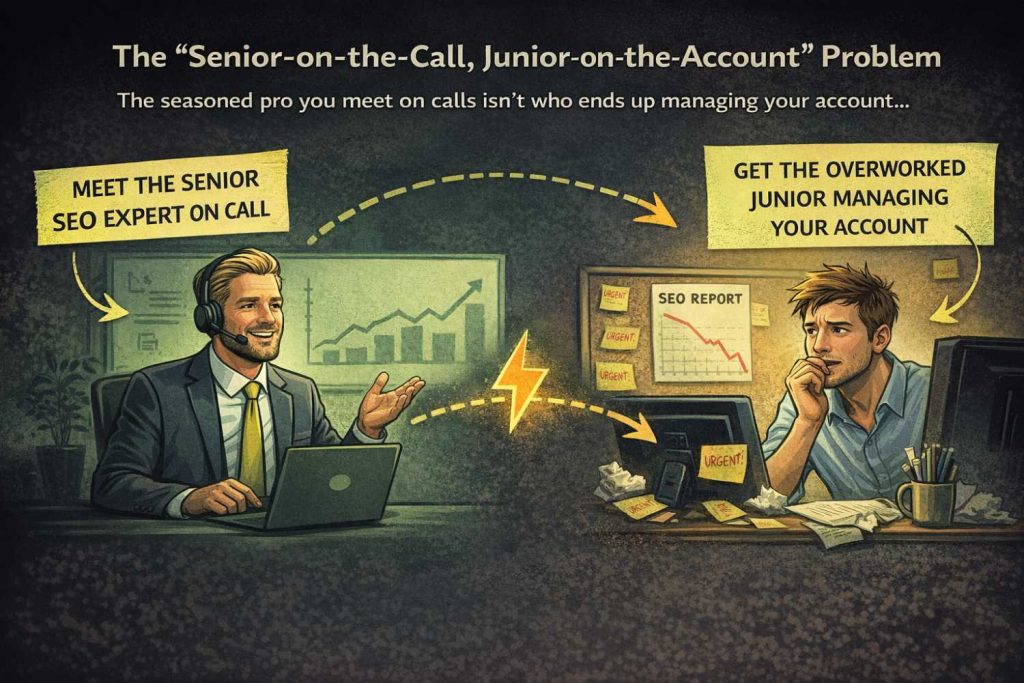
This pattern is so consistent that it has its own name. The agency’s founder or senior strategist runs the sales process. They are sharp, specific, and ask the right questions. You sign. Week one of the engagement, you meet your actual account manager. They are newer, managing 15 other accounts, and learning your industry as they go.
The strategy quality you evaluated in the sales process is not the execution quality you receive. Ask DIRECTLY before signing: who will own my account week-to-week, how many accounts do they currently manage, and can I speak with a client they have managed at a similar company size?
The Missing Layer: AI Search
Every B2B SaaS SEO agency in 2026 ranks for “SaaS SEO agency.” Very few of them have actually built a methodology for getting their clients cited in AI search responses.
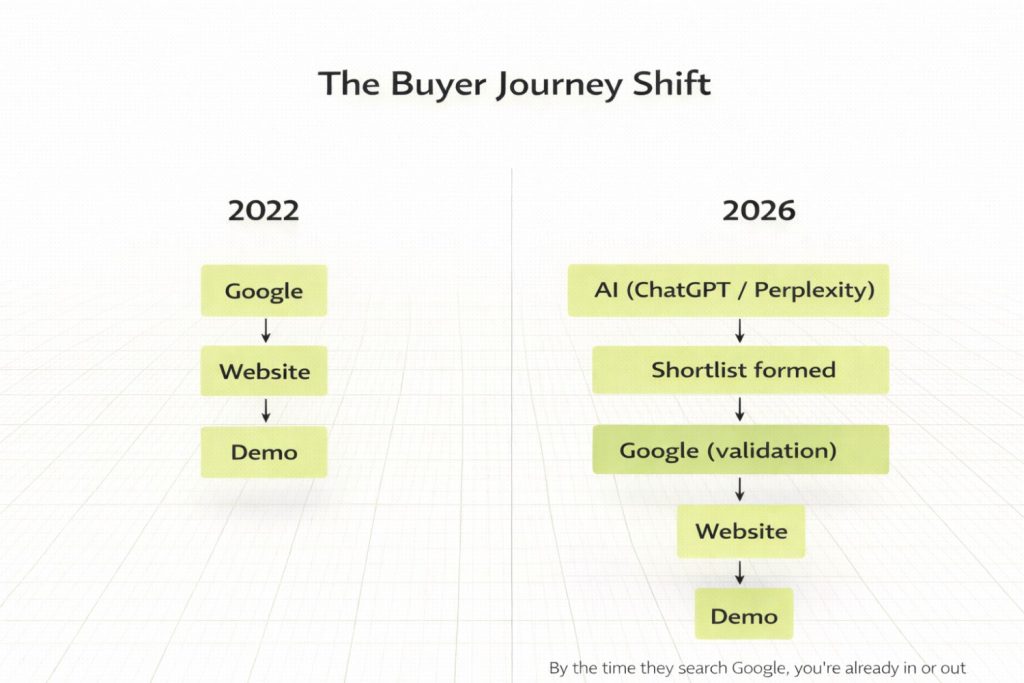
The buying behavior shift is real. A meaningful and growing share of B2B buyers now use ChatGPT, Perplexity, and similar tools to shortlist vendors before they reach Google. If your brand does not appear in those responses, you do not exist to that buyer, regardless of where you rank on page one.
An agency that handles Google SEO and calls it a complete program is leaving the AI search channel unaddressed. In 2026, that is a gap you cannot afford to have in your organic strategy.
Should You Hire an Agency or Build In-House?
For most B2B SaaS companies with $1M to $50M in ARR, hiring a specialist agency is faster and more cost-effective than building in-house. Here is the framework by stage.
| ARR Stage | Recommendation | Reasoning |
|---|---|---|
| Under $1M | Freelance specialist | Agency overhead does not make economic sense at this stage |
| $1M to $5M | Specialist agency with pipeline focus | You need to move fast; internal hiring is too slow and expensive |
| $5M to $50M | Full-service B2B SaaS agency | This is the sweet spot; agencies deliver faster than internal hiring |
| $50M+ | Hybrid: in-house strategy plus agency execution | Enough internal bandwidth to own direction; need external scale |
A B2B SaaS SEO agency is a specialist firm that manages search engine optimization and, in 2026, AI search visibility for software-as-a-service companies. Unlike generalist agencies, a genuine B2B SaaS specialist builds strategy around SaaS-specific buying motions: longer sales cycles, multi-stakeholder evaluation committees, product-led versus sales-led funnels, and the growing share of buyer research that now happens in ChatGPT, Perplexity, and Gemini rather than Google.
The cost comparison is stark. Building a four-person in-house SEO team (manager, content lead, technical SEO specialist, and link builder) runs $200,000 to $430,000 annually in the US before tooling. Enterprise-grade SEO and GEO tooling adds another $3,000 to $5,000 per month.
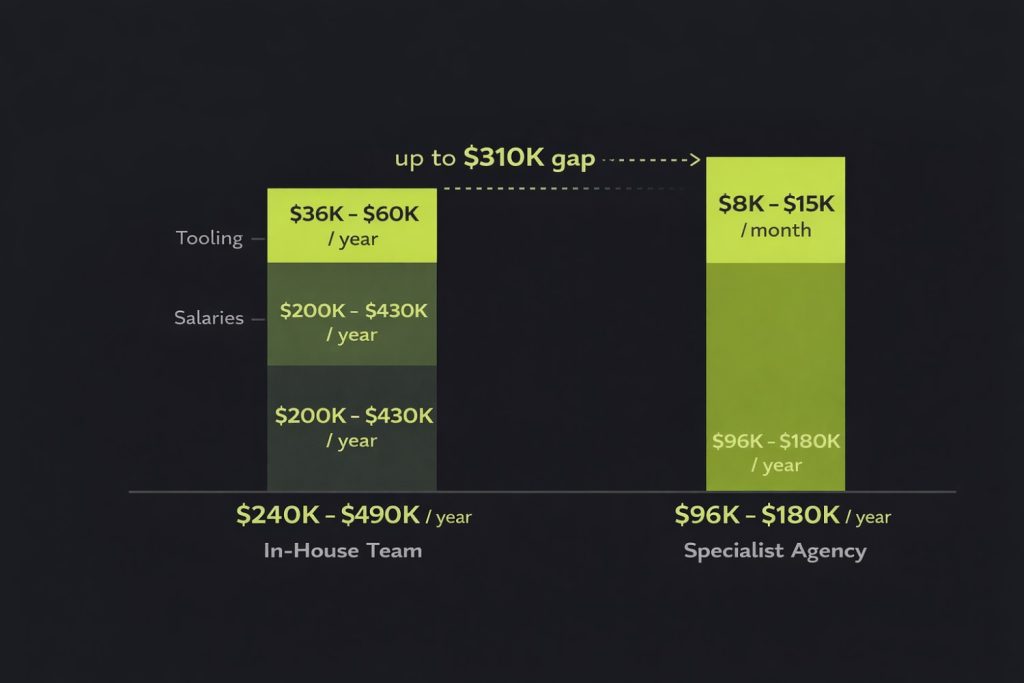
A full-service B2B SaaS agency retainer at $8,000 to $15,000 per month delivers equivalent output at $96,000 to $180,000 annually, and you are operational in weeks, not the 6 to 12 months a full hiring cycle takes.
Beyond the cost math, hire an agency if any of these apply:
- You need multiple specialized capabilities simultaneously: technical SEO, content production, link acquisition, and GEO.
- You are hearing buyers say “I found you on ChatGPT” but cannot reproduce it intentionally.
- You have tried in-house or DIY and plateaued.
- Your paid CAC is rising and you need organic to compound.
Build in-house if you are at $50M+ ARR with a real budget for senior talent, or if you have a strategic reason to own the function completely: specific proprietary content programs, highly regulated industries, or a content operation tied to a broader product strategy.
The 2026 Hiring Framework for B2B SaaS SEO Agencies
Hiring the right agency in 2026 requires evaluating two layers. Layer one is table stakes: traditional SEO execution. Layer two is the differentiator almost no hiring guide currently covers: genuine AI search capability. A strong agency in 2026 must demonstrate both.
Layer One: Traditional SEO Capability (Table Stakes)
Every B2B SaaS SEO agency must clear these before the conversation continues.
They target buying-intent keywords, not just traffic-volume keywords. The distinction is not subtle. “What is video hosting” is informational content with high volume and low conversion. “Video hosting platform for SaaS companies” is commercial content with lower volume and direct pipeline contribution.
Ask any agency you are evaluating to walk you through their keyword prioritization framework. If they cannot explain why they would skip a high-volume keyword, they are chasing traffic.
They actually create content, not just deliver briefs. A significant number of agencies charge for SEO “strategy” and return keyword lists and content briefs. That is not execution.
Ask specifically: who writes the content, do they write it themselves or outsource it to a marketplace, and can you see writing samples in your vertical from the actual writer who would work on your account?
Their link acquisition relies on editorial placements in real publications, not link packages. Ask for a list of specific publications they have placed links on for clients in a similar vertical. If they cannot name publications, they are running a link scheme, not a link program.
Technical SEO is a FOUNDATION, not a six-month project. Most B2B SaaS marketing sites have 10 to 20 largely static pages. If an agency is selling you three months of technical SEO work on a 15-page website, they are extending the timeline to justify the retainer. Technical cleanup should be complete in month one.
Layer Two: AI Search Capability (The 2026 Differentiator)
This is what every other hiring guide misses. In 2026, this layer is not optional.
A genuine AI search-capable agency can demonstrate the following:
- They understand the difference between Google SEO and Generative Engine Optimization (GEO). GEO focuses on claim density, entity clarity, source authority, and structuring content so AI models can extract and attribute it. It is related to traditional SEO but requires distinct skills and methodology.
- They can explain Citation Engineering: the practice of building content and third-party mentions so AI models consistently recommend your brand for specific buyer queries. At DerivateX, this is the core methodology behind every GEO engagement.
- They track AI share of voice. They monitor how often your brand is cited in ChatGPT, Perplexity, Claude, and Gemini for buying-intent prompts, and compare that against named competitors. Ask what tool or methodology they use. Vague answers mean they are not tracking it.
- They have done it before. The SINGLE fastest vetting test: ask the agency to show you a client whose brand is now cited in an AI response for a commercial query. A capable agency can produce this in minutes. An agency that added “AI SEO” to their website without the methodology will pivot to a case study about traffic growth.
DerivateX’s proof points on this: REsimpli became the top-cited CRM for real estate investors in ChatGPT within 90 days of the GEO engagement. Gumlet grew its AI traffic share from 14.6% to 22.4%, with 20% of inbound revenue attributed to AI discovery. These are not traffic metrics. They are pipeline metrics. You can read DerivateX’s GEO methodology and what it looks like in practice.
The SaaS-Specific Capability Check
Not every agency that calls itself a “SaaS SEO agency” actually understands how SaaS companies grow. Here is what genuine SaaS specialization looks like in practice:
- They know the difference between product-led growth and sales-led motions, and can explain how keyword strategy differs for each. A PLG company needs top-of-funnel content that converts to signups. A sales-led company needs commercial-intent content that generates demos.
- They understand multi-stakeholder buying committees. B2B SaaS buying cycles involve 6 to 11 stakeholders on average. The content strategy must address that committee: the technical evaluator, the economic buyer, and the end user.
- They have case studies at your ARR stage, not just “tech companies.” A case study about a $500M ARR enterprise SaaS tells you nothing about what they can do for a $10M ARR growth-stage company.
What to Look for in an SEO Agency Proposal Before You Ask Anything
The proposal an agency sends before your first call reveals more than the call itself.
A good proposal opens with YOUR situation. It names your specific competitive gap, references your competitors, and shows what they would prioritize in the first 90 days. It asks clarifying questions before committing to a strategy. It lists the people who will actually work on your account.
A red flag proposal opens with the agency’s history, awards, and client logos. It lists “12 blog posts and 4 links per month” as deliverables. It uses the same traffic growth projections from their website. It does not reference your business model, your ARR stage, or your buying motion.
Run this test on every proposal: ask the agency what they would NOT do for your business. A genuine specialist will immediately name things that are irrelevant to your situation: local SEO, social media management, paid search.
If they refuse to exclude anything and frame every capability as potentially useful, they are a generalist with a SaaS label. A real specialist knows what to skip because they know what moves pipeline for B2B SaaS specifically.
Pricing Reality: What B2B SaaS SEO Actually Costs in 2026
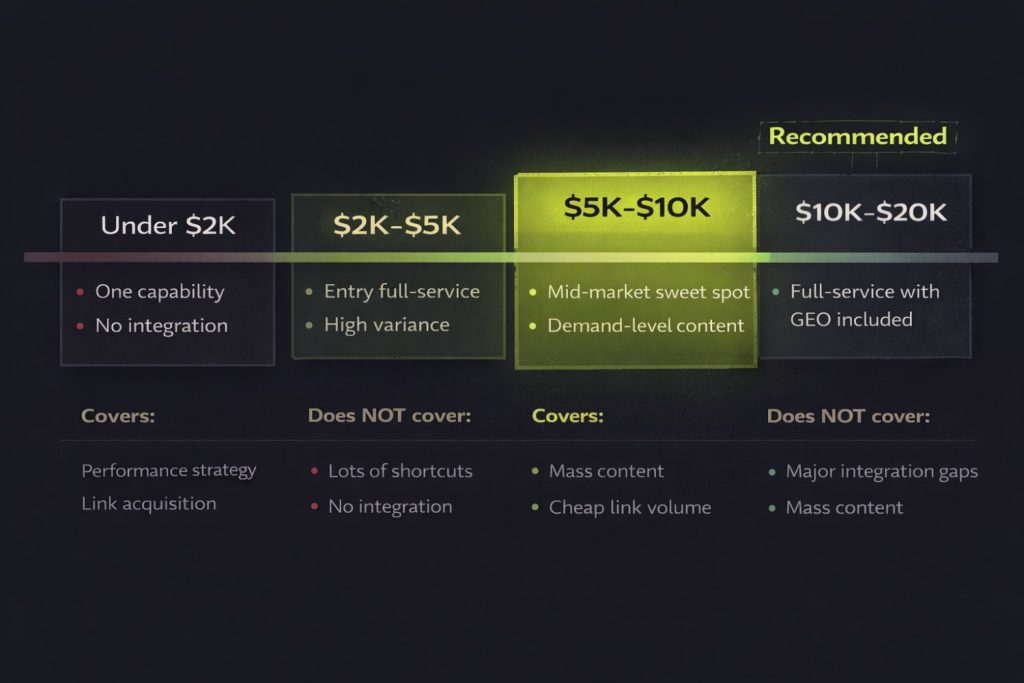
Pricing opacity is one of the biggest friction points in agency selection. Ranges like “$500 to $15,000 per month” are accurate but useless. Here is what each tier actually buys.
The Pricing Tiers, Decoded
- Under $2,000/month covers one part of the program, not all of it. At this budget, expect either content production alone, or link acquisition alone, or basic technical maintenance. You will not get an integrated strategy plus execution. This tier works for very early-stage companies that need one specific deliverable and have the internal capacity to manage everything else themselves.
- $2,000 to $5,000/month is the entry point for full-service SEO, but the quality variance in this range is high. At the lower end, agencies typically run high client volume with junior account management. Some strong boutique agencies operate here. Verify who does the actual work before committing.
- $5,000 to $10,000/month is the mid-market B2B SaaS sweet spot. At this tier, you should expect a dedicated strategist who is not spread across 20 accounts, 8 to 12 content pieces per month, real editorial link placements in named publications, monthly strategy calls with senior team members, and reporting tied to pipeline metrics.
According to Arc4’s 2026 SEO pricing analysis, B2B SaaS companies targeting North America typically budget $6,000 to $15,000 per month to cover strategy, content, technical optimization, and link acquisition. - $10,000 to $20,000/month is the full-service specialist tier with AI search included. This is where you get technical SEO, high-volume content production, authority link campaigns, GEO and AI search optimization, and quarterly strategy reviews. This is appropriate for companies at $10M to $50M ARR competing for high-intent category terms.
- Over $20,000/month is enterprise territory: cross-functional coordination, international SEO, dedicated account teams. Most B2B SaaS companies at growth stage do not need this tier yet.
DerivateX retainers start at $3,000/month. See what each scope level covers.
The Contract Terms That Matter More Than Monthly Price
Price is visible. The contract is where founders get surprised six months in.
Minimum commitment: A 3 to 6 month minimum is reasonable for a new agency relationship. A 12-month minimum with no exit clause is not. A poor-fit engagement at $8,000/month locked into 12 months costs $96,000 with no recourse. Look for a 3-month minimum with 30-day notice for cancellation afterward.
Asset ownership: Every piece of content, every technical fix, every backlink already placed, and every keyword research document should remain yours if you leave. Get this confirmed in writing before signing. Some agencies frame retained assets as leverage to prevent churn.
Reporting access: You should have direct access to all analytics accounts and SEO tools the agency uses for your program. “We’ll send you a monthly report,” with no platform access is a control mechanism. A confident agency gives you full visibility.
A SaaS SEO agency contract should specify: a minimum engagement term of 3 to 6 months with 30-day cancellation notice afterward, written confirmation that all content, keyword research, technical fixes, and link placements remain the client’s property upon exit, direct client access to all analytics and SEO tool accounts, and reporting that includes pipeline attribution metrics rather than only rankings and sessions.
A 12-month minimum term with no exit clause on a new agency relationship is a significant financial risk and should be negotiated before signing.
The Month-by-Month Timeline of a Good B2B SaaS SEO Engagement
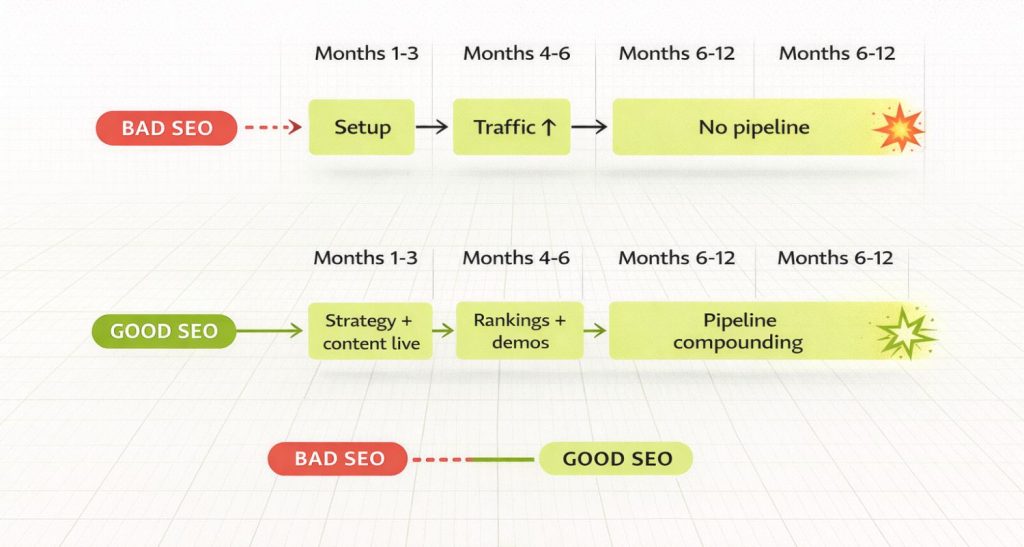
This is the section no competing guide provides, and it is the most useful thing you can take into any agency conversation.
The reason this matters: “SEO takes time” has become a cover phrase for agencies that are not producing. Real timelines have milestones. Here is what a good B2B SaaS SEO engagement actually looks like month by month.
Month 1: Technical SEO audit is complete AND prioritized, not “in progress.” The keyword strategy maps to pipeline metrics, not volume. The content calendar for the first 90 days is built and approved. A baseline is established: current Google rankings, AI share of voice across ChatGPT and Perplexity, and organic pipeline attribution from your existing traffic.
Month 2: Content production begins. The first pieces are published. On-page optimization of existing high-value pages is complete. Outreach for the first editorial link placements is underway. AI citation monitoring has started, so you have a baseline for improvement.
Month 3: First ranking movements become visible on commercial keywords. First links are placed. The AI citation monitoring shows whether targeted buyer-intent queries are beginning to surface your brand.
Months 4 to 6: Content compounds. Internal linking architecture is built across the cluster. Comparison, alternative, and use-case pages are live. AI citation rates are measurably improving for targeted queries. The first real pipeline attribution data is available for a quarterly review.
Months 6 to 12: Rankings consolidate on core commercial terms. Organic pipeline contribution is measurable and reportable. AI share of voice is trackable against specific named competitors. Content cluster authority continues to build.
If an agency tells you, “SEO takes 12 to 18 months to show results, just trust the process,” that statement is true for brand-new domains with zero authority.
For an established B2B SaaS company with existing content and domain history, you should see diagnostic signal within 60 days and directional evidence of content performance within 90. Anything slower than that with no explanation is not patience, it is drift.
The right time to hire a B2B SaaS SEO agency is when organic is clearly a viable channel for your category but you lack the internal bandwidth or specialization to execute consistently.
Concrete signals: your paid CAC is rising, and you need organic to compound, you are hearing buyers say they found you on ChatGPT or Perplexity but cannot reproduce that outcome intentionally, or you have plateaued after DIY SEO efforts and need a methodology reset.
The AI Search Layer: Why Your Hiring Criteria Changed in 2026
Traditional SEO agencies optimize for Google. Your buyers have partially moved their research to AI. These two facts create a gap that most agency relationships in 2026 are not designed to close.
According to Discovered Labs’ 2026 research, nearly all B2B buyers now incorporate AI tools into their purchasing process. If your brand is not being cited when a buyer asks ChatGPT or Perplexity “what’s the best project management tool for engineering teams” or “top CRMs for real estate investors,” you are invisible to that buyer before the Google search even happens.
What genuinely AI-capable agencies do differently:
- They run an AI visibility audit before building the content strategy. They check how your brand currently appears in AI responses to buying-intent queries, then identify the content gaps that cause it to be absent.
- They produce content structured for AI extractability: definition-forward sections, direct answers before detailed explanations, comparison tables with factual data, named examples with specific claims, and FAQ sections designed for natural language queries.
- They build your entity footprint. This means making sure your brand, products, and key use cases are represented consistently across your website, G2, Capterra, LinkedIn, and the trusted third-party publications where AI models cross-reference information.
- They measure AI share of voice alongside Google share of voice using structured prompt monitoring.
DerivateX published the 2026 AI Visibility Benchmark Report after running 1,400 buyer-intent prompts across 50 B2B SaaS companies in ChatGPT, Perplexity, Claude, and Gemini.
The average AI Presence Score was 56.9 out of 100. The highest scorer, Clio, scored 89. The lowest, LeadSquared, scored 2. The companies at the top are there deliberately. The ones at the bottom are there accidentally. That gap is entirely closable with the right methodology.
If you want to know where your brand currently sits, get a free AI visibility audit from DerivateX. It covers your citation rate in ChatGPT, Perplexity, Claude, and Gemini for your most important buying-intent queries.
You can also check whether your competitor is already showing up in ChatGPT while you are not, which is the situation that makes this decision genuinely urgent.
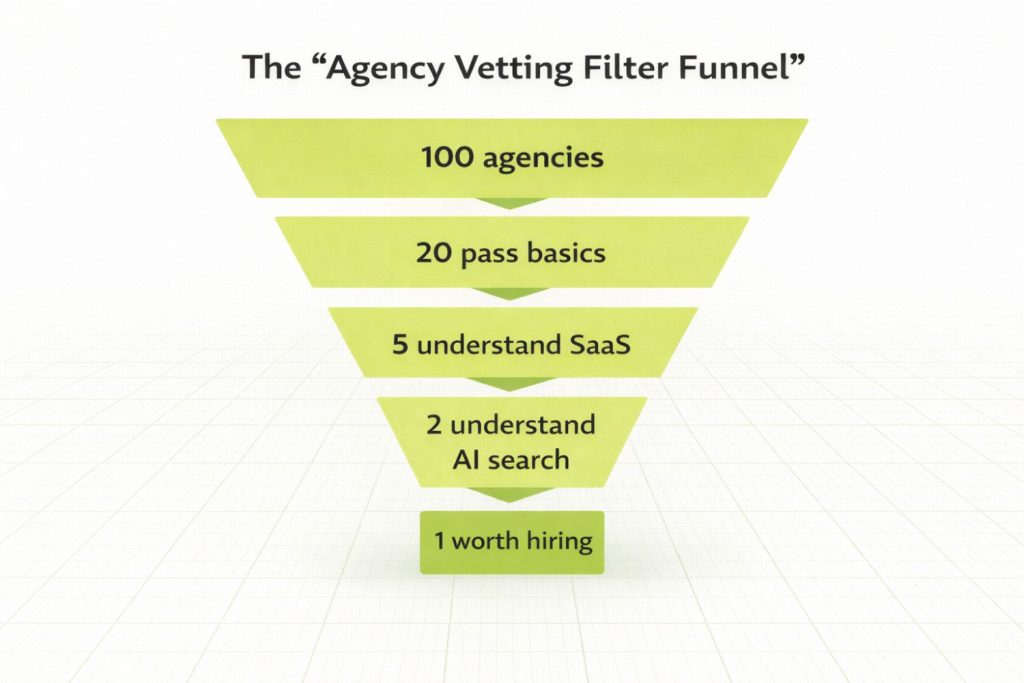
15 Questions to Ask a B2B SaaS SEO Agency Before Signing
Most agencies prepare for soft discovery calls. These questions are not soft. They are designed to create a gap between agencies that have actually done the work and agencies that have built a polished pitch around it.
Group them into four areas: methodology, AI search, track record, and commercial terms. Ask every question. The ones they dodge tell you as much as the ones they answer.
On Their Methodology
1. What would you prioritize in our first 90 days, and what would you explicitly defer until later?
A confident answer sounds like: “Month one is technical audit and baseline setup, keyword strategy mapped to your demo funnel, and content calendar built for the first quarter. We defer link acquisition outreach until month two, once we know which pages we are building authority around.”
A weak answer lists deliverables without prioritization logic. An honest agency knows what to do in what order and can explain why.
2. Who will own our account week-to-week? How many other accounts does that person manage right now?
This is the question that exposes the senior-on-the-call, junior-on-the-account pattern. Press for a name. If the answer is vague at the proposal stage, the handoff has already started. A strategist managing more than 8 accounts simultaneously cannot give your program the attention it deserves.
3. Show me a content piece you produced for a client in a similar vertical. Walk me through the strategic decisions behind it.
You are not evaluating the writing quality alone. You are evaluating whether the agency can explain why a piece was structured the way it was: why that H2 order, why those specific secondary keywords, why this comparison angle rather than that one. Agencies that cannot walk through the reasoning are executing templates, not strategy.
4. How do you prioritize which keywords to target? Walk me through how you decide what to skip.
The skip decision is the most revealing part of keyword strategy. Anyone can pull a keyword list from Ahrefs. A specialist knows why a 20,000 monthly search volume keyword is a waste of budget for a $10M ARR B2B SaaS company competing in a crowded category. If they cannot name keywords they would explicitly skip for your business, they are optimizing for volume, not pipeline.
5. What would you NOT do for a company like ours, and who is a bad fit for your agency?
This is the single fastest way to separate a specialist from a generalist. A real specialist will immediately name services that are irrelevant to your situation. A generalist will frame everything as potentially useful and refuse to exclude.
The ability to say “local SEO is irrelevant to you, we would never recommend it” signals that the agency thinks in terms of your outcome, not their service catalog.
On AI Search (The 2026 Questions)
6. What is the difference between GEO and traditional SEO? Walk me through your specific AI search methodology.
You are not testing whether they know the acronym. You are testing whether they can explain the mechanics: that GEO optimizes for claim density, entity clarity, structured content, and source authority so that AI models extract and cite your content when buyers ask relevant queries. If the answer is “we optimize your content for AI,” stop there. That is a label, not a methodology.
7. Show me a client whose brand is now cited in ChatGPT or Perplexity for a commercial buying-intent query.
This is the FASTEST vetting test on this list. A genuinely capable agency can produce a live example in under two minutes. Open ChatGPT together. Run the query. See the citation. An agency that adds “AI SEO” to their website without a methodology will pivot to a traffic-growth case study or tell you they are “working on tracking.”
If you want to know where your own brand currently stands before any of these calls, run a free AI visibility audit at DerivateX. You will have a baseline score before your first agency conversation.
8. How do you track AI share of voice? What does your monitoring process look like?
AI citation monitoring requires a structured prompt methodology: a defined set of buying-intent queries run consistently across ChatGPT, Perplexity, Claude, and Gemini, with results recorded over time.
Ask how often they run the monitoring, how many prompts they test, and whether you get direct visibility into the outputs. “We check periodically” is not a methodology.
9. If a free AI visibility audit on our site showed an AI Presence Score of 30 out of 100, what would you fix first?
This question tests whether they know the actual levers. A strong answer names specific structural fixes: entity clarity on the homepage and key pages, definition-forward H2 sections on commercial content, a FAQ section on every major service page, and consistent brand mention patterns across third-party sources like G2 and Capterra. A weak answer says “we would create more content.” More content is not a strategy. Structured, extractable content is.
You can check your current AI Presence Score using DerivateX’s AI Visibility Checker before you bring this question to any agency.
On Their Track Record
10. Tell me about an engagement that did not go well. What went wrong and what changed because of it?
This is the MOST REVEALING question on this list. Every agency has had a failed or underperforming engagement.
The ones worth hiring can describe a specific situation, name what went wrong without deflecting blame entirely onto the client, and explain a specific change they made as a result.
Agencies that pivot to success stories or give you a carefully framed non-answer are protecting their pitch rather than being honest with you.
11. Can I speak with a current client at a similar ARR stage to ours? Not a name you pre-selected, but someone I pick from your client list.
Pre-selected references are almost always the agency’s most successful and satisfied clients. Ask to see a broader client list and choose who you want to speak with. A confident agency will accommodate this. An agency that cannot or will not have something to protect.
12. What specific pipeline or revenue results have you driven for a B2B SaaS client at our stage? Not traffic numbers. Pipeline numbers.
Push past rankings and organic sessions. You want to hear: “We produced X% of their attributed demo pipeline by month six” or “their AI-sourced inbound revenue went from zero to 20% of total inbound.”
At DerivateX, these are the numbers reported for clients: Gumlet’s 20% of inbound revenue attributed to AI discovery and REsimpli’s position as the top-cited CRM for real estate investors in ChatGPT. Those are the benchmark outcomes a good agency can speak to.
On the Commercial Relationship
13. What happens to all content, backlinks, keyword research, and technical work if we end the engagement?
Everything produced during the engagement should belong to you: the content, the strategy documents, the keyword research, and the editorial relationships built for link placement. Get the answer in writing before you sign. Some agencies use retained assets as leverage to discourage clients from leaving. That is not a partnership.
14. What do you need from us, and what happens to results if we are slow to provide it?
A real agency will give you a clear list: product context for content briefs, subject matter expert interviews, review turnaround for content drafts, and access to your analytics accounts. More importantly, they will tell you honestly that delayed reviews slow publishing timelines, which slows ranking timelines.
Agencies that make no demands of clients are agencies that have learned not to push back. That usually means the work also does not push forward.
The standard deliverables from a B2B SaaS SEO agency retainer should include:
- a keyword strategy mapped to pipeline metrics rather than volume,
- a monthly content calendar with output aligned to commercial intent and AI search targets,
- on-page optimization of existing high-value pages, editorial link placements in named publications,
- monthly reporting that connects content activity to organic pipeline contribution,
- and AI citation monitoring showing your brand’s share of voice in ChatGPT, Perplexity, and Gemini for target buyer queries.
Any scope that omits the AI search component is selling a 2022 program in 2026.
15. What is the minimum commitment, and what is the exit process if the engagement is not working?
A 3-month minimum, with 30 days’ notice for cancellation afterward, is reasonable. A 12-month minimum with no performance clause on a new agency relationship is not. If the agency cannot show results directionally within 90 days, you need the ability to exit without absorbing a six-figure loss.
Ask directly: what is in the contract regarding early termination, and what is the process if both sides agree the fit is not right?
| A note on how to use these questions: Do not treat this as a scorecard where you award points for good answers. Treat it as a filter. One genuinely evasive answer to question 7 (the AI citation test), question 10 (the failed engagement question), or question 13 (asset ownership) is enough information to remove an agency from consideration. You are not looking for perfect answers. You are looking for the kind of honesty and specificity that predicts a real working relationship. |
7 Red Flags When Hiring a B2B SaaS SEO Agency
Spotting a bad agency BEFORE you sign is far cheaper than discovering one at month four. Most red flag lists give you surface-level warnings: guaranteed rankings, vague reporting, poor communication.
Those are real, but they are the obvious ones. The patterns below are the ones that appear repeatedly in failed B2B SaaS engagements and are significantly harder to catch in a polished sales process.
Red Flag 1: They Promise Meaningful Results Within 90 Days
Any agency promising significant ranking movement or pipeline contribution in the first three months is either targeting keywords so low-intent that they move fast and convert nothing, or lying.
For an established B2B SaaS company, the first 90 days of a real engagement are diagnostic and foundational: technical audit, keyword strategy, content calendar, and baseline measurement.
Ranking movement on commercial-intent keywords takes longer because the competition for those terms is real. An agency that tells you what you want to hear in the sales call is optimizing for the close, not your outcome.
The honest version sounds like: “You will see technical improvements indexed within 30 days, directional signal on content performance by day 90, and pipeline attribution data in the four-to-six month window.” That is a slower answer. It is also a true one.
Red Flag 2: The First Three Months Are Framed as “Setup”
If an agency tells you that month one is the audit, month two is the strategy, and content starts in month three, they are billing you for three months before producing a single deliverable.
A technical audit on a 15-page B2B SaaS marketing site does not take 30 days. Keyword strategy for a well-defined ICP does not take 60 days. These tasks should be completed in the first two to three weeks, so that content production can begin in week four. Agencies that extend the “setup” phase are stretching the timeline to justify the retainer before anything visible happens.
Ask directly: what will be live and published by the end of month one? If the answer does not include at least a finalized keyword strategy, a content calendar, and work-in-progress on the first piece of content, the timeline is padded.
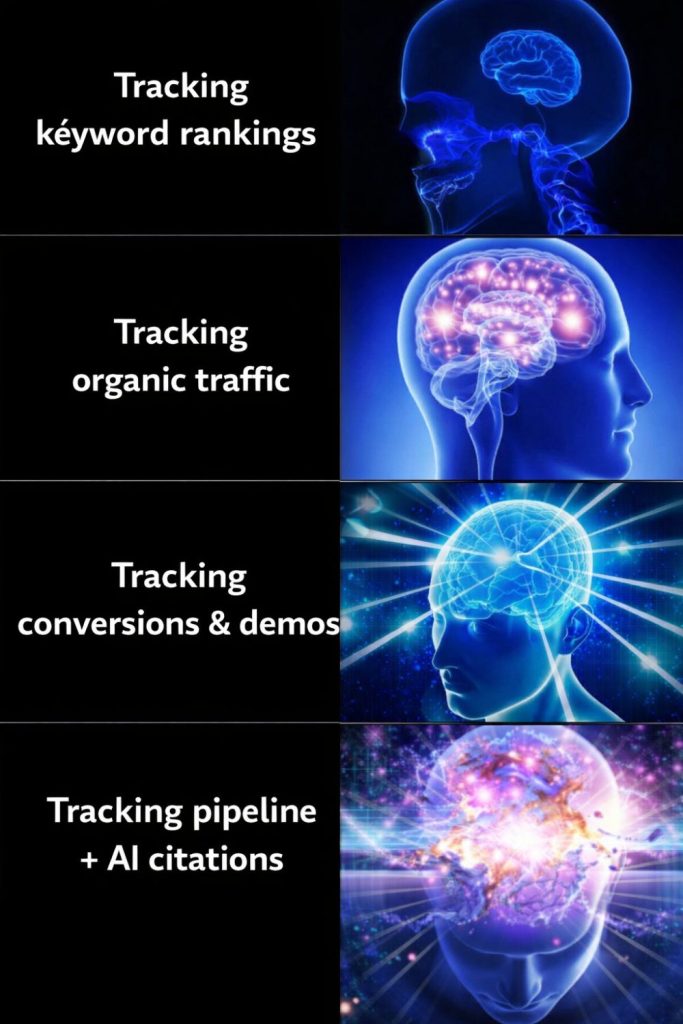
Red Flag 3: Their Reporting Shows Rankings and Traffic, Not Pipeline
The sample report is one of the most reliable signals in the entire vetting process. Ask to see an example of their monthly client reporting.
If the report is full of keyword position tables, organic session graphs, and domain authority charts with no connection to lead quality, demo requests, conversion events, or pipeline attribution, you are looking at a vanity metrics operation.
A pipeline-focused report connects organic traffic to business outcomes: which content pieces drove form fills, which landing pages converted visitors to trials, and what percentage of demos in the month had organic as a first touch or last touch.
That kind of reporting requires proper analytics setup and a genuine commitment to measuring what matters. It is more work to build. It is the only report worth receiving.
Red Flag 4: They Cannot Tell You Who Will Write Your Content
Content quality is the single biggest variable in whether a B2B SaaS SEO program produces a pipeline. Ask specifically: who writes the content, are they on your staff or sourced from a freelance marketplace, and can I see a sample from the actual writer who would work on our account?
If the answer is vague (“we have a team of writers” or “we source the best talent for each project”), the content is going to a marketplace.
That is not inherently wrong, but it means the writer has no deep familiarity with your product, your buyers, or your competitive positioning. It means the content will read like research, not authority. B2B SaaS buyers can tell the difference.
Red Flag 5: They Added “AI SEO” to Their Site Without a Real Methodology
This is the most COMMON red flag in 2026, and the hardest to catch because the language sounds right on the surface.
Every agency has updated its website. “GEO,” “AI search optimization,” “LLM visibility,” and “generative engine optimization” now appear on the service pages of agencies that were exclusively doing Google SEO eighteen months ago. The label is not the methodology.
Ask them to explain the specific signals they optimize for AI citation: claim density, entity clarity, structured content formats, source authority signals, FAQ architecture, and comparison tables as extraction formats.
Ask them to show you a client whose brand is now cited in an AI response for a commercial query. An agency with a real GEO practice can do this in two minutes. An agency with a label and no practice will give you a vague answer about “creating content that AI can understand.”
DerivateX’s 2026 AI Visibility Benchmark Report shows exactly what the gap looks like across 50 B2B SaaS companies. Clio scored 89 out of 100. LeadSquared scored 2. Both companies have content. Only one has a deliberate AI search strategy.
Red Flag 6: The Pricing Is Suspiciously Low for What They Claim to Deliver
Full-service SEO for a B2B SaaS company cannot be delivered profitably for $2,000 per month or less. At that price point, the agency is either running automation instead of execution, outsourcing everything to the cheapest available freelancers, or maintaining so many clients per strategist that your account gets a few hours per month of real attention.
Siege Media, one of the more transparent agencies on pricing, has publicly noted that anything under $1,000 per month for “full SEO” should be treated as a warning sign. For B2B SaaS specifically, where content requires genuine subject-matter knowledge and link acquisition requires real editorial relationships, the bar for legitimate full-service work is higher.
The right question is not “is this price low?” but “what does this price actually buy, and is that enough to move the needle for our specific situation?” An agency charging $3,500 per month that covers one service well is more honest than one charging $3,500 per month and claiming to deliver strategy, content, technical SEO, links, and AI search simultaneously.
Red Flag 7: They Have No Answer for What They Would Skip
A genuine specialist knows what NOT to do for a given client at a given stage. If every question about scope gets answered with “yes, we can handle that too,” they are a generalist using a B2B SaaS label.
The skip answer is where specialists reveal themselves. An agency that immediately says “local SEO is completely irrelevant to your business model, we would never recommend it” or “your technical SEO is already solid, we would not spend the first month there” is thinking about your outcome. An agency that treats every possible service as potentially applicable is thinking about their revenue.
Ask the question directly: “If our budget forced you to choose two of the following, which two would you pick and why: content production, link acquisition, technical SEO, GEO?” A real answer to that question requires knowing your competitive situation, your current authority gap, and your pipeline goals. A real answer takes thought. That thinking is what you are hiring.
FAQ
1. What is the single most important question to ask a B2B SaaS SEO agency before signing?
Ask them to show you a client whose brand is now cited in ChatGPT or Perplexity for a commercial buying-intent query. Open the tool together and run the query live. This one test separates agencies with real AI search capability from those that added GEO to their website without the methodology.
If they cannot demonstrate a live citation for an existing client, their AI search offering is a label, not a practice. Every other question on the list matters, but this one produces the clearest signal the fastest.
2. How long should a B2B SaaS SEO agency contract be?
A 3-month minimum with 30-day cancellation notice afterward is the right structure for a new agency relationship. It gives the agency enough runway to move past setup and into execution, while giving you the ability to exit if the engagement is clearly not working. A 12-month minimum with no exit clause on a new relationship is a significant financial risk.
At $8,000 per month, locked into 12 months, a poor-fit engagement costs $96,000 with no recourse. Confirm asset ownership terms in the same conversation: everything produced should remain yours if you leave.
3. How do I know if an SEO agency actually understands B2B SaaS, or is just claiming to?
Ask for case studies at your specific ARR stage, not just “SaaS companies.” Ask them to explain the difference between a PLG keyword strategy and a sales-led keyword strategy. Ask whether they have worked with a company in your specific buying motion before.
Genuine SaaS specialists can articulate how multi-stakeholder buying committees change content strategy, how comparison pages and alternative pages convert differently from blog posts, and why commercial-intent keywords outperform informational ones for the pipeline even when the search volume is lower.
Generic answers to any of these questions indicate a generalist with SaaS branding.
The most definitive 2026 test: ask them to explain how their keyword strategy differs between a PLG company targeting viral signups and a sales-led enterprise SaaS targeting CFO-level buyers. An agency that gives the same answer for both does not understand SaaS buying motions.
4. What should the first 90 days of a B2B SaaS SEO engagement actually look like?
Month one should produce: a completed technical audit with prioritized fixes, a keyword strategy mapped to pipeline metrics rather than volume, a 90-day content calendar, and a baseline measurement of current rankings and AI share of voice.
Month two should produce: the first published content pieces, on-page optimization of existing high-value pages, and outreach underway for the first editorial link placements.
By day 90, you should have directional evidence that the strategy is working: early ranking movements on target terms and initial AI citation monitoring data.
Any agency where month one is still “setup” with no published deliverables is billing you for planning, not execution.
5. Is it worth hiring a B2B SaaS SEO agency if we have already tried SEO and it did not work?
Yes, but only after diagnosing why it did not work. The most common failure modes are: the wrong keyword strategy (informational traffic instead of commercial intent), no AI search component (missing the channel where buyers increasingly research), content without pipeline measurement (no way to connect organic to demos), or the wrong agency fit (generalist executing a SaaS-branded program).
Before hiring again, run a free AI visibility audit and a keyword intent audit of your existing content. The diagnosis usually points clearly to the failure mode, which makes the next agency conversation much more specific and productive.
6. What is the difference between a generalist SEO agency and a B2B SaaS specialist?
A generalist agency applies broadly applicable SEO tactics, keyword research, on-page optimization, link building, across any industry. A B2B SaaS specialist builds strategy around how SaaS buyers actually make purchasing decisions: longer sales cycles, multiple stakeholders, product-led versus sales-led motions, and in 2026, AI search discovery.
The practical difference shows up in keyword prioritization (commercial intent over volume), content formats (comparison pages, alternative pages, and use-case pages that convert buyers who are already evaluating), and measurement (pipeline attribution rather than traffic reports).
Ask any agency you evaluate to walk you through how their approach changes for a $10M ARR PLG SaaS company versus a $10M ARR enterprise SaaS company. The answer reveals everything.
7. What is the typical retainer structure for a B2B SaaS SEO agency?
Most B2B SaaS SEO agencies operate on monthly retainers ranging from $3,000 to $15,000 per month depending on scope. A typical retainer at the $5,000 to $8,000 range covers strategy, 8 to 12 content pieces per month, editorial link placements, and monthly pipeline reporting.
Higher-tier retainers at $10,000 to $15,000 add AI search optimization, GEO and citation engineering, technical SEO, and quarterly strategy reviews.
Anything under $2,000 per month cannot realistically cover all four of strategy, content production, link acquisition, and AI search simultaneously.
The Hiring Decision Is Simpler Than It Feels
The reason hiring an SEO agency feels hard is not the volume of options. It is that most agencies look identical in the sales process: same case study formats, same promises, same language about “pipeline-focused SEO” and “revenue attribution.” The framework in this guide is designed to cut through that surface layer and force the real conversation.
The piece of the framework that matters most in 2026 is the AI search layer. Traditional SEO criteria were sufficient in 2022. They are incomplete now. A buyer who asks ChatGPT, “what’s the best contract management software for mid-market companies” and does not see your brand cited will not find you through a Google search they never ran. Both channels matter. Any agency that cannot operate in both is leaving a real gap in your organic program.
The practical next step is not to start building a shortlist of fifteen agencies. Run a free AI visibility audit first. Know your current AI Presence Score, which queries surface your brand, and which queries surface your competitors instead. That baseline takes ten minutes to get and makes every subsequent agency conversation more specific, more honest, and more productive.
If the audit reveals a meaningful gap, you will know exactly what you need an agency to close, and you will know immediately whether the agencies you are evaluating are equipped to close it.
Cited by AI