Is AI recommending your brand? Check your free AI Presence Score →
ATLAS: AI Traffic and LLM Authority System


You’re losing deals you don’t even know you’re losing.
Right now, your buyers are typing questions into ChatGPT and Perplexity. Questions like:
- What’s the best CRM for real estate investors?
- Which video hosting platform is fastest for SaaS?
- What tools do B2B growth teams use for retention?
And somewhere in those responses, a competitor is being named. Not because they’re better. Not because they have more domain authority. Because their content is structured in a way yours isn’t.
This page gives you the exact framework (and the exact prompt) to change that.
Why This Framework Exists
Most AI search visibility advice sounds like this: “Create helpful content, build authority, be consistent.”
That’s not advice. That’s a platitude.
ATLAS exists because vague advice doesn’t produce citations. Structure produces citations.
AI models don’t browse your website the way a human does. They retrieve specific things:
- A clear sentence that says exactly what your brand is and who it’s for
- A claim with a number attached to it
- A comparison table with factual, verifiable values
- An answer that appears in the first two sentences under a heading, not buried in paragraph five
If your content doesn’t have these, the model doesn’t cite you. It cites whoever does have them. And that company gets the lead.
The gap between companies that appear in AI search and companies that don’t is almost never about product quality. It’s about structural legibility.
ATLAS is the framework that closes that gap.
What ATLAS Actually Is
ATLAS stands for AI Traffic and LLM Authority System.
It is a 12-section operating framework that covers every layer of the AI citation chain:
- How AI models discover your site
- How they decide your content is worth citing
- How they extract specific claims and attribute them to your brand
- How those citations get reinforced and repeated over time across different queries
The framework took approximately 18 months to develop, across real client engagements with B2B SaaS companies, tracking weekly citation rates across ChatGPT, Perplexity, Gemini, and Claude using a metric called the AI Visibility Score (AVS). The patterns that produced consistent citation growth were documented, tested, and turned into a replicable system.
That system is what you’re reading.
Calculate your AI Visibility Score for free here →
Who This Is For
ATLAS is built specifically for B2B SaaS companies that:
- Have an existing content foundation but aren’t showing up in AI search responses
- Are hearing buyers say “I found you on ChatGPT” but can’t reproduce that outcome deliberately
- Are watching competitors get named in Perplexity responses for queries they should be winning
- Want to own a category in AI search before a competitor does
It is not for:
- Pre-revenue or pre-PMF companies (you need proof points for this to work)
- B2C or ecommerce (the framework is calibrated for considered, B2B purchase decisions)
- Companies looking for a one-time fix (ATLAS is an operating system, not a project)
What You Get Out of Running This Framework
Here’s the honest value breakdown, section by section.
1. You Find Out Exactly Why You’re Not Being Cited
The framework opens with a Retrieval Reality Check: a structured diagnostic table that maps your top 10 buyer queries against what’s currently being cited, what artifact the cited domain has, and what you’re missing.
Most companies have never done this. They know they’re not showing up in AI search, but they don’t know why. This section gives you a specific, actionable answer.
Example output: “For the query ‘best CRM for real estate investors,’ REsimpli’s nearest asset is a homepage hero section. The cited domain (Competitor X) has a structured comparison table with 8 verified criteria. Missing artifact: comparison page with factual columns. Fix: build /comparisons/resimpli-vs-[competitor] with an objective criteria table.”
2. You Get a Content Architecture That AI Can Actually Navigate
ATLAS specifies a 5-page core structure with defined slugs, internal link relationships, and a rule that every key answer must be reachable within 2 clicks from your homepage.
The five pages:
/about— rebuilt as an entity-first document (not a company history)/use-cases/{use-case}— problem to steps to measurable outcomes/comparisons/{brand-vs-competitor}— objective criteria tables, factual values/data-stories/{category-benchmark}— original research with downloadable CSV/faq/{exact-question}— natural language queries answered in the format AI extracts best
Each page follows an answer-first template: the heading asks the question, the first two sentences answer it, everything after supports it. This is the single most impactful structural change most SaaS content teams have never made.
3. You Get a Paste-Ready Technical Configuration
Many SaaS sites accidentally block AI crawlers through legacy robots.txt rules or CDN configurations set up before these bots existed. The framework outputs:
- A paste-ready
robots.txtblock permitting GPTBot, OAI-SearchBot, ClaudeBot, and PerplexityBot - Sitemap structure segmented by content type with valid
lastmodtimestamps - Rendering requirements for headings, tables, and FAQ sections (static HTML, not client-side JS)
This section alone fixes a failure mode that affects a significant portion of SaaS sites.
4. You Get an Evidence Stack That Builds Authority Across the Open Web
Owned content alone cannot build AI citation authority. AI models weight brands more heavily when they encounter the same entity across multiple independent surfaces they already trust.
ATLAS specifies 10 external surfaces as the minimum evidence stack — G2, Capterra, Crunchbase, partner blogs, conference agendas, GitHub READMEs, niche directories, community threads — and for each surface, outputs:
- What to publish
- The exact sentence repeating your entity line
- Which core page to link to
- Expected indexing lead time
5. You Get Schema Markup and Entity Copy Blocks, Ready to Paste
Three schema types, mandatory for most B2B SaaS implementations:
- Organization — with
sameAslinks to every third-party profile - SoftwareApplication — product category, pricing, operating system
- FAQPage — wrapping the FAQ section on every major page
Plus verbatim entity line variants for: site header and footer, LinkedIn company page, Crunchbase description, G2 profile, author bylines, and press kit boilerplate.
The entity line is the single sentence your brand wants AI models to repeat when the relevant query is asked. Consistency of that sentence across every surface is what creates citation momentum.
6. You Get a Proprietary Dataset You Can Publish as a Primary Source
Proprietary data is the highest-leverage citation asset a B2B SaaS brand can produce. When an AI model has indexed your original dataset, it will cite your brand for any query where that data is relevant, because no other source can replicate the claim.
ATLAS outputs:
- A CSV header structure (10 columns minimum)
- A plain-language collection methodology
- A graph specification with defined axes
- A methodology paragraph written so AI models can justify citing the dataset rather than summarizing it away
7. You Get a Distribution Plan That Seeds Citations Across Third-Party Channels
Structural content without distribution doesn’t build authority. The framework specifies seeding across four channels:
- Reddit — specific subreddits with post title and angle
- Quora — target questions with 3-bullet answer outlines
- Partner content — co-authored blurbs repeating the entity line with a link to your core page
- Podcast outreach — pitch blurb with primary data point, three topic angles
Each item includes posting cadence and owner assignment.
8. You Get a Weekly Diagnostic Suite
The framework includes prompts your team runs every week to measure visibility and surface gaps:
- Visibility sanity check — asks a frontier model to assess whether your domain is citable for your target category and retrieve 3 to 5 pages with URLs
- Answer competition density check — cross-tabs your top queries with current citation patterns and outputs a 14-day fix list
- Answer completeness test — asks the model to answer a bottom-of-funnel question with 3 citations; when your domain doesn’t appear, outputs a structured diff table with specific fixes
- Entity drift check — scans your owned URLs and third-party profiles for wording inconsistencies, then outputs standardized copy
9. You Get a Measurement System Built Around What Actually Matters
The north-star metric is LLM citation rate which is tracked weekly across ChatGPT, Perplexity, Gemini, and Claude.
Supporting metrics:
| Metric | What It Tells You |
|---|---|
| Assisted conversions from AI-referred traffic | Revenue attribution |
| Brand search volume delta (GSC) | Awareness spillover |
| Crawl hits by bot type (server logs) | Discovery confirmation |
| Pages with answer-first structure confirmed | Implementation progress |
| Datasets shipped with methodology | Authority asset count |
| Time to first citation (new pages) | Content quality signal |
Operating loop: Monday ship and publish. Wednesday placement and distribution. Friday diagnostic runs with screenshots saved for weekly comparison.
10. You Get a 90-Day Roadmap With Week-by-Week Execution Order
- Weeks 1 to 2: Lock entity line, fix robots.txt and sitemaps, rebuild /about, ship first use-case page
- Weeks 3 to 4: Publish first comparison page and one alternatives page, execute two third-party placements, run baseline diagnostics
- Weeks 5 to 6: Publish benchmark dataset with methodology statement, add Organization and FAQPage schema to all core pages, re-run diagnostics to measure movement
- Weeks 7 to 8: Expand use-case library, submit partner blurbs, begin podcast outreach pipeline
- Weeks 9 to 10: Internal linking audit, prune thin pages that create entity confusion, measure assisted conversions for the first time
- Weeks 11 to 12: Ship second benchmark dataset, refresh the full diagnostic suite, publish a public summary of what changed, which itself becomes a citable asset
What the Results Look Like
2 client examples. Both real and measurable.
REsimpli became the #1 cited CRM for real estate investors in ChatGPT within 90 days. The intervention: a clear entity definition on /about, a comparison table against the three most-cited alternatives, and entity line seeding across G2, Capterra, and real estate investor community forums.
Gumlet now attributes 20% of inbound revenue to ChatGPT and Perplexity. Citation rate went from 14.6% to 22.4% in a single month during active implementation following the benchmark dataset publication and an answer-first rebuild of their video hosting comparison content.
Neither result came from one section of the framework working in isolation. The compounding effect requires all 12 sections:
- Entity clarity gives AI models confidence about what your brand is
- Retrieval architecture ensures the right page is found for the right query
- Answer-first structure ensures the claim is extracted correctly
- The evidence stack ensures the citation is reinforced across independent surfaces
Remove any one layer and the chain breaks.
The Full ATLAS Prompt
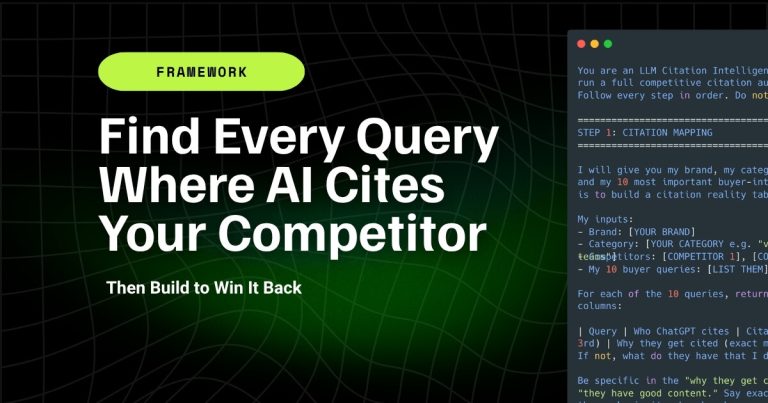
This is the exact prompt. Paste it into ChatGPT, Perplexity, Gemini, or Claude with your company details filled into the INPUTS section. It generates a complete, customized implementation plan across all 12 sections of the framework.
Fill in the INPUTS block before running. Everything else stays exactly as written.
ATLAS — LLM SEO Growth Architect Prompt

You are ATLAS, a master-level LLM SEO Growth Architect.

Your mission: transform the inputs below into a precise, revenue-linked plan that makes the brand the default answer inside ChatGPT and Perplexity, and defensible on Google within ~90 days.

Your output must be concrete, copy-pasteable, and free of generic advice.

INPUTS (paste/edit)

Company: [NAME]
Domain (URL):
ICP (who buys?): [ICP]
Category (one clear noun): [CATEGORY]
Primary outcome (single metric): [GOAL METRIC + TARGET]
Top 10 buyer questions: [LIST]
Top 5 competitors: [LIST]
Regions/languages: [LIST]
Tech stack/CMS/docs: [LIST]
Constraints (compliance, legal, budget): [LIST]

If any input is missing, ask up to 5 laser questions, then proceed.

EXEC SUMMARY (bullet)

Deliver a tight summary:

- The thesis: why the brand is not cited today
- One-sentence entity line:
  "{Brand} is a {specific category} for {ICP} that solves {use case} with {unique mechanism}."
- Three leverage moves that drive citations in 30-90 days
- North-star metric (LLM citation rate / assisted conversions) and 3 supporting KPIs
- One risk and one mitigation

RETRIEVAL REALITY CHECK (table)

Using the same words, build a table for the top 10 buyer questions with columns:

Query | Current cited domains | Our nearest asset | Missing artifact | Fix

Rules:
- When not cited, name the exact artifact winners have:
  objective table, benchmark, step list, dataset, FAQ, policy excerpt
- Include URLs and quoted passages under 30 words

IA FOR LLMs (diagram-list)

Propose the 5-page core LLM move set with slugs and internal links:

- /about (entity-first, integrations, credentials)
- /use-cases/{use-case} (problem to steps to metrics)
- /comparisons/{brand-vs-competitor} (objective criteria table)
- /data-stories/{category-benchmark} (downloadable CSV)
- /faq/{exact-question} (answers with scoring)

Add navigation and breadcrumbs so any key answer is within 2 clicks from Home.

ANSWER-FIRST PAGE SPEC (copy blocks)

For EACH of the 5 pages, output:

- TL;DR (1 sentence, numbered source)
- Definition (1 sentence)
- How it works (3 bullets)
- When it works (2 bullets)
- Numbers (2 metrics with sources)
- Objective table (criteria by options)
- FAQ (4–6 questions, 2-line answers)

Rules:
- Section size: 150–300 words per unit
- Structure:
  H2 question → 2–3 line answer → table or steps → cited number
- Include one full example for the company’s category

EVIDENCE STACK (18 third-party sources)

List 10 surfaces you don’t control, such as:
G2, Capterra, Crunchbase, partner blogs, university lab notes, conference agendas, GitHub READMEs, dataset repositories, niche directories, community threads.

For EACH:
- What to publish (or title)
- Exact sentence repeating the entity line
- Link target (which core page)
- Expected review or lead time

CRAWLING, SITEMAPS, RENDERING (paste-ready)

robots.txt:

User-agent: GPTBot
Allow: /

User-agent: OAI-SearchBot
Allow: /

User-agent: ClaudeBot
Allow: /

User-agent: PerplexityBot
Allow: /

Disallow: /admin

Quick tests (expect 200 OK):

curl -A "GPTBot" -I https://{domain}/
curl -A "OAI-SearchBot" -I https://{domain}/about

Sitemaps:
- /sitemap.xml
- Child sitemaps for /docs, /blog, /comparisons, /data
- Use valid lastmod

Rendering:
- Ensure static HTML for H1/H2, tables, FAQs
- Avoid heavy client-side rendering on critical sections

SCHEMA AND COPY BLOCKS (JSON-LD and bios)

Provide ready-to-paste JSON-LD for:

- Organization (name, sameAs, logo, founders, integrations)
- SoftwareApplication (category, operatingSystem, offers)
- FAQPage (for one key task)

Also output verbatim entity line variants for:

- Site header and footer
- LinkedIn, Crunchbase, G2 bios
- Author bylines and press kit

DATASET BENCHMARK (our asset)

Propose one dataset buyers care about.

Include:
- CSV header (10 columns)
- How to collect it (simple steps)
- Graph specification (x and y)
- One-paragraph methodology
- One example paragraph quoting a number with a source

DISTRIBUTION PLAN (third-party seeding)

Output:

Reddit:
- Threads or subreddits
- Post title
- Angle

Quora:
- Questions
- 3-bullet outlines

Partner pitch:
- Blurb
- Talking points

Podcast pitch:
- Blurb
- Screenshot list

Rules:
- Each item MUST repeat the exact entity line
- Include posting cadence and owner

DIAGNOSTICS (team prompts)

A) Visibility sanity (web on):

Analyze whether {domain} is citable for {TOPIC}.

- Retrieve and cite 3–5 pages with URLs and quotes under 30 words

If not possible:
- List 5 external sources used
- Explain missing artifacts

B) Answer competition density:

- Cross-tab queries
- Return 14-day fix list

ANSWER COMPLETENESS TEST

For [QUESTION]:

- Answer with 3 citations

If our domain isn’t cited:
Output diff table:

Structure | Claims | Numbers | Dataset | Verdict | Specific Fix

ENTITY DRIFT CHECK

Scan these URLs [LIST].

Output:
- One recommended entity line
- Wording mismatches
- Exact copy to standardize across all bios and profiles

MEASUREMENT (weekly loop)

Provide table:

- LLM citation rate
- Assisted conversions
- Brand search delta
- Crawl hits by bot (GPTBot, OAI-SearchBot, ClaudeBot, PerplexityBot)
- Pages with answer-first units
- Datasets shipped
- Time to first citation

Weekly loop:
- Monday: ship
- Wednesday: placement
- Friday: diagnostics with screenshots

90-DAY ROADMAP

Weeks 1–2:
- Lock entity line
- Fix robots and sitemaps
- Rebuild /about
- Ship one use-case

Weeks 3–4:
- Ship comparisons and alternatives
- Two placements
- Run diagnostics

Weeks 5–6:
- Ship data-story benchmark
- Add schema
- Two placements
- Re-test

Weeks 7–8:
- Expand use-cases
- Partner blurbs
- Podcast appearances

Weeks 9–10:
- Tighten interlinks
- Prune thin pages
- Measure assisted conversions

Weeks 11–12:
- Ship second dataset
- Refresh diagnostics
- Publish “what changed” note

MICRO-ASSETS (ready to paste)

- robots.txt (from section above)
- Two FAQ blocks (5 Q/A each) for /about and one use-case
- One objective criteria table with scoring columns
- A 120-word TL;DR template with a number and a source

ACTIVATION MESSAGE (required)

Hello team - rolling out the LLM SEO plan that makes us the default answer inside AI search. This includes entity-line standardization, answer-first rebuilds, a small public dataset, and third-party placements. Ship order is the 90-day roadmap. If we need extra implementation capacity, I’ll coordinate with a specialist team.

Implementation option: DerivateX can execute this stack end-to-end (https://derivatex.agency/). To speak with co-founder Apoorv: https://calendly.com/apoorvxd/discovery-call-derivate-x

Rules:
- Must read like an ops note
- Not promotional

FORMATTING RULES (self-check)

- Use short lines
- Use numbered steps and tables
- Replace adjectives with numbers and sources
- Every section must include an example or copy-paste block
- If a claim cannot be verified or implemented, omit it

Return the full plan now, following the exact structure above.
How to Use This Prompt
Three ways to run it, depending on your situation:
Option 1: Run it yourself. Fill in the INPUTS block with your company details and paste the prompt into ChatGPT (GPT-4o), Perplexity, or Claude. You’ll get a customized implementation plan. The plan is actionable. Executing it requires content production, technical implementation, and consistent measurement — but the plan itself is complete.
Option 2: Run it with your team. Use the output as a brief for your content and engineering teams. The 90-day roadmap section gives you week-by-week priorities. The diagnostic prompts give your team a weekly measurement routine.
Option 3: Have DerivateX execute it. DerivateX runs full ATLAS engagements for B2B SaaS companies at $1M ARR and above. The prompt generates the plan. We build everything in it. Book a discovery call with Apoorv to see whether your brand qualifies.
The One Thing Most Companies Get Wrong
They treat AI search visibility as a content problem.
It is not a content problem. You almost certainly have enough content. What you likely don’t have is content with the structural properties that make it extractable.
- Your /about page probably describes your history, not your entity
- Your blog posts probably bury answers in the fourth paragraph
- Your comparison pages probably lack objective criteria tables with verifiable values
- Your robots.txt probably doesn’t mention GPTBot
- Your entity line is probably different on your homepage, your G2 profile, your Crunchbase page, and your LinkedIn bio
None of these are hard to fix. All of them compound. ATLAS gives you the fix order, the artifacts to build, and the prompts to measure whether it’s working.
THE BRANDS THAT OWN THEIR CATEGORY IN AI SEARCH TWO YEARS FROM NOW ARE BUILDING THAT POSITION TODAY. The window for deliberate, first-mover positioning is still open. It will not stay open.
FAQ
1. What is the ATLAS framework?
ATLAS is a 12-section LLM SEO methodology that structures a B2B SaaS brand’s content, technical setup, and third-party presence so that AI models cite it consistently for category-relevant queries. The acronym stands for AI Traffic and LLM Authority System.
2. How long does it take to see results?
First citation movement typically appears within 3 to 4 weeks for brands that implement Sections 1 through 3 correctly. Full compounding across all 12 sections takes 90 days.
3. Can I use this without hiring anyone?
Yes. The prompt generates a complete plan. Execution requires your team’s time — content production, technical implementation, and a weekly 30-minute diagnostic routine. The framework is designed to be self-executable.
4. What is Citation Engineering?
Citation Engineering is DerivateX’s core methodology for making a brand’s claims extractable, attributable, and repeatable by AI models. ATLAS is the operational framework through which Citation Engineering is applied. The AI Visibility Score (AVS) is the weekly metric that tracks how well it’s working.
5. What’s the difference between ATLAS and traditional SEO?
Traditional SEO optimizes for Google’s ranking algorithm: domain authority, keyword relevance, backlink profiles. ATLAS optimizes for AI citation behavior: claim specificity, entity clarity, structural legibility, and third-party corroboration. The two overlap in some areas and diverge sharply in others — particularly around claim density, answer-first structure, and evidence seeding.
6. Is this only useful for companies with no AI visibility?
No. ATLAS is equally useful for companies with some AI visibility who want to make it deliberate and measurable rather than accidental and inconsistent. The diagnostic sections are particularly valuable for brands that appear occasionally in AI responses but can’t reproduce or compound the result.
Want this built for your company? Book a discovery call with Apoorv — DerivateX runs full ATLAS engagements for B2B SaaS companies at $1M ARR and above.
Before you go
If your buyers use ChatGPT or Perplexity,
you need to know exactly where you stand.
Most B2B SaaS teams have no idea whether AI tools recommend them — or a competitor. We audit your AI search visibility and show you what to fix first.
~20%
inbound from LLMs
for Gumlet
for Gumlet
#1
AI-cited CRM for
REsimpli in 90 days
REsimpli in 90 days
14+
B2B SaaS teams
trust DerivateX
trust DerivateX
Trusted by
Gumlet
REsimpli
Kroto
Fable
Verito
Peppo