Case study: Gumlet turned ChatGPT mentions into 20% of inbound revenue. Read it →

How an Indian Fintech Grew Organic Traffic 86% Year-Over-Year

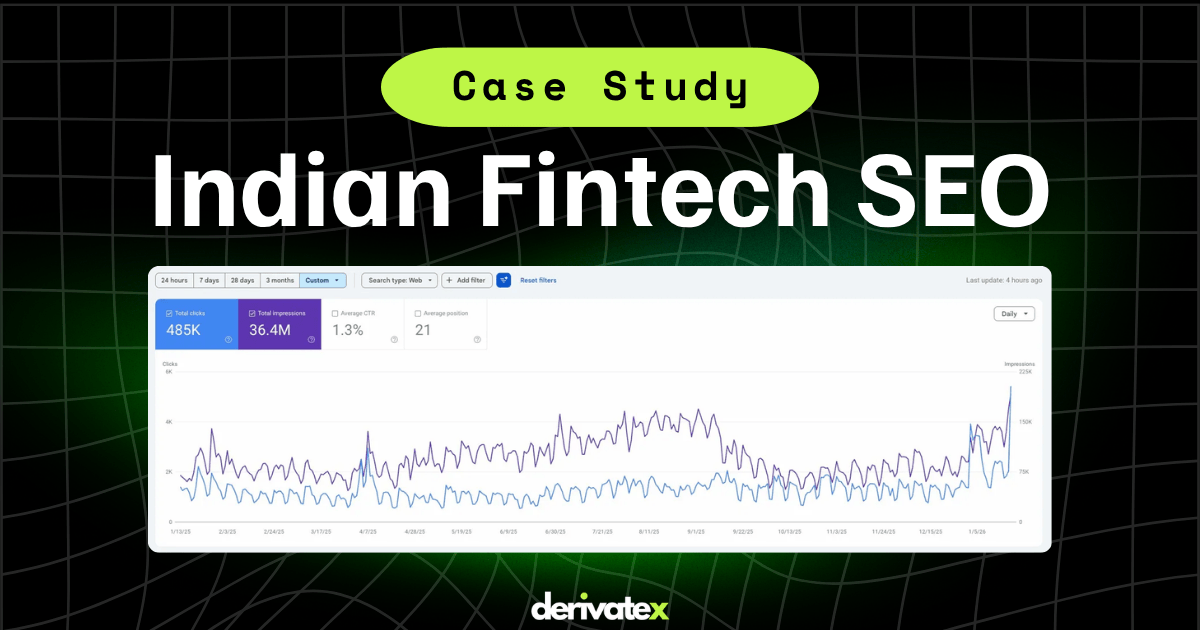
Sector: Fintech (India) | Engagement: January 13, 2025 – January 20, 2026 | Client: Undisclosed (NDA)
| Metric | January 2025 | January 2026 | Change |
|---|---|---|---|
| Monthly organic clicks | 27,129 | 50,547 | +86% |
| Daily click run rate | 1,188 | 2,598 | +119% |
| Daily impression run rate | 66,110 | 146,322 | +121% |
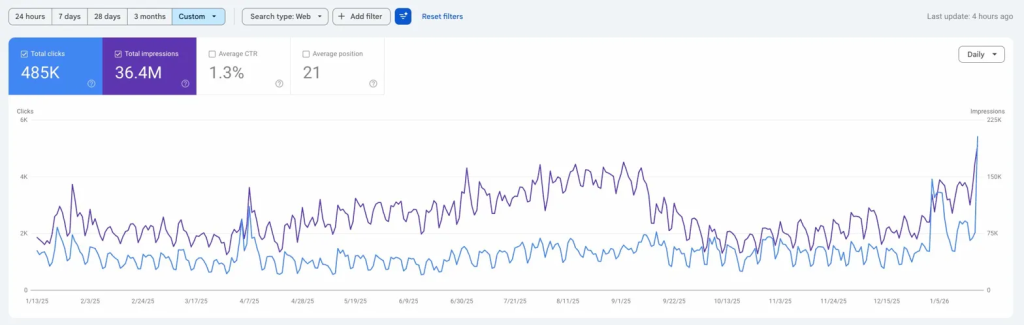
| Total clicks (since engagement) | — | 485,000 | — |
| Total impressions (since engagement) | — | 36.4M | — |
| Peak single-day clicks | — | 5,418 | Jan 20, 2026 |
| CTR at end of engagement | 1.62% | 1.91% | Recovered above baseline |
The Client
A regulated fintech platform based in India, operating in the US-equity investment space. It lets retail investors buy and hold US stocks and ETFs. The client’s name is withheld under a mutual NDA. All data in this case study comes directly from Google Search Console exports covering the exact engagement window.
The category sits firmly in YMYL (Your Money, Your Life) territory. Google applies elevated quality standards to pages that could affect a user’s financial decisions, which means every ranking gap costs more to close than in a generic content vertical.
What We Inherited: The Starting Point
When the engagement started in January 2025, the domain averaged position 22.0 across its tracked keyword set. Most pages were not on page one for any query that drove intent-qualified traffic. Daily clicks ranged between 845 and 1,417. Impressions ran at 65,000 to 97,000 per day, a large crawl surface converting poorly because ranking positions were weak.
Three structural problems surfaced immediately on audit.
Brand queries were masking informational gaps. The client ranked well for its own name and branded navigation searches. Outside branded search, its presence across high-intent categories was thin. Queries covering US stock investing from India, ETF education, tax treatment of foreign investment income, and platform comparison searches were either unaddressed or covered by content too thin to rank.
E-E-A-T signals were inconsistent. Some content was well-sourced and credible. Other pieces lacked author framing, regulatory context, or citation discipline. Google’s quality evaluator guidelines treat this inconsistency as a domain-level trust signal, not just a page-level one.
Internal link architecture was not distributing authority. Pages in the same topical cluster were not linking to each other. The site had accumulated content across multiple years without a unifying structural logic, so authority signals were fragmenting rather than compounding.
How Long Does Fintech SEO Take To Show Results?
The most common question from fintech marketing teams before committing to a content programme: when does it actually work?
From this engagement: meaningful ranking improvements started appearing around month 5 to 6. The most significant traffic gains materialized in months 8 through 12. Pages published in Q1 2025 were accumulating authority signals throughout the summer, even when the traffic dashboard looked flat. The position drop from 22 to 13 between August and October 2025 was not a single event. It was a large number of pages crossing the page-one threshold simultaneously, after months of signal accumulation.
The inputs happen months before the outputs become visible. This is the compounding pattern that makes content-led fintech SEO difficult to evaluate on a short timeline.
The Three-Phase Approach
Phase 1: Topical Audit and Cluster Architecture (January – April 2025)
The first four months were about mapping the full query universe the client could realistically compete for and building the content architecture to claim it.
The audit covered every relevant cluster across the client’s core categories: US equity investing from India, ETF categories (copper, Bitcoin, S&P 500, Nasdaq 100), tax and compliance content (TCS on foreign remittances, LRS limits, SWIFT transfer mechanics), and platform comparison queries.
Each cluster was mapped to its funnel position. Awareness queries got informational articles. Evaluation queries got comparison and how-to pieces. Decision queries got transactional content, support pages, and FAQ structures. Informational clusters were prioritized first — they are how a financial brand earns the authority to rank for higher-stakes queries later.
By April 2025, monthly clicks had grown from 27,129 to 36,798, a 35% lift in four months. Average position weakened from 22.0 to 27.2. That seems contradictory. When new pages enter the index for harder, more competitive queries, average position declines before it improves. The domain was competing for more.
Phase 2: Production Scale and E-E-A-T Depth (May – August 2025)
With the architecture established, the work shifted to full cluster build-out, tighter sourcing, expert framing, and rebuilt internal linking across the cluster set.
This phase is where the impression curve split from the click curve in a way that looks alarming without context. Monthly impressions grew from roughly 2.5M in April to 4.5M in August. Monthly clicks grew from 36,798 to 42,908 over the same window. CTR fell to a trough of 0.84% to 0.95% across May through August.
New content was entering the index across high-volume, harder queries where positions of 18 to 25 are the initial norm. The denominator grew faster than the numerator because rankings had not yet consolidated. This is the standard trajectory for a content programme competing into mid-volume, competitive query sets.
Every published piece went through a fact-checking process referenced against SEBI guidance, RBI circulars, and primary financial data. Author framing was standardized across the content set. The goal was to raise the quality floor to a level consistent with Google’s standards for YMYL financial pages.
Phase 3: Ranking Consolidation and Traffic Acceleration (September 2025 – January 2026)
In September 2025, average domain position dropped from 24.8 to 17.2 in a single month. By October, it reached 13.2. By January 2026, it had settled at 13.0, with consistent sub-12 performance on priority clusters.
Monthly clicks crossed 44,000 in September and 50,000 in January. CTR recovered from its 0.84% trough to 1.94% in October, then held at 1.91% in January 2026 — both above the 1.62% baseline from the engagement start.
The final day of the engagement recorded 5,418 clicks, the highest single-day total of the year.
Month-by-Month Organic Traffic Breakdown
| Month | Clicks | Impressions | Avg Position | CTR |
|---|---|---|---|---|
| January 2025 | 27,129 | 1.67M | 22.0 | 1.62% |
| February 2025 | 30,960 | 2.22M | 24.8 | 1.39% |
| March 2025 | 30,574 | 2.18M | 26.1 | 1.40% |
| April 2025 | 36,798 | 2.49M | 27.2 | 1.48% |
| May 2025 | 30,916 | 3.08M | 23.7 | 1.00% |
| June 2025 | 29,393 | 3.10M | 24.1 | 0.95% |
| July 2025 | 40,142 | 3.94M | 23.1 | 1.02% |
| August 2025 | 42,908 | 4.49M | 24.8 | 0.95% |
| September 2025 | 44,018 | 3.48M | 17.2 | 1.26% |
| October 2025 | 41,989 | 2.16M | 13.2 | 1.94% |
| November 2025 | 38,565 | 2.25M | 13.7 | 1.71% |
| December 2025 | 41,051 | 2.66M | 16.9 | 1.54% |
| January 2026 | 50,547 | 2.64M | 13.0 | 1.91% |
The table encodes the full arc. Impressions peak in August at 4.49M, then fall sharply in September as positions consolidate. When a page moves from position 20 to position 8, it generates fewer total impressions but converts a much higher share of them to clicks. The impression decline from August to October is the fingerprint of ranking improvement, not a traffic problem.
What Content Clusters Drove the Most Organic Traffic?
US Equity Investing From India
Queries covering how Indian retail investors can buy US stocks, fund transfer mechanics, and platform comparisons drove the largest share of informational traffic. Multiple pages in this cluster reached top-five positions for high-volume queries by Q4. Because the cluster used systematic internal linking, ranking gains on pillar pages lifted supporting pages simultaneously.
The top-performing page across the full engagement generated 173,904 clicks at an 8.11% CTR. Pages with sub-5% CTR at comparable impression volumes indicate a mismatch between query intent and content.
ETF Education: Copper, Bitcoin, and Index Funds
The copper ETF cluster is the clearest example of topical authority being built deliberately. By Q4 2025, the client’s content on copper ETFs was averaging below position 3 on primary queries, generating several thousand monthly clicks. That result came from cluster completeness, covering not just the main query but the full surrounding set of adjacent, comparison, and sub-variant queries.
Readers in this cluster commonly ask: “which copper ETF has the lowest expense ratio in India,” “is copper ETF better than gold ETF,” “how do copper ETFs track LME prices,” and “what is the tax treatment for ETF gains in India.” Content that covers the full query tree (not just the head term) is what captures rankings across a cluster.
Tax and Compliance Content
SWIFT copy queries, TCS on foreign investment income, LRS limits, and remittance mechanics are high-intent searches made by investors actively moving money. Content in this cluster ranked well not because of aggressive keyword targeting, but because it was factually accurate, properly sourced against RBI and SEBI guidance, and updated as regulations changed.
This is the category where content refresh matters most. A piece on LRS limits that is not updated when RBI revises the framework will lose ranking as its factual currency decays. Regulatory accuracy functions as a ranking signal in Indian fintech.
Platform Support and FAQ Content
FAQ and support-style content that helps users complete specific actions such as fund transfers, account linking, withdrawal mechanics, etc. are ranked consistently for brand-adjacent queries and drove meaningful traffic at the bottom of the funnel.
This category is often deprioritized in favor of acquisition content. The data shows it handles significant volume and reinforces conversion for users already in the decision process.
Why Did CTR Drop Mid-Engagement, Then Recover Above Baseline?
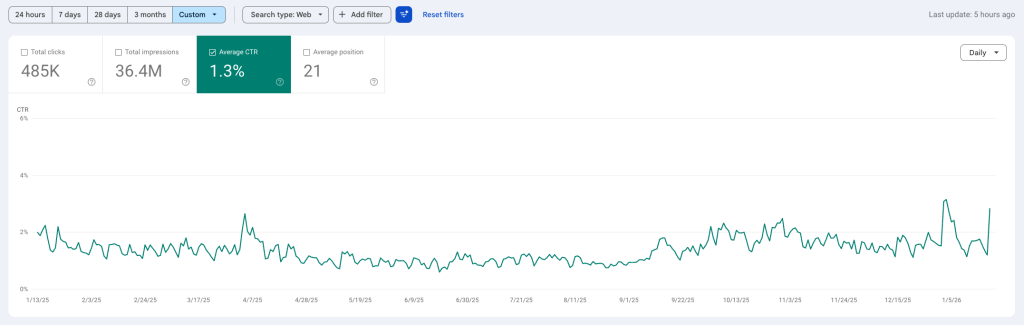
The CTR decline from 1.62% in January to 0.84% in May through August looks like a problem. The mechanics explain why it is not.
CTR is clicks divided by impressions. When a content program expands into new, higher-volume queries, the impression denominator grows faster than clicks because those new pages initially rank at positions 15 to 25, where click rates are consistently below 1%. The site was generating 4.49M impressions in August at an average position of 24.8.
When those same pages consolidated into positions 10 to 13 in Q4, CTR recovered to 1.94% in October and held above the January 2025 baseline through January 2026. A CTR that stays suppressed despite improving positions indicates a title and meta mismatch. A CTR that recovers as positions improve confirms the content was right, it just needed time to rank.
What Is YMYL Content and Why Does It Change Fintech SEO Strategy?
YMYL stands for Your Money, Your Life. Google uses this classification for pages that could materially affect a reader’s financial decisions. Investment platforms, tax guidance, and brokerage comparison content all fall into this category.
For fintech content, three things change in practice.
E-E-A-T signals stop being optional. Author credentials, sourcing practices, factual accuracy, and update frequency become ranking gatekeepers. A well-written article with no author attribution and content that has not been updated in 18 months will struggle to rank in this category regardless of keyword strategy or backlink count.
Thin or generic content that might rank in a lower-stakes category will not rank here. Google’s quality evaluators apply higher scrutiny to YMYL pages, and that evaluator feedback shapes the training signals that influence ranking.
Content refresh cycles matter on shorter timelines. A content strategy built for LLM visibility and traditional search has to account for the fact that regulatory guidance from SEBI and RBI can materially change what was accurate six months ago.
How Does Topical Authority Work For Financial Content Sites?
A common question from fintech content teams: “should we focus on fewer, longer articles or more, shorter ones?” The framing misses the actual mechanism.
Google does not reward individual articles. It rewards domains that demonstrate comprehensive coverage of a topic. The copper ETF result documented above reached sub-3 average position not because any individual piece was exceptional but because the full query tree was covered.
Topical authority is established cluster by cluster. The sequence that worked here: map the full query universe for a cluster, build the pillar page, build the supporting articles, link them to each other and back to the pillar, then move to the next cluster. Spreading production across disconnected topics simultaneously delays authority development in any of them.
For fintech content teams asking “how do we compete against platforms with 10x our domain authority,” the answer is cluster ownership. A mid-authority domain that owns a topic completely will often outrank a high-authority domain with shallow coverage of the same topic. This is how entity optimization and topical depth work in practice.
What Caused the September 2025 Ranking Inflection?
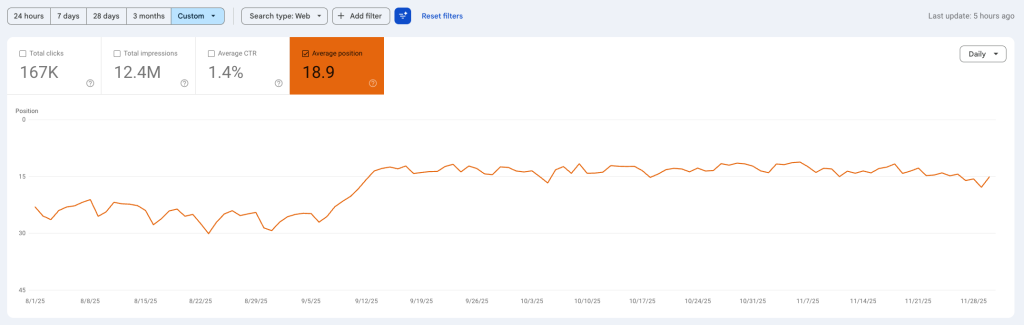
The sharpest single transition in this dataset is the position drop from 24.8 in August to 17.2 in September, followed by 13.2 in October. Understanding what caused it matters more than noting that it happened.
Content does not rank linearly. A page published in February does not gradually drift from position 50 to position 10 in steady increments. Pages accumulate signals, topical association from internal linking, engagement data, entity association as Google’s understanding of the domain’s expertise develops, and then cross ranking thresholds once those signals reach a critical level.
The content published across Phase 1 and Phase 2 was accumulating these signals throughout the summer. The impression surge from May through August was the visible indicator: Google was showing those pages to users in significant volume and refining its assessment of the domain’s topical authority. The September position collapse was the result — a cluster of pages crossing the page-one threshold simultaneously.
Two data points confirm the gains were structural. Average position held below 14 for four consecutive months from October through January. CTR in October (1.94%) and January 2026 (1.91%) both exceeded the engagement baseline, which is only possible when pages are ranking for queries where the content precisely matches user intent.
What Does an SEO Agency like DerivateX Actually Do For a Fintech Client?
A question that appears frequently in fintech founder communities and Reddit threads on organic growth: “what do you get from an agency that you couldn’t get from hiring a content writer?”
The gap is in the architecture layer. A content writer can produce accurate, readable articles. The decisions that determine whether those articles rank — which clusters to build, in what sequence, with what internal linking structure, targeting which specific queries, against which position thresholds — require a different skill set.
In YMYL categories, the E-E-A-T design layer sits on top of that: author credibility systems, sourcing standards, regulatory accuracy review, and content refresh protocols that a generalist writer is not positioned to build.
In this engagement, the work that generated the position improvement was not any individual article. It was the cluster architecture, the internal link structure, and the quality discipline applied consistently across the full content set. Without that architecture, the writing would have produced pages competing in isolation rather than a content surface that compounds.
The full content marketing methodology behind this kind of architecture is documented for SaaS and fintech brands.
Why Does Fintech Content Decay Faster Than Other Verticals?
An article on LRS limits published in January can be meaningfully inaccurate by October if RBI updates the framework. A piece on TCS treatment of foreign stock gains can lose accuracy within a quarter if tax rules change. A brokerage fee comparison can go stale as platforms revise their pricing.
This is structurally different from a B2B SaaS content program, where a piece on project management methodology can remain accurate for years. In Indian fintech, content that is not refreshed on a regular cycle will decay in ranking not because competitors publish more, but because the underlying facts become stale.
The practical implication: a fintech content program needs a formal refresh calendar alongside its production calendar. High-traffic pages on regulatory content, fee comparisons, and platform-specific guidance need quarterly review at minimum. Pages on relatively static conceptual topics can be reviewed annually.
In this engagement, the refresh program ran as a standing workflow, not a periodic project. That discipline was a direct contributor to the ranking stability observed in Q4 2025, when positions held below 14 for four consecutive months.
The 12-Month Summary
The engagement started with 1,188 average daily clicks and a domain position of 22.0. It ended with 2,598 average daily clicks, a domain position of 13.0, and a peak single day of 5,418 clicks.
Across the full 12 months, the program generated 485,000 organic clicks and 36.4 million impressions without paid amplification.
The more important output than the traffic total is the structural shift in the domain’s search standing. A domain averaging position 13 across its content set, with consistent sub-12 performance on priority clusters, has established topical authority in its category. New content published from this position benefits from a higher authority baseline. New clusters get indexed and evaluated more favorably than they would have in January 2025.
For an investment platform where the research-phase experience is a primary trust-builder before a prospect opens an account, this kind of organic visibility functions as product distribution.
The full methodology behind how this content architecture is built covers the Citation Engineering framework used across DerivateX client engagements.
All data is sourced directly from Google Search Console covering January 13, 2025 to January 20, 2026. The client name and all brand-identifiable information are withheld under NDA. No competitor names appear in this document.